A Quintillion spokesperson says the company should be able to offer broadband to five coastal Alaska communities by early next year. (Image courtesy of Quintillion)
The biggest local internet-service provider in northern Alaska expects high demand for the broadband connections. It’ll be offering the service early next year.
“Everybody is enthusiastic about this project that is a heavy user of broadband – the schools, libraries, clinics,” said Jens Laipeneks who directs operations for Arctic Slope Telephone Association Cooperative. “All of those are anchor institutions.”
Laipeneks said ASTAC has been upgrading its system over the past year or so to transition from the satellite-based system it now uses to provide internet and wireless service to one that uses a subsea fiber-optic cable that Anchorage-based Quintillion Networks will be laying off the coast of northern Alaska this year.
“The capacity that we’re going to have access to is much, much greater than everything that was done over the satellite,” he said.
Laipeneks said that’s good news to residential customers who’ve had to deal with the slow, bulky and expensive internet connections for such bandwidth-hogging uses as streaming video.
“Netflix, gaming – things that require very quick response times.”
He said the fiber optic cable is more dependable and less expensive to maintain, enabling ASTAC to offer its 1,000 or so customers twice as much bandwidth for about the same price they’re paying today.
It’ll also no doubt be good news to ASTAC’s newest customers in five coastal communities that have never had real broadband before, including Nome, Kotzebue, Point Hope, Wainwright and Barrow.
But it’s also troubling news for Steve Oomittuk, a lifelong resident of Point Hope.
Steve Oomittuk, who was born and raised in Point Hope, hopes broadband won’t aggravate the problem of Western culture overwhelming Native culture – especially among youth. (Photo by Jiri Rezak/Courtesy Greenpeace)
“I just feel that high technology is good, but there’s a time and place that it should be used,” he said.
Oomittuk, an Inupiat whale hunter-turned schoolteacher, said he’s concerned that all that expanded internet access will distract young people in the villages, and further erode their cultural identity that’s already being overwhelmed by Western culture.
“I try to let the younger generation understand that they have an identity that should never be forgotten,” he said. “And (they) have a rich history, a rich culture, and should never forget their identity as a people.”
Oomittuk said pretty much all the young people in the village, like their counterparts in just about anywhere else in the world, already are constantly glued to their cellphones. He’s concerned those mobile devices combined with broadband will widen the gap between Native and Western culture.
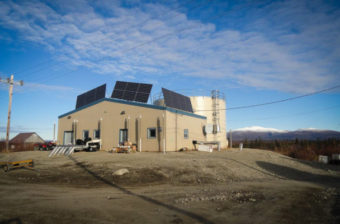
Solar panels in the Northwest Arctic village of Shugnak. (Photo courtesy of Ingemar Mathiasson/NWAB)
Solar panels will soon help power three communities in the Alaskan Arctic. The Department of Energy awarded federal funding to install panels in Kotzebue, Buckland and Deering, but decreasing the region’s dependency on diesel is easier said than done.
Energy costs are notoriously high in rural Alaska, where diesel is often barged up to remote communities. Sonny Adams is the Director of Alternative Energy for NANA, the regional corporation for the Northwest Arctic Borough. Adams was born and raised in Kotzebue.
“The cost of living in our region is 60% higher than it is in Anchorage,” Adams explained. “Our people have to make tough choices between putting food on the table or heating their home.”
While the price of diesel has dropped in recent years, Adams said climate change has made fuel deliveries more expensive.
“We’re not seeing the snowfall that we used to in the past,” Adams said. “Whenever that happens, you’re not getting the high river levels that you’re used to barge up the fuel.”
The low water levels are forcing some up-river communities like Kobuk and Ambler to fly in fuel at a much higher cost. That’s one of the reasons Adams is looking towards renewable energy sources like wind and solar.
NANA Corporation was recently awarded $1 million from the Department of Energy to partially fund solar panel installations in Kotzebue and two nearby communities—Buckland and Deering. Adams said all three already have wind turbines that help offset the high cost of energy.
“So solar is just the next viable option,” explained Adams.
Ingemar Mathiasson couldn’t agree more. He’s the Energy Manager for the Northwest Arctic Borough based in Kotzebue.
“There’s no reason for us to just sit and just wait for more oil to come down the pipeline,” Mathiasson said. “In some respects, that’s a pipe dream.”
Originally from Sweden, Mathiasson moved to the Alaskan Arctic in the late 80s. He’s been living off the grid and on solar power for decades, but he said those indigenous to the region have been doing it for far longer.
“Pre-contact, the people in Alaska were the most energy efficient people anywhere, being able to live in the Arctic on almost nothing, with very energy efficient houses and energy-efficient living,” Mathiasson explained.
But oil changed all that. Mathiasson pointed towards far-off places like Saudi Arabia that now supply diesel to remote communities like Selawik and Shungnak. With funding from the Department of Energy, both Mathiasson and Sonny Adams hope to power communities in the Northwest Arctic from more local sources.
Doug MacCourt from the Department of Energy said community-driven projects like the one Adams is spearheading is just what rural Alaska needs.
“Solutions that work are solutions that come from Alaska, solutions that are designed and thought of and conceived and really baked in the communities,” MacCourt insisted.
That’s easier said than done said David Nicol. Nicol works for an energy consulting firm based in Washington state. He helps plan and implement solar projects in rural Alaska. Nicol said when companies don’t shop around for the best deals, costs can soar.
“Companies here need to figure out how to install it for cheaper,” Nicol said. “It is possible, but we need to stop trying to reinvent the wheel.”
Nicol said training locals on installation and upkeep is the key to solar’s success. Right now, he explained the lack of institutional knowledge in the state is keeping costs high.
“If I could have one wish right now it would be that every single time somebody in Alaska encounters a problem with solar, whether it’s legislative, insurance, financing, building, just go, ‘Okay, this problem has been encountered before by others. Let’s go find out how they solved it,’” Nicol urged.
Because of all the obstacles, Nicol said powering communities solely by solar power is a still a long way off.
“Realistically, rural Alaska is not going to completely get away from diesel for a long time,” Nicol said. “It’ll come eventually, but it’s not going to be anytime soon.”
In the meantime, Sonny Adams is keeping his focus on solar. He’s working to finalize the finances of the solar project. Adams said rural Alaska has to keep pushing forward.
“We know that we cannot promote economic development with high energy costs,” Adams insisted. “We have got to get off this diesel fuel.”
Construction on the new solar panels in Kotzebue, Buckland, and Deering is set to begin in the spring of 2018.
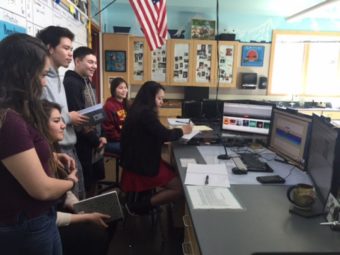
SeaTech students on a Skype call with Josh Jones of Scripps Institution of Oceanography. (Photo by Brielle Schaeffer/KCAW)
Despite graduation, school is not over for some science students at Mount Edgecumbe High School in Sitka. The class, known as SeaTech, is headed to the Scripps Institution of Oceanography in San Diego to present their original research on beluga and narwhal bioacoustics.
You’ve probably never heard a beluga whistle or a narwhal click. Not many people have. But Michael Mahoney’s students are experts on the bioacoustics of these mammals, after spending hours logging recordings of their sounds from the Chukchi Sea and Northwest Passage.
“We’re trying to figure out if they’re happy if they’re sad, like, if there’s more fish around, to see if their clicks and their buzzes represent what’s going on in the ocean around them,” said Natalia Smith, a 17-year-old junior from Elfin Cove.
The SeaTech class is not your regular science lab. The students are actually contributing to the research at Scripps Institution of Oceanography at the University of California, San Diego.
“You’ll have people who come to your classroom who say, ‘If you go to school for a really long time you can be a scientist like me, too,’” Mahoney said. “Scripps and the Whale Acoustics Lab says, ‘Why don’t you guys be scientists with us right now.’”
Using Skype, SeaTech students connect with the oceanographer John Hildebrand and Josh Jones, a graduate student in biological oceanography at Scripps, to talk about how researchers analyze the acoustic data to study the marine mammals.
Jones says the diversity of students at Mount Edgecumbe, many who are from the villages near his study area, benefits the project. The students from subsistence communities have cultural ties to whales, having grown up around them or depending on them for food.
“That perspective, that sort of cultural and personal perspective on the animals really lends a lot to their insights on what might be going on in these otherwise numerical analytical processes,” he said.
And, Jones says, working with the SeaTech class is good for productivity.
“In a certain respect we work harder down here in our lab because we are trying to keep up with the students who are up there making steady progress on this research,” he said.
The Whale Acoustics Lab collects the sounds underwater with a high-frequency acoustic recording package, which is basically a computer and hydrophone anchored to the sea floor. The system can record underwater sound continuously for a year at a time.
Mahoney says the students go through the tape with a computer program to identify any patterns in sounds made by the whales at different times of year. The work looks to see effects of climate change and human activity on these animals.
“We can know when ice formation happens, we hear ice sounds,” he said. “Or lots of other environmental sounds. We can hear anthropogenic sounds, sounds that humans make so we can hear ships that pass over or any of those types of things.”
Jones says the Scripps/Mount Edgecumbe partnership has been going on for about 10 years. He started the program as an undergrad interested in science outreach and with roots in Sitka, having worked at the Baranof Wilderness Lodge.
As the program grew, several of Mahoney’s former SeaTech students have presented at other symposiums and even had their work published in scientific journals. A couple even chose to attend UCSD and got jobs at the Whale Acoustics Lab when they started.
In San Diego, SeaTech students will present their findings from the research they’ve been conducting during class, which is kind of a big deal.
Natalia is looking forward to the trip.
“It’s really cool,” she said. “I never thought it would be this big. I thought it was just we go into his class and we learn how to use these programs. I never thought we would get to go down to San Diego and talk to all these important people in science and learn more about these animals.”
The students will also spend time on some Scripps Institution research vessels and when the hard science is over, they’ll study the habitat of mice, talking dogs, and flying elephants during a visit to Disneyland.
“Subsistence,” a sculpture by Marek Ranis from old military maps suspended on metal fish racks, part of the Anchorage Museum’s “The View From Up Here” exhibit. (Photo Zachariah Hughes/Alaska Public Media)
When people imagine Alaska’s Arctic, experimental art isn’t typically the first thing that comes to mind.
But a new exhibit at the Anchorage Museum is getting visitors, urbanites, and art-lovers to connect to the Arctic in different ways. And the works expand well beyond the gallery walls.
Standing outside the Anchorage museum during busy mid-day traffic, two radio producers from Brooklyn plug earbuds into an iPhone as they get ready to test a sound walk.
“A sound walk is like a museum audio tour, but it’s outside,” explained Isaac Kestenbaum, who has spent the last few months in Alaska as part of a project called “Frontier of Change,” a partnership with public radio station KNBA in Anchorage.
Kestenbaum, along with his collaborator and wife Josie Holtzman, is about to try their mile-long sound walk for the first time together, taking notes about how they can improve it for visitors in the days ahead.
“There’s just a lot of imagining that you have to do,” Holtzman explained of the challenges for synchronizing audio and the surrounding environment.
Sculpture’s by John Grade as part of his “Floats” exhibit within “The View From Up Here.” (Photo Zachariah Hughes/Alaska Public Media)
The two set out on the same route groups of guided guests will travel starting Friday. They slipped pairs of headphones into their ears, the dangling cords connecting to a smartphone loaded with a 31-minute podcast.
“I’d like to welcome you aboard Frontier of Change Airlines,” begins a flight attendant (voiced by Holtzman) in the audio file. “Non-stop service to Shaktoolik, by way of downtown Anchorage.”
The experimental piece isn’t actually about Anchorage, but instead Shaktoolik, a community of around 300 people hundreds of miles off the road system.
“You’ll be traveling in two places at once,” chimes the recording.
It’s a little discombobulating: my eyes are looking at traffic lights and JC Penny’s, but in my ears are the wind and waves you hear walking down the man-made berm separating Shaktoolik’s 61 homes from the Bering Sea.
“Shaktoolik is one mile long, and a little bit wider than this city block,” the flight attendant voice pipes in.
Across the street from the museum, we begin meeting people from around town.”
“Welcome to Shaktoolik,” says Mayor Eugene Asicksick. “Stormy Shaktoolik, I should say.”
A lot of what Asicksick and others talk about is the shifting climate: What warming winters, worsening storms, and a growing day-to-day fear over the weather feel like in the small town.
“It’s changing,” Asicksick says in the recording. “But to me, that’s home.”
Rounding the corner, a 15-story luxury hotel comes into view just as Shaktoolik teacher Lynda Bekoalok describes how her 11-year-old students talk about evacuating in a flood.
“They said, ‘I’d take water, and I would take food, and I’d take Band-Aids and I’d grab my VHF.’ Where before they’d grab toys, their phones, their video games,” says Bekoalok in a concerned by considered tone. “Their whole way of thinking is different.”
As the sound walk continued, the urban surroundings that can feel insulated from climate change began feeling closer to it. At times, was hard to tell if the airplanes I was hearing were from the earbuds or the actual Cessna’s overhead on their way to Merrill Field. Same with the buzzing hum of trucks, the wind, and seagulls.
As Holtzman scribbled notes after the tour, I asked if the Shaktoolik sound walk downtown is supposed to be a complement, a contradiction, or both.
Mary Mattingly’s “Arctic Food Forest,” a living sculpture that functions similar to a small-scale ecosystem, exhibited in front of the Anchorage Museum as part of “The View From Up Here.” (Photo Zachariah Hughes/Alaska Public Media)
This is just one of the experimental pieces in “The View From Up Here” exhibit. Most of the installations are inside the museum–although the lawn is playing host to an “arctic food forest.”
Derek Cote grew up in rural Canada and now teaches in Detroit. His video piece “Legends Are Made Here” (with an accompanying score by Paul Haas, played the Anchorage Symphony Orchestra) started years ago when the museum invited him to experiment with a new format during his time as an artist-in-residence.
A sculpture by Christoph Kapeller, part of his “Yedoma: Mounds of Life” exhibit within “The View From Up Here.” (Photo Zachariah Hughes/Alaska Public Media)
At one point in Cote’s film the burning pink globe of a shallow sunrise outside Shishmaref is shown alongside the lush red curtain rising at Anchorage’s Performing Arts Center. The movements and music harmonize on the screen, which is no accident.
“I think there’s a lot of dichotomy here that I’ve experienced, sort of the urban and the rural and remote, and I’m trying to find ways to reconcile those two,” Cote said.
The show’s theme is loose, and most of the works look nothing alike. There are sculptures of glass and wood suspended from the ceiling like ornamental cocoons, a multimedia display of prehistoric permafrost patterns, even a vinyl record made from wood burned during a bonfire in Kotzebue that you can listen to through headphones.
Museum director Julie Decker says the idea was to give support to several artists with long-standing ties to northern regions as they explore this particular point in time for Alaska’s Arctic.
“There’s always been a fascination with the Arctic, and with the North, and so artists have come to these places for centuries,” Decker said.
“But there’s an urgency to the story now, and there’s an increased curiosity because of the rapid pace of change,” she added.
The View From Up Here opens Friday and runs through October 6th.
The “Frontier of Change” sound walk will be available online at KNBA through the end of the summer.
Polar Bears (Photo by Atwell Gerry, U.S. Fish and Wildlife Service)
The United States will not support an international ban on the trade of polar bear products at an upcoming meeting on endangered species.
In a statement released last week, the U.S. Fish and Wildlife Service said it remains concerned about the commercial use of polar bear hides, but it said it won’t encourage the ban.
“We are putting our resources into working in collaboration with other polar bear range states to address climate change and mitigate its impacts on the polar bear as the overwhelming threat to the long-term future of the species,” the agency said in its statement.
Inuit leaders and organizations from Canada have been lobbying the U.S. for the last year. Polar bear sport hunting is an important industry to the Inuit economy.
Polar Bear sport hunting has not been legal in the U.S. since the passage of the Marine Mammal Protection Act in 1972.
Delegates from across the globe will meet in South Africa this fall at the Convention on International Trade in Endangered Species of Wild Fauna and Flora, or the CITES Conference.
The 2013 CITES Conference was the last time the U.S. attempted to ban the international trade of polar bear products. Forty-two countries voted against the ban, and 38 voted in favor of it.
Alaska’s undeveloped expanses represent one of the last opportunities to preserve intact habitat within the United States. But many of those lands also contain natural resources. (Public Domain photo by National Park Service)
Public lands managers in Alaska say climate change brings new challenges to the decadeslong dilemma over balancing resource extraction with conservation of undeveloped land within the state’s 425 million acres.
“That’s a huge scale – it’s a continental-sized landmass that’s being managed,” says Mark Myers, who managed Alaska’s 100 million-acre share of that landmass – a chunk about the size of California – until about two months ago, when he resigned his job as the state’s Department of Natural Resources commissioner.
Myers said in a recent forum on Arctic policy at the University of Alaska-Fairbanks that conservationists believe vast expanses of land should be protected because they’re the last opportunities in the United States to preserve entire healthy ecosystems.
“Other parts of the country – that land’s been overwhelmed by development,” he said. “There is very little truly functional ecosystem land left. In Alaska, it’s largely intact.”
But much of that land also holds valuable natural resources, and Myers says climate change has complicated the task of balancing conservation and development because warming has melted enough sea ice to open up access to those resources.
“Our sea routes – they’re opening, with the changes in sea ice,” he said, “and that’s putting some significant new demands, in terms of infrastructure, in terms of stressors, and in terms of a need to monitor and understand the environment.”
Myers says despite today’s low prices, demand for oil and gas in the coming years will increase, and that and other resources in the circumpolar north will draw industry here.
“A huge part of the undiscovered resource endowment left in the world sits in the Arctic,” he said. “And of that, about 27 percent of that sits in Alaska.”
International law professor Betsy Baker says much work needs to be done to enable development of those resources, including infrastructure such as deep-water ports and further surveys of the Arctic Ocean floor. Meanwhile, Baker says managers and leaders must carefully plan to achieve a balance between conservation and development.
“We still have a chance to get it better up here, to get it right,” she said.
Baker, who sat in on the Arctic-policy forum, says projects like the Red Dog zinc mine in northwestern Alaska demonstrate the economic benefits of a well-managed resource-development operation that also protects the ecosystem in which the mine operates.
Close
Update notification options
Subscribe to notifications
Subscribe
Get notifications about news related to the topics you care about. You can unsubscribe anytime.