Arctic

Young ‘Bio Blitzers explore and examine the Arctic environment

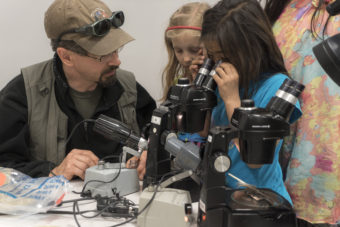
Seven-year-old Anna Nukapigak looks through a microscope at samples. Jeff Rasic and the rest of the students look on.
Seven-year-old Anna Nukapigak looks through a microscope at samples. Jeff Rasic and the rest of the students look on. (Photo courtesy of the National Park Service)

Last week a group of scientists traveled to a small village in the Arctic to find as many different species as they could. It was happening all over the country in celebration of the 100th anniversary of the National Park Service. But it had special meaning in Anaktuvuk Pass, where the local Inupiaq people live a subsistence lifestyle inside of a national park.
It was warm and sunny when we left Anaktuvuk Pass early in the morning. We headed toward Blueberry Hill, walking through soggy tundra and patches of snow.

Soon the village disappeared and we were surrounded by an amphitheater of mountains.

Suddenly there was something fluttering around our feet. Kyndall Hildebrandt lunged after a small flying creature. She cupped her hands over a patch of tundra and peeked underneath.

It was a brown butterfly, an exciting catch even though she was actually looking for voles. She had set over a hundred mouse traps in two days, smearing them with peanut butter and setting them near the openings of small holes in the tundra.

“It’s the Snicker(s) bars of the animal kingdom so everybody eats them,” Hildebrandt said. “So if there’s a lot of voles then you know there’s gonna be a lot of happy eagles and a lot of happy foxes.”

Hildebrandt is a small mammal researcher at the University of Alaska Fairbanks Museum. She’s one of 25 scientists and volunteers trying to find as many living things as they can in the dirt, mountains, and ponds around town.

Jeff Rasic works for Gates of the Arctic National Park.

“Wilson’s warbler, raven, Savannah sparrow, glaucous gull, American tree sparrow, orange crowned warbler, fox sparrow, white crowned sparrow,” Rasic said as he read off some of the species in the park.

Rasic organized the event to get a snapshot of what’s happening in the Arctic and to get the community involved in science. It’s called a Bio Blitz.

“It’s a scavenger hunt,” Rasic said. “Let’s tally up as many things as we can in a short amount of time: birds, plants, small mammals, large mammals (and) if we happen to see them, fish.”

While spring is well underway in most of the country, it’s a little early in the Arctic. So the species tended to be pretty small.

Among the species were slimy sculpin, wolf spiders, glacier avens, flower, snowshoe hair, singing vole, arctic ground squirrel, etc.

A louswort, one of the plants being examined.
A louswort, one of the plants being examined. (Photo by Molly Rettig, KUAC – Fairbanks)

After tramping through the park with nets, Ziploc bags, and binoculars, scientists returned to the Nunamiut school with backpacks full of samples. They set up tables in the gym and covered them with fox skulls, bird wings, and various types of scat.

The brown butterfly we had found on the hillside was now flattened onto a square of wax paper. Kathryn Daly studies insects at the UAF museum. She was straightening the wings, which had orange spots along the outer edges.

“The genus Erebia was documented here in the 70s,” Daly said. “It’s great to know it’s still here.”

The local people have a different name for it.

“I was talking to an elder last night who said ‘Oh, the chocolate butterflies,” Daly said. “That’s what you call it. And I said yes, chocolate butterflies.”

There were little scientists helping out too. Kids ran around the yard with nets searching for bugs and took turns looking through the microscope.

Seven-year-old Anna Nukapigak has long dark hair and was wearing a blue T-shirt with a butterfly on it. She said bugs are her favorite part of the BioBlitz.

She learns a lot about nature from her elders, especially when her family goes camping in the summer.

Kids searching for beetles and bugs outside the school.
Kids searching for beetles and bugs outside the school. (Photo courtesy of the National Park Service)

“They like teach us how bugs live and they teach us a lot of stuff in Inupiaq about cutting squirrels,” Nukapigak said. “Don’t eat that don’t eat them because we only use the skin to make atiqluq. I mean parkas.”

Animals are the basis of life in Anaktuvuk Pass. Far away from roads or supermarkets, most of the people living here hunt their food. One animal in particular: the caribou.

Vera Woods is curator at the Anaktuvuk Pass museum, and a hunter.

“We live with it every day,” Woods said. “I don’t care if it was for breakfast. I like it frozen raw, and it warms you up in the body because it’s cooking in your stomach and keeps you warm all day.”

The Western Arctic caribou have traditionally come right through the village on their way to the coast. But the past few years, the herd has been shrinking and moving farther away. It’s been hard for hunters, but they’re finding ways to adapt. Woods said the local people can learn from scientists about things like animal population and water quality. And they’re sharing their knowledge as well.

“We’re teaching them how we live here and they’re valuing us our ways of life, how we survive and live here in the mountains, in the park,” Woods said.

By Sunday, the bio blitzers had found over 100 species and counting. As locals headed up the valley looking for caribou, three scientists hunted for plants north of town. Down on the tundra, you could tell summer was near.

As Arctic Ocean Gets Spicier, Hunting May Be More Dangerous

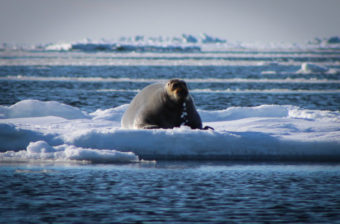
A bearded seal, or ugruk, on the sea ice.
A bearded seal, or ugruk, on the sea ice. (Courtesy of Kawerak Subsistence Program)

The Arctic Ocean is getting spicier. A new study published in the Journal of Physical Oceanography suggests that rising temperatures in the far north could result in spicier water, or warmer water whose density is more affected by temperature than salinity.
This could make marine mammal hunting off Alaska’s coast more dangerous.

Mary-Louise Timmermans is a professor and oceanographer at Yale University. She studies how ocean circulation affects sea ice in the Arctic.

“For it to get ‘spicier’ means it’s going to get warmer, and changes in temperature will affect density to the same measure that changes in salinity affect density,” Timmermans explained.

The deeper you go in the ocean, the colder it gets. That’s because cold water is denser than warm water, so naturally it sinks to the ocean floor. But the dynamics are different in the Arctic.

“At low temperatures, the water doesn’t really care whether it’s warm or cold,” Timmermans said.

Seawater in the Arctic Ocean is so cold that temperature isn’t the deciding factor in its density. Instead, Timmermans said, salinity, or how salty the water is, makes more of a difference.

But that’s about to change as the climate changes.

“As you warm up the ocean, it turns out temperature changes can have a bigger impact on density than in a cooler ocean,” explained Timmermans.

Timmermans teamed up with Steven Jayne of the Woods Hole Oceanographic Institution. The two found that a spicier Arctic will likely be able to store more heat.

“This means that the way that the Arctic Ocean works will be somewhat different,” Timmermans said.

It’s tough to predict just how different the Arctic will be, but she said warmer seawater may speed up sea ice melt. That’s bad news for marine mammal hunters like Brandon Ahmasuk.

“The sea ice, it offers a protective barrier,” Ahmasuk explained. “It keeps the ripples and waves down, it keeps them from forming.”

Ahmasuk is Kawerak’s Subsistence Director based in Nome. He grew up out on the water hunting with his dad. He now takes his own kids with him to hunt for bearded seal, or ugruk, and walrus.

“When you have that larger open water, it’s more susceptible to large waves (and) bad weather,” Ahmasuk added.

He says if warmer, saltier seawater makes for thinner, sparser sea ice, most hunters won’t fare too well in their standard, 18-foot Lund boats.

“Your side height on a Lund boat is only 28 inches, but if you have four or six-foot rollers coming at you, you’re probably not going to want to be out there.”

But some villages, especially the ones without grocery stores to rely on, might not have any other choice. Despite the potentially more dangerous conditions to hunters like Ahmasuk, a spicier ocean is still the best grocery store around.


Barrow experiences earliest snowmelt on record

NOAA’s Barrow Observatory recorded the earliest snowmelt on record this year. (Public Domain photo by NOAA)

Snow in the northernmost town in the nation is melting earlier than ever before on record.

The National Oceanic and Atmospheric Administration’s Observatory in Barrow reported a snowmelt starting May 13. That’s 10 days earlier than the previous record set in 2002. NOAA has been recording snowmelt from its Barrow Observatory for over 70 years.

The record melt follows a winter of record-setting temperatures. Alaska was more than 11 degrees warmer than usual this winter.

This winter didn’t just see an early melt on land. According to the National Snow and Ice Data Center, 2016 also saw the lowest winter sea ice extent in satellite history.

David Douglas, a research biologist with the U.S. Geological Survey, said in a NOAA press release that conditions in the Arctic are looking more like they would in late June or early July right now.

The early thaw is already taking a toll on wildlife in the far north.

“Polar bears are having to make their decisions about how to move and where to go on thinner ice pack that’s mostly first-year ice,” Douglas said. Douglas also expects walrus to struggle this summer with the thinner sea ice and warmer temperatures.

U.S. Senate bill includes $1B for icebreaker

Coast Guard Cutter Healy July 13, 2015
The Coast Guard Cutter Healy patrols the Arctic Ocean during a joint civil and federal search and rescue exercise near Oliktok Point, Alaska, July 13, 2015. The Healy is a 420-foot icebreaker homeported in Seattle. (Photo by Petty Officer 2nd Class Grant DeVuyst/Courtesy U.S. Coast Guard)

A U.S. Senate subcommittee has passed a bill that includes $1 billion to build a new polar icebreaker.

Sen. Lisa Murkowski on Tuesday thanked the other members of the Defense Appropriations Subcommittee for including the ship in its spending bill for next year.

“With the insertion that you have made, Mr. Chairman, and to the members of the committee, of a billion dollar commitment to an icebreaker for the United States of America, an Arctic nation, this is going to be noted around the globe,” Murkowski said.

For years, Murkowski and other lawmakers put a few million dollars at a time in the annual Coast Guard budget toward a heavy icebreaker. The cost of a single icebreaker would exceed that agency’s entire yearly allotment for ship-building. The pending Senate bill would fund the whole project from a much larger pot: the Navy’s budget. It’s far from a done deal, though.

Even if the full Senate approves the bill, the House version doesn’t yet include the funding.

Do Arctic villages need oil? Point Lay leaders say no

BOEM director Abigail Ross Hopper and Wainwright Mayor John Hopson prepare to testify before the Senate Energy Committee. (Photo by Liz Ruskin/APRN)

If oil companies are ever going to return to drill for oil in federal waters of the Arctic, they will need leases. Sen. Lisa Murkowski complained at a hearing in Washington Thursday that the leasing plan the feds are considering is too limited.

Murkowski bolstered her position by calling on an Arctic Slope mayor, who testified that he and his neighbors need the industry. Other Arctic residents passionately opposed to offshore drilling listened from the back of the hearing room.

In Washington, both sides of any Arctic drilling dispute want to show they have locals on their side. John Hopson, Jr., a whaling captain and the mayor of Wainwright, on the Chukchi Sea, came out to make the case for federal leasing in the Arctic. Hopson is also a member of the North Slope Borough, which taxes the industry to provide services to the region.

“Every one of our eight communities is surviving on oil and gas money,” he said.

A snow machine can cost $12,000, he said. A boat and motor might cost $20,000. Last year, Hopson said, he had to pay over $7 a gallon to operate his truck, his boat and his 4-wheeler.

“We need infrastructure to be able to tax so that we can employ people, so they have an opportunity to hunt,” he said. “The world is banking on saving animals without thinking of my life, my children’s life. Where are we going to live?”

The Bureau of Ocean Energy Management has proposed three lease sales in Alaska over the next five years, one each in the Chukchi Sea, the Beaufort Sea and Cook Inlet. But Abigail Ross Hopper, director of the agency, could not assure Murkowski that those sales would remain in the final plan.

“I think, chairman, it would be premature to make any statement about the fate of those

Alaska sales in the final program,” Hopper said.

Murkowski says Alaska’s governor, the congressional delegation and the vast majority of Alaskans support offshore drilling. She zeroed in on a tweet Hopper’s agency issued the day before.

The tweet shows the BOEM boss meeting with tribal council members from Point Lay. Although it’s just down the coast from Wainwright, this group of village leaders is ardently against offshore drilling. They came to Washington to participate in a “Keep it in the ground” rally.

Murkowski said she didn’t have a problem with the picture the agency tweeted, just the message.

“You tweet in it that they … are opposed to drilling in the Arctic,” Murkowski said. “I looked at it and I said, ‘How do we not conclude that the die is already cast and that your agency has already decided what it is you’re going to be doing?’”

Hopper said she didn’t write the tweet, but she’d seen it.

“I’m sorry if you took that impression from it,” she said.

The Point Lay delegation had an appointment to meet with Murkowski after the hearing. Some said they were surprised their visit, hosted by an environmental group, seemed to tick people off.

Tribal council member Cilia Attungowruk and Jane Tukrook are both raising children in Point Lay to respect traditional ways. They say offshore drilling is a threat to the environment and they dispute that they need the oil industry to support their subsistence lifestyle.

“We don’t have to have money to go out there. We can go out there on foot and with our own bare hands and still get what we need to eat,” said Attungowruk.

“Because that’s exactly how our ancestors did it in the past,” Tukrook said. “It worked for them. So what’s to say that it won’t work for us?”

Tukrook has a job. She’s Point Lay’s tribal administrator. She says a switch to renewable energy technology might produce more paychecks in Point Lay.

Satellite used to record sea ice data malfunctions

The graph above shows Arctic sea ice extent as of February 3, 2016, along with daily ice extent data for four previous years. (Image courtesy of the National Snow & Ice Data Center)

The satellite used to record sea ice data in the Arctic malfunctioned in April, and scientists are scrambling to calibrate a month of missing data.

In mid-March, the National Snow and Ice Data Center reported the lowest maximum sea ice extent in satellite history.

“It was a record low in our satellite record, which is quite consistent,” explained NSIDC lead scientist Ted Scambos. “We work on it a lot to make sure we can compare it, one year to the next.”

NSIDC first started recording sea ice data in 1978.

Julienne Stroeve is an NSIDC scientist who studies sea ice conditions in the Arctic. Stroeve said she and her fellow scientists noticed a glitch in their data in early April.

“We started getting false ice concentrations in parts of the Arctic where you wouldn’t have sea ice,” Stroeve explained, “so it was biasing our extent.”

“The good news is they’ve found another satellite in that same type of series,” confirmed Amy Holman with the National Oceanic and Atmospheric Administration. “They believe the data (are) compatible enough that we can continue the data record,” Holman said.

The satellite Holman is referring to has been recording sea ice data for a year now, which Julienne Stroeve said should be enough time to cross-calibrate. Consistency is key, Stroeve said.

“You want as long of a data record as possible to really see how much this change we’re seeing is due to natural climate variability, for example, or how much is due to anthropogenic warming.”

Arctic sea ice extent for March 2016 was 14.43 million square kilometers (5.57 million square miles). The magenta line shows the 1981 to 2010 median extent for that month. (image courtesy of the National Snow & Ice Data Center)

To help make that distinction, NSIDC captures an image of sea ice extent in the Arctic every day and posts daily updates online. The agency has since suspended the updates and removed all of April’s data from NSIDC’s archives.

While the malfunction was a bit of a shock, Stroeve said it was bound to happen.

“It wasn’t surprising that this happened because the satellite was pretty old,” Stroeve said, “so eventually the sensors do degrade and start giving bad data.”

The satellite that malfunctioned was launched 10 years ago. The one they’re relying on now was launched nine years ago. Stroeve said there is a backup to this backup, but that one is still on the ground.

“Congress took away the funds for the Air Force to launch it, which is very unfortunate,” Stroeve said. “Obviously, we’re hoping that pressure can be put on Congress to launch that other satellite.”

For now, Stroeve and her colleagues will continue cross-calibrating data, with the hopes that the one they’re using now will stay online until Congress approves funding for the next series of satellites.

Site notifications
Update notification options
Subscribe to notifications