Arctic

Russia launches largest, most powerful icebreaker in the world

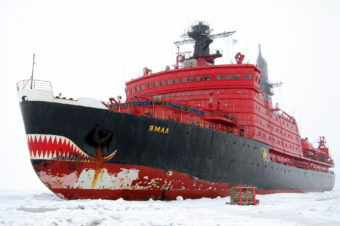
Icebreaker Yamal during removal of manned drifting station North Pole-36. August 2009. (Creative Commons photo by Pink floyd88)

Activity in the Arctic is on the rise. Retreating sea ice and rising ship traffic have some worried the region could serve as the next stage for international conflict. Coast guards across the Arctic are busy laying the groundwork for cooperation.
Russia just launched the largest, most powerful icebreaker in the world.

Blue and red balloons fly through the air as onlookers cheer from the docks St. Petersburg shipyard. It’s a massive vessel, bright blue with the Russian flag painted front and center on the bow of the boat.

The icebreaker is the first in a series of ships the nation plans to launch in the coming years, and that worries many since Russia’s icebreaker fleet is larger than every other Arctic nation combined.

But Andreas Østhagen said that isn’t foreshadowing an Arctic-style arms race.

“I don’t think it’s all about counting icebreakers, as some tend to do in the Arctic,” Østhagen said.

He said what’s more important is how the captains of those icebreakers cooperate. Østhagen works for the Norwegian Institute for Defense Studies in Oslo. In an article recently published in the Arctic Review on Law and Politics, Østhagen argued coast guards are the key to keeping the peace in the far north.

“All the Arctic coast guards have different institutional setups, Østhagen said. “They have different capabilities or lack of capabilities, so I think sharing information and sharing best practices is key.”

And they’ve been doing just that through the Arctic Coast Guard Forum, established last fall. Leaders representing the coast guards of all eight Arctic nations gathered again in Boston recently to sign a multi-year strategic plan for the Arctic.

That joint agreement joins an increasingly lengthy list of international accords for the region. There’s the Arctic Search and Rescue Agreement adopted in 2011 and the Agreement on Cooperation on Marine Oil Pollution, Preparedness and Response in the Arctic, adopted in 2013.

Ultimately, Østhagen said, the severe weather and remoteness of the region necessitates cooperation between coast guards.

“If an incident were to occur, let’s say an oil spill actually took place in the Arctic or a cruise ship were to go down in the Northwest Passage or around Greenland or in the Bering Sea or Barents Sea, then everyone would have the interest of trying to save these people, trying to minimize damage,” Østhagen said.

An incident did occur in 2014 when a Korean fishing vessel went down in the Bering Sea.

At the Glacier Conference in Anchorage last fall, Rear Admiral Dan Abel said the Coast Guard was in constant communication with Russian search and rescue efforts.

“We were posting messages, we were synchronizing their response, we were synchronizing what South Korea was sending, and at the tactical level, things were working extremely well,” Abel said.

While nearly everyone aboard the vessel died at sea, Abel said both the US and Russia shared the same objective.

“When it comes to saving lives and protecting the environment, those are kind of universally accepted goods that both countries realize should be beyond any geopolitical interests,” Abel said.

Those geopolitics interests have come to a head recent years, with Russia’s annexation of Crimea and resulting international sanctions.

Because of that and lingering Cold War tensions with the US, Abel said he’s not completely carefree when he sends the Healy, one of only two American icebreakers, into the Arctic.

“There is no buddy system for her,” Abel said. “If she dings a prop [or] she has some problem with a reduction gear, there’s nothing with an American flag that’s going to come save her. So, as far as things that keep me up at night, that’s one of those. If you extend that far into some very hostile area, she’s a lone vessel out there and we certainly wish her a safe voyage, get her work done, and get her home.”

The Healy just set sail for its first solo trip in the Arctic this season. It’s not a strong or shiny as Russia’s newest icebreaker, but with less emphasis on military operations and more on research, for now, it doesn’t have to be.

Nome Port Commission preps for a busy summer

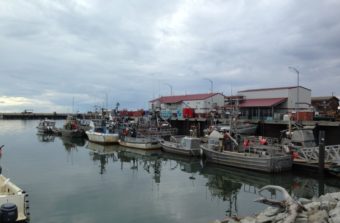
Fishing vessels at the Nome harbor. (Photo Matthew Smith/KNOM)

The Nome Port Commission is preparing for a steady stream of visitors this summer. Vessels serving the fiber optic cable installation will be in harbor the last week of June.

But it’s the month of August that will likely be the busiest for Nome’s port. While the city isn’t the official host, the U.S. Coast Guard will be in and out of town during its Arctic Chinook search and rescue drill in mid-August.

At its most recent meeting, City Manager Tom Moran told the Port Commission it’s not just Americans that will be in town

“We’re also going to have some Canadian National Guard presence at our National Guard hanger,” Moran explained.

The Arctic Chinook drill is taking place between Kotzebue and Tin City. While the decision not to be based out of Nome is frustrating for some, Moran says those two locations were next in line for Coast Guard training.

And, he said, it actually might be a good thing.

“Long story short is the fact that we’re not having this monstrous microscope on us during this training session is not a bad thing administratively because of the timing,” Moran said.

The timing of the Arctic Chinook drill coincides with what will likely be the port’s business day of the summer. The thousand-passenger Crystal Serenity cruise ship will call to Nome’s port on August 21.

As comment deadline approaches, military leaders weigh-in on Arctic lease sales

Drift ice camp in the middle of the Arctic Ocean as seen from the deck of icebreaker XueLong, July 2010. (Photo by Timo Palo via Wikimedia Commons)

More than a dozen former military leaders jumped into a fight over offshore drilling in the Arctic yesterday, asking the Department of the Interior to allow lease sales in Alaska’s Arctic.

The deadline is Thursday for groups to weigh-in on the interior department’s plan.

The military leaders say the U.S. is lagging behind other nations and could lose its economic and political foothold in the resource-rich region without new investments.

Gen. Joseph Ralston, formerly of the U.S. Alaskan Command, joined 15 other military veterans, and a former Secretary of Defense, asking for the Arctic leases to be kept in the plan. It covers the next five years.

“The idea that we would somehow take leasing from the Chukchi and the Beaufort Sea off the table while Russia is investing heavily, while Norway is drilling, while Canada will be drilling, just does not make sense from a national security perspective,” Ralston said.

The Interior Department has been deluged with comments. Nearly 200,000 have been logged since the agency first requested them in mid-March.

Some industry and pro-exploration groups fear the administration might drop the Arctic from its leasing plan. The agency is already proposing to drop similar lease sales in the Atlantic.

Michael LeVine is the Pacific Senior Council for Oceana, an ocean conservation organization based in Juneau.

He said private companies shouldn’t be responsible for the nation’s geopolitical ambitions.

“Certainly, all of us in Alaska and in the environmental community are sensitive to the needs of national security and a sustainable energy future. If, however, we are depending on Shell and other companies for national security, we’re all in trouble,” LeVine said.

In the past six months, several companies, including Shell, have abandoned the leases they already hold in the region.


388 scientists ask Obama to stop offshore lease sale

Shell Polar Pioneer
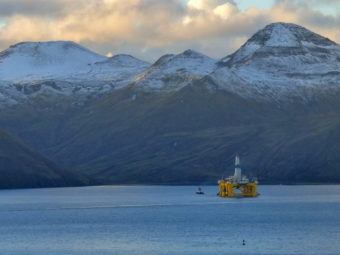
Shell’s Polar Pioneer leaving Dutch Harbor on Oct. 12, heading for Washington state. (Photo by John Ryan/KUCB)

Nearly 400 scientists sent a letter to President Barack Obama Wednesday asking for an end to offshore lease sales in the Arctic. The U.S. Department of the Interior is considering leasing areas in the Beaufort and Chukchi Sea for offshore drilling.

More than 30 scientists from Alaska signed the letter. Eugénie Euskirchen, an associate research professor at the University of Fairbanks, says most of her colleagues are opposed to the lease sale.

Euskirchen studies the effects of climate change in the Arctic and worries that if drilling occurs a crisis could follow.

“First of all, it upsets an ecosystem that’s already very fragile,” Euskirchen said. “And second of all, if there’s a disaster or spill or any sort of problem, the oil companies do not seem like they’re very well ready to handle any such problem.”

There hasn’t been a lease sale in Alaska since 2008. Last year, the Department of the Interior canceled the current lease cycle after Shell decided to halt exploratory drilling, citing disappointing results and lack of industry interest.

Josh Kindred, of the Alaska Oil and Gas Association, says even though oil prices are low now, that may change. He thinks getting rid of the lease sale altogether could bar the U.S. from drilling in the Arctic forever.

“You know, at the end of the day, we don’t know where we’re going to be as a nation from an energy standpoint five years from now,” Kindred said. “And so foreclosing this opportunity prematurely — particularly when we’re still afforded that opportunity four or five years from now to simply have BOEM pull those lease sales — seems like poor policy.”

BOEM is the Bureau of Ocean Energy Management. The bureau’s public comment period for the 2017 to 2020 plans ends Thursday.

Snow geese numbers rise after protective actions

Snow geese at Barrow nesting area.
Snow geese at Barrow nesting area (Photo courtesy of ABR Inc.)

Like other large waterfowl species, the North American population of snow geese was decimated in the early part of the twentieth century due to over hunting.  But since then, thanks to hunting restrictions and habitat protection, snow geese numbers have bounced back strongly – some might say a bit too strongly.

Wildlife management officials are now trying to curtail the growth of snow geese colonies on the North Slope, before they get out of hand.

Numbering in the millions of birds, dense colonies of snow geese on the breeding grounds in the central Canadian Arctic have caused widespread ecological damage there.

Julian Fischer from the U.S. Fish and Wildlife Service Migratory Bird Management Office explained, an overabundance of snow geese in an area will leave the land barren and ripe for erosion.

“And that’s due to the fact that snow geese have a very robust bill, that’s capable of excavating root systems, and that results in the organic layer being stripped away,” Fischer said.

Extensive habitat degradation has not been seen yet on the North Slope of Alaska, which is home to several snow geese colonies.  But snow geese numbers in Alaska are exploding.  North Slope Borough Department of Wildlife Management biologist Brian Person monitors the largest colony in Alaska, located about 60 miles southeast of Barrow.

“Last year we enumerated 12,000 nests,” Person said. “To put that in perspective, in early 2000, there were only 250 nests out there, so it is growing exponentially.  We think the population is doubling every three years.”

The snow goose population in Alaska as a whole continues to grow despite the fact that in some years, almost all of the nests in a particular colony fail to produce goslings. Brown bears treat snow geese colonies as a kind of all-you-can-eat buffet serving only one thing: eggs.

In 2009 when an estimated 99 percent of snow geese nests in the Ikpikpuk colony southeast of Barrow failed due to bear predation, Person watched it happen.

“At any given time, I never had more than a half mile visibility because of the fog,” Person said. ” And at one time we counted four bears, going to nest to nest to nest, eating these eggs.  It’s a wonderful food source for the bears.”

But despite hungry bears and humans with shotguns, snow geese numbers in Alaska continue to skyrocket.  One reason is that snow geese are fairly long-lived birds, with a maximum life span of 10 to 12 years.  So they have many opportunities to reproduce.  They’re not picky eaters.  And there’s another factor in play, according to Julian Fischer from the Fish and Wildlife Service.

“From models that are being produced by the USGS Science Center, it appears that the growth is faster that can be explained by just production of goslings alone, suggesting that there must be emigration from another breeding area,” Fischer said. “Most likely that would be coming from the Banks Island area of Canada, or possibly even the central Canadian Arctic.”

Snow geese from overcrowded areas in Canada, it seems, are seeking greener pastures in Alaska.

Liberalized hunting regulations in the lower 48 and Canada aimed at reducing the Canadian breeding stock of snow geese have not proven to be effective to getting the population down to a sustainable level.  But nevertheless, biologists like Person think that subsistence hunters and egg collectors on the North Slope can play a role at regulating the Alaska breeding stock now, before the population gets too large.

“I think that’s really the only good alternative in this case,” Person said. “I think hunters in the lower 48 and Canada are already saturated.”

Expanded subsistence hunting in Alaska can be an easier tool to wield on the snow goose situation, because changes to hunting regulations at snow geese wintering grounds in the lower 48 would require federal authorities to go through the National Environmental Policy Act review process.


Despite Federal Changes, ‘Eskimo’ Still in Use in Western Alaska

Nome Eskimo Community
Nome Eskimo Community. (Photo by Emily Russell/KNOM)

The term “Eskimo” is divisive across much of the Arctic, but it’s still being used in western Alaska. Some identify with it, while others want to see change.

President Barack Obama recently removed the words “Eskimo” and “Aleut” from two pieces of federal legislation, but it may take another generation for it to fade out of Alaska’s Arctic.

“It wasn’t until I went to graduate school in Montreal at McGill University for English as a second language when I got in trouble for using that word in one of my classes, ” confessed Yaayuk Alvanna-Stimpfle.

The word Alvanna-Stimpfle is referring to is “Eskimo.”

“We all identify with that word ‘Eskimo,’ as to who we are,” she explained, adding “my generation, we grew up speaking our native language as well.”

Alvanna-Stimpfle is a retired teacher from Nome Public Schools, where she taught her native language, Inupiaq, along with English as a second language. She’s now in her fifth year directing Kawerak’s Eskimo Heritage Program.

“It was a folklorist — an anthropologist — that thought of the title ‘Eskimo Heritage Program’ because it is about our history,” she said.

In some cases, the word Eskimo doesn’t bother Alvanna-Stimpfle. She grew up around it, but she said others are more resistant to it.

“Through education and awareness, our younger generations try not to use that word Eskimo or try not to identify with it because that was just a name that was given to categorize our people.”

Hattie Keller is 25 years old. Her family is from Shishmaref, but she was born and raised in Nome.

“Atiġa Iviilik. Kigiqtaamiuguzruŋa. My name is Hattie Keller,” Keller translates. “My Eskimo name is Iviilik and I am from Shishmaref.”

Keller describes ‘Iviilik’ as her Eskimo name, but she’s quick to clarify.

I see myself as an Inupiaq, so when people do ask me what is my ethnicity, instead of saying Eskimo, I do say Inupiaq,” Keller explained.

She’s working towards an associate’s degree in tribal management and her bachelor’s in Alaska Native studies and rural development through UAF’s Northwest Campus.

Keller traveled to Fairbanks earlier this year for tribal management classes. She said even there she had to clarify her ethnicity to other Alaska Natives.

I met with people and they were from a different culture, they were Athabascan, and I was the only quote-unquote Eskimo in the room,” Keller explained. “They asked me, ‘What do you prefer to be called, and what do your people prefer?’ And I told them it’s a personal preference.”

Keller said this happened after the Alaska Airlines “Meet our Eskimo” campaign, which, after public outcry, the company replaced with “Meet the Eskimo.”

Keller said she doesn’t get offended when people use the term Eskimo, unless it’s meant to be derogatory. She’s a member of Nome Eskimo Community, a federally recognized tribe from the Nome area.

Along with Nome Eskimo Community and the Eskimo Heritage Program, western Alaska is also home to the Eskimo Walrus Commission and the Alaska Eskimo Whaling Commission.

Arnold Brower is the executive director of the Alaska Eskimo Whaling Commission.

“I think ‘Eskimo’ covers it all for the broader range of representation for our subsistence way of life,” Brower said.

He considers himself Eskimo, and he said it’s a useful term for the commission.

“To be inclusive of Yup’ik whalers and Canadian whalers and Alaskan whalers, (the name) just came out naturally as Alaska Eskimo Whaling Commission,” explained Brower.

But Yaayuk Alvanna-Stimpfle doesn’t think the term will be around forever. She started brainstorming a few years back about how to remove the word from the Eskimo Heritage Program. It hasn’t changed yet, but she thinks her program and others like it will give in to generational shifts.

“Whether it’s economics, culture or language, yeah, I think it will fade away,” Alvanna-Stimpfle said.

With the terms Eskimo and Aleut removed from two pieces of federal legislation, it’s already fading from the Washington bureaucracy.

Site notifications
Update notification options
Subscribe to notifications