Arctic

Warm water Blob survives as El Niño dies

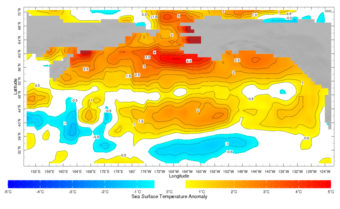
Sea surface temperature observations in late July 2016 show higher-than-normal temperatures lingering in the North Pacific and Bering Sea.
Sea surface temperature observations in late July 2016 show higher-than-normal temperatures lingering in the North Pacific and Bering Sea. (Courtesy of National Oceanic and Atmospheric Administration’s National Centers for Environmental Prediction)

It’s being called a marine heat wave. The combination of the strongest El Niño in recent history and the warm water anomaly known as the Blob generated the greatest amount of warm ocean water that has ever been recorded, possibly affecting marine life up and down the West Coast.

New research has now linked the two phenomena, with each believed to be alternately affecting the other through the atmosphere and the ocean.

El Niño is the warming of the equatorial Pacific Ocean and it can affect wind, temperature and precipitation patterns around the globe. While the latest El Niño did bring some needed precipitation to parts of the drought-stricken West Coast, it was also blamed for flooding, mudslides and other damage in California, according to an ABC News story in January.

After peaking in late 2015 with sea surface temperatures of at least 2 degrees Celsius above normal, the latest El Niño has disappeared. The National Oceanic and Atmospheric Administration’s Climate Prediction Center in Maryland recently reported that sea surface temperatures have dropped to below average in the eastern equatorial Pacific over the last two months.

But while El Niño is dead, the Blob lives on.

“To put it in a little bit more colorful terms, kind of a lingering hangover,” said Nicholas Bond, a research meteorologist at the University of Washington and the state climatologist for Washington.

Bond said latest sea surface temperature measurements show that unusually warm conditions are still persisting, especially in the Gulf of Alaska and the Bering Sea.

“For the Gulf of Alaska, 2.5 degrees C warmer than normal and in parts of the Bering Sea it’s 4 degrees C, or 7 degrees Fahrenheit warmer than normal,” Bond said. “I noticed some temperatures there near the west coast of Alaska that were 16 degrees C. That’s over 60 degrees (Fahrenheit) in the Bering Sea.”

Bond first identified the warm water anomaly three years ago and nicknamed it The Blob. He said unusual weather patterns have allowed the ocean to retain that heat.

“It got quite a bit warmer than normal, quite deep depths, as deep as 300 meters or so,” Bond said. “There was just a tremendous reservoir of this extra heat that is taking a long time to go away.”

That means that Alaskans, especially along the coast, could expect warmer weather this summer.

Climate hypothesis to explain the generation, evolution and persistence of the North Pacific warm anomaly between the winters of 2013/14 and 2014/15.
Climate hypothesis to explain the generation, evolution and persistence of the North Pacific warm anomaly between the winters of
2013/14 and 2014/15. (Di Lorenzo & Mantua, Nature Climate Change, 2016)

New research suggests a link between the Blob in the North Pacific and the former El Niño in the tropical Pacific.

“El Niño was kind of in the middle of the event in terms of changing the pattern of ocean warming and making it last for three years,” said Nate Mantua, a climate and fisheries research scientist at NOAA’s Southwest Fisheries Science Center in Santa Cruz, California.

In a paper published in July in the journal Nature Climate Change, Mantua and his co-author, Emanuele Di Lorenzo of the Georgia Institute of Technology, examined the connections between the two separate ocean events despite the great distance between them.

The Blob’s formation in the Western Pacific’s extratropics, or mid-latitudes beyond the tropics, in 2013 could have had a small influence on the development of the weak tropical El Niño of 2014. Then, during the stronger El Niño that developed in 2015, warm temperatures at the equator remotely affected the storm track and weather patterns in the North Pacific extratropics.

“The El Niño influence favors a much stormier weather pattern that includes a lot of wind from the south along the coast of the Pacific Northwest into Alaska,” Mantua said. “That is what caused the offshore warm Blob to move inshore and to expand.”

Mantua calls it a marine heat wave, and he said the amount of warm water was dramatically more than any other event in the historical record dating back to 1880.

The Blob and El Niño tag team is the prime suspect for several unusual biological events along the West Coast in the last three years. They include sea bird die-offs, giant algal blooms, demoic acid in shellfish, whale and marine mammal strandings, and low salmon returns and lightweight salmon.

“This is all indicative of a lot of stress on the marine food web lower productivity that’s in keeping with this idea of what warm water typically does,” Mantua said. “It just reduces the ability to get nutrients up into the sunlit upper ocean and cuts down on the abundance of the lipid-rich, sub-Arctic species that we find at the base of the food web.”

Mantua said there’s no evidence yet that global warming prompted the recent arrival of the Blob. But he and his co-author do believe that such events may happen more often and with greater intensity as the ocean warms.

“We see that the energy in the climate patterns that caused the warm Blob, it increases,” Mantua said. “By the end of this century, the energy increases about 16 percent over that from the late 20th century.”

Short-term relief may just be around the corner. Temperatures in the equatorial Pacific Ocean are cooling, finally signaling an end to one of the strongest El Niños in 20 years. Bond said there’s an increased chance that the pendulum will swing the other way this winter toward La Niña, or equatorial cooling.

“And, if it has the usual sort of atmospheric pressure and wind patterns associated with it, then we should continue to see continued moderation of temperatures in the Northeast Pacific, Gulf of Alaska, Bering Sea, and off the Pacific Northwest Coast,” Bond said.

“And more wind out of the north, more cold storms, and that could start moving the Blob out,” Mantua said.

Mantua notes that current weather patterns are already much different than those that created the Blob. He said we’ll know more in six to nine months.

“So, La Niña would be good for bringing things back to normal, maybe even getting us a little cooler than normal,” Mantua said.

Without quorum, tribal delegates push AVCP demands to October

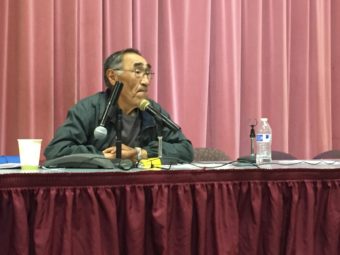
Newly appointed meeting Chair Ivan M. Ivan at the Yupiit Piciryarait Cultural Center in Bethel. (Photo by Charles Enoch/KYUK)
Newly appointed meeting Chair Ivan M. Ivan at the Yupiit Piciryarait Cultural Center in Bethel.
(Photo by Charles Enoch/KYUK)

Tribal delegates in Bethel this week tried to hold an emergency meeting of the Association of Village Council Presidents.

They want the AVCP administration and executive board to provide answers on financial matters and respond to what some delegates see as a mismanagement of power and lack of transparency within the organization.

AVCP administration and executive board members did not attend nor sanction the meeting, which began Tuesday and ended Wednesday.

Only 13 tribes sent delegates; 38 were needed to constitute an official meeting under AVCP bylaws. For lack of quorum, the delegates are pushing their questions and demands to the October annual meeting.

AVCP acting president and legal counsel did not respond to KYUK’s emails seeking comment on the meeting.

Q&A: Teen White House honoree from Shishmaref talks climate change

Esau Sinnok (second from the left) talked at the White House aout “Climate Equity” (Photo courtesy of the Department of Interior)
Esau Sinnok, second from the left, talked at the White House about climate equity. (Photo courtesy Department of Interior)

A 19-year-old from western Alaska was honored last week at the White House for his work advocating on behalf of communities experiencing climate change first hand. Esau Sinnok spoke to me from his cousin’s house in Nome on his way back home to Shishmaref. He was in Washington advocating for climate equity.


ESAU: Climate equity, to me, means we’ll have available resources so that Shishmaref will have the available resources to either relocate or adapt to climate change so that our future generations can have fun and experience the lifestyle that I had the privilege. So that our future generations can live the traditional lifestyle that ancestors have been living for the past 4,000 years on Shishmaref.

HUGHES: In your own life, have you seen changes to the climate?

ESAU: Yeah, ever since I was born in 1997, we had to move about three dozen houses from one side of the island to the other because of big storm surges that happened in Shishmaref so that they don’t topple over and go into the ocean. It affects me personally because I lost a loved one. He fell through the ice when him and my dad and a few others went out to the mainland on their snowmachines on the ice to go duck hunting. And on their way back, he fell through the ice and he thought that the ice would be frozen like in previous years, but for some reason it wasn’t frozen all the way so he fell through and lost his life.

HUGHES: What’s one of the messages from Alaska that you’ve tried to bring to the attention of other influencers and other leaders?

ESAU: I always tell other people, wherever I go and whoever I meet, that the youth voice is very powerful. That they are the future leaders of tomorrow. It’s very important for us youth to have a voice in all these types of movements and all these types of issues. Because the future that we’re going to inherit is being decided right now and affecting my hometown of Shishmaref greatly, affecting 223 communities all across Alaska greatly. And not just in Alaska but in the Gulf Coast, in the Lower 48 like in Louisiana and Florida, those states.

HUGHES: And can you tell me what it was like at the White House?

ESAU: It was like a once in a lifetime opportunity at the White House. I had my goosebumps and my heart was beating every time I was there. It was like I couldn’t believe I was there. I’m just a rural village Native kid, and to experience that … it felt like a once in a lifetime opportunity for me. And I would love to get other youth involved to share the same experience. To share what I felt when I was there.

HUGHES: My last question for you is, what your next step is?

ESAU: I’m currently studying at the University of Alaska Fairbanks in tribal management and hopefully continue with a rural development degree so that I can go back to Shishmaref and run as city mayor and to experience how to lead our community. Hopefully one day I could run for governor of Alaska by the year 2030 to represent, not only the big cities like Anchorage and Fairbanks and Juneau, but also the rural communities. I wanna make a change and try to make a positive and better future so that our future generations can live in a safe environment and don’t have the problems that I’m seeing every time I’m back at the community.

Young promotes Chouest ship to fill ‘icebreaker gap’

The Coast Guard is down to two working icebreakers, and the sole heavy icebreaker still on the job is due to retire before a replacement can hit the water.

That “icebreaker gap” was the subject of a hearing in the U.S. House on Tuesday. The hearing turned testy when Congressman Don Young pressed the Coast Guard to consider leasing an icebreaker from the private sector, from a company whose owners happen to be big contributors to Young’s campaign.

U.S. Rep. Don Young
U.S Rep. Don Young speaks to the Capital City Republicans and Capital City Republican Women at the Prospector Hotel in April. (Photo by Jennifer Canfield/KTOO)

Everybody on the Coast Guard and Maritime Transportation Subcommittee, at least the few who attended the hearing, seemed to agree that the nation needs icebreakers. A Senate bill already includes $1 billion for one icebreaker. But building it would take a decade. The country would likely have no heavy icebreaker for three to six years, hampering potential ship traffic in the Far North.

Alaska Congressman Don Young confronted the Coast Guard witness with a suggestion, and the hearing took a very specific turn.

“I’ll get the elephant out in the room, in a sense,” he said. “During the Shell activity, there were anchor-layer, ice-capable ships.”

As he and others continued to describe it, it became clear they were talking about one ship: the Aiviq. That’s a huge, heavy tug, owned by the shipbuilding firm Edison Chouest and built specifically for Shell’s Arctic work. Young wanted to know why the Coast Guard couldn’t hire that ship to break ice.

The heavy tug Aiviq on Dec. 20, 2015. The ship is owned by shipbuilding firm Edison Chouest. (Creative Commons photo by <a href="https://flic.kr/p/CrFLZZ">Andrew W. Sieber</a>)
The heavy tug Aiviq on Dec. 20, 2015. The ship is owned by shipbuilding firm Edison Chouest. (Creative Commons photo by Andrew W. Sieber)

“Would you be interested in that, admiral, if that was to take place?” Young asked. “I know you’ve got the proposal on your desk, by the way. It’s already been laid on your desk and it’s an automatic no. Why?”

Coast Guard Vice-Commandant Charles Michel said his boss checked out that ship, in person, but the admiral said the vessel is not suitable. He offered to explain, but Young cut him off.

“Wait a minute. Stop!” Young told him “You think so, but if the shipbuilder said ‘I can take and meet your requirements,’ with the bow it has now, tungsten steel and the power to do it …”

The admiral wasn’t budging. He said all Coast Guard icebreakers have to operate as military ships, able to enforce the law and assert national sovereignty.

“Sir, our current opinion is that ship is not suitable for military service, without substantial refit,” the admiral said.

“That’s what I call, Mr. Chairman, a bull—- answer.” Young said. “Military service. I’m talking about moving ice.”

The chairman of the subcommittee, Rep. Duncan Hunter, R-Calif., took up Young’s line of questioning, challenging the admiral to explain why it couldn’t use a private icebreaker.

Young never named the ship, and in the hallway after the hearing, he wouldn’t provide the name of the ship he said was available, preferring to stick to generalities.

“I don’t know. But there are ships available and all I’m saying is let’s use them,” he said.

Young’s spokesman later confirmed that the specific ice-capable ship Young was describing was the Aiviq. The 360-foot tug is worth about $200 million, according to trade publications. It presumably has some spare time, since Shell canceled its Arctic project. Aiviq’s owner, Edison Chouest, is a privately held, family-run company that is a major source of campaign contributions to Young. The Chouest family and employees have contributed more than $250,000 to Young over the past decade, and Steve Lindbeck, a Democrat running for Young’s seat, has already made an issue of it. Rep. Hunter, who chaired today’s subcommittee meeting, is also a favorite of the Chouest family, according to OpenSecrets.org.

Young’s spokesman, Matt Shuckerow, said Young was just using the Aiviq as an example, a possible solution to the icebreaker gap.

“The Coast Guard says there’s only one available option and that’s building a new ship,” Shuckerow said. “It’s Congress’ responsibility to look at all options. As the Congressman has said time and again he believes we should look at everything on the table.”

Shuckerow said Young would be happy to talk to other U.S. shipbuilders.

A spokesperson for Edison Chouest did not respond to phone messages by deadline.

By the way, If the name Aiviq rings a bell, this was the tug pulling the ill-fated Shell rig that went aground near Kodiak in 2012.

Obama administration announces new rules for Arctic drilling

Shell Polar Pioneer
Shell’s Polar Pioneer leaving Dutch Harbor on Oct. 12, 2015, heading for Washington state. (Photo by John Ryan/KUCB)

The Obama Administration on Thursday issued new regulations covering offshore drilling in the Arctic.

The new rules will hold oil companies in the Arctic to a higher standard than those drilling in other regions, including the Gulf of Mexico.

But currently, there are no companies with plans to drill in the Arctic Ocean off Alaska — and that seems unlikely to change any time soon.

The Department of the Interior began formulating the regulations after Shell’s first effort to drill in the Arctic in 2012 resulted in a series of serious mishaps.

Speaking on a conference call with reporters on Thursday, Assistant Interior Secretary Janice Schneider called the new rules “world class.”

“This rule seeks to set the highest safety and environmental standards for companies interested in Arctic exploration,” Schneider said.

The regulations essentially codify the rules imposed on Shell during its 2015 drilling season, including a requirement that companies keep a second rig available at all times to drill a relief well.

Shell called those regulations a contributing factor in its decision to pull out of the Arctic last fall.

But Abigail Hopper, Director of  the Bureau of Ocean Energy Management, said the rules were prompted by mistakes that Shell itself made in 2012.

“We realized that one of the challenges was a lack of contractor oversight, and a deficit in planning the entire operation,” Hopper said. “So we have required…what’s called an integrated operations plan. That is a plan from the very beginning of the program, all the way through demobilization at the very end.”

The Interior Department is also deciding whether to include the Arctic in its next round of offshore lease sales. That is a separate decision, expected later this year.

The new regulations only cover floating operations, not near-shore projects like Hilcorp’s Northstar unit or its proposed Liberty project, which drill from man-made gravel islands in the Beaufort Sea.

The regulations prompted predictable reactions from industry and environmental groups.

The Center for Biological Diversity emailed out a statement saying, simply, “Arctic drilling can’t be made safe, period.”

But other environmentalists called the regulations a good first step.

“If, in fact, companies ever do want to come back and explore in the Arctic Ocean, they’ll know what the basic safety and prevention requirements are, and they’ll be substantially improved over what they used to be,” said Michael LeVine, of the conservation group Oceana.

But, Levine said, he doesn’t believe any company is truly prepared yet to deal with risks like oil spills in Arctic waters.

Meanwhile, Kara Moriarty of the Alaska Oil and Gas Association repeated her organization’s warning that regulations will slow Arctic development.

“Obviously we’re still trying to sift through all 348 pages,” Moriarty said. “But at first blush, it does appear the federal government is creating additional cumbersome regulations that will make it more challenging to entice companies back to the Arctic when oil prices rebound.”

It remains an open question what it would take to entice companies back to the Arctic, regulations or no regulations.

With the exception of Hilcorp’s near-shore operations, no company currently has any plans to drill in the Chukchi or Beaufort Seas.

In the nine months since Shell announced it was abandoning its nearly decade-long quest in the region, several companies, including ConocoPhillips, Norway’s Statoil, and the Spanish company Repsol have relinquished leases: of more than 700 leases purchased in the Arctic since 2003, only 43 are still held by companies.

Coast Guard stationed in Kotzebue for the summer

Kotzebue. (Photo by Neal Herbert/ National Park Service)

The U.S. Coast Guard is setting up for activities in Kotzebue this summer and summers to come. The Coast Guard signed a five-year lease with the Alaska Army National Guard facility in Kotzebue. It’s the first long-term lease for the Coast Guard above the Arctic Circle and will serve as a station for Arctic operations.

U.S. Coast Guard Tribal Liaison Sudie Hargis is based in Juneau. She was part of a team that visited Nome last week for an oil spill response drill. Hargis says having the Coast Guard stationed in Kotzebue offers an opportunity for more local search and rescue and disaster response support. An Arctic liaison officer will also connect with community members in Nome, Kotzebue and Barrow.

Hargis says the Coast Guard is still deciding where to establish a “hard infrastructure” for Arctic operations, but this five-year lease does “provide a lot of capability to come up to the region and operate for the people of Alaska.”

The State of Alaska turns over the Kotzebue Army National Guard hangar Friday. It will be marked by a Coast Guard MH-60T Jayhawk helicopter rolling into the facility followed by a community barbecue. In addition, both the State and NANA Corporation will honor former National Guard adjutant general John Schaeffer.

The Coast Guard will be in operation in Kotzebue from July through October.

Site notifications
Update notification options
Subscribe to notifications