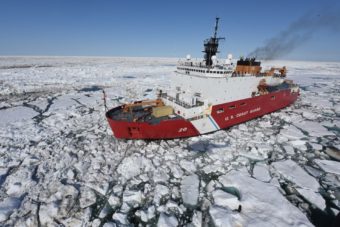
The Coast Guard Cutter Healy patrols the Arctic Ocean during a joint civil and federal search and rescue exercise near Oliktok Point, Alaska, July 13, 2015. The Healy is a 420-foot icebreaker homeported in Seattle. (Photo by Petty Officer 2nd Class Grant DeVuyst/Courtesy U.S. Coast Guard)
El Nino has transitioned to below normal sea surface temperatures in the mid-latitude Pacific.
If that persists, then the condition known as La Nina, typically results in a colder than normal winter for Alaska.

However, National Weather Service climate science and services manager Rick Thoman said low sea ice and remaining warm water around Alaska, will be primary drivers of the state’s autumn weather.
“The Gulf of Alaska, the Bering Sea on up into the Chukchi Sea … much warmer than normal,” Thoman said. “That heat will take a while to dissipate. Sea surface temperatures don’t typically reach their maximum until the end of August or even early September so that’s kinda locked in.”
Warmer seas provide more, potentially rain and snow yielding, moisture to the air, Thoman said.
“That’s one part of the equation,” Thoman said. “The other part of the equation is we had to have the atmospheric conditions. We need storms to be able to turn that moisture into precipitation. Typically in the autumn, that’s not so hard to do.”
Thoman stressed that ocean temperatures and moisture most directly impact coastal weather.
“Once we move inland a little bit, then it becomes more complicated. For instance, across the Interior, if our dominant flow during the fall is out of, say the East or the Northeast from Canada, well… it won’t matter very much that the oceans around us are warm, cause that’s not where our air’s coming from. So it can have a potential effect, but away from the coast, there’s other factors involved.”
Thoman cautions that while the overall fall outlook for Alaska is for warmer than normal, there can still be below normal days, weeks or even a month.
Dean Westlake is challenging Barrow Rep. Bennie Nageak in the Democratic primary; in 2014, Westlake lost the race by 131 votes. (Photo by Rachel Waldholz/Alaska’s Energy Desk)
Only three votes now separate two northern Alaska House candidates.
Dean Westlake of Kotzebue has 780 votes, ahead of 777 votes for incumbent Rep. Ben Nageak, who’s from Barrow.
Alaska’s Division of Elections is still counting votes from House District 40, which stretches from Kotzebue to Kaktovik.
Elections director Josie Bahnke said a review board met in Nome on Tuesday, Aug. 23, and certified 42 ballots in the race.
But, there are still more to count.
“I’ve been talking to staff about this being a marathon, not a sprint.”
Bahnke’s division has come under fire in recent days for voting irregularities in the Northwest Arctic village of Shungnak. Voters there were given ballots for both primaries, though they only were supposed to get one.
Bahnke’s division is working with the Department of Law to determine what to do if the added ballots in Shungnak appear to change the outcome of the race, she said.
There are at least 120 ballots left to count for House District 40, which includes questioned, special needs and absentee ballots.
The state deadline to count absentee ballots is Friday.
The election should be certified by September 2.
The race is one of two that State Democratic Party officials targeted in an attempt to unseat two Democrats who caucus with the Republican-led House majority.
The challengers, and party officials, say they’re hoping to build a bipartisan coalition in the House.
With no Republicans in either race, the candidate who wins won’t have a general election challenger.
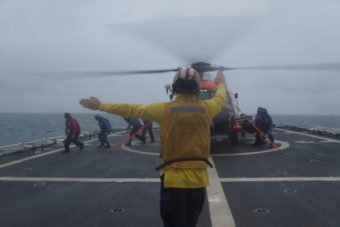
A member of the Stratton’s crew signals to the pilot of a Coast Guard helicopter during a training exercise held earlier this month off Alaska’s northern coast. The agency has stationed two MH-60 helicopters in Kotzebue to help it respond more quickly to emergencies around the remote Arctic expanse. (Photo by Gina Caylor, U.S. Coast Guard)
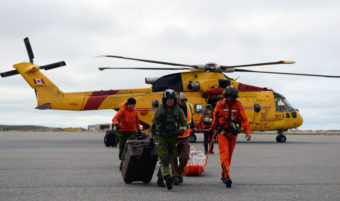
The U.S. Northern Command and Coast Guard have launched a major field-training exercise off Alaska’s northwest coast.
Arctic Chinook is intended to demonstrate how local, state and federal agencies would respond to a simulated cruise ship accident.
More stories about the Crystal Serenity
On the Serenity, keeping alert for an icy voyage ahead
Coincidentally, a big luxury cruise ship will sail through the area while the exercise is under way.
And to further complicate things, bad weather has just set in.
Arctic Chinook planners have had to incorporate some extra precautions into the exercise because of rough weather that set in over the weekend over the Bering and Chukchi seas, said Coast Guard Commander Mark Wilcox.
“We are having to adapt our exercise just slightly to accommodate what is going to be gale-force winds,” he said.
The National Weather Service had issued a gale warning effective through Tuesday evening for waters off the Seward Peninsula, where the exercise will be held.
It’s also where the luxury liner Crystal Serenity and its 1,600 passengers and crew will soon be traveling through en route to the Northwest Passage and on around to New York.
The weather service predicted the storm would whip up 35- to 45-knot winds off Alaska’s coast, and it issued a winter storm warning and forecast up to 8 inches of snow on the western end of the North Slope.
The Coast Guard and the U.S. Northern Command, or NorthCom, scheduled Arctic Chinook for now because usually it’s the best time of year to conduct such an exercise, Wilcox said.
“We place a lot of these sort of key events – we time them for August, because we expect to get the best weather and least sea ice,” Wilcox said. “Mother Nature doesn’t always let us move forward as planned.”
Wilcox said the exercise is intended to test the ability of local, state and federal emergency responders to rescue 200 passengers from a cruise ship that’s run into trouble in those waters, The scenario calls for bringing passengers to shore around Tin City, near the westernmost tip of the Seward Peninsula – where rescuers would face their next logistical challenge. (This morning, organizers announced they’d moved the evacuation portion of the exercise to the Kotzebue Long Range Radar Site, due to rough weather.)
“So, how do we keep people alive on the beach while the secondary round of rescue assets that will bring them to an Arctic hub or village – how do we keep alive in that time span?”
The exercise scenario called for responders on the beach to triage the evacuees, sending uninjured passengers to Nome, then on to Anchorage. Fifty people will play the role of injured passengers, who’ll be taken initially to Kotzebue, said Army Col. Michael Forsyth. He’s chief of staff for Alaskan Command, the NorthCom subordinate agency based at Joint Base Elmendorf-Richardson that’s helping the Coast Guard manage the training exercise.
“There’s about 50 folks who will actually get in lifeboats. They are going to … casualties that the municipal community will have to react to.”
Forsyth said Arctic Chinook will involve up to thousand people from several agencies, along with three ships, about a dozen aircraft and many other types of equipment. He said agencies involved include U.S. Army Alaska; Air National Guard; federal Homeland Security Department and its state counterpart and the Arctic Domain Awareness Center, Homeland Security’s University of Alaska-affiliated research arm.
“Canada is also contributing to the exercise a helo, a fixed-wing aircraft and also dozens of personnel.”
Forsyth said other Arctic nations are sending observers. He said management of the complex exercise will be done out of the Alaskan Command’s facilities at JBER, where many of the agencies already have offices.
The luxury cruise liner Crystal Serenity arrived off the coast of Nome on Sunday. (Photo by Lauren Frost/KNOM)
A view of Nome from the deck of the Crystal Serenity. (Photo by Lauren Frost/KNOM)
The pool on the top deck of the Crystal Serenity. (Photo by Lauren Frost/KNOM)
The interior of the Connoisseur Club on board the Crystal Serenity. (Photo by Lauren Frost/KNOM)
The Crystal Serenity’s onboard spa. (Photo by Lauren Frost/KNOM)
Prego, an Italian restaurant on board the Crystal Serenity. (Photo by Lauren Frost/KNOM)
Birger Vorland is the captain of the Crystal Serenity, and he doesn’t shake hands, he touches elbows.
“Make sure everybody stays healthy,” said Vorland. “It’s a Crystal handshake.”
The Crystal Serenity is carrying 980 passengers on a 32-day journey from Anchorage to New York City.
The cruise ship is the largest ever to navigate the Northwest Passage, a voyage of many other firsts for Crystal Cruises, according to Captain Vorland.
“I mean, this is the longest single cruise we’ve ever made,” he said. “And it is the most expensive cruise we’ve ever made. And it’s the one that sold out the fastest — 48 hours, it was basically gone.”
A trip like that comes with a lot of pressure.
“The captain never sleeps heavy,” Vorland said. “He always sleeps a little light.”
Vorland’s biggest concern is the ice that the ship might encounter further north.
The ship is equipped with searchlights, an ice radar, thermal-imaging technology and a Canadian navigation program called IceNav, all to detect that ice.
The icebreaker vessel Ernest Shackleton joins the cruise in Ulukhaktok.
Vorland thinks that ice isn’t all bad.
“This goes two ways,” he said. “We don’t want ice, but we do want ice because if we don’t have ice, we don’t have polar bears.”
This is one paradox of the Crystal Serenity’s current voyage.
The ice is the greatest threat to the ship, but it’s also why the ship is traveling through the Northwest Passage in the first place.
Crystal Cruises Land Programs vice president John Stoll thinks the passengers are on this cruise for the Arctic wildlife sightings, first and foremost.
“So if we have to, we’re going to convince the captain to go where we need to go to spot the wildlife,” Stoll said.
In the Crystal Serenity’s open, airy Palm Court lounge, Stoll showed off the ship’s Cineflex system.
Giant television screens line the dance floor.
During wildlife sightings, the onboard cameraman will zoom in on the animals and broadcast those images to the screens, as well as to the TVs in all the state rooms.
The system has already been put to use. On their way to Nome, they spotted a pod of whales.
On this voyage of new experiences, one thing isn’t new: the passengers.
Keith Steiner is a passenger who has sailed 81 cruises with Crystal. He said he’s seeing a lot of familiar faces onboard.
“Many of them are seasoned cruisers,” Steiner said. “I think all but six people have sailed Crystal at least one time or more beforehand. So that’s very unique. You have people who cruise every year, they cruise for many days.”
There are even three passengers who currently live full-time aboard the Crystal Serenity.
Although many passengers participated in a variety of tours while in Nome, approximately 200 passengers never deboarded the ship.
To some, the Northwest Passage is a chance for a new adventure, and to others, it’s cruising as usual.
Back in the Palm Court lounge, Captain Vorland looked out the window at the rain.
He sees himself as part of tradition as well.
Not a tradition of cruising, but a tradition that hearkens back to Roald Amundsen, who became the first explorer to travel the Northwest Passage by ship in 1906.
Amundsen was Norwegian, just like Vorland. And like the seafarers of old, Vorland isn’t above a little superstition.
“I told my wife when I went on the world cruise in January, I said, ‘Honey, when I come back from the world cruise, I’m going to stop shaving,” he said. “I am going to keep it that way until all the ice is behind me, and then I’m going to shave again.’ Once we leave Greenland, and all the ice is behind us, the beard is going off.”
On this voyage, Captain Vorland isn’t taking any chances. Not even with his facial hair.
The future of monitoring Arctic ice begins in space.
NASA scientist Thomas Wagner said to think of the IceSat-2 like a giant laser pointer.
Rather than entertaining your cat, these lasers can measure the height of ice above the water. A total of six of them will be beamed down to Earth.
“The point being that we’re going to get our most accurate maps ever of the thickness of the Arctic sea ice,” Wagner said. “And that’s one of the most important things that we put into our models.”
Those models could influence conservation and planning decisions in the Arctic, Wagner said.
NASA launched a prototype of IceSat in the early 2000s, but it was decommissioned in 2010.
This new and improved satellite — along with additional measurements collected by NASA — will help determine what the future could look like in the Arctic.
And it’s happening at an important time.
“A lot of ice experts, including myself, thought we were headed for a record year minimum,” said Hajo Eicken, a professor at the International Arctic Research Center at the University of Alaska Fairbanks.
Arctic sea ice is important because it acts like a giant air conditioner for our planet, he said.
This year, a combination of events, such as a major ice retreat near Russia, left scientists wondering if the summer would beat a previous low. The last recorded minimum in the Arctic was in 2012.
But wind patterns offset the loss of sea ice and things cooled down a little.
“So now it looks like we’ll have well below normal ice extent, but we won’t have that record minimum,” Eicken said.
Still, Eicken said scientists are trying to figure out how the blob — a large pool of warm water in the Pacific Ocean — could be affecting the Arctic.
Sunlight is the most effective way to melt ice.
“However, the heat that comes up from below, some of it actually survives the winter,” Eicken said. “So in part, what we’re seeing now is that we have years where some of the heat that’s put into the ocean, upper ocean, from the sun and the atmosphere in the summer survives well into the winter.”
That could mean melt episodes even in the colder months.
Eicken is excited about the NASA satellite, which can help document these changes.
Even though what it finds might appear alarming, Wagner said people should be concerned, not afraid.
“Look, I have kids, too, and I’m not hopeless at all,” Wagner said. “All the time I see things that are going on in society that make me think that we are generating the social will to deal with this. And I think we’re getting a better handle on the challenges that we face today, and I think we are going to be able to deal with them.”
The luxury cruise liner Crystal Serenity arrived off the coast of Nome on Sunday. (Photo by Lauren Frost/KNOM)
The Crystal Serenity docked in Nome on Sunday and a special commemoration speech was given for this historic event. (Photo by Lauren Frost, KNOM)
Despite rainy weather, the luxury cruise liner Crystal Serenity arrived in Nome on schedule, Sunday morning.
About a thousand people poured out of the floating hotel and emptied into the town of Nome for a full day of scheduled activities and events, including the formal commemoration held at the Nome Mini Convention Center.
Commemoration speaker and Nome Mayor Richard Beneville said it’s days like these that make him feel excited to be mayor of Nome.
“And I got to be honest with you, as mayor of this town, I am so proud,” Beneville said. “I am so proud of our city employees that have come out to help this happen; I’m so proud of our volunteers that have worked on it; I’m so proud of Kawerak, who brought people in from the villages to sell goods. So it’s such a win-win-win, and it’s beautiful, and there’s a buzz in the air, and it’s energy, and it feels great.”
Many of the passengers getting off the boat were stepping onto Alaskan soil for the first time, Beneville learned from people onboard.
Passenger Marc Sola described the activities he was able to participate in as he ventured into Nome.
“We went to the church, we went to the visitors’ center, and then, there’s a little gift gallery we went to, and now we’re over here at the blueberry festival,” Sola said. “We just came out of that, all kinds of things going on in there, singing, gifts, all that kind of stuff.”
Carl Topkok and Linda Kimoktoak, a drummer and dancer for the King Island Dance Group, were thrilled to share some of their culture with these newcomers inside the Mini Convention Center.
“It really means a lot to us, it has to come from the heart, and you have to want to love it to do these songs,” Topkok said.
“Oh, it’s amazing to pass down our culture to people who haven’t experienced it before,” Kimoktoak said. “You kind of get goosebumps, and you get a really good, tingly feeling.”
Crystal Serenity captain Birger Vorland will have to traverse the icy Arctic waterway in order to successfully land in New York City within 30 days. An icebreaker vessel is accompanying the cruise liner throughout the journey.
The Norwegian ship captain was presented with a key to the City of Nome yesterday in the Mini Convention Center, and he took the opportunity to sink all rumors of his cruise liner being the next Titanic.
“We are the largest ship ever to attempt to go through the Northwest Passage, and when I say ‘attempt,’ that’s just for show, you know. We are going to make it, guaranteed,” Vorland said.
Captain Vorland and the Crystal Serenity’s next stop will be Ulukhaktok in the Northwest Territories of Canada.
Crystal Cruises is already booking passengers for another trip through the Northwest Passage next year.
Close
Update notification options
Subscribe to notifications
Subscribe
Get notifications about news related to the topics you care about. You can unsubscribe anytime.