Walker said in a letter to House Speaker Mike Chenault that there’s no evidence that some areas are unheard, and that it’s important for board members to respect each area.
He also opposed a provision that required residents to live in an area for two years before joining the board, saying it isn’t consistent with Alaska’s embrace of personal freedom.
Bill sponsor Wasilla Republican Lynn Gattis said she doesn’t agree with Walker’s reasoning.
“Boy, that’s a lot of BS, and you could go ahead and put that on the radio,” Gattis said. “Because I think the bottom line is, the fact that we do have very different regions. That’s why we elect representatives from those different regions. They bring a different flavor to the table.”
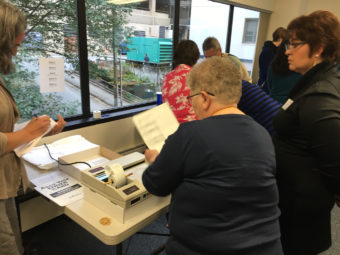
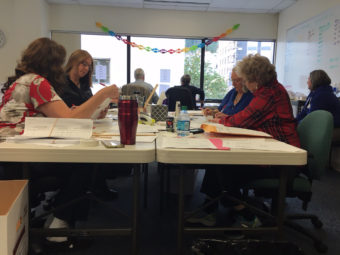
Election review board members work to certify the primary results at the Alaska Division of Elections office in Juneau on Aug. 30. (By Andrew Kitchenman/KTOO)
There will be a recount Monday of the Democratic primary results for the House district covering the North Slope and Northwest Arctic boroughs.
Division of Elections Director Josie Bahnke said the recount will take place in Juneau.
“We’ve got staff and state review board members that will be counting the ballot using four optical scan units,” Bahnke said. “So, both candidates have been informed and are allowed to have one observer at each unit.”
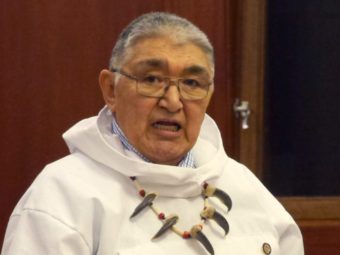
Nageak said he’s hopeful about the recount.
“If it came to be that it was, you know, positive for my campaign, I think it would be great,” Nageak said. “We’ll never know until we do it. I mean, it’s only four votes.”
Republican officials have raised concerns about the handling of ballots in the Kobuk River village of Shungnak. Voters were wrongly given ballots for both the Republican primary and the primary for all other parties.
Westlake received 47 votes in Shungnak and Nageak received three, according to the certified results.
Nageak has hired election law attorney Timothy McKeever to advise him. Nageak said all options are on the table for pursuing a legal challenge to the results.
“There’s a lot of stuff that happened during the election, not only in my area but … a lot of places in the state,” Nageak said.
Some Republicans in the North Slope Borough and elsewhere have said they weren’t allowed to vote in the Democratic primary, or were required to file questioned ballots.
The Democratic primary is open to all voters.
Bahnke didn’t provide a timeframe for when the recount would be completed.
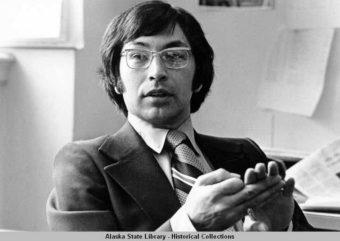
An undated photo of William “Willie” “Iggiagruk” Hensley, who served as a state representative, a House majority leader and a state senator on and off in the ’60s, ’70s and ’80s. Hensley represented his home region of northwest Alaska. (Photo courtesy Alaska State Library Portrait File)
The outcome of the disputed primary contest between Rep. Benjamin Nageak and Dean Westlake is uncertain. Whoever wins, it may unsettle what’s been a unique tradition in Alaska politics.
Democratic legislators have a long history of joining Republican-led legislative majorities.
To understand why Alaska is so different, it pays to go back to the 1960s. Democrats had dominated Alaska, but a resurgent Republican Party disrupted that. Regional divisions prevented a single party from forming a legislative majority, so they turned to partners across the aisle.
Willie Hensley is a Democrat who caucused with members of both parties in the House and Senate in the 1960s, ‘70s, and ‘80s, representing Kotzebue and the North Slope. He said rural legislators were able to accomplish much during periods of bipartisan politics – they worked to allow village children to attend locally controlled schools, improve rural access to affordable power, and build local housing authorities.
“Partly because we were able to put ourselves in a position of influence with these various coalitions, that enabled a lot of that to happen,” Hensley said.
Rural lawmakers became powerbrokers in the legislature. For example, in 1981, then-Rep. Al Adams of Kotzebue led a mid-session revolt in which rural Democrats joined with Republicans to switch control of the House. And every Republican-led House majority since then has had at least one Bush Democratic caucus member.
But by the late 1990s, Bush legislators had become fragmented, with members split between the majority and minority caucuses. Mary Sattler represented Bethel from 1999 to 2009, and chose not to caucus with the majority.
“My focus was really on building the Bush Caucus back up to where it had been in the ‘70s and ‘80s,” Sattler said.
Sattler says that even minority-caucus rural lawmakers were able to build relationships that led to capital projects in their districts.
“One of the kind of hallmarks of rural legislators – you know, it’s a lot like rural Alaskans, where we tend to be very non-confrontational,” Sattler said. “We much prefer governing with consensus. And being confrontational and combative doesn’t work really well if you’re from a small town and intend on living in a small town.”
The rural lawmakers have faced challenges in recent years to maintain their influence. Alaska’s population is increasingly urban, which means fewer rural seats in the legislature.
And as the drops in oil prices and production have shrunk the state’s capital budget, rural lawmakers haven’t been able to bring home as many state dollars to villages with small economies.
Now it’s the Republican Party that usually leads in state politics. And all four Democratic House members from northern and western Alaska have caucused with the Republicans since House Speaker Mike Chenault invited them to join in 2008. Chenault said this has allowed the caucus to include a broader range of voices.
“It made our caucus stronger, because at that point in time, we represented all areas of the state, from Barrow to Nome to Adak to Ketchikan, and all areas in between,” Chenault said. “And it made us a better caucus, in our opinion.”
Rep. Nageak’s predecessor, Reggie Joule, said that after having spent 12 years in the minority, he chose to join the majority in 2008. He said this gave rural lawmakers a say in the budget, including the capital budget.
Rep. Reggie Joule stands to ask the House to support a bill he sponsored during a floor session in Juneau, April 5, 2012. (Photo courtesy Alaska House Majority)
“You know, I tried throwing rocks before and sometimes we were quite effective,” Joule said. “But when you’re inside the tent, you can make your case inside the tent on what’s important, and still stay true – I think – to many of the values that you hold dear.”
Voters generally have re-elected rural Democratic legislators who crossed party lines, and they have faced few primary challenges from other Democrats.
That pattern changed this year, with state Democratic leaders supporting Dean Westlake over Nageak, as well as Zach Fansler in his successful bid to unseat Bethel Representative Bob Herron.
Joule said the extended and special legislative sessions cut into the time that the incumbents had to fundraise and campaign. He says this made it difficult for them to dissuade challengers, like rural Democrats have in the past.
“At one point when the Democratic Party would try to assert itself in rural races, I think the Bush Caucus did a pretty good job of keeping people out of those races – but we would go right to people and have a direct conversation with them,” Joule said.
Former University of Alaska Southeast political scientist Clive Thomas said it appears that the party is more willing to assert itself in challenging rural Democrats who break with the party.
“They definitely I think are saying enough is enough in that regard and they’re trying to do something about it,” Thomas said.
Thomas said the drop in the capital budget may be causing the changed approach.
“Maybe now there’s no capital money, capital budget, there’s nothing in it for the Democrats to keep quiet about it,” Thomas said.
It isn’t just Democrats who are challenging sitting legislators who cross caucus lines. For the first time since Chenault invited the Bush Democrats to join the House majority, one Bush Democrat is facing a Republican challenger. Dillingham Representative Bryce Edgmon is challenged by William Weatherby, who’s receiving support from state Republican leaders.
Opinions are split over whether the primary challenges and increased competition will lead to long-term changes in how rural Democrats choose to caucus. But as Democrats aim to build a bipartisan coalition that would include moderate Republicans, it could have an effect on the next legislature.
Dean Westlake has a four-vote lead over Rep. Benjamin Nageak. (Photo by Rachel Waldholz/Alaska’s Energy Desk)
The Democratic primary results for the District 40 House seat grew closer Tuesday.
Dean Westlake remains ahead of incumbent state Rep. Benjamin Nageak, but Westlake’s lead was cut to four votes, from 21. The district includes North Slope and Northwest Arctic boroughs, as well as nearby precincts in the the Unorganized Borough.
The state election review board certified the results in Juneau, adding absentee ballots and adjusting other returns. Nageak picked up 17 votes, while Westlake’s total didn’t change. Westlake leads, 819 votes to 815.
Nageak or 10 qualified voters have five days to ask for a recount. The state pays for any recounts in elections where the margin is 20 or fewer votes.
Nageak has caucused with House Republicans. Alaska Republican Party Chairman Tuckerman Babcock criticized the Division of Elections for certifying the results. He cited irregularities in how the election was conducted in some precincts.
“It’s an absurdity that the review board or the Division of Elections director can claim that they can certify who actually won that election,” Babcock said.
But Division of Elections Director Josie Bahnke said she wanted to certify District 40 to resolve a potential recount sooner.
Nageak has hired Seattle-based lawyer Timothy McKeever to advise him. McKeever said a recount request is likely. Westlake couldn’t be reached for a comment.
Much of the concern has focused on the results in Shungnak, where voters were allowed to vote in both the Republican primary and in the primary for all other parties.
Westlake received 47 votes in Shungnak, compared with three for Nageak. Westlake lost one vote while Nageak gained one in Shungnak as a result of the election review.
Arctic cod is an important part of the marine food web. (Photo courtesy of NOAA)
A new report shows more fish are moving to Arctic waters. The U.S. Geological Survey and the Bureau of Ocean Energy Management teamed up to create the inventory, which describes more than 100 species of fish found in the Chukchi and Beaufort Seas — including 20 species new to the region.
“We’re starting to see either new introductions of temperate fishes from the south or at least larger numbers of them, particularly in the Beaufort Sea,” said Love.
At this point, Love isn’t sure what these changes mean for fish traditionally found in the Arctic. Since the area has historically been difficult to sample, it’s hard to establish if fish are coming from the south, growing in population, or both.
One species that could be affected is Arctic cod, a major player in the marine food web. Love says the species does better in near-freezing water.
“If ice becomes less predominant over time and waters warm, then perhaps Arctic cod will not do as well,” he said. “There are a number of predatory birds and mammals that certainly feed in great quantity on Arctic cod.”
If those species aren’t able to eat anything else, they could be impacted, too.
Because of the importance of Arctic cod, the team analyzed the effects of a warming climate on the species as well as its major competitor – saffron cod. As temperatures rise, both species will likely shift north. That would expand the range for saffron cod, but restrict the range for Arctic cod.
Love sees a wide range of uses for the new report, from evaluating environmental impacts on the region to monitoring changes in fish distribution and managing fisheries. It also includes traditional Iñupiaq names to improve communication between researchers and local communities.
The Western Arctic caribou herd is smaller than previous estimates of 206,000. (Photo courtesy of Alaska Department of Fish and Game)
Originally thought to total 206,000, the Western Arctic caribou herd is smaller than first estimated.
A new photo survey done by the Department of Fish and Game indicates the Western Arctic caribou herd totals 201,000.
The herd is Alaska’s largest that many use for subsistence and sport hunting.
Photo surveys of the herd are done every two to three years.
Officials on the Baldwin Peninsula have been carefully monitoring the herd, wary of the population nearing numbers appropriate for reduced harvest recommendations.
“One of the concerns brought up was that they weren’t able to do a survey in 2015,” Wildlife Division chief Chris McKee said. “The conditions for taking pictures, the light conditions, were not good so it didn’t allow them to really get good pictures in order to count the herd.”
Without an accurate count, and a history of user conflict in the area, the Federal Subsistence Board passed a special action to keep non-resident hunters out starting July 1 of this year in hunting Unit 23.
Now, the survey will be used in the latest information to repeal the special action.
“Our office is all of a sudden responsible for providing the analysis and then it goes through several levels of review before finish analysis is given to the board,” McKee said. “The board sees that analysis, deliberates, and has a vote to determine how they’re gonna come down on the issue”
The information to repeal the action is currently in the last stage of review. After review, the analysis will go to one more committee. That committee will make a policy recommendation to the Federal Subsistence Board. And after everything is said and done, the board will vote to overturn the special action, or continue to keep non-resident hunters out of Unit 23.
Close
Update notification options
Subscribe to notifications
Subscribe
Get notifications about news related to the topics you care about. You can unsubscribe anytime.