Arctic

Killing Reindeer To Stop Anthrax Could Snuff Out A Nomadic Culture

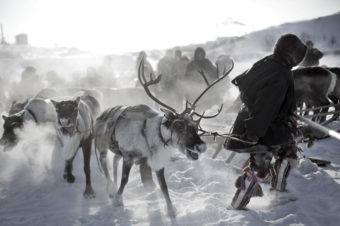
Nenet men hold a reindeer race. Photo by PW PIX/Getty Images)

There’s a heated debate in the Arctic Circle. It’s about reindeer. Lots of them.

Russian health officials want to cull a quarter million animals by Christmas, The Siberian Times reports. That’s enough reindeer to fill about 400 Olympic-sized swimming pools.

The announcement comes on the heels of three anthrax outbreaks in western Siberia this summer, caused by “zombie” bacteria brought back to life from thawing tundra.

A heat wave struck the region. The record-breaking temperatures melted deep layers of permafrost. And reindeer carcasses — infected with the deadly bacteria — rose to the surface of the thawing mud. It spread across the tundra via contact with people, animals and wind.

About 100 people were infected. One boy died. And officials euthanized more than 2,300 reindeer.

Now officials say they need to kill hundreds of thousands of animals to keep the reindeer from amplifying future anthrax outbreaks.

“The more dense the animal population is, the worse the disease transfer medium [and] the more often animals get sick,” Nikolai Vlasov, deputy head of Russia’s Federal Veterinary and Phytosanitary Surveillance Service told The Siberian Times.

But when you dig just beneath the surface of these official statements and headlines, you’ll find there’s something else at stake: “One of the most vibrant cultures in the world,” says Florian Stammler, an anthropologist at the University of Lapland.

The Nenets may be the last group of people on Earth who herd and raise reindeer in the ancient nomadic way, says Stammler.

“The entire household is nomadic,” he says. Mom, dad, babies — even dogs — all live in handmade tents and move their households hundreds of miles across the tundra each year so their reindeer can graze. The families live off reindeer meat and hides, but they also use the animals to haul their households to new grazing locations.

“The Nenets have preserved all their beautiful traditions,” Stammler says. “They sew their own clothes, tents and build their own sledges.”

At the same time, they are very modern. “They have GPSs, the best bobsleds in the world and iPhones,” he says. “But they’ve made a conscious decision to not give up their nomadic lifestyle.”

Now, Stammler says, if the Russian government does indeed kill 250,000 reindeer, some families will be left with too few animals to haul their household across the tundra.

“When you deprive these people of their means of movement, they have to settle and find another way to make living,” he says.

On the surface, it looks a bit like the Russians may be trying to get the Nenets to settle down.

One of the government policies under consideration calls for giving herders “affordable mortgages” on apartments in exchange for handing over their reindeer for culling, The Siberian Times reports.

“It’s a logical plan,” Stammler says. “but it induces people to get rid of their reindeer so they can’t move anymore.”

There’s no question the reindeer population is larger than it’s ever been in the Yamelo-Nenets region — where the Nenets live.

“Herds have swelled since the 1920s until now,” says Bruce Forbes, an ecologist at the University of Lapland. “There’s been only one dip in the population. That was during World War II when the animals were used as food.”

Today there are more than 700,000 animals grazing in the Yamelo-Nenets. Russian officials say the area should have about half as many animals. They say large herds are damaging the ecosystem. They’re overgrazing and leaving the land vulnerable to erosion. They’re also trampling on — and killing — lichen that grow across rocks at higher elevations.

But Forbes says all these ideas are speculation at this point. “When we actually look at aerial photos of the area, the data show that parts of the Yamal Peninsula aren’t being grazed enough,” he says.

Some areas have tall shrubbery that are getting taller and taller, faster and faster, he says. “Reindeer have grazed on the shrubs but not enough to keep them close to the ground.” And the total area of sandy, overgrazed areas hasn’t expanded since the 1960s, Forbes says.

So before we draw conclusions about the reindeer’s effects on the land, Forbes says, scientists need to figure out really what’s going on ecologically — and whether a massive culling will indeed help curb future anthrax outbreaks.

“Let’s avoid short-term decisions based on questionable data that will affect tundra nomads for decades to come, perhaps permanently,” Forbes wrote in a comment on The Siberian Times website.

Copyright 2016 NPR. To see more, visit http://www.npr.org/.

Judge reverses House District 40 primary, gives Nageak a two-vote edge

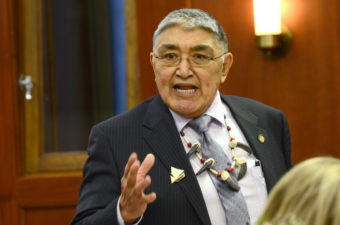
Rep. Benjamin Nageak speaks on the House floor, Jan. 21, 2014. (Photo by Skip Gray/Gavel Alaska)
Rep. Benjamin Nageak speaks on the House in 2014. Superior Court Judge Andrew Guidi’s decision puts Nageak two votes ahead of Dean Westlake in the House District 40 Democratic primary. (Photo by Skip Gray/360 North)

A judge on Thursday reversed the outcome of the Democratic primary for the House district that includes the North Slope and Northwest Arctic boroughs.

Superior Court Judge Andrew Guidi ordered the Division of Elections to certify that incumbent Benjamin Nageak of Barrow won the primary over Dean Westlake of Kotzebue by a two-vote margin.

The outcome of the primary could determine who organizes a House majority. While both are Democrats, Nageak caucuses with the Republican-led House majority, and Westlake said he’ll caucus with the Democrats.
The decision reverses the outcome of a recount, which had Westlake winning by eight votes.

Nageak, who is the co-chairman of the House Resources Committee, expressed relief.

“I’m pleased by the court’s result and hopeful it will be sustained during the appeal to the Supreme Court,” Nageak said. “I’m sure that’s where it’s going to go. And I hope this decision will result in improvement of training.”

The outcome hinges on the Kobuk River village of Shungnak, where local election officials wrongly allowed 50 voters to cast ballots in both the Republican primary and in the “ADL”  primary for the Alaska Independence, Democratic and Libertarian parties.

Westlake led Nageak in Shungnak, 47 votes to three, after the recount but before the decision.

Judge Guidi decided to subtract votes, based on the average number of Shungnak residents who voted in Republican primaries over the past 10 years.

Guidi subtracted 12 votes based on the idea that they would have voted Republican. He took away 11 votes from Westlake in Shungnak, as well as one from Nageak. He also decided that election officials wrongly allowed both candidates to gain one vote from Kivalina in the recount.

Westlake, who was out fishing, couldn’t be reached for comment.

His lawyer Thomas Amodio said no votes should have been subtracted.

“In our view, all of them qualified,” he said. “None should be disenfranchised. There’s no evidence that any of them would have voted in anything but the ADL primary. Especially with a very contested, close race.”

Amodio argues that the competitive Democratic House race gave Republican voters more of a reason to cross over in the primary than they had in previous years, when there were more competitive Republican statewide races.

Amodio says Guidi’s decision effectively disenfranchises voters in a village that’s 95 percent Alaska Native.

“By his calculations, he’s casting those aside,” he said. “You know, he’s the judge. He gets to decide that. Now, the Alaska Supreme Court gets to decide whether he was right or wrong.”

Under Guidi’s decision, the final outcome would be 815 votes for Nageak, 813 for Westlake.

The winner will take the seat, since there are no general-election opponents.

Nageak said the small margin reinforces the importance of every voter.

“Every vote counts,” he said. “We’ve been saying that for years. And it was borne out.”

Lt. Gov. Byron Mallott, who oversees elections, said in a statement that officials are “disappointed that the Superior Court ruled that a poll worker error in Shungnak was sufficient to change the outcome” of the primary.

He added that they want “absolute clarity” on the issues involved and will follow whatever measures the Supreme Court deems appropriate to secure a fair election.

Division of Elections Director Josie Bahnke has said the division will use this year’s primary experience to improve how the state trains election workers.

The Supreme Court asked lawyers for Nageak, Westlake and the state to file briefs by Saturday, Oct. 8.

Oral arguments will be Wednesday, Oct. 12.

And the Court is expected to rule by Oct. 14, to give elections officials enough time to distribute ballots for the Nov. 8 election.

Will Obama look north for his legacy?

These are the days when a president turns to thoughts of legacy.

As the months tick down on this administration, President Barack Obama has created a marine national monument off new England and last month vastly expanded one near Hawaii.

Alaska interest groups are working to get his attention, too.

Some want him to take bold action in the 49th State before he leaves office, and others are urging him to resist those calls.

A TV ad ran in Washington, D.C., this month that flashed footage of oil tankers bathed in the golden light of a Valdez sunset, an offshore drill rig and Alaska Natives on the tundra.

Its call to action: “Tell the White House to keep the Arctic in the next off shore leasing program. It’s the right thing for Alaska. It’s the right for our nation.”

That’s part of a six-figure ad campaign by a coalition that includes the Alaska Oil and Gas Association, Arctic Slope Regional Corporation, unions and the Independent Petroleum Association of America.

They took out a full page ad in the Washington Post, too.

Meanwhile, environmental groups are working just as hard to make sure Obama knows how much they want the Arctic ocean tracts removed from the off-shore leasing plan, due out this fall.

That’s one way the president might choose to leave his mark on the 49th state.

Or he could do something really dramatic, like use his powers under the Antiquities Act to declare a national monument in Alaska, or off its shores.

Sen. Lisa Murkowski dreads a White House announcement like that, which she believes would diminish Alaska’s opportunities.

“We’ve seen some indication that he doesn’t plan on any ocean protection designation,” she said. “But until we’re on the last day of the administration, I’m not going to rest and believe that’s the case.”

Some Alaskans, though, are hoping Obama will help them preserve their marine environment, in ways short of monument status.

Austin Ahmasuk of Nome is trying to marshal federal and local support for a presidential order about managing the Bering Strait. Locals are especially concerned about increased pollution from ship traffic, said Ahmasuk, a marine advocate for Kawerak, the Native non-profit for the Bering Strait region.

“At each point that our tribes have considered the north Bering Sea and climate change and shipping, we’ve asked – basically pleaded – with the Coast Guard that no discharges occur,” he said.

Ahmasuk says they’re still working an executive order they’d like the president to sign, and still gathering local support, although they started quite a while ago.

“At that time we thought, ‘Oh my gosh, there’s virtually no time with this president.’ This is two years ago,” he said. “And now here we are in 2016 and we think we have, of course, even less time now.”

Another person feeling deadline pressure is Pat Pletnikoff, the mayor of St. George, one of the Pribilof Islands in the Bering Sea. He does not want a presidential order, but he’d like to see the waters around St. George protected. Pletnikoff said St. George is witnessing some upsetting changes, like the loss of vast bird populations.

“You know, we see a lot of seals on our rookeries at St. George Island dead. And they’re dying because they’re probably starving,” he said, adding that they’d need more research to know for sure.

Pletnikoff is wary of opposition from the fishing industry, so he wants to nominate St. George for possible designation as a marine sanctuary. That’s a public process that can take years. Pletnikoff says it would be more transparent.

“We’re not looking to close of lots of areas of sea to non-fishing,” he said. “What we want to do is start to understand what it is that the fur seal population and the sea bird population require in the way food in order to thrive.”

Though he isn’t asking for an executive order, Pletnikoff has taken his case to the White House, to Obama’s top Arctic advisor.

Pletnikoff knows this is a critical time for marine conservation.

“A lot of folks talk about the fact that perhaps the president would like to leave a legacy,” the mayor said, “and they’ve already done that significantly in the Hawaiian area and that there might be some need or desire on the part of the president to do the same thing in Alaska, because he’s the first sitting president to visit north of the Arctic Circle, in Alaska.”

If Obama is planning to declare any monuments in Alaska, or off Arctic shores, then he’s keeping his cards close to his vest.

Bureau of Land Management Director Neil Kornze recently told Murkowski, at a committee hearing, that he does not know of any planned monuments in Alaska. But, he added, he’s not privy to the president’s thoughts.

Reykjavik Turns Off Street Lights To Turn Up The Northern Lights

On Wednesday evening, the city of Reykjavik, Iceland, turned off street lights and encouraged people to darken their homes so that everyone could watch the northern lights.

The city council released a statement saying street lights would be turned off in multiple sections of the city between 10 p.m. and 11 p.m. local time and warning people to drive carefully.

The city of about 120,000 people, which is located just below the Arctic circle, prides itself on its frequent shows of the aurora borealis. The blackout attempt appeared justified — photos and videos posted to social media by people in Reykjavik showed dancing lights against a mostly dark sky.

Although it is a small city, light pollution from Reykjavik is visible in past photos of the northern lights, appearing as an orange or pink glow at the horizon.

The Icelandic news outlet The Reykjavik Grapevine reported that the lights stayed off until midnight to accommodate a late start by the solar system, and that some people were initially annoyed when the green glow didn’t appear on schedule.

The northern lights are routinely visible in the circumpolar region, sometimes even well below the Arctic circle. The same solar activity that led to the intense lights over Iceland are creating good conditions for the aurora borealis over much of Alaska, where the forecasted likelihood of northern lights tonight is high.

Copyright 2016 NPR. To see more, visit http://www.npr.org/.

Luxury cruises don’t signal Arctic shipping boom, expert says

The company that sent the first big luxury cruise ship through U.S. and Canadian Arctic waters is preparing the Crystal Serenity for a repeat performance in 2017, but one expert believes this year’s historic transit doesn’t mean the Arctic is likely to become a hotspot for global shipping anytime soon.

The hoopla over the luxury cruise ship Crystal Serenity’s arrival in New York on Sept. 16 after a 32-day voyage from Alaska through the Arctic has died down a bit.

Crystal Cruises’ CEO and President Edie Rodriguez still was enthusiastic last week as she described what she said was a smashingly successful cruise.

“By every standard,” Rodriguez said, “a monumental success!”

Coast Guard passenger-vessel safety specialist Cecil McNutt agreed – at least, to the extent that nothing bad happened.

“It pretty much went without a hitch,” McNutt said.

Rodriguez said it all went off so well the company is well under way in preparing the 1,000-passenger Crystal Serenity’s second cruise next year on the same route.

“It was so popular that we are doing it again,” Rodriguez said.

It would’ve been unthinkable until now for a big luxury cruise ship like the Crystal Serenity to transit formerly ice-choked Arctic waters, especially the Northwest Passage.

A steady decline in Arctic sea ice due to the warming climate has made it possible.

Still, sea-ice conditions in the Arctic have always been unpredictable, which is why the company went to such lengths to prepare for the cruise, including lengthy consultations with U.S. and Canadian coast guards.

But McNutt said ice wasn’t a problem this year.

“I got some reports from the ship itself that showed that the vessel was sailing basically in pretty much ice-free conditions,” McNutt said.

In fact, one of the ship’s passengers told a reporter they spent much of their voyage looking for sea ice, instead looking out for it.

One of the predictable things about the Arctic is that conditions there are unpredictable.

McNutt said that’s why rough weather that set in late last month forced the Coast Guard relocate an evacuation site that was to be used in a big field-training exercise held to practice rescuing passengers from a cruise ship that runs into trouble in waters off Alaska.

“I guess the one lesson learned is that Mother Nature always rules,” McNutt said.

And that, said Arctic maritime expert Lawson Brigham, is why the Crystal Serenity’s voyage does not necessarily signal the beginning of boom in cruise tourism or other kinds of shipping in this part of the circumpolar north.

Arctic sea ice has receded enough in late summer for cruise ships and other vessels to take advantage of the open water, Brigham said. But for the rest of the year, it’s as difficult and expensive to operate in the region as it’s always been.

“The challenge for using the Arctic Ocean for navigation is that it is, in fact, ice-covered,” Lawson said. “It’s ice-covered partially or fully likely nine months out of the year, through (the end of) the century.”

Brigham is a distinguished professor of geography and Arctic policy at the University of Alaska-Fairbanks, and a retired Coast Guard officer with years of experience serving in the Arctic.

He thinks despite all the talk of a shipping boom in the Arctic Ocean brought on by receding sea ice opening up more shipping lanes, the law of economics make that unlikely.

“It is all about economics,” he said.

Brigham said the only type of shipping that’s likely increase in the near future is the kind that brings raw materials out of the region that have become more accessible by receding sea ice.

“The biggest increase in traffic will be the movement of natural resources out of the Arctic to global market,” Brigham said.

Brigham thinks that kind of shipping isn’t likely to increase much on this side of the Arctic until global prices rebound for such commodities as iron ore, nickel, copper and hydrocarbons.

And even then, he expects the shipping lanes on the Eurasian side of the Arctic Ocean will be busier because there’s generally less sea ice along that coastline and because nations there have for decades been building up their shipping and industrial infrastructure.

“Where is offshore development? Where is hydrocarbon development? In the Norwegian Arctic right now and in the Russian Arctic – not in our Arctic and not in the Canadian Arctic,” Brigham said.

Brigham said receding sea ice may open shorter Arctic routes that may enable ships to get their goods to market more quickly. But that’s not guaranteed, due to weather and other uncertainties that come with operating in the region. Those include a lack of up-to-date maps and hydrography of the continental shelves and Arctic Ocean floor.

Brigham he said recent expansions of the Panama and Suez canals and other facilities in the lower latitudes suggest investors aren’t likely to gamble big sums on the still-risky venture of Arctic shipping. At least, not yet.

As WRDA bill passes in Senate, Nome Arctic deep draft port back in conversation

With U.S. Senator Dan Sullivan’s help, the Water Resources Development Act has passed the U.S. Senate, inching Nome closer to the possibility of an Arctic deep draft port.

The act will bring $1.4 billion dollars to new water infrastructure over the next five years.

The funding is focused in three areas: infrastructure, subsistence harbors, and an Arctic deep draft port.

Working with the Tribal Health Consortium, the act’s focus on infrastructure places grant money in villages that do not have basic drinking water or wastewater services.

The money also will help communities whose water systems are below health standards.

The Army Corps of Engineers will conduct a feasibility study for an Arctic port. That study was put on hold after a period of instability, including an economic loss after Shell’s withdrawal from the Chukchi Sea.

Sullivan said this study will be look past economics.

“National security, search and rescue, oil contamination cleanup: all of these things need to be factored in when the Corps is looking at the importance of these issues,” Sullivan said.

Little Diomede will be given money to build a harbor.

The Water Resource Development Act also allows small regional benefits to be taken into consideration for coastal communities looking to justify the construction of smaller subsistence harbors.

From this point, the bill goes on to the House, and if passed, will be signed into effect.

Currently, more than 30 Alaskan communities do not have access to water or wastewater services.

Site notifications
Update notification options
Subscribe to notifications