Arctic

Q&A: Polar architect designs for extreme environments and climate change

A renowned contemporary architect is touring Alaska this week.

Hugh Broughton spoke at the Alaska Design Forum in Anchorage and will lecture in Juneau before giving the keynote address at the American Institute of Architects’ Polar Futures forum in Fairbanks on Friday.

He’s considered one of the world’s leading designers of research facilities in Polar regions.

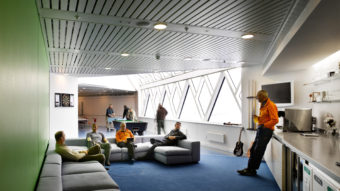
Broughton and his UK-based team of architects just finished the space-age Halley VI for the British Antarctic Survey.
It was a challenging project. The ultramodern modular series of buildings sit atop the Brunt Ice Shelf which moves about 1,300 feet a year.

Broughton’s team designed a facility that can be relocated inland, climb above the area’s rising snow levels and minimizes environmental impact.

Now, he’s on a whirlwind tour of Alaska. He sat down to talk about the demands of building in some of the harshest climates on Earth and how those demands have changed with the climate.


Q: How long have you and your firm been doing this kind of work?

So we started in 2005 when the British Antarctic Survey organized a competition to find a designer for their Halley VI Antarctic Research Station. Actually at that point the largest building we had designed as a practice, was a 1,600 square foot building for Girl Guides in the center of London. But, I never let on about that until after we’d finished the Antarctic Research Station.

Q: What made you guys decide to jump into — I mean that’s an extreme project — what made you think, I can do this?

I have just always loved the natural world. And I thought to myself, well I probably don’t stand much of a chance winning but it had the promise of some fantastic photographs of penguins and ice and I just thought, I’ll go along just for those.

Q: Can you talk about the technical hurdles of building in polar and Arctic regions?

Each situation is quite particular. As it happens the British base is in a very dynamic location. Because it’s on what’s called a floating ice shelf which is where the ice has flowed off the main continent of Antarctica and is actually supported on in this case the Weddell Sea underneath.

And the ice is moving at quite some speed, it’s around 1,500 foot per annum. It was even faster. The ice is around 500 feet thick and every now and then it breaks off as a giant iceberg.

Of course, after that, it’s very cold. I guess you wouldn’t necessarily think it that cold here but it’s at least -50. It’s very windy. There’s winds in excess of 150 miles an hour. And every winter the sea ice freezes to up to 600 miles out from the coast of the Antarctic so it’s very isolated as well.

Q: How has climate change influenced your designs?

I think one of the things I’ve learned about the process of working on designs for polar research stations is issues related to global warming are incredibly complex and rely on changes to do with weather systems, sea currents and so on.

So interestingly, for example in the east Antarctic, you might see temperatures fairly stable and in some cases getting colder. Whereas in the west Antarctic and the Antarctic Peninsula temperatures are rising at a scary rate.

Unfortunately, you then go to the Spanish base. And you can see there when we were digging for example the foundations. Remember we’re in Antarctica here, but no permafrost. 

Similarly we find in the water production for that Spanish base that you’re having to be much more diverse in the ways in which you can get water for the residents. And I think it’s particularly in areas like water production that small communities in cold and remote places are going to see significant change taking place.


Broughton said his team is interested in building in extreme environments all over the world. He says many of the sustainable design principals they’ve used in polar facilities can be applied in other smaller communities or in urban areas.

Running for U.S. House seat, Lindbeck says diversifying Alaska’s economy a key issue

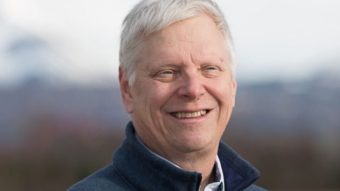
Democrat Steve Lindbeck is challenging incumbent Republican Don Young for Alaska’s lone seat in the U.S. House of Representatives. (Photo courtesy Lindbeck for Alaska)

Democratic candidate for the U.S. House of Representatives Steve Lindbeck was scheduled to be in Wrangell on Saturday, but fog prevented him from making one of his final Southeast campaign stops.
The former public radio executive officially announced his candidacy in May, hoping to unseat Republican Rep. Don Young, the Alaska Dispatch News reported.

Lindbeck spoke with KSTK by phone.

One of Lindbeck’s key issues is diversifying Alaska’s economy.

He said developing the arctic is one way the federal government can spur development and help the state’s economy.

“We really should approve the law of the sea treaty because that will clarify boundaries and authorities as exploitation of minerals and fisheries takes place,” Lindbeck said. “There’s just a tremendous amount of opportunity and risk that comes with the way this place is opening up, and we are not prepared as a country today.”

Lindbeck said building a deep-water port is one the key infrastructure components needed, as well as greater Coast Guard coverage.

He promotes exploring for resources in the Arctic National Wildlife Refuge before making decisions on its development.

Lindbeck also supports Gov. Bill Walker’s push to build a natural gas pipeline.

Lindbeck argues he would be a strong advocate for transboundary mining issues in Southeast and would like to see the International Joint Commission become involved. That’s a U.S.-Canada panel that handles transboundary water issues.

“The State Department needs to push hard. The IJC obviously addresses this in other places and needs to do so here. We need to get President (Barack) Obama and Secretary (John) Kerry and President (Hilary) Clinton – presumably going forward – to stay after this problem,” Lindbeck said. “I think it’s probably a good idea to have a moratorium on approval of new Canadian permits until the government in British Columbia sort some of the recommendations.”

Among other Southeast issues, Lindbeck said the Tongass should be able to supply timber for at least one mill, while protecting fisheries in the region.

He said Alaska becoming exempt from the “roadless rule” would be one way of opening up logging lands.

The federal regulation set aside millions of acres of forest across the country. The U.S. Supreme Court declined to hear the state’s case for an exemption in March.

Lindbeck also said the proposed Alaska Mental Health Trust land exchange would be good for the state.

That’s been a contentious issue in Southeast.

If Congress doesn’t approve the exchange by January, then Mental Health wants to log Ketchikan’s Deer Mountain and land above Mitkof Highway in Petersburg.

Other issues Lindbeck is pushing for are broadband infrastructure expansion and legislation allowing college students to renegotiate loan debt.

Linbeck’s campaign said it will focus on Anchorage and Fairbanks voters leading up to Election Day.

Libertarian Jim McDermott and independent candidate Bernie Souphanavong also are  running against Republican incumbent Don Young.

As Climate Changes, Meteorologists Relying Less on ‘Using the Past to Inform the Future’

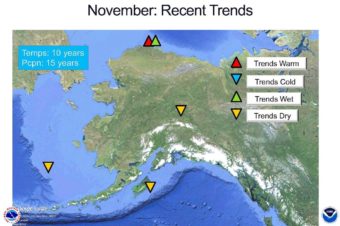
The National Weather Service has kept records for than a century on Alaska's weather, but Thoman relies on more recent trends for his 2016-17 winter forecast: the past 10 years of temperature data and 15 years of precipitation data. The data suggest there will be less precipitation next month in the Interior but more along the Arctic Ocean coast, and warmer temperatures..
The National Weather Service has kept records for than a century on Alaska’s weather, but Thoman relies on more recent trends for his 2016-17 winter forecast: the past 10 years of temperature data and 15 years of precipitation data. The data suggest there will be less precipitation next month in the Interior but more along the Arctic Ocean coast, and warmer temperatures.
(Courtesy National Weather Service)

National Weather Service meteorologist Rick Thoman predicts more snow, more cold snaps – more normal winter weather – in Alaska this year now that the El Niño phase that helped make last winter so mild has moved on and been replaced by a La Niña.

At least, that’s what’s happened in previous years. But he says climate change has made forecasting in the Arctic more challenging.

“Well, that is the big problem with using the past to inform the future,” Thoman said.

Experts such as John Walsh, chief scientist with the University of Alaska Fairbanks’ International Arctic Research Center, say climate change always must be taken into consideration when analyzing weather in the far north.

“No weather event is completely independent of climate change,” Walsh said in an interview last year.

Thoman says the weather service has pretty good data collected over the past 65 years on the so-called Pacific Decadal Oscillation, or PDO, cycle that drives El Niños and La Niñas.

But he says meteorologists are relying on data from recent years because climate change is a more recent phenomenon that’s made older data, collected before the Arctic began to warm so quickly, less relevant.

Thoman's "mid-winter" forecast, for November through January, also is based on more recent temperature and precipitation data. It calls for above-average snowfall in the Interior and continued above-average temperatures and snowfall along the Arctic Ocean coast.
Thoman’s “mid-winter” forecast, for November through January, also is based on more recent temperature and precipitation data. It calls for above-average snowfall in the Interior and continued above-average temperatures and snowfall along the Arctic Ocean coast.
(Courtesy National Weather Service)

“So it does shorten our record, and that’s bad, because then we wind up with fewer, say, La Niñas winters to develop these kinds of averages,” he said. “But the tradeoff is that we’re not including winters that are not really appropriate for what we have today.”

The size and location of a large body of warm water in the equatorial Pacific Ocean drive the transition from El Niño to La Niña. And Thoman says researchers are studying other phenomena that occur in lower latitudes that may play a role in La Niña. But he says in the Arctic, it’s the local factors that exert a more powerful influence on the region’s weather.

“The changes are happening so fast in the Arctic – with sea-ice loss, with increased time of no snow cover – that that’s really the driving feature. And the lower-latitude factors are being swamped those big cryosphere changes,” he said.

And because sea ice is sparse around Alaska, and snow comes later and melts sooner, Thoman says this winter is likely to be cooler and snowier than the past few winters. Still, he says it’ll be a relatively mild winter, compared with La Niña winters of years past, because the climate overall is warmer now.

No El Niño, but sparse sea ice, warm ocean water could mean near-normal 2016-17 winter

A year ago, National Weather Service meteorologist Rick Thoman and many other forecasters and climate researchers knew the winter of 2015-16 was going to be a warm one.

“We had warm sea-surface temperatures all around Alaska in the late fall,” Thoman said. “We had below-normal sea ice. And we had a strong El Niño.”

So, prognostications of the warm Arctic winter to come last year may be in hindsight as close to a no-brainer as it gets for the complex science of weather forecasting. And sure enough, the winter was the warmest on record, warmer than the previous record-setting winter and the unusually warm 2013 season.

A graphic of sea-surface temperatures, or SSTs, around Alaska shows some cooling over the past month in the Gulf of Alaska, but not so much in the Bering Sea. The scale at right shows the temperature-difference anomalies, compared with the norm, in Celsius.
(Public Domain image courtesy of the National Weather Service)

“Last year was pretty easy,” he said. “The climate dice were all loaded toward warm for Alaska.”

But not so this year, Thoman says, largely because the warm-weather-inducing El Niño has faded away and been replaced by a quirky La Nina.

“This year,” he said, “I’m going to have to work for my forecast.”

Thoman says La Niñas generally portend a cooler winter for Alaska, south of the Brook Range, and more precipitation for areas along and near the coasts. But he says that tendency is going to be somewhat moderated this winter, because a couple of factors left over from last year.

“We have continued warm sea-surface temperatures near Alaska, both in the Gulf of Alaska and in the Bering Sea,” Thoman said. He added the seawater isn’t quite as warm as last fall, especially in the Gulf of Alaska. But as for the other factor …

“We have even less sea ice near Alaska than we had last year, at this time.”

Sea-ice extent is one of several factors that climate scientists consider when formulating forecasts. There's less sea ice around Alaska than there was a year ago, but Thoman predicts the winter of 2016-17 will be cooler overall than last winter, largely due to the influence of a La Niña phase that's replaced the El Niño that helped make last winter the warmest on record in the Arctic.
Sea-ice extent is one of several factors that climate scientists consider when formulating forecasts. There’s less sea ice around Alaska than there was a year ago, but Thoman predicts the winter of 2016-17 will be cooler overall than last winter, largely due to the influence of a La Niña phase that’s replaced the El Niño that helped make last winter the warmest on record in the Arctic. (Public Domain image courtesy of the National Weather Service)

For those reasons, Thoman predicts the coming winter in the Arctic will be a bit warmer than normal – both here in Alaska and elsewhere around the region. But he concedes that forecast is mainly based on data from the past few decades when the circumpolar north began to warm at an extraordinary rate.

“Because conditions now are so different than they were, say, in the 1950s and ’60s, we don’t include those older (data), and start, say, in the mid-70s” for a more relevant set of data.

Next week: The challenges of Arctic weather forecasting in a warming climate.

Editor’s note: More information about climate change impact on Alaska is available through the Alaska Center for Climate Assessment and Policy.


Juneau beats Fairbanks to first snowfall for first time in 70+ years

Snow covers Mount Juneau, Sunday, Oct. 16. (Photo by Tripp Crouse/KTOO)

National Weather Service meteorologist Edward Liske said this season is the first-time Juneau has seen measurable snowfall before Fairbanks since about 1940.

The National Weather Service reported Sunday that Juneau is one of the first communities in the state to see measurable snowfall this year.

“Fairbanks has not seen any snow yet so far this season, neither has Anchorage. Nome has had zero. Kotzebue has had zero,” Liske said. “The only place that really has had measurable snow this season has been Barrow with a tenth of an inch so far.”

Liske said Juneau has seen snow earlier in the past. In 1974 and again in 2000, Juneau saw its earliest snowfalls on Oct. 2.

This year, Liske said Juneau saw 2 inches of snow in downtown Sunday, 5 inches near the airport and 8-9 inches at the National Weather Service Forecast Office in the Mendenhall Valley.

The precipitation started as a sudden mix of rain and snow that hit Juneau on Saturday, interrupting what Liske called unusually warm conditions.

“As we started getting heavier and heavier rain, or heavier and heavier (precipitation), it just made the surface temperatures colder and colder to the point that the rain changed over to snow during Saturday evening,” Liske explained.

But, he said the snowy weather was short-lived. It was already reverting to rain Sunday evening.

He predicted Juneau will continue to see warmer and rainier weather through the rest of the week, and the snow will most likely melt.

Before the early snowfall, Liske said an area of high pressure called a ridge surrounded much of Interior Alaska and the Gulf of Alaska giving Juneau uncharacteristically dry October weather.

“That ridge has actually been deflecting a lot of our storm systems that we usually see farther south,” Liske said.

“The storms that the Pacific Northwest has been seeing over the last several days (are) basically those storm systems that have been deflected farther south.”

He said that ridge has mostly collapsed.

Liske also said this entire year has been much warmer than usual for Juneau.

That plus this month’s earlier dry weather, and this most recent early-season snowstorm, has led him to conclude: this year has been “odd to say the least.”

Russian aggression unlikely to hit Arctic, security experts say

Russia is antagonizing the U.S. on multiple fronts these days, in Europe, in Syria and in cyberspace, if claims prove true that Moscow is behind some high-profile email hacks.

But in the Arctic, Russia is still playing nice, one conclusion a panel of national security experts made at a Washington, D.C., briefing Thursday.

Russia has certainly built up its military on its side of the Arctic.

It has installed or refurbished Arctic bases, enlarged ports and built new airfields.

“But the fact is there’s really no evidence of aggressive intent by Russia,” said Julia Gourley, the senior Arctic official at the State Department.

She says it appears Russia is gearing up to protect its economic interests. (It has offshore oilwells.)

“Frankly, all countries would do the same,” she said at a Capitol Hill briefing for Congressional staff.

Warnings of a massive Russian land grab have been circulating since 2007, when a Russian submarine planted a flag on the Arctic seabed, at the North Pole.

Russia has submitted a claim to a U.N. commission for more Arctic territory, based on how far it says its continental shelf extends into the ocean.

The documents aren’t public, but Gourley said the State Department believes Russia did not make an outlandish claim.

“In determining its outer limits of the continental shelf, so far there are no overlaps with the United States, from what we know of its submission,” she said.

The U.S. is still mapping its continental shelf in the Arctic.

John Pendleton, a military expert at the Government Accountability Office, agreed: It’s likely Arctic warfare is NOT on the horizon.

The Department of Defense “has assessed the threat of military conflict – we have it from several sources – is low in the near term. Armed conflict,” he said.

Sherri Goodman sounds more wary.

A former Pentagon official and now a think-tank fellow at the Woodrow Wilson International Center said the U.S. needs to assert its military presence in the Arctic and remain alert for changes in Russia, for signs it may be “resurgent” in the north, as it is elsewhere.

“I agreed that today we are not facing those challenges in the Arctic, with Russia,” she said. “But we’ve got to operate up there with eyes wide open.”

All the panelists concurred on the need for more icebreakers and for Arctic ports.

They were speaking to a room full of Congressional aides, the people who work for the people who could fund such projects.

Site notifications
Update notification options
Subscribe to notifications