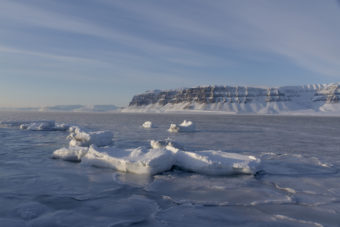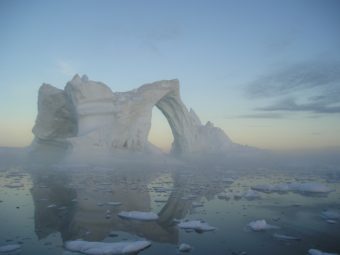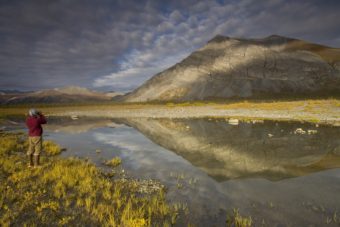
Scientists released this year’s so-called Arctic Report Card on Tuesday, and it is a dismal one.
Researchers say the Arctic continues to warm up at rates they call “astonishing.” They presented their findings at the American Geophysical Union’s fall meeting in San Francisco.
“The Arctic as a whole is warming at least twice as fast as the rest of the planet,” says Jeremy Mathis, climate scientist at the National Oceanic and Atmospheric Administration and one of the report card’s authors.
The cause of the warming is in part due to a feedback loop unique to the Arctic’s northern climate. Normally, the region stays cool because snow and ice reflect a lot of sunlight back into space. But warmer temperatures are melting that snow and ice. The melting snow exposes darker ground and water that absorb more of the sun’s heat. That makes the Arctic warm up even faster.
Mathis adds that the warming is getting progressively worse.
“The Arctic is getting persistently warmer; sea ice is continuing to show declines, particularly during the summer months,” he says. “The second big story for 2016 has been the winter temperatures.”
Mathis says it wasn’t so long ago that the temperature in Fairbanks, Alaska, where he lives, would drop to minus 40 F for weeks at a time in the winter.
“Now since about 2012 and 2013, it’s pretty rare for the temperature to even hit minus 40 in Fairbanks,” he says.
Warmer winters have created what polar scientist Marco Tedesco calls a new “precondition” for a higher rate of melting in the spring, when the sun first rises, ending the dark Arctic winter.
“You change the physics of the snowpack so that snow becomes more vulnerable to melting as soon as the sun comes up,” he says.
Tedesco, from the Lamont Doherty Earth Observatory in New York, says polar regions are not as resilient to warming as other places. That’s because it takes only one or two degrees to change the Arctic from a frozen world to an unfrozen — and very different — one.
“In other places, going from 75 F to 80 F might not make such a great difference,” he says. “But if you cross the melting point, you are basically stepping into a completely new world.”
Copyright 2016 NPR. To see more, visit http://www.npr.org/.
The coastal plain of the Arctic National Wildlife Refuge ranks as one of the most controversial chunks of land in Alaska. Since Congress set it aside for more study in 1980, environmental groups, politicians and industry have battled over whether to explore for oil there or to protect the wilderness forever.
Video: Natalie Carrasco, Eric Keto, Elizabeth Harball
Music: Garrett Bevins
Additional Footage: U.S. Fish and Wildlife Service
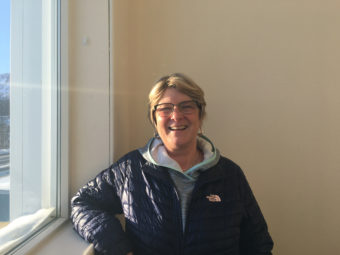
Former state Rep. Beth Kerttula served as the National Ocean Council director for two years. She said marine planning is important. (Photo by Andrew Kitchenman/KTOO)
Former Juneau state Rep. Beth Kerttula returned to Alaska this summer after two years serving the White House as director of the National Ocean Council.
In this position, she helped two regions write the country’s first marine plans, and worked on some issues particularly important to Alaskans.
Kerttula said it’s important to plan for the future of the oceans that surround Alaska and the rest of the United States. She said just as people can have personal trauma when they don’t plan for their future, the U.S. oceans could face disaster.
“If you aren’t planning where your ship lanes are, if you’re not planning around the sea mammals, if you’re not planning so that you can have development, then you’re going to have a mess at some point,” she said. “And you’re going to have conflict between subsistence users, between the developers.”
The attraction of making a difference for the future of the oceans is why Kerttula left the Alaska House of Representatives in 2014, after 15 years.
The Juneau Democrat served as the minority leader for her last seven years in the House.
She spent six months at Stanford University’s Center for Ocean Solutions before she joined the National Ocean Council. President Barack Obama formed the council under an executive order in 2010. Kerttula explained why he did it.
“It’s a huge challenge right now with the ocean,” she said. “We’re facing some very severe problems: ocean acidification, erosion, sea-level rise, the lack of coordination among users, the lack of coordination among the federal agencies. And all of those things are really coming to a head.”
The National Ocean Council includes 27 federal agencies.
Kerttula worked with officials in all of the agencies to plan with state and tribal governments. The council adopted the first two marine plans on Dec. 2, covering the waters off of the Northeast and Mid-Atlantic.
She said planning is especially important for Alaska.
“We have so many conflicts,” she said. “And we have worse problems on the horizon, particularly in our ocean space. And this is just a really wonderful method to put all of the users, the stakeholders, the federal agencies, the tribes, at the table.”
Along with resolving conflicts, Kerttula said, the focus on planning can provide more information about coastal waters, such as mapping the seabed.
“We know so little about the ocean floor. We don’t even have charts,” she said. “I mean, in many parts of Alaska, we don’t have accurate charting. So it comes down also to health and safety.”
Kerttula was also engaged in efforts to stop illegally caught fish from being brought into the country.
“One of the things that was very shocking to me when I went Outside, spent so much time Outside these last two years, was the problem with illegal fish, I mean, not knowing what fish you were even getting many times in restaurants,” she said.
Kerttula ended her work at the end of June. Since Obama launched the National Ocean Council with an executive order, President-Elect Donald Trump will be able to end it with a stroke of a pen.
That has Kerttula worried.
“My hope is that there won’t be knee-jerk reactions about overturning the executive order,” she said. “But there’s a lot of concern about it, and about what that would mean. If that happens, the effort’s not going to stop, because you need something like this.”
She’s taking some time off now that she’s returned to Juneau, helping her husband, University of Alaska Southeast Professor Jim Powell, and her elderly father, former state Sen. Jay Kerttula.
Hardcore science: Jason Fellman, research assistant at University of Alaska Southeast, opens one of the freezers containing snow and ice samples taken from the Juneau Icefield. (Photo by Matt Miller/KTOO)
Scientists this year started sampling the snow and ice above Southeast Alaska’s glaciers for the particles left from over from forest fires, diesel engines, and industrial activity. The particles of black carbon can accelerate warming of glaciers and the atmosphere.
The big question is: where does this carbon come from?
“That’s a core sample right here,” Jason Fellman said as he opened an upright freezer in a University of Alaska Southeast (UAS) research facility located off campus in Juneau. The freezer is filled from top to bottom with plastic bags, packed with about a liter of snow. A nearby chest freezer is partially filled with even more bags of ice and snow.
Fellman is a research assistant professor at UAS who studies how carbon flows through watersheds. He participated in the first-ever effort to sample black carbon from multiple locations on the Juneau Icefield, high above the Capital City.
In the early spring, Fellman and his colleagues took surface samples and dug snow pits down about a meter. That gave them an idea of how much black carbon had fallen with the winter and spring snowfall. They returned to the same sites in the summer to find out how much black carbon had accumulated without being deposited by precipitation.
Looking closely in these bags of snow, you can’t see the microscopic particles of black carbon, otherwise known as soot.
“Visually, it’s really hard to see and they’re pretty small, I think, for the most part,” Fellman said.
Black carbon sampling trip on the Juneau Icefield in May 2016. (Photo courtesy UAS)
Researchers traveled to ten sites on seven glaciers on the Juneau Icefield in 2016 to find traces of black carbon or soot. (Map courtesy UAS)
Researchers dug snow pits to sample black carbon that had accumulated with rain and snowfall on the Juneau Icefield over the previous few months. (Photo courtesy UAS)
Each of the snow pits dug during the sampling effort were about three feet deep. (Photo courtesy UAS)
Juneau Icefield black carbon sampling in May 2016. (Photo courtesy of UAS)
This snow and ice sample was taken from Eagle Glacier in July 2016. (Photo by Matt Miller/KTOO)
A second freezer contains even more snow and ice samples from the Juneau Icefield. These bags will be sent to laboratories where the black carbon will be separated from the snow and other matter, and then it will be analyzed. (Photo by Matt Miller/KTOO)
A helicopter was used to collect black carbon samples from ten sites on seven glaciers in a single day. (Photo courtesy UAS)
The total amount of black carbon in the atmosphere is still the subject of ongoing research and debate. But you probably see it in its concentrated form every day.
“If you look at the particulates coming out of a really dirty burning diesel engine like a truck, down the highway it accelerates and you see this black smoke coming out. That’s almost completely black carbon that’s coming out of that engine,” said Sarah Doherty, a senior research scientist specializing in atmospheric sciences at the Joint Institute for the Study of the Atmosphere and Ocean in Seattle.
Doherty said black carbon emissions are a public health issue. They’re also a major factor in climate change.
“We estimated it’s the second largest climate warming agent after carbon dioxide,” Doherty said. “It’s sort of on par with methane.”
But Doherty said you can’t just slow down the earth’s warming by removing black carbon from the atmosphere or all burning sources.
Surface samples were collected from the Juneau Icefield in July 2016 to determine how much black carbon or soot had been deposited without any precipitation. (Photo courtesy UAS)
“That component contributes a lot to climate warming. But you can’t just remove that component without removing other components that also affect climate,” Doherty said.
Any type of burning source also produces organic carbon and sulfates that may scatter light and cool the climate.
Doherty said black carbon particles do not break down in the atmosphere. But they’re also chemically inert, meaning they do not react with other substances.
“They also get incorporated in cloud droplets,” Doherty said. “So, they get washed out of the atmosphere in rainfall or snowfall.”
If any significant deposits of black carbon settle on snow and ice, Doherty said it could kick off more melting in a positive feedback loop.
“A sort of change in the evolution in the snow pack itself which, again, makes it less reflective, absorb more sunlight,” said Doherty. “Both of those contribute to the snow melting sooner. Once it starts melting, it gets even darker. It sort of accelerates the snow aging process.”
Sonia Nagorski, a UAS assistant professor of geology who helped with the sampling on the Juneau Icefield, said – despite their very small size – black carbon particles can retain additional solar energy as they settle on the snow and ice, and accelerate melting of glaciers.
“We saw small leaves on the snow. Just little translucent, brown leaves. Most of them were already sunk into the snow like a post hole,” Nagorski said. “Just showing how any kind of dark color absorbs more solar radiation, heat melts the bit of snow right around it. That’s sort of on a big scale what’s happening with black carbon particles.”
The UAS sampling project aims to answer two big questions: How is the black carbon affecting the melting of Juneau Icefield’s glaciers? And, is it coming from nearby in town or maybe from across the Pacific Ocean?
Once it’s determined exactly how much black carbon is being deposited, then UAS professor of environmental science Eran Hood said they can figure out how much – if at all – it’s affecting the icefield’s albedo, or how much solar energy is reflected back into space.
“What we’ve seen so far on the icefield are pretty low concentrations relative to other places on earth where they’ve measured this in Asia or the Pacific Northwest or things like that where there are more localized sources than we have here,” Hood said.
UAS black carbon sampling on the Juneau Icefield in July 2016. (Photo courtesy UAS)
The black carbon will also be radiocarbon dated to give a rough idea of its age and determine if it’s anthropogenic, which is a fossil fuel source, or biogenic, meaning from burned wood.
Hood said it’ll also be useful to compare the black carbon found on the Juneau Icefield to other relatively isolated locations.
“Is most of what we’re seeing just global background or are there some local sources that might be contributing to what we’re seeing up there? Then, in turn, how much of that is going to influence melting of the icefield?” Hood said.
Hood said preliminary results of their black carbon analysis should be available early next year.
The Porcupine Caribou herd in the Arctic National Wildlife Refuge’s coastal plain. (Photo courtesy U.S. Fish and Wildlife Service)
The coastal plain of the Arctic National Wildlife Refuge ranks as one of the most controversial chunks of land in Alaska. Since Congress set it aside for more study in 1980, environmental groups, politicians and industry have battled over whether to explore for oil there or to protect the wilderness forever.
As the Trump administration gets ready to take the White House in January, the debate will likely flare up again. And even though the fight has dragged on for decades, there’s still a lot we don’t know about what lies beneath the refuge.
It might be the biggest secret in Alaska:
“It’s sort of like a murder mystery — you know — a paperback book,” said David Houseknecht with the U.S. Geological Survey in Reston, Virginia. “You can speculate about why the information is not leaked out, what was found.”
Houseknecht is talking about a single exploratory oil well from 1985 — the only well ever drilled in the Arctic National Wildlife Refuge. The companies behind it, Chevron and BP, keep the results under lock and key. Even the USGS couldn’t see the data in 1998, which is when it made the most recent estimate of the amount of oil in the refuge.
Alaska’s politicians have pushed to explore for oil in the coastal plain — or 1002 area — for decades. In 1980, Congress put off permanently protecting the area like the rest of the refuge because of its potentially massive oil and gas reserves. But how much oil is actually there is a big question.
“There is a lot of uncertainty about whether or not the resources are present and whether or not the resources are of sufficient size to be deemed technically recoverable,” Houseknecht said.
USGS estimates there’s somewhere between 4.3 billion and 11.8 billion barrels of oil in the coastal plain. Those are huge numbers. For comparison, Alaska’s second biggest oil field, Kuparuk, holds about 2.5 billion barrels. So there could be an oil bonanza in the coastal plain — or not.
Whether it makes economic sense to drill there depends a lot on how big the oil deposits are and how hard it is to get to those deposits.
Some Alaskans say that uncertainty is an argument for exploration.
“We believe there is tremendous opportunity in the 1002 area,” said Andy Mack, who leads Alaska’s Department of Natural Resources.
“At a minimum, and this has always been the state’s request, is that we be able to go in and look and find out what’s there,” Mack said.
In 2014, Alaska sued the Obama administration when it refused to let the state study the coastal plain’s oil potential. Alaska’s politicians are hoping a Trump administration will finally let them find out if a huge oil discovery lies beneath the refuge.
But they’ll still face stiff opposition.
“This is a place where the Wilderness Society and others will continue to draw a line in the sand,” said Nicole Whittington-Evans of the Wilderness Society in Anchorage.
Her group believes the coastal plain isn’t just an important part of the Arctic National Wildlife Refuge — it’s the most important part of the refuge.
The state and the oil industry argue that oil development there can be done responsibly.
“No one is better equipped to drill safely in Alaska’s Arctic better than Alaskans,” Kara Moriarty, president and CEO of the Alaska Oil and Gas Association, said in a statement when the Obama administration moved to designate the coastal plain as a wilderness last year. “We’ve proved over the course of decades that Arctic oil can be produced safely and responsibly for the benefit of all Alaskans.”
But Whittington-Evans said she isn’t convinced.
“There is no way that oil and gas development could proceed in the coastal plain of the refuge without large, far-reaching infrastructure impacts across either entire sections or the entire coastal plain itself,” Whittington-Evans said.
The region is home to polar bears, migratory birds and the famous Porcupine caribou herd. The Gwich’in people have joined environmental groups in calling for the coastal plain to be protected permanently because they hunt the caribou.
“Many times people were hungry, but caribou migrate through our country,” said Sarah James, who is from Arctic Village and sits on the Gwich’in steering committee.
“If it wasn’t for the caribou, we probably wouldn’t be here today.”
But the Arctic Slope Regional Corporation is in favor of opening the coastal plain to oil exploration; the Native corporation owns subsurface rights to the spot where the mysterious test well was drilled in 1985.
And about that well: Houseknecht said the USGS wasn’t allowed to look at the results, but they could access other data collected around the test well. That means the federal government has a rough idea of what the oil companies found. But it turns out USGS has never published that finding, so the results of that test well will remain a mystery.
It will take an act of Congress to allow more oil exploration in the refuge — and Alaska’s representatives in Washington have been trying to clear that hurdle for 30 years.
Next week, reporter Liz Ruskin examines the debate ahead in Washington, D.C.
Glenn Burleigh practices piloting a tanker with a damaged rudder. (Photo by Zoë Sobel/KUCB)
In a windowless room at Maine Maritime Academy, Glenn Burleigh is standing calmly at the controls of a massive tanker. He is stuck, encased in a sea of ice, waiting for an icebreaker to break him free.
When help arrives, the rescue doesn’t go as planned.
“I think this is one of the situations where things do go wrong,” Burleigh said. “I seem to have lost my rudder.”
Burleigh is one of nearly 1,000 students studying at Maine Maritime Academy. He hopes to one day captain a ship. Today is a preview of what that job might look like in the Arctic Ocean.
The software is so detailed; you can hear the birds circling overhead. Just like a real ship. But without the danger.
“I mean you can ask the people who ran the Titanic what the risks are associated with ice transit and you would have a pretty good understanding what that’s all about,” said Capt. Ralph Pundt.
He designed this polar navigation course with help from a Department of Homeland Security grant. The $450,000 grant was awarded to Maine Maritime Academy and the University of Alaska Anchorage’s Arctic Domain Awareness Center.
Before teaching, Pundt served as a merchant marine captain and spent time working at both poles. His time sailing taught him how much he didn’t know. That lack of knowledge was dangerous.
He says practicing in the simulator is a chance for real world experience, kind of.
“There’s nothing like the real thing,” Pundt said. “It’s as close as you can get without being in the real thing. The nice thing is that stop gap between basic book learning and having the responsibility of a multi-billion-dollar vessel. If they make mistakes, let them make the mistakes here.”
This class isn’t the only way to learn arctic navigation. Pundt’s working on a more advanced version and AVTEC, the technical college in Seward, has one, too. These classes will get mariners up to speed for the Polar Code, which goes into effect in January. That international code requires additional training for mariners to protect ships, passengers, and crews operating in the harsh Arctic and Antarctic environments.
Pundt says the Arctic Ocean today is a dramatically different place than when he was there 30 years ago.
“We could not go through most of the ice up there without an icebreaker escort at that time. I talk to my students who transit up there and I say, ‘how is the ice this year?’ They say to me, ‘what ice?’ It’s that open now.”
With less ice, Pundt says there’s a new set of risks. Mariners have to know what they’re up against.
The Northwest passage connects the Pacific and Atlantic Oceans. (Image courtesy NASA)
That’s what’s great about practicing in the simulator. With the click of a mouse, almost any situation becomes reality.
“From here I can control weather,” Pundt said. “I can make things very nasty, very quickly here. How about some blowing snow? That’s Alaska weather right?”
That’s part of why Burleigh signed up for Pundt’s class. With Arctic ice decreasing, more ships will transit the Northwest Passage. That could mean a growing job market, which Burleigh has his eyes on.
“When that industry does open up more, I can walk in and say I’m already certified for this. You don’t have to send me back to school for it,” Burleigh said. “I’m ready to go right now. I’ve had experience doing simulations with ice and whatnot, so that puts me ahead of a normal third mate who hasn’t done anything with this.”
Right now, the market is small and it’s unclear what the future holds for icebreakers. This summer, the cruise ship Crystal Serenity made a historic transit of the Northwest Passage with a personal icebreaker escort.
Back on the bridge, success. Both ships have broken through the ice.
Burleigh completed the course earlier this year and is one step closer to a future as an Arctic mariner. But his teacher, Pundt, questions if those jobs should even exist.
“I’m not a fan of all this happening in the Arctic or in the Antarctic,” Pundt said. “I think it needs to remain pristine. If we do have to go up into the Arctic, we need to understand it and respect it for what it is.”
With the class, Pundt wants to cultivate a new crop of mariners trained to navigate polar waters with minimal impact, even if he’s hoping they don’t have to go there at all.
Close
Update notification options
Subscribe to notifications
Subscribe
Get notifications about news related to the topics you care about. You can unsubscribe anytime.