Arctic

Chukchi Sea polar bears are thriving but only in the short term

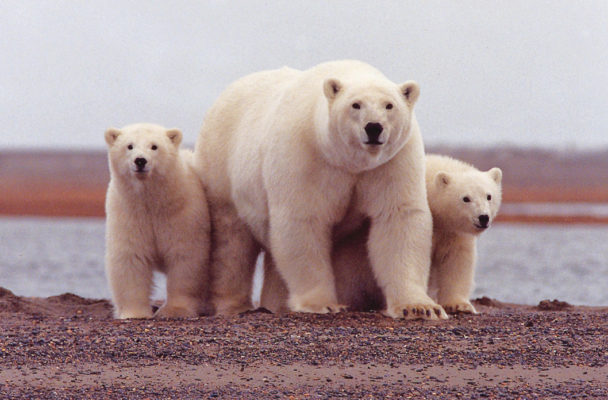
A polar bear keeps close to her young along the Beaufort Sea coast in Arctic National Wildlife Refuge.
A polar bear keeps close to her young along the Beaufort Sea coast in Arctic National Wildlife Refuge. (Public Domain photo by Susanne Miller/USFWS)

If there’s a poster child for Arctic animals affected by climate change, it’s the polar bear. But the data behind those famous furry faces tells a more complicated story.

Dr. Eric Regehr is a biologist with the U.S. Fish and Wildlife Service in Anchorage. He’s the lead author of a new study on the global conservation status of polar bears. Assessments of the conservation status of polar bears have been done before, but this is the first one that takes a databased, quantitative approach.

The study establishes a relationship between sea ice reduction and polar bear population numbers. The researchers then used that trend to predict how the world’s 26,000 polar bears will fare in the future.

“Putting together all available data, and making some informed projections on the basis of those data, do suggest that there is a high probability that the global population of polar bears could face reductions of up to one-third or greater in the next 35 to 40 years,” said Regehr.

However, not all polar bear numbers are suffering, at least in the short term. There are nineteen individual subpopulations of polar bears across the Arctic. Some of these subpopulations are stable, and a few are even growing.

One group that’s thriving is the Chukchi Sea subpopulation, which includes Western Alaska and the Russian coast across the water.

“The waters are shallow, they’re nutrient rich; there are a lot of seals, ringed seals and bearded seals, out there for the polar bears to eat,” said Regehr. “And so, other studies suggest that, despite the fact that the Chukchi Sea region has exhibited a loss of Arctic sea ice the bears in that region appear to be faring quite well, currently.”

But their neighbors to the East, the South Beaufort subpopulation, are declining in number.

“The continental shelf is much narrower, the region is less biologically productive,” said Regehr. “And scientific studies there suggest that the polar bears have been negatively affected by sea ice loss. So there is a lot of variation in their status across the Arctic.”

Despite this variation, Regehr says the decline in population numbers expected in the next few decades is likely to affect bears in all regions of the Arctic.

“Fundamentally, at the end of the day, polar bears require sea ice to do what basically makes them bears, which is killing and eating seals,” he said.

That means even healthy subpopulations, like the Chukchi Sea, bears face long-term threats.

“Just logically, there’s some point at which a polar bear in the Chukchi Sea may not have enough days of the year on sea ice catching seals to get the nutrition they need and be healthy,” he said.

Regehr doesn’t know when that time will come, but he’s already seeing the bears spend an extra month on land each year. And there’s evidence that the sea ice loss is affecting not just the polar bears in the Chukchi Sea, but those that hunt them. Regehr says polar bear harvest numbers in the region have been declining for the past few decades.

He hopes that as polar bears in the Arctic continue to be monitored, his team’s study will set a precedent for more quantitative assessments.

“Polar Code” a Step In The Right Direction?

Drift ice camp in the middle of the Arctic Ocean as seen from the deck of icebreaker Xue Long, July 2010.
Drift ice camp in the middle of the Arctic Ocean as seen from the deck of icebreaker Xue Long, July 2010. (Photo by Timo Palo via Wikimedia Commons)

At the beginning of 2017, the International Maritime Organization, or IMO, instituted a new set of regulations for ships traveling throughout Arctic waters. It’s called the Polar Code, and it builds upon 2009 guidelines to help ships operate safely in polar waters.

Kawerak’s marine advocate, Austin Ahmasuk, says the Polar Code is an improvement on the previous regulations for ships in the Arctic, but it still doesn’t change the nature of sailing through Arctic waters.

“The Polar Code, which took effect January 1, 2017, it doesn’t make the Arctic absolutely risk free,” emphasized Ahmasuk, “but it is a gigantic step forward to address the demands that are placed upon ships in polar waters, as well as addressing impacts and acknowledging that there have been coastal communities in the Arctic for a very long time.”

According to the IMO’s website, the goal of the Polar Code is to “provide for safe ship operation and the protection of the polar environment, by addressing risks present in polar waters.”

But of course, it can’t prevent all damaging situations from happening to ships traveling in icy Arctic waters. Just this week, according to an article in the Maritime Executive, two Russian carriers and icebreakers got stuck in three-foot-thick ice near the Chukotka Peninsula.

A missing feature of the Polar Code that Ahmasuk hopes will be addressed in the future is “how Arctic communities will be engaged in mitigating and addressing shipping plans, ship operations. You know, how will communities be engaged? That is something I am interested in,” he said.

Natasha Brown, who works for IMO, said via email that the Polar Code was developed by Member States of the IMO over the course of a few years with input from a range of non-governmental organizations (NGOs), shipping groups, and environmental groups. Brown did not specifically mention local Arctic communities being a part of the development process.

Even though the Polar Code took effect on January 1, not all of the ship-design requirements will be put into place this year. Some won’t be ready until 2018 after the first survey of ships is complete. When asked if the Polar Code is an indicator of more shipping traffic coming to the Bering Sea, Ahmasuk said:

“Oh, boy, well, that’s the million-dollar question, right? It does seem apparent that there is an interest to reduce shipping costs, which the Northern Sea route would obviously do for the global shipping market. It seems as though that interest is going to be maintained despite the new Polar Code,” stated Ahmasuk.

Regardless of how many ships come through the Bering Sea and other parts of Arctic waters, the Polar Code dictates that they be categorized based on how much ice they can sail through safely.

Brown says it’s up to the Member States to enforce the Polar Code regulations on their own domestic ships and any vessels docking in their ports.

Trump team met with Native leaders before inauguration

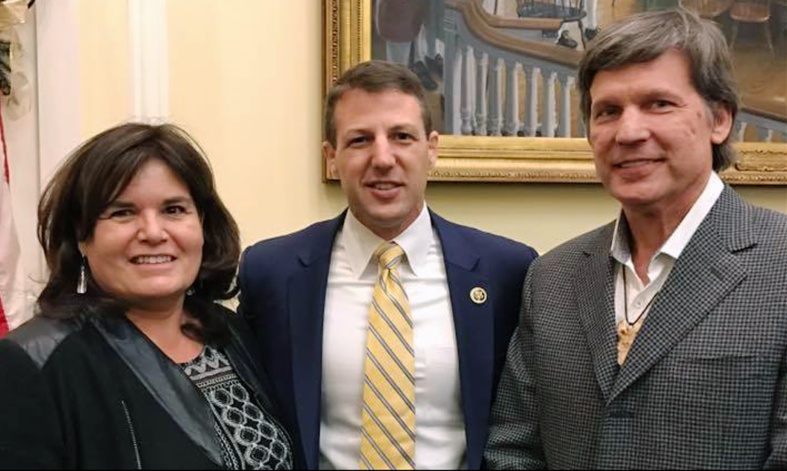
Central Council of Tlingit and Haida Indian Tribes of Alaska Vice Presidents Jacqueline Pata, left, pose with Trump Native American Coalition Chairman Markwayne Mullin and the Central Council's Second Vice President Will Micklin during a mid-December listening session. (Photo courtesy Central Council of Tlingit and Haida Indian Tribes of Alaska)
Central Council of Tlingit and Haida Indian Tribes of Alaska Fourth Vice President Jacqueline Pata, left, poses with Trump Native American Coalition Chairman Markwayne Mullin and Tlingit-Haida Central Council Second Vice President Will Micklin during a mid-December listening session. (Photo courtesy Central Council of Tlingit and Haida Indian Tribes of Alaska)

President Donald Trump angered many Native activists by moving to restart Dakota Access Pipeline construction.

Thousands have protested the line, saying a portion of it could poison the Standing Rock Sioux’s water supply. They also see the move as an affront to tribal sovereignty.

But before Trump’s inauguration, his transition team met with Native leaders to ask what they wanted out of the new administration.

The meetings were billed as listening sessions with Trump’s Native American Coalition and included members of the president’s transition team.

The coalition, formed just before November’s election, is chaired by Republican U.S. Rep. Markwayne Mullin, a member of the Cherokee Nation of Oklahoma.

Jacqueline Pata of the Juneau-based Central Council of Tlingit and Haida Indian Tribes of Alaska was among those at the western meeting. She’s executive director of the National Congress of American Indians and a board member of Sealaska, Southeast’s regional Native corporation.

“There are things in this administration’s agenda that we can find common ground on, like infrastructure development, like improving the economies of our communities,” she said. “But tribal leaders made it really clear tribes are governments and should be treated as such and respected as such.”

She said tribal leaders brought up health care, government contracting, education and resource extraction. That included opposition to the Dakota Access Pipeline.

“Tribal leaders said things like, ‘We’re not opposed to development. But we want to be able to make sure that we have a meaningful place and that our consent is part of the process of evaluating the permits that may affect our lands,'” she said.

Some leaders went into the mid-December meetings angered by reports that the coalition’s chairman wanted to take tribal lands out of tribal hands.

Tlingit-Haida Central Council’s Will Micklin, who also attended the meeting, said those reports were refuted.

“He assured me he had no intention of privatizing tribal lands,” he said. “It was a misinterpretation of his desire to make productive the tribal estate, which are tribal lands.”

Micklin said an overriding issue was the future of Obamacare.

“We’re concerned that the repeal of the affordable health care act not also repeal the Indian Health Care (Improvement) Act and not reduce funding for it from our other funding sources,” he said.

Another issue to watch was land into trust, which allows tribal governments to transfer title to the federal government and protects the land from taxation or seizure.

Alaska Native tribes have just begun using the program.

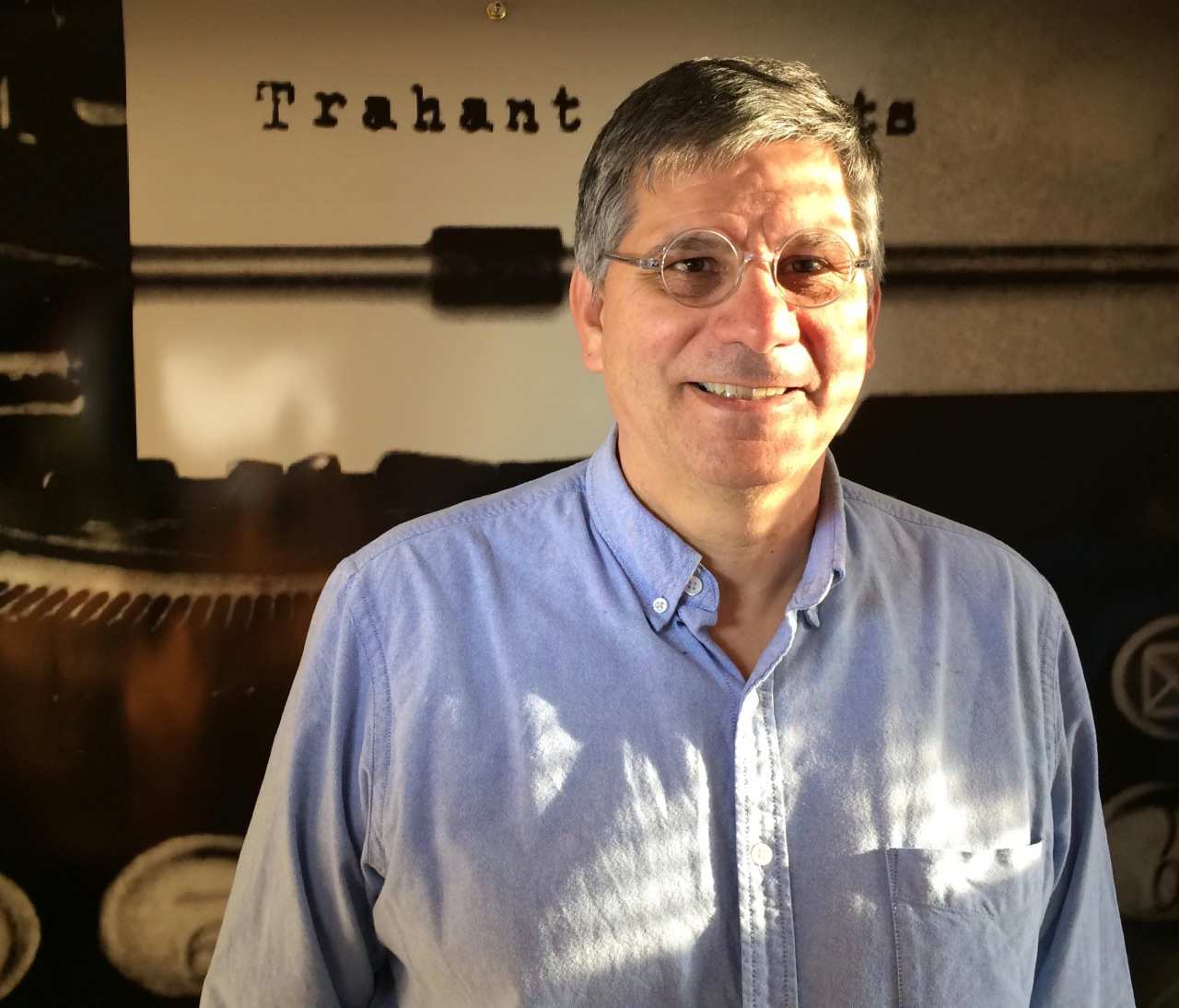
Mark Trahant is an independent journalist, professor and blogger on Native issues. (Photo courtesy Trahant Reports)

Mark Trahant is a former University of Alaska journalism professor and a blogger on Native issues. He’s a member of the Shoshone-Bannock Tribe now teaching at the University of North Dakota.

“That was kind of evolving late in the Obama administration. And now, (if) organizations and tribes want to follow through they’re going to need some sort of mechanical side to make the process work. And whether or not resources are put into that by the administration, I think will be interesting to see,” he said.

Changes in the state’s far north are also being watched by some Alaska Native leaders.

Trahant worries the new administration doesn’t know much about it, beyond the potential for oil and gas production.

That’s especially since Trump and members of his administration question the human role in climate change.

“Even thinking about the United States as an arctic nation and a changing arctic nation and what does that mean and what are the policy implications,” Trahant said. “The Obama administration had pushed very hard on the environmental side of that. But now you may see things like more interest in shipping lanes and resource extraction and that sort of arctic issues.”

Trahant predicts tribes will have fewer problems with Ryan Zinke, Trump’s pick to lead the Interior Department.

He said the Montana congressman understands tribal sovereignty and other key issues.

“The person who’s been nominated for Interior secretary is an avid fisherman,” Trahant said. “He understands the language of that and recognizes the importance of a healthy fishery, both as a food source and subsistence.”

Trump takes over from an administration that expanded relations with tribal governments and other Native groups.

Each department had a Native liaison who reached out and addressed concerns.

Tlingit-Haida Central Council’s Pata is among those hoping that continues in some form. But they say Obama will be a hard act to follow.

“What made a big difference was President Obama went to Indian country and when he saw it, it compelled him,” she said. “I’m hoping that we do get high-level officials from the Trump administration into Indian country and they will fulfill their desire to bring some of their drive for economic opportunity to Indian country as well.”

While most attended the Trump team’s Native coalition meetings were encouraged by the interest, they know many of their concerns don’t mesh with the new administration’s goals.

That’s certainly the case with the Dakota pipeline.

Gov. Walker hits on same budget themes with new Legislature

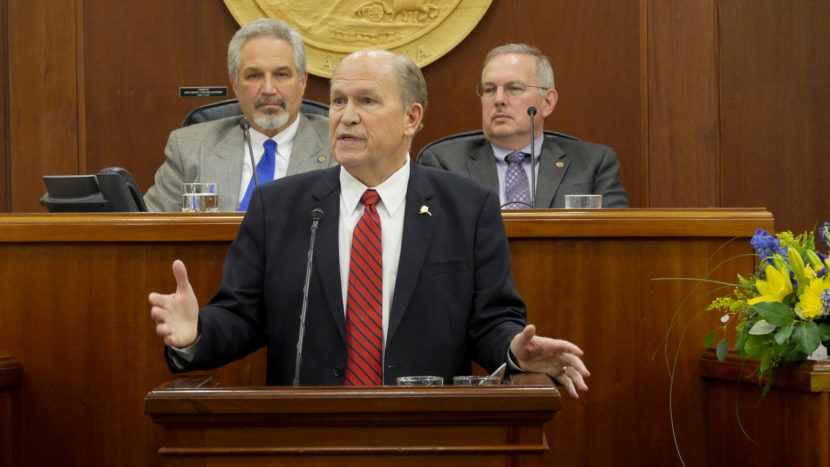
Gov. Bill Walker delivers his State of the State address to the Alaska Legislature, January 18, 2017. Behind him, left to right, are Senate President Pete Kelly (R-Fairbanks) and Bryce Edgmon (D-Dillingham), Speaker of the House.
Gov. Bill Walker delivers his State of the State Address to the Alaska Legislature on Wednesday. Behind him, left to right, are Senate President Pete Kelly, R-Fairbanks,  and House Speaker Bryce Edgmon, D-Dillingham. (Photo by Skip Gray/360 North)

Same concepts, new Legislature.

In his annual State of the State Address on Wednesday, Gov. Bill Walker pushed a lot of the same ideas and proposals for solving the state’s budget crisis as last year.

Walker said the state government risks spending all of its savings if it denies there’s a problem and hopes for oil prices to rise.

“Here’s the hard truth: Denial doesn’t make the problem go away. Hope doesn’t pay the bills,” Walker said. “We need to pass a plan to stabilize our fiscal future and we need to do it now.”

The gap between state spending and the money it brings in from oil, as well as other taxes and fees, is roughly $3 billion.

Walker renewed his call for a series of measures he proposed last year. They include drawing money for the budget from Permanent Fund earnings. Walker also wants to introduce an income tax. Walker said relying heavily on spending cuts would hurt the state’s economy.

“Whatever your plan may be, put it out there,” Walker said. “And let’s get to work to find a solution. But if your plan does not close the fiscal gap, be sure to also identify the amount from our dwindling savings it’ll take each year to cover the gap under your plan.”

Walker said the state Board of Education is taking a series of steps to improve schools.

And he called for more efforts to reduce deaths from heroin and prescription opioids, by limiting the number of opioids in prescriptions, and strengthening a database used to track opioids.

Walker said the state government will seek to involve every sector of the state to address climate change.

“It is one of the greatest challenges of our era,” Walker said. “We look forward to working with you to create a legacy of timely response.”

Walker’s speech touched on other topics. He called for oil drilling in the part of the Arctic National Wildlife Refuge. And he said he’ll continue efforts to build a natural gas pipeline.

Lawmakers from both houses say they’ll offer more details on their budget plans in the coming weeks.

Newtok asks: Can the U.S. deal with slow-motion climate disasters?

Newtok is asking for ongoing erosion and thawing permafrost to be qualified for federal disaster relief from FEMA. Village relocation coordinator Romy Cadiente spoke with reporters about the effort to relocate the village, Aug. 15, 2016. (Photo by Eric Keto/Alaska’s Energy Desk)

The village of Newtok has requested a federal disaster declaration from President Barack Obama to address ongoing erosion and thawing permafrost. It’s one of the first tests of whether the nation’s disaster relief laws can be used to deal with the slow-moving impacts of climate change.

Disaster declarations, which make a community eligible for federal funding, are usually reserved for specific catastrophic events — like a hurricane or landslide. But Newtok is applying for damage that has occurred through many smaller incidents over the last ten years. It’s a long shot, but village relocation coordinator Romy Cadiente says, at this point, the village doesn’t have a lot of options.

“We just need to get out of there,” Cadiente said. “We really do. For the safety of the 450 people there. We need to get out of there.”

The village of Newtok, August 2016. (Photo by Hanna Craig/Alaska Public Media)

Many Alaska villages are facing erosion and thawing permafrost made worse by warming temperatures, but Newtok’s needs are maybe the most immediate. The village has lost its barge landing, sewage lagoon and landfill. It expects to lose its current drinking water source this year, and the airport and school by 2020. More than half the homes in the village have been damaged by thawing permafrost. Six homes are at immediate risk from coastal erosion.

The community is ready to move: there’s a new site, with several houses already built. The major problem, Cadiente said, is money. Money for key and expensive infrastructure, like a new airstrip, school, and water source.

“The price tag on this village move is astronomical,” Cadiente said. “We’re thinking probably in the $150 to $300 million range. And what we have right now is nowhere near.”

And, after more than a decade of waiting, Newtok needs that money now.

Alaska had hoped to fund the relocation with a grant from the federal Department of Housing and Urban Development, but the state learned last winter it had been turned down. Officials cast about for another solution and settled on the Stafford Act. That’s the law that governs disaster relief, coordinated by the Federal Emergency Management Agency (FEMA).

The only problem? It’s never been used for a multi-year disaster before. That’s according to Newtok village attorney Mike Walleri and Erin Ward, of FEMA’s Region X office.

But Walleri argues nothing in the law prevents the president from declaring a disaster for a multi-year event like the thawing permafrost in Newtok.

“You know, disasters are not planned, and they don’t come in one size fits all,” he said. “And FEMA over its life has, I think, understood that. And it’s tried to adapt to the changing circumstances of these disasters.”

Newtok is the first test of that theory.

Rob Verchick teaches at the Loyola University College of Law in New Orleans, where he focuses on disaster law and climate adaptation.

“This is a trailblazing effort that will definitely put problems like this on the radar screen for federal and state policy makers and make it impossible for the public, I hope, to avoid these kinds of discussions in the future,” Verchick said. “Because Newtok may be the first community to make such a request, but it is not the only community that’s experiencing these kinds of problems.”

Verchick said the request, whether it’s accepted or not, is a milestone.

“At the very least what this shows is we have a huge gap in our federal laws and in our federal planning, because there are lots of communities that are going to be facing this kind of a problem, many of them on the coast and many of them tribal communities,” Verchick said. “And we need some kind of a federal approach, some kind of a federal policy, to address concerns like these.”

As for Romy Cadiente – he’s just hoping the answer from the White House is yes.

The request is now under review by FEMA. Newtok is hoping to get an answer before the Obama administration leaves office on Jan. 20.

At hacking hearing, Sullivan steers clear of Russia

In the Senate Armed Services Committee, U.S. Sen. Dan Sullivan has been a consistent voice warning about the Russian threat, particularly when it comes to Russia’s military buildup in the Arctic.

At a hearing on cyber hacking Thursday, Sullivan focused on hacking by other countries and didn’t discuss Russia at all.

The subject of the hearing was “foreign cyber threats to the United States.”

Senate Armed Services Committee Chairman John McCain, R-Arizona, made Russia and its pre-election hacking the focus.

“There’s no escaping the fact that this committee meets today for the first time in this new Congress in the aftermath of an unprecedented attack on our democracy,” McCain said.

For McCain and other senators, this was a chance to push back at President-elect Donald Trump.

Trump has publicly scorned the U.S. intelligence agencies for concluding that Russia hacked American email systems to interfere with the presidential election.

Sen. Lindsey Graham, R-S.C., said Trump should reconsider his disparagement of the intelligence agencies and hit Russia hard for what it did.

“I want to let the president-elect know that it is OK to challenge the intel. You are absolutely right to want to do so,” Graham said. “But what I don’t want you to do is to undermine those who are serving our nation in this arena until you are absolutely sure they need to be undermined, and I think that they need to be uplifted.”

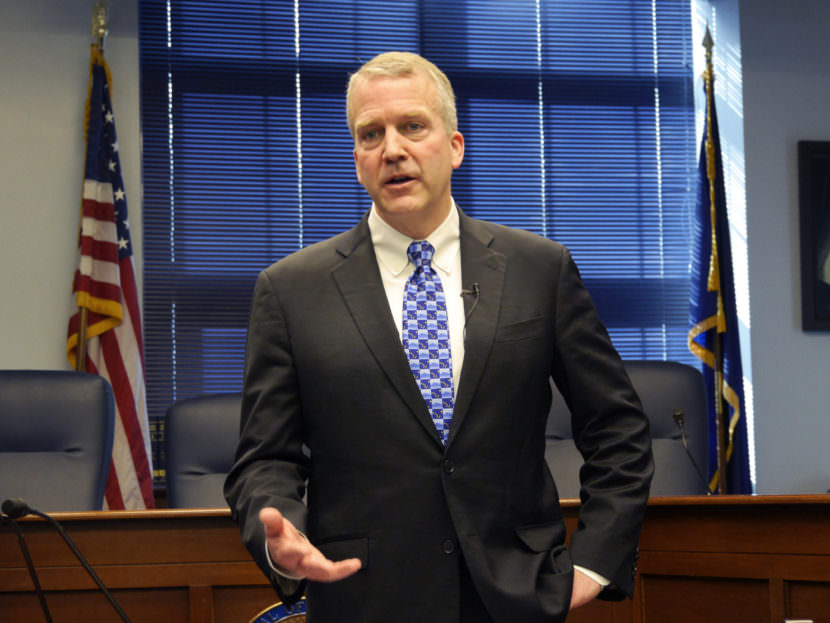
U.S. Senator Dan Sullivan, R-Alaska, at a press availability fol
U.S. Senator Dan Sullivan, R-Alaska, at a press availability following his annual address to the Legislature, Feb. 29, 2016. (File photo by Skip Gray/360 North)

When it was Sullivan’s turn to question a trio of intelligence agency witnesses, he didn’t ask about Trump or Russia. Sullivan focused instead on the threat from North Korea, Iran and China. Sullivan said the U.S. hasn’t responded forcefully enough to foreign computer breaches from several countries.

“I did not hear any claim of a retaliation on a huge hack. Huge,” Sullivan said. “Twenty-two million American federal, military, intel workers hacked by the Chinese.”

National Intelligence Director James Clapper suggested that was cyber espionage, rather than an attack.

“We and other nations conduct similar acts of espionage, and so if we are going to punish each other for acts of espionage, that is a different policy issue,” Clapper said.

Sullivan said America has become “a cyber punching bag.”

After the hearing, Sullivan said he had Russia questions, but, by the time he spoke, most had been asked already. And Sullivan said the topic has been politicized.

“I think — I don’t think, I watched — that there were some people that have been using the Russia hacking issue as a way to try to delegitimize the results of the November election,” Sullivan said. “What was clear today was that, you know, Donald Trump and Mike Pence won fair and square.”

Clapper testified that the intelligence community has no way to gauge whether Russia’s hack influenced how Americans voted.

Sullivan said it’s important to look at what Russia is doing, but he, like McCain, said he doesn’t see evidence that hacking determined the election outcome.

None of the senators at the hearing disputed the intelligence chiefs’ conclusions that the hacks came from Russia and were an attempt to interfere with the U.S. election.

“No, I mean you watched the hearing today, right? I mean they were quite definitive on that,” Sullivan said. “And they’re the experts and I don’t have a reason to doubt that.”

Whether Trump is still skeptical of the agencies is hard to say. A few hours before the hearing he said in a tweet that he’s a big fan of “intelligence.”

Site notifications
Update notification options
Subscribe to notifications