Arctic

National Park Service predicts the future of shipping in the Bering Sea

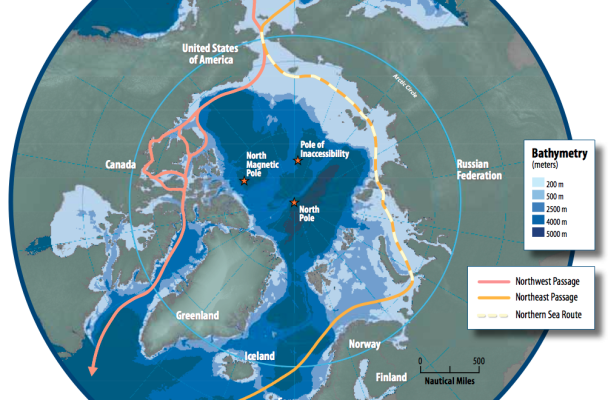
A map of Arctic shipping routes, including the Northern Sea Route over Russia.
A map of Arctic shipping routes, including the Northern Sea Route over Russia. (Public Domain photo courtesy the Arctic Council)

It’s no crystal ball, but it could show us the future of Arctic shipping. A new simulation created by the National Park Service and its partners maps out projected ship traffic in the Bering Sea for the year 2025. Tahzay Jones is a coastal ecologist with the National Park Service, and he helped this simulation come to life.

“There’s already projections about how much traffic is gonna increase,” said Jones, “and what we really wanted to get at was, what does that actually look like?”

In the simulation video, colorful dots representing vessels sail up and down the Alaskan coast.

“If you imagine, like, a train track or something, we create boat tracks that these little boats can go back and forth on,” said Jones.

Most dots are clustered around the Aleutian Islands. But it’s the Bering Strait region that will see the greatest increase in traffic in the next decade. Between two and eight percent of ships that currently pass through the Suez and Panama canals are expected to start using the Northwest Passage instead.

Overall, the simulation predicts that between 115 and 275 more ships will pass through the Bering Sea during the most active month of the 2025 season. And those numbers don’t include one category of vessel that the region may see a lot more of soon: cruise ships.

“We just haven’t had enough cruise ships in the area to understand all of their routes,” said Jones. “I mean, we had one that went through last year. And so, that’s the only track that we have for large cruise ships that would potentially be going through the Bering Strait, and that’s not enough to really base a model on.”

However, the model could be adapted in the future once cruise ship patterns are established. In the meantime, Tahzay Jones’ task is to determine how the simulation can be used to prepare people living on the Alaskan coast for an increase in traffic.

“It’s one thing to create a model,” he said, “and then it’s another thing to say, how does this model actually apply to community needs, to management planning needs, those kinds of things?”

Jones visited Nome this week to meet with Kawerak Inc. representatives and share the potential uses of his project. Those uses include predicting the location of oil spills, and determining which animal populations might be threatened by traffic or noise disturbances. He also asked the representatives for suggestions of species that may be especially at risk. This collaboration with communities is important to Jones because he says the undertaking started with them.

“This project itself was really conceived and developed not as an agency-derived thing, but more so, it was very specifically an issue that communities had been conveying to the Park Service, and the Park Service saying, ‘I think that there might be a way we can address this,’” he said.

Of course, the real impact of the Arctic shipping boom won’t be known for certain until 2025.
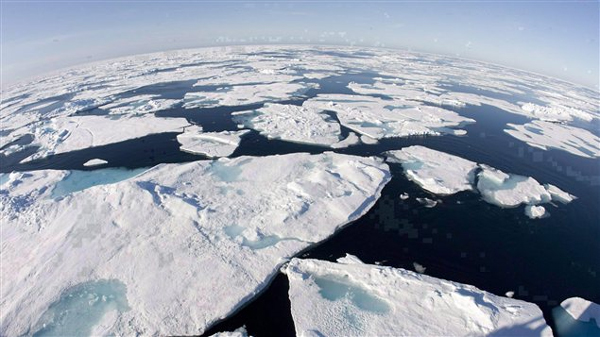
Human intervention: scientists propose plan to help refreeze the melting Arctic

Ice floes float in Baffin Bay between Canada and Greenland above the Arctic circle on July 10, 2008. A new paper from Arizona State University physicists proposes using sea water pumps to facilitate more ice formation in the Arctic. (Photo by Jonathan Hayward/Canadian Press)

The Arctic could see its first ice-free summer as soon as 2030 as the region continues to warm faster than the rest of the planet.

Some scientists think we’ve reached a point of no return, where no amount of reducing carbon emissions will save the Arctic, and a small group of scientists think it’s time for an intervention to help Mother Nature out.

Douglas MacMartin at Cornell University works in a field called geoengineering, which sounds like a branch of geology or something, but it’s a little more out there than that.

“The idea is any large-scale project that is designed to intentionally deal with some of the consequences of climate change,” he said.

Examples of these large-scale projects are manipulating ocean currents with heat pumps or spraying reflective particles into the troposphere to reflect solar radiation back into space.

It sounds like science fiction, but with math to back it up.

Arizona State University astrophysicist Steve Desch recently published a paper describing his geoengineering idea: placing sea water pumps in the Arctic that would assist nature in making sea ice.

“What we’re proposing doing is helping the ice freeze over 10 percent of Arctic,” he said.

Desch mostly studies the climates of other planets and moons — especially the really icy ones. But he found himself at more and more conferences with scientists focused on planet Earth.

“I came away thinking the problem is urgent, but I didn’t feel like they were addressing solutions or actions we could take, other than reducing CO2,” he said. “That’s when I decided to contribute something.”

The motivation behind Desch’s recent paper is that reducing carbon emissions from our cars and our factories and homes is not enough to reverse global warming.

Basically, desperate times call for proactive and potentially costly engineering measures.

Desch’s plan would require 10 million wind-powered pumps spread out across the sea. They would create a meter of sea ice across 10 percent of the Arctic.

It’s a lot, but not impossible.

“It sounds like a ridiculous number at first,” Desch said, “but on the other hand we make 10 million cars in this country every year.”

Made of steel, each pump would cost about $50,000 to manufacture. The total price tag would be somewhere around $500 billion. Desch says that amount is comparable to the Manhattan Project or the Iraq War.

The plan may be grandiose in scope and cost, but the idea itself is relatively simple. It’s relatively natural as far as geoengineering projects go.

Even Doug MacMartin, the engineer, thinks it’s an elegant solution.

“I grew up in Ottawa where every winter they flood the canal with ice. If it’s going to be a cold night they pump more water on the ice to make it thicker so you can skate on the canal,” he said. “So I’ve always thought why can’t we do that in the Arctic?”

Even if you think of geoengineering as a last resort, scientists like MacMartin don’t want people to stop trying to reduce carbon emissions.

“It seems hard to imagine why one would consider some of the more radical solutions if we hadn’t taken the first step to cut our carbon emissions,” he said.

Anchorage-based climatologist Brian Brettschneider thinks geoengineering projects are starting to sound less crazy than they did a few years ago.

“I’m still an optimist that we can do some dramatic reductions in greenhouse gas emissions, but maybe we can’t,” he said. “At what point do we say now we’re in emergency mode?”

“Maybe we’re there. I don’t know.”

One thing’s for sure, if and when we can agree that we are there, the geoengineers will be ready.

Murkowski says Trump policies on Arctic, climate still unclear

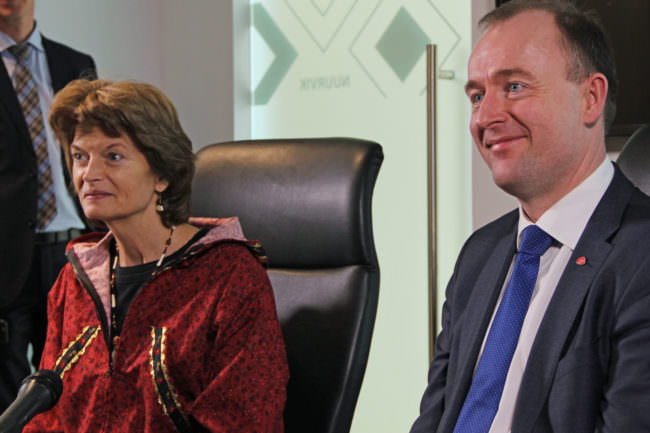
Alaska Sen. Lisa Murkowski, left, and Norwegian member of parliament Eirik Sivertsen took questions from reporters during a meeting of the Conference of Parliamentarians of the Arctic Region in Anchorage on Friday. (Photo by Rachel Waldholz/Alaska’s Energy Desk)

Alaska U.S. Sen. Lisa Murkowski says it’s still unclear what the Trump administration’s Arctic or climate policies will look like.

Murkowski met in Anchorage Friday, Feb. 24, with elected officials from around the Arctic. The meeting was a gathering of participants in the Conference of Parliamentarians of the Arctic Region.

At a news conference, Murkowski said she’s fielding questions from her counterparts about potential changes in U.S. policy.

“One of the questions that we heard today, and again there is no clear answer to it, was the status of the Paris climate talks and the U.S. role in that,” she said.

She’s referring to an international agreement to limit greenhouse gases.

Murkowski noted that while President Donald Trump criticized the agreement during the campaign, there has been no clear decision from the White House since he was sworn in.

That uncertainty extends to other areas of Arctic policy, from infrastructure to economic development.

“Just the place that we are at right now with a new administration standing up, there has not been a clear lay-down of a policy on all things Arctic,” Murkowski said.

Norwegian member of parliament Eirik Sivertsen, who joined Murkowski for the news conference, said he hopes the U.S. will continue to be a leader on climate change and Arctic policy.

“The most important thing we are hoping for is that the Arctic will still be high on the agenda, that the U.S. will engage in discussing challenges and looking for solutions for the challenges we are facing in the Arctic,” Sivertsen said.

Murkowski stressed that it’s still early days for the Trump administration, and said she will discuss Arctic policy when she sits down with new Secretary of State Rex Tillerson.

The Anchorage meeting included representatives from Canada, Russia, Norway, Denmark, Sweden, Finland and Iceland.

Ask a Climatologist: This winter’s alarming record low Arctic sea ice

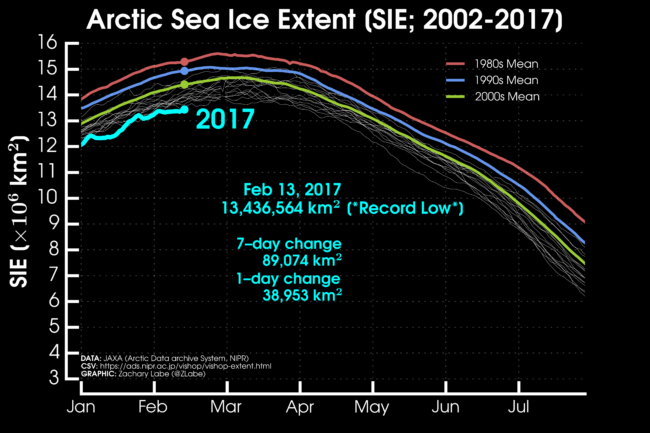
This winter, Arctic sea ice extent is at record lows. (Graphic Courtesy of Zack Labe/UC Irvine)

During a normal winter sea ice grows quickly in the Arctic Ocean, filling up nearly the entire ocean basin. This year though, unusually warm weather and storms are keeping the sea ice extent at record lows.

Climatologist Brian Brettschneider says Arctic sea ice is in pretty sad shape.

Most of the last 200 days, the sea ice has achieved a daily record low,” he said. “So even though it’s still mid-winter or late winter up there, we should expect a lot of growth and we really haven’t seen nearly what we would expect given the time of year.”

There are a number of reasons why sea ice growth has been particularly slow this winter. Very warm temperatures in the high Arctic is an important culprit.

“There have been times when even at the North Pole it’s hit at or above freezing, which is almost unheard of,” Brettschneider said.

He also says that stormy conditions around Iceland and Scandinavia have promoted increased wave action, which disrupts sea ice formation.

“So just a lot of things have come together to slow and, at times, reverse the sea ice growth in winter, which is pretty unprecedented,” he said.

Winter sea ice growth offsets the summer melt. The more ice that build up in winter, the less ice will melt in the summer.

“It is pretty alarming,” Brettschneider said. “There’s been open water not far off the North Slope of Alaska in January and February, which is really astonishing. Over to the east of Greenland, around Svalbard Islands of Norway, I don’t think they’ve had any sea ice and they’ve been above freezing. These are areas that should be locked into ice and should be below zero, so it’s very concerning about where we could end up in the summer melt season.”

Alaska’s Energy Desk is checking in with climatologist Brian Brettschneider each week as part of the segment, Ask a Climatologist. What do you want to ask?

Online teaching tool incorporates Bering Strait community members in oil spill response

Communities near the Bering Strait now have access to a new teaching tool and will be able to share information with various organizations and agencies about threats to arctic marine life, such as oil spills.

The Bering Strait Response Teaching Tool is now available online, thanks to a University of Alaska Anchorage student and the Defenders of Wildlife organization.

Allison Dunbar, a junior studying environmental engineering and biology at UAA, is project lead for the online teaching tool. She’s been working part time on the layers of the website for the last year in order to make the tool accessible to everyone, including those who live in the Bering Strait region.

“The local people will know the tides and the currents and will best be able to inform that response, and that is our ultimate goal,” Dunbar said. “By utilizing and working with the local experts, impacts to marine mammals and to the communities will be less, and for us, (that’s) a common sense thing, but we want it to be written into the protocol for response agencies.”

Dunbar explains what information can be accessed through the online teaching tool.

“The content in the BSRTT includes layers that show where spill response equipment is housed, whether it’s in Kotzebue or Nome and some other communities throughout the area, and it is also showcasing some of the different response areas that are used by the Coast Guard and other spill response agencies,” Dunbar said. “That’s to say if oil was to come to shore, what areas would be focused on first.”

With a significant marine mammal population present in the Bering Strait region, and the various threats to them, Rhonda Sparks said the online teaching tool was created to streamline the oil spill response process and cut response time.

“You know, after talking a lot with our partners and spill response agencies, that is what’s most beneficial to them in a response situation, is having the community members who are knowledgeable of the currents, knowledgeable of any debris the agency needs to be aware of. It cuts the response time in half to have those types of individuals participating in a response,” Sparks said.

Sparks is the arctic liaison for the Defenders of Wildlife. She is in charge of implementing the online teaching tool into local communities, which will involve her visiting and training residents throughout the region.

“Recognizing that internet in remote areas is unreliable, we have these screencasts that we can play, and we’ll go through the tool; we’ll go through different features of the tool; we’ll discuss spill response and spill response preparedness and any questions, comments, or concerns that communities have,” Sparks said.“I’ll take that back and share it with all of our partners at the U.S. Coast Guard, the Alaska Department of Environmental Conservation and EPA.”

Even though this educational tool helps inform its users about response plans to oil spills and other potentially harmful situations that occur in the Bering Strait, Sparks emphasizes that it will not be used to clean up or take action in those situations, but, instead, to share information.

“So, it’s not something the Coast Guard or EPA will use in the event of a spill, but it gives the communities a platform to kind of understand the complexity of a spill response,” Sparks said.

Anyone who uses the Defenders of Wildlife’s new BSRTT website can leave feedback and share their knowledge with the Coast Guard or other organizations that also use the tool.

Community trainings on spill response and the teaching tool in the Bering Strait region are expected to begin this month.

Local residents lead the change to more renewable energy in the Arctic

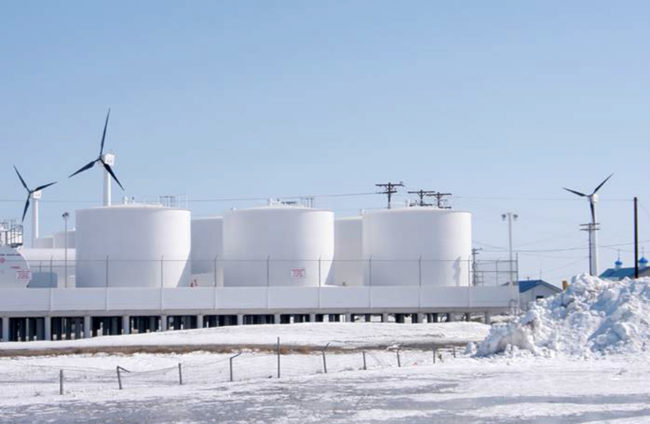
Wind turbines hover over diesel tanks in Kasigluk in March 2016. (Photo courtesy of Alaska Village Electric Cooperative)

Isolated communities across the Arctic are looking at relying more on renewable energy. A new program aimed at helping rural areas make that transition is starting this month. Instead of bringing in experts, Arctic Remote Energy Networks Academy, or ARENA, is relying on local residents to lead the change. 

George Roe says ARENA is largely a knowledge sharing program focused on rural areas with remote energy networks, or micro-grids as he likes to call them.

“The idea of learning from one another, asking each other questions, brainstorming. Because when you’re in the same space, you have great things to share with one another,” Roe said.

Roe works for the Alaska Center for Energy and Power at the University of Alaska Fairbanks. The arctic academy will appoint 20 fellows and is endorsed under the Arctic Council’s sustainable development working group. In between the in-person meetings and visits to several Arctic countries, participants will work with mentors and each other on renewable energy projects.

“I talked to several applicants who were concerned that ‘oh I don’t have a college degree, does that keep me away?’” he said.

Roe says they wanted to find people who could become champions for alternative energy and have credibility in their community.

“It was so fun, if you will, to talk with them and say no, you have a lot to offer to this program,” he said.

Roe says  some training will be focused on community involvement. They want to make sure the work is a benefit to every resident.

“Because if the community doesn’t engage the overall project, it’s not going to be sustainable in the long run,” said Roe

Fellows were nominated either by themselves or by a participating organization and come from across the arctic, including Alaska, Canada, and Greenland. Nine of the 20 participants live in Alaska and are based all over the state.

“We got some from Southwest, we got some from Northwest, we got some from Western, we got some from the Interior. So it’s really quite gratifying to see the representation,” Roe said.

The full list of participants will be released by January 30th, and they will meet for their first in-person meeting this March in Yellowknife, Northwest Territories, Canada.

Site notifications
Update notification options
Subscribe to notifications