It’s been a relatively cool and snowy winter here in the Interior, compared with the past couple of winters.
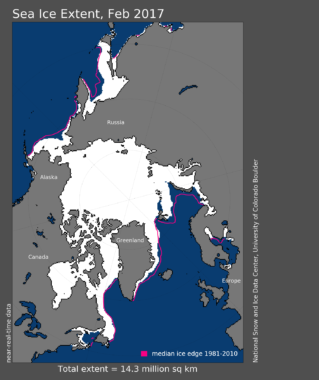
But climate experts say the Arctic has been warmer than average. They say that’s why it appears this year’s maximum Arctic sea ice cover, measured near the end of winter, is likely to set another record for the smallest maximum on record.
Arctic sea ice extent for February 2017 averaged 5.51 million square miles (14.28 million square kilometers), the lowest February extent in the 38-year satellite record. February 2017’s sea-ice extent is about 15,400 square miles 40,000 square kilometers) below February 2016’s, which set the previous lowest extent for the month, and 455,600 square miles (1.18 million square kilometers) below the February 1981-2010 long-term average. (NSIDC)
Spring equinox is a week away, which means the time is nigh for the National Snow and Ice Data Center’s annual declaration that Arctic sea ice cover has grown as much as it’s going to this winter.
“We’re at about the maximum sea ice extent you’ll see for the year. Usually the maximum happens around mid-March,” said Mark Serreze, a senior research scientist with the Snow and Ice Data Center.
Serreze said the formation of sea ice this past winter was once again sparse, due mainly to above-average air and sea-surface temperatures throughout the winter and again last month.
“We already had a record-low sea ice extent in February,” Serreze said. “We’re looking at a very, very low sea ice extent ending the freeze-up season, starting the melt season.”
This may seem contradictory to residents of the Interior after a week during which the mercury dropped to 30-, 40-, even 50-below overnight in many areas around the region. Serreze said this season was cooler than the previous two, which set consecutive records.
Overall, for the Arctic, it’s been a very, very warm winter, and you see that reflected in the very, very low sea ice levels that we have right now,” he said.
National Weather Service climate specialist Rick Thoman said it’s been a chilly winter for much of the Alaska.
“For Alaska as a whole, for the 2016-17 mid-winter – say, December-through-February period – Alaska as a whole was actually very close to the long-term normal,” Thoman said.
Except for some parts of the state. Thoman said it was a much milder winter north of the Brook Range, especially along the Arctic Ocean coast.
“As you would expect in Alaska, there (are) regional differences,” Thoman said. “The North Slope, in particular, was quite warm this winter – about the 12th warmest winter for the North Slope as a whole.”
Serreze said it’s been especially warm on the Atlantic side of the Arctic. And he expects that will be reflected in the sea ice maximum extent map the Snow and Ice Data Center will post in the next week or so.
U.S. Sens. Lisa Murkowski and Dan Sullivan brought their case for developing Alaska’s resources to the Oval Office on Wednesday, March 8.
Murkowski said they and Interior Secretary Ryan Zinke met with President Donald Trump for nearly an hour.
“It was a great opportunity to just kind of make the case for all things Alaska,” Murkowski said afterward. “The president was clearly interested and engaged. I had lots of maps.”
Murkowski showed the president how much of Alaska is controlled by the federal government, which resources are where and what kind of restrictions are in place.
“He did state at one point in time he had not realized how restricted our opportunities have become over the years,” Murkowski said.
They talked about Arctic drilling and the difficulty of getting a road for King Cove through federally protected wilderness, but Murkowski said the discussion was more of an overview.
“Very general. I mean, we talked about, obviously, the prospects for greater development in the off-shore and on-shore in the Arctic,” Murkowski said. “We also talked about our fisheries. We also talked about how our geography allows us to be a national security asset.”
Murkowski said Melania Trump was also in the room and she spoke to the first lady before and after the meeting.
“I had asked her if she had ever been to Alaska and she says no, she absolutely wanted to come,” Murkowski recounted. “She said that she enjoyed listening to the conversation and she had learned a great deal, and that made her want to come to Alaska even more. So that was good.”
Murkowski said the president also expressed a desire to visit Alaska but she knew of no specific trip in the works.
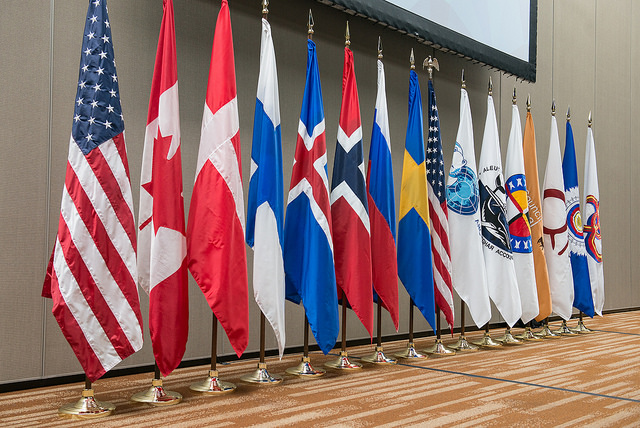
The flags of the eight Arctic Council member states and six indigenous permanent participant organizations. (Photo by Linnea Nordström/Arctic Council Secretariat)
On a cold, sunny day in Juneau, about 40 people gathered in the Capitol to eat lunch and learn about the Arctic. Juneau will host an Arctic Council meeting later this week, and state lawmakers got a visit from national and international scientists, policymakers, and researchers on Tuesday.
Roberta Burns chairs the Sustainable Development Working Group for the Arctic Council. She started the lunchtime presentation with a geography quiz, asking which countries were permanent, participating members of the council.
“Norway,” “Russia,” “Greenland,” the crowd shouted answers, eventually coming up with all eight Arctic countries. As part of the council, representatives from these countries work on the scientific, social and economic problems facing their shared regions, and collaborate with indigenous groups throughout the Arctic.
The U.S. currently chairs the council, but will be handing control over to Finland later this year.
Burns says that while the council has been led by the U.S. it has been focused on economic and living conditions in the Arctic, working on projects designed to combat suicide and improve rural water and sanitation.
Ukallaysaaq Okleasik bounced his six-month-old daughter in his hands and kept a close eye on his son, during a break in the meetings.
Okleasik is Inupiaq and Qawiaraqmuit. He was in Juneau on behalf of the Sitnasuak Native Corporation. He said he and has family have been adapting to a region that is very different from the one his ancestors knew.
And alongside those changes in weather, shrinking ice coverage and open Arctic water, shipping traffic has moved into the region. And Okleasik said Nome wants to evolve with those changes and expand its port.
But, he said, he also wants to personalize the region for policymakers.
“I think I’d like to say the Arctic is a place, the Arctic is also the people and the Arctic is also communities and so, when we talk about the Arctic, there’s a sense to make it abstract or make it a place only, and we forget that it is a people and its has been our homeland for many generations,” Okleasik said.
Larry Hinzman, vice chancellor of research for University of Alaska Fairbanks, talks about the Week of the Arctic at the Feb. 28 Greater Fairbanks Chamber of Commerce meeting. (Photo by Tim Ellis/KUAC)
A U.S. State Department official said planning is well under way for the big, biennial meeting of top diplomats from the eight Arctic Council member nations to be held this spring in Fairbanks.
“We have an advance team of 40 individuals who are up with us – to give you an idea of how much commitment and how much work goes into planning a meeting with these many moving parts,” Ann Meceda, a State Department Arctic affairs officer, said.
Meceda told the Greater Fairbanks Chamber of Commerce this week that the advance team handles the logistics of preparing for a high-profile meeting like the Arctic Council’s ministerial – now known as the Fairbanks ministerial.
“So they come and look at the locations and preparations in advance of a meeting like the Fairbanks ministerial,” Meceda said. “So this will be the ministerial at the end of the U.S. chairmanship of the Arctic Council.”
Larry Hinzman, vice chancellor for research at the University of Alaska-Fairbanks, told the chamber audience that local and statewide organizers also are working on preparations for a weeklong series of events called the Week of the Arctic, to be held May 8-14, in conjunction with the ministerial.
“The Week of the Arctic is going to be a big event for Fairbanks,” Hinzman said. “We’ll have a thousand people coming in, we’ll have policy-makers, decision-makers, engineers, scientists from around the world. We’ll have local stakeholders.”
Hinzman is helping coordinate UAF’s support for events to be held in Fairbanks, most of which focus on scientific, engineering and technological issues Arctic nations are dealing with. The events include the Arctic Interchange, a four-day series of sessions to review U.S. achievements during its two-year Arctic Council chairmanship; and the Arctic Broadband Forum, a two-day series on the challenges of providing telecommunications to the region, and efforts to improve broadband availability here.
The Week of the Arctic will wrap up with a series of arts- and culture-related events called North by North, to be held May 12-14 in Anchorage.
“And so they’ll have a film festival, culture and craft shows, dance party, local foods and brewery tasting,” Hinzman said. “So, it’s going to be fun.”
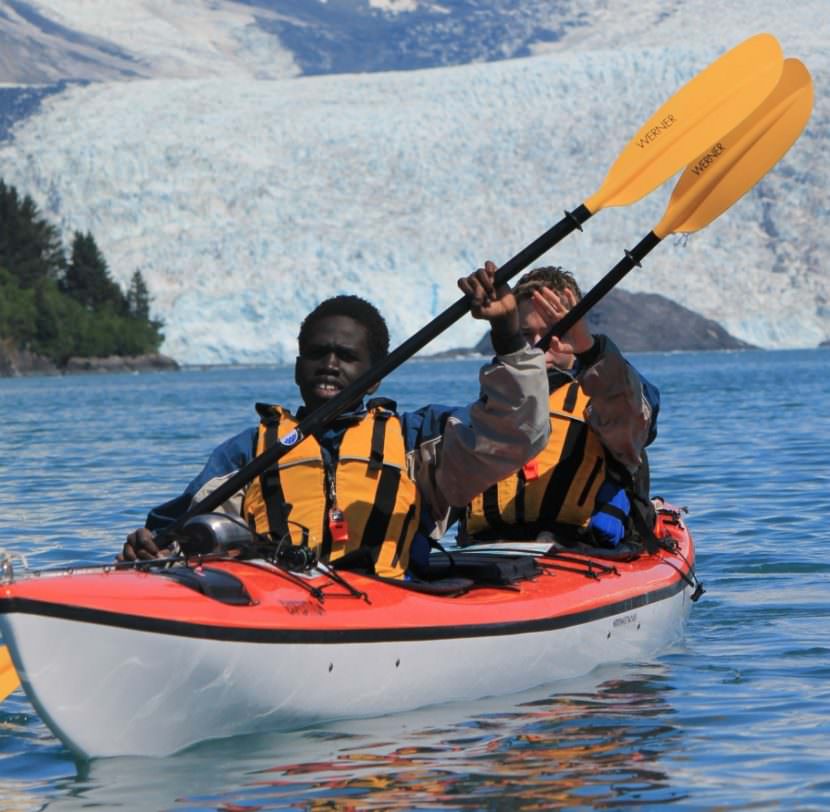
After high school, Reth Duir got the opportunity to explore the outdoors through a kayaking expedition in Prince William Sound. The trip changed how he felt about the outdoors. (Photo courtesy Chugach Children’s Forest)
When you open a REI catalog or page through Outside magazine, what do you see? Do the people on the page look like you? Arctic Youth Ambassador Reth Duir is working to make that imagery more representative.
“When you look at the depiction of what people go outside it’s usually white people,” Duir said. “When you look at these catalogs, you look at Facebook ads, and you go to REI, you don’t see a lot of diversity of people. So I think it can be very tough for someone trying to explore the outdoors because there’s not much commonality.”
But the University of Alaska Anchorage junior hasn’t always been an outdoors enthusiast. His childhood was split between Minneapolis, Minnesota, and Omaha, Nebraska. Playing outside meant playing basketball or cops robbers with his friends.
When he was 8 years old his mom told him a story that made him fear the outside world.
“I noticed there was a wound on the outside of my mom’s ankle and her skin was just completely different,” Duir said. “I was like, ‘how did that happen?’ And my mom was like, ‘I was bitten by a snake.’ She became instantly very sick and she could have died that day.”
Duir had a different childhood than his parents.
Before he was born, they fled East Africa because of political and religious oppression.
When he was 10 years old, his life and his parents’ lives were about to become even more different. They were moving from Nebraska to Alaska.
“I thought they were crazy when they first said that,” Duir said. “I knew Alaska, there was a lot of snow it was very cold. I knew about polar bears. I just had this picture of (the) Ice Age, but with people.”
Landing in Anchorage, his new home, the first thing he saw was the Chugach mountain range.
For a kid from Nebraska, it was the first time he’d ever seen a mountain.
At that moment, Duir began think about starting to explore the outdoors.
After graduating high school, he got that opportunity through a kayaking expedition in the Prince William Sound.
Immediately Duir found his calling.
“Oh yeah, I was hooked for sure,” Duir said. “They definitely had me hooked. They reeled me in.”
“A lot of people don’t understand that this is our public lands. It is for everyone,” he said. “It should be for everyone. I want to get rid of these misconceptions that the outdoors is for a particular audience. There are different ways to explore our outdoors — going hiking, backpacking or fishing with your family and friends.”
He wants to help communities find ways to connect to the outdoors that work for them.
“I know Alaska Native communities they live off the land,” Duir said. “We have Hmong communities that like to go fishing. I think it’s really figuring out what the community needs are and how people enjoy their public lands. How they like to be outdoors. Then creating a way to do that.”
He knows he’s still learning.
“This program has really opened my eyes to different things that are happening in the state of Alaska and why the voices of people in rural communities are important and they should be at the table,” Duir said. “I want to be able to help with that experience.”
Duir will graduate next year with a degree in elementary education. He used to want to be a teacher in a big city — like Chicago or Oakland — but he’s changed his mind. He wants to work in rural Alaska and give back to the place he’s called home for a decade.
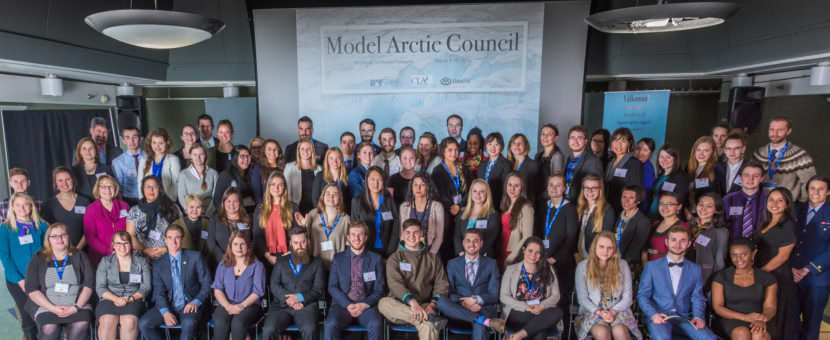
Total of 63 students from 13 countries participated at Model Arctic Council 2016 in Fairbanks. (Photo courtesy University of Alaska Fairbanks)
At the Model Arctic Council, tomorrow’s Arctic leaders are already having an impact with helping shape today’s Arctic policy.
The Arctic Council returns to Alaska with meetings in Juneau this week and in Fairbanks in May. Representatives from eight Arctic countries and six indigenous groups work on shaping Arctic policy.
Listen to the radio version of the story:
To understand the work of the Arctic Council first-hand, a group of university students met in Fairbanks last spring to form a model council with real-world impacts.
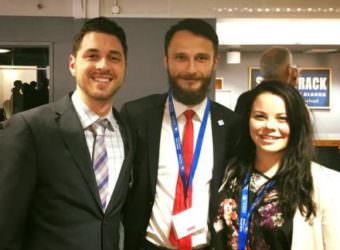
Model Arctic Council delegates included University of Alaska Anchorage student Caleb Amos, faculty adviser Piotr Graczyk from University of Tromsø The Arctic University in Norway, and York University student Veronica Guido from Canada. (Photo courtesy University of Alaska Fairbanks)
The Model Arctic Council is a simulation where future leaders in Arctic and international affairs hone their negotiation, communication, leadership, critical analysis and research skills. It’s much like the Model United Nations in high school. But, this time, its college students role-playing representatives from circumpolar countries as they tackle problems together in a rapidly changing Arctic.
Sixty-three college students from 13 countries, ranging from Iceland to Venezuela, compressed as much as two years’ worth of work into a little over a week.
Veronica Guido, an indigenous student with a degree in political science from York University in Toronto, said they either represented the Arctic Council’s member states or non-voting representatives of the various circumpolar indigenous groups.
“You have the indigenous groups from Russia. You have the Saami Council, Inuit Circumpolar Council, Aleut, and you have the Arctic Athabaskan,” Guido said. “Then I represented Gwich’in which is more of First Nations from Alaska and Canada. That was my role.”
Mary Ehrlander, director of the Arctic and Northern Studies Program at the University of Alaska Fairbanks, was a faculty adviser to the group. She said they tried to match indigenous students to a role that was close to their ethnic background.
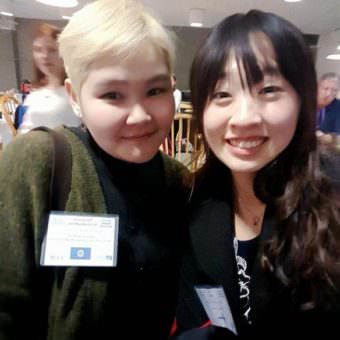
Model Arctic Council delegates included Northeastern Federal University student Margarita Krivoshapkina from Russia and University of Alaska Fairbanks student Kimmy Cao from China. (Photo courtesy University of Alaska Fairbanks)
“Because we wanted to have authenticity in that way,” Ehrlander said. “On the other hand, some of the students seem to have the greatest experience with trying to play a role that wasn’t them at all. It was really a learning experience for them to take on that identity and try to perform it.”
Students prepared research papers on topics such as sustainable cruise tourism in the Arctic, managing maritime traffic for marine resource development, and human health and well-being in the Arctic.
Eva Wu, an undergrad from McGill University in Canada studying the interplay between health and environment, said she was impressed by the level of preparation and critical analysis demonstrated by her fellow students.
“It was really amazing the amount of people and the variety of people who were in the room,” Wu said. “They provided numerous different aspects and perspectives of each situation. That really was able to provide the entire program with a holistic focus. People would have expertise in various different areas.”
The Model Arctic Council came up with list of priorities that could be considered by their real world counterparts this week in Juneau.
They include advocating for ratification of an international convention controlling vessel ballast water, the hiring of indigenous people for tourism activities, alternative fuel use in the Arctic, sharing updated hydrographic maps for safe navigation, protecting water sources for communities affected by climate change, and reducing suicide among indigenous groups.
Some students play the role of each country’s representative to the Arctic Council, while others represent the various indigenous groups, called Permanent Participants, as they all discuss and debate the projects.
“I took my role very personally,” said Guido, reflecting on her role as the Gwich’in representative. “It was really great to see other people respect that and stay in their role while still getting over the shock factor of having the actual Permanent Participants speak just as loudly or louder than the actual nation states. I enjoyed that part, that’s for sure.”
Piotr Graczyk, a faculty adviser from University of Tromsø The Arctic University of Norway, said most of the work and consensus building usually happens at the lowest level of the Arctic Council.
“The structure is quite different. And from one level, you go to another level. On the first level, working groups work on the projects,” Graczyk said. “When they’re approved and when there is consensus, you go to the next level, the level of the senior Arctic officials.”
Once consensus was reached, students role-playing SAOs or each country’s representatives to the Council vote on the proposals, but the Permanent Participants don’t get to vote.
Rhiannon Klein, who’s studying public policy at the University of Saskatchewan, said it works much like the real world Arctic Council.
“The Arctic Council is not legally binding, necessarily,” Klein said. “They don’t have direct influence on making the policies at the government level in each of the countries, but they truly have an impact on shaping the policies that happen. I believe that the Arctic Council has quite a bit of sway within decision-makers in each of the Arctic state countries.”
Last spring’s meeting of the Model Arctic Council coincided with the real Arctic Council meeting. Guido said Council members grabbed copies of their final document called the Fairbanks Declaration, as well as her fellow student’s research.
“People approached them from the actual Arctic Council asking to read them further,” Guido said. “So, I know a lot of students didn’t expect anyone to read our position papers either.”
Students were also approached by the Canadian Department of Foreign Affairs, Klein said.
“They’ve asked to see all the student’s position papers as well, to pass them around the Ministry,” Klein said. “It’s just incredible to see that people are actually interested, too.”
Students’ proposals are now expected to show up on the agenda in future meetings of the real Arctic Council, including in Alaska this spring.
Close
Update notification options
Subscribe to notifications
Subscribe
Get notifications about news related to the topics you care about. You can unsubscribe anytime.