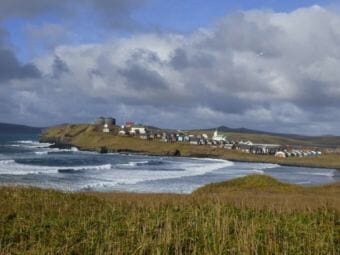
St. Paul Island will continue to have flights to Anchorage — at least through Sunday, according to a community notice.
The island could lose all air service after that, and the city of St. Paul fears it will not return until Ravn Alaska’s airplanes servicing the remote community are certified to fly over open water.
A statement from Ravn says the regional airline found out Dec. 13 that the Saab 340 aircraft they planned to lease from former PenAir CEO Danny Seybert to fly to St. Paul will not be available, but they are working to get their aircraft certified to fly to the island as soon as possible.
Since Tuesday, community leaders from St. Paul have been in talks with the U.S. Department of Transportation, the court appointed trustees overseeing the sale, Ravn, PenAir, the Dunleavy administration, and Alaska’s congressional delegation in an effort to keep their flights running over the holidays.
“We’re in a situation where (because of) the transition and possibly no planes available to PenAir Ravn to fly out to St. Paul, that we’re going to have a lapse in service,” said St. Paul Island City Manager Philip Zavadil.
Between now and February — when Ravn’s Bombardier Dash 8 airliners are expected to be certified to fly over water by the Federal Aviation Administration — Zavadil said there are nearly 500 passengers scheduled to fly to and from St. Paul Island.
“I find it unfortunate that the community’s been put in this position,” Zavadil said. “That we’re the ones that are having to address this, and make calls, and find out what’s going on when the airline is the one that has the legal responsibility to provide the service.”
Zavadil said Trident Seafoods has already set up charters to fly in about 240 workers for the snow crab season, and St. Paul officials are exploring that option as well to ensure community members can travel over the holidays.
The attorney for the trustee overseeing the PenAir sale, Michael Markham, said, “As always, it is the intention that the route to St. Paul will continue uninterrupted.”
The aim is to finalize the PenAir sale to Ravn by the end of the year.
“Here’s the rat. You can see it’s little beady eye and you can see it move,” Divine said. “These were taken the first week of September with that wildlife camera right there.”
Then the rat disappeared without a trace until October 21. And that’s been frustrating for Divine’s office with the local tribe, which helps keep the island rat-free.
Can you spot the rat? (Courtesy ECO)
“I’ve never wanted to see a dead rat or have a dead rat in my hand, but that’s very much what I want,” Divine said. “I think everyone wants to see the dead rat. They want to hold it and know that it’s dead.”
Divine says that may sound extreme. But for St. Paul, rat prevention is very important.
“It poses a serious threat to our island. It’s wildlife, its sensitive habitat. It’s an invasive species,” Divine said. “It’s something that would devastate the seabirds and would change wildlife life on the island forever.”
To stop that from happening, Divine says ECO increased its already formidable anti-rat program after the first sighting. They added traps, changed bait, and installed game cameras to bolster the rat prevention measures at all points of entry on the island.
But Divine says they’ve since learned that might not be the best response.
“By placing more traps or having more human activity around, we may have scared it away or encouraged it to move it’s home location,” Divine said. “We would adjust our response in the future to that.”
That insight comes after ECO reached out to the Alaska Maritime National Wildlife Refuge, which agreed the threat was so severe that they chartered a plane for a team of rat eradication experts.
Today they’re replacing rusty traps that have succumbed to extreme weather conditions.
“Making sure that your biosecurity measures work is really critical. You literally have one chance to catch that rat. And you you want that trap to fire when it fires,” said Chris Gill of Island Conservation. “Islands only make up less than 5 percent of the Earth’s land mass, but they harbor a disproportionate portion of endemic species,” Gill said. “Therefore, when an invasive species, such as a rat, gets to those islands, there’s a high likelihood that an extinction could occur.”
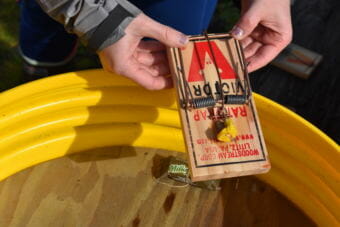
Yellow barrels sprinkled around St. Paul are part of the tribes permanent rat prevention program. (Zoë Sobel/KUCB)
Normally, St. Paul has 43 yellow barrels to catch the rats — inside there’s a trap waiting to snare the rodents.
During their week on the island, the strike team refreshed existing bait stations and added other detection devices — game cameras and temporary stations. They’ve also brought in UV chew blocks that if the rats nibble, they’ll be able to track the invaders glowing poop.
Plus, the team did a lot of good old fashioned sleuthing.
“You have a number of hiding places on this island and you have to get into every single house and every single nook and cranny to ensure you’ve targeted every single rat on the island,” Gill said.
They inspected nearly every commercial building or abandoned structure around the fish plant.
Refuge Manager Steve Delehanty estimates the strike teams response has cost about $50,000 so far. But he says that’s a fraction of the price tag if rats were to take hold on St. Paul.
“I can’t tell you how many zeros, but it would be a lot of zeros if you were going to do an eradication,” Delehanty said.
There’s only been one island in Alaska — Hawadax, formerly known as Rat Island — where rats have been eradicated. That cost millions and it was uninhabited.
But for St. Paul to stay rat-free, Delehanty says success will depend on residents.
“The make or break is the people who live here. It’s their community. It’s their island, and it’s going to be their ongoing diligence and monitoring through the years to keep it rat-free,” Delehanty said. “That’s what will be essential.”
And Divine says ECO is up to the task.
“We scaled back the number of traps,” Divine said. “We’re using a deadly combo of peanut butter and bacon grease, and we’re switching out all of our baits from Three Musketeers to Almond Joys because apparently that is the most attractive bait for a rat.”
A child experiences the feeling of being stuck in a glue trap. (Zoë Sobel/KUCB)
Now, it’s a waiting game.
Divine says ECO will remain on high alert through the end of November, with staff checking traps and bait stations twice a month.
At that point, if there’s still no sign of the rat, they’ll reevaluate the risk and meet with the city, refuge, and strike team to decide how to proceed.
Divine says they’d all love to have a body to learn more about the furry intruder. They could determine what species of rat it is, it’s gender and use genetic testing to narrow down where it came from.
But even if they never collect a corpse, she says the whole experience has been helpful in preparing for the future.
“I hope we never get another rat because it’s exhausting,” Divine said. “But if we do, the education of just knowing the employees of each entity can work together and cover a certain area or do a certain task or divy up the work has been very helpful for us to have.”
Although this rat is still at large, Divine is aware of increased risks at the airport. With new flights originating from places like Unalaska with lower rat prevention measures, she’s concerned that will mean a higher likelihood of another unwanted rat visitor.
For more than two decades, the Pribilof Islands have implemented a rat prevention program to keep the island rat-free. (John Ryan/KUCB)
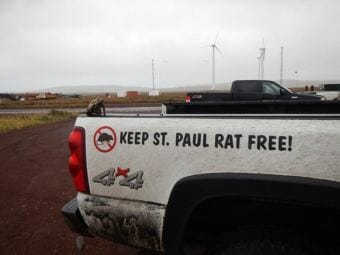
A rat is loose on St. Paul Island. And that’s a big deal because the Pribilof Islands have always been rat free.
Steve Delehanty, Refuge Manager for the Alaska Maritime National Wildlife Refuge, says rats bring significant economic and environmental concerns.
“They damage people’s property. They damage food storage. They damage ship and boat electronics. They damage wildlife,” Delehanty said. “They eat birds, they eat bird eggs, they eat chicks. They can also transmit diseases.”
For more than two decades, the Pribilof Islands have had a rat prevention program to keep the island rat-free.
“They maintain year-round, 365 days a year traps in strategic locations near the docks at St. Paul, so if a rat comes off a boat hopefully it will be captured right away,” Delehanty said.
During that time, six rats have been killed, but Delehanty says this is the first to make it past the traps near the docks.
A rat sighting was first reported in late August at the Trident fish processing plant and is still at large. The U.S. Fish and Wildlife Service is working alongside Trident, and the city and tribal governments to find it.
The quick response, Delehanty says, may help stave off the worst case scenario: breeding rats.
“If there’s more than one rat there and they are breeding, then they’re already having babies,” Delehanty said. “We want to get at it when there are two rats on the island, or six or eight rats, not when there’s 56 rats or a 1,000 rats.”
For now, organizations on island are working diligently to find the intruding rodent. They’ve set up a game camera and they’re planning to send a “strike team” of experts to the island next week.
Not only do they want to eradicate any rats, they hope to determine the source of the rodent.
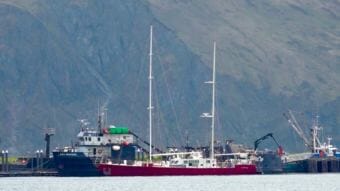
The crew of the S/Y Infinity hopes to transit the Northwest Passage and circumnavigate the top of Greenland by the end of September. (Chrissy Roes/KUCB)
The crew of the S/Y Infinity pride themselves on exploring untouched places around the world while raising a little environmental awareness along the way.
But when the sailboat passed through Unalaska this summer on its way to the Northwest Passage, one crew member had a questionable interaction with a bald eagle.
The Instagram video posted on May 28 shows a gloved hand reaching out towards a bald eagle perched on a dumpster.
“Don’t get upset,” Nico Edwards tells the eagle. “I’m going to touch you a bit. This is the hand, and it’s going to touch you gently.”
He continues approaching the eagle, which moves away and shrieks.
“I want to touch you, you don’t want me to touch you, and there are some problems associated with this thing,” says Edwards. “Well, don’t be offended by the touching that’s going to happen. Shhh. You need to be quiet.”
The video was shot not long after the Infinity arrived in Unalaska before attempting to transit the Northwest Passage to Alert, Canada — the northernmost permanently inhabited spot in the world — and circumnavigate the top of Greenland.
When KUCB toured the 120-foot sailboat, Edwards joked about getting injured for publicity, in an exchange with crew engineer Victor Legros.
“I think — but it’s not a universally shared thing — that it would be good if somebody were to die or get heavily maimed,” said Edwards. “It would help us get PR.”
“He’s trying to get me to pet eagles,” said Legros of Edwards. “So that they hopefully mangle my face or my fingers on camera.”
“You can display your mangled nubs,” said Edwards.
That humor doesn’t play well with those who regulate eagle-human interactions.
“We would encourage anyone to avoid trying to touch or capture eagles,” said Jordan Muir of the U.S. Fish and Wildlife service. He monitors raptors in the state of Alaska.
Muir didn’t respond to questions on this specific eagle incident. But he said pestering the birds is illegal and dangerous.
“Eagles have extremely powerful talons and feet,” he said. “They are capable of killing large animals. We wouldn’t want to see anyone injured by them. And eagles themselves — they’re really fragile animals, believe it or not, with hollow bones. That makes them susceptible to injury by people with even the best intentions.”
Oftentimes, penalties come down to whether the interaction was intentional.
“If it’s an unintentional act, we really try to work with the public to inform them and educate them,” said Muir. “If there’s a need to gather eagles or collect them, we’ll work with them through the permit system to best address their issues and help the situation.”
It’s unlikely Edwards had a permit when he approached the eagle.
The crew of the Infinity has a history of flouting regulations.
When they went to Antarctica in 2014, they didn’t have permits or insurance. Edwards said they were caught after posting pictures on Facebook. That expedition is chronicled in the documentary “Sea Gypsies: The Far Side of the World.”
Ultimately, the crew was fined $270.
“If we had gotten a guide, it would have been thousands and thousands of dollars,” said Edwards. “And we were careful. We washed our boots. We didn’t want to put the penguins at risk. We took all our trash with us. We sailed on the power of the wind and sun. We’re way better than all those cruise ships. But we got a lot of flack for that — $270 worth of flack.”
Edwards said it’s better to ask for forgiveness than permission. At this point, it’s unclear if he’ll be penalized for disturbing eagles in Unalaska.
His last social media posts show the Infinity in Teller on July 12. The crew hopes to conclude their expedition by the end of September.
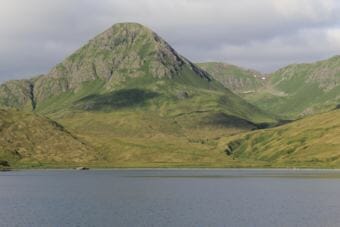
Attu village was located in Chichagof Harbor before the Attuans were taken as prisoners during World War II and then forbidden to return home. (Photo by Zoe Sobel/KUCB)
Descendants of Alaska’s westernmost island want permanent access to their ancestral home.
The Native people of Attu have been separated from their homeland since World War II.
In the 1700s, the Russians colonized the community during the fur trade.
Two hundred years later, the Japanese military arrived and took the Attuans as prisoners of war to Japan, where half of them died in captivity.
The U.S. government sealed off the island and forbade survivors from returning home.
“I want my children’s children’s children to be able to go back to Attu with no cost to us,” she said. “Thats the justice that needs to be done on our people. The U.S. government, the Japanese government, and the Russian government took our culture away. And we need your help since (Fish and Wildlife) owns the island.”
The agency oversees the Alaska Maritime National Wildlife Refuge, which cares for most of the island — although the Aleut Corporation still owns the Attu village site.
Top officials said Fish and Wildlife is open to the idea of descendants returning.
They hosted a conference call in late July to begin the discussion.
Theresa Deal joined Schmitz in representing the Attu descendants.
“It should not be a once-in-a-lifetime trip,” Deal said. “Would I want to go back again? Yes, I’d be thrilled to get to go back again.”
Deal was part of the group that visited Attu last summer.
Her mother, Marina Hodikoff, was born on the island, but Deal grew up disconnected from her culture in the Pacific Northwest.
After making the meaningful trip, Deal wants the same opportunity for her children.
“I would have liked to have had my sons there, because then we can all help process the emotions — and how neat it is to be up there,” she said.
Deal also would like the trips to be open to spouses and significant others.
They may not be Native themselves, but she said they’re part of descendants’ lives and provide an important support network as they deal with the trauma of displacement.
Alaska Maritime National Wildlife Refuge Director Steve Delehanty said he’s ready to listen to these requests. He’s not Attuan, but he understands where they’re coming from.
“We humans have these place connections that mean a lot, so it’s totally understandable that it’s coming from them,” Delehanty said. “I also think it’s quite understandable that they’re reaching out to the Fish and Wildlife Service to say, ‘Do you have any ideas for helping to make this happen?’ Because we were able to do so in a small way last year.”
While descendants made that trip aboard the research vessel Tiglax, there’s also an airstrip on Attu, so it’s possible to fly.
Still, at this point, Delehanty said descendants need to get more specific.
“Is it only the physical ability to walk on the island?” he asked. “Is it being on the village site itself? Is it more of a cultural connection? Or I don’t know what.”
Delehanty said involving more people may lead to creative solutions and funding.
He’s reaching out to other federal entities that have a stake — including the National Oceanic and Atmospheric Administration, the Bureau of Indian Affairs, the Department of Defense, and the U.S. Coast Guard — and inviting them to join the conversation.
“We have to put on the table what the wish is, what the vision is, and then what the possibility is — and see if there’s any overlap,” he said.
For their part, Deal and Schmitz seek funding from private entities and the possibility of creating a trust for the program.
There’s no set date for when anything will happen, but the group is planning to continue the conversation this fall
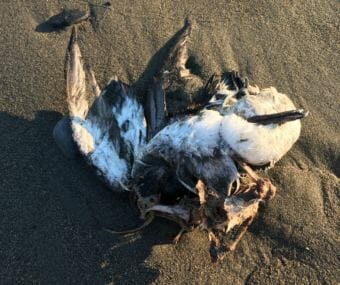
A dead murre that washed ashore in Nome in June 2018. (Photo: Zoe Grueskin, KNOM)
Since May, hundreds of dead and dying seabirds have been found across the northern Bering and southern Chukchi seas.
The National Park Service and the U.S. Fish and Wildlife Service (USFWS) have labeled the event a die-off and are coordinating efforts within local communities.
“These birds have been starving,” said Kathy Kuletz, a wildlife biologist for the USFWS. “They’re very emaciated. Their muscles have atrophied. There’s a lot of physical signs inside the body they’ve been starving.”
So far, there has been no evidence of disease or toxins in the seabirds.
But coastal communities on St. Lawrence Island, near Nome, and in Shishmaref have all found dead birds — including murres, fulmars, shearwaters, kittiwakes, auklets, and puffins — washing up on shore. Kuletz said most of the carcasses were found in June, but have continued through the summer.
This die-off is unusual because of the duration and large geographic area. Since the spring, seabird die-offs have also been recorded in the Pribilof Islands and the northern Gulf of Alaska.
Kuletz said it’s concerning from an ecological standpoint and because the birds are a food source.
“People who live in these remote communities, they rely on birds for eggs or for the meat,” Kuletz said. “They have noticed the birds weren’t coming to the colony or they were finding sick birds, birds acting odd.”
Dead murres. (Courtesy U.S. Fish and Wildlife Service)
This die-off is separate from an event that began in 2015 and killed an estimated half million common murres in Alaska.
But researchers hypothesize it could be connected to the blob, like that die off was. Although at this point, Kuletz said scientists haven’t proven that link.
There’s not much scientists can do besides monitoring the die-off.
But because there isn’t baseline data in many areas, Kuletz said that poses a particular challenge.
“It’s going to be hard to tease apart what is normal level, baseline level, compared to the changes in conditions,” Kuletz said. “And things are definitely changing up here.”
Kuletz says they are working alongside other agencies including the National Oceanic and Atmospheric Administration and U.S. Geological Survey to determine what the ocean conditions were like before the die-off.
If you see dead of dying birds, you can report the sighting to the USFWS at 1-866-527-3358.
Close
Update notification options
Subscribe to notifications
Subscribe
Get notifications about news related to the topics you care about. You can unsubscribe anytime.