The drafted ordinance would prohibit plastic bags at Unalaska’s grocery stores, including Safeway. (Berett Wilber/KUCB)
City Councilors and community members in Unalaska expressed support Tuesday night for an ordinance that would ban single-use plastic bags in Unalaska.
As it stands, the proposed ordinance would put the burden on retailers. Starting Jan. 1, businesses would receive $100 fines for providing a customer with a disposable shopping bag. That does not include plastic bags used to package bulk items like fruit.
Vice Mayor Dennis Robinson first added the issue to a City Council agenda in April and said he fully supports the ban.
“I think we need to get away from plastics,” Robinson said. “If you have eaten a fish out of the sea in the past 10 years, you have nanoplastics in your blood from that fish. It’s a horrible thought.”
Nearly a dozen Unalaskans voiced their support for the bag ban. But some, like Abi Woodbridge, said it doesn’t go far enough.
“In the very near future, I highly recommend that straws be added, but also the industrial use of plastics on the docks,” Woodbridge said. “When people shrink wrap pallets, that stuff gets loose. It ends up in the bay.”
Earlier this month, Seattle became the first major U.S. city to ban drinking straws. Now, food packaging in the city must be recyclable or compostable.
No one expressed opposition to Unalaska’s ban, and councilors said they may add other plastic items.
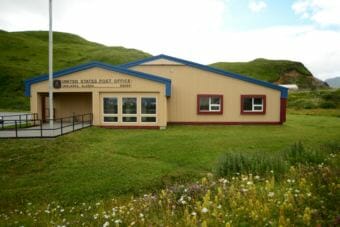
The Unalaska post office has had inconsistent service since last summer. The branch lost its Saturday service, and then package and counter hours were cut back. Some days, it didn’t open at all. (Photo by Berett Wilber/KUCB)
The Unalaska post office has had reduced service for months. But officials say that’s due to staffing shortages — not an attempt to shutter the branch
“No, there is nothing in the works for closing a post office in Unalaska/Dutch Harbor,” said Dawn Peppinger, a marketing manager for the U.S. Postal Service. “There are no plans for that.”
Currently, the Unalaska post office is open for package pick-up on weekdays from noon until 4 p.m. Counter service also reopened recently so patrons can buy stamps.
But the branch has experienced inconsistent service since last summer.
First, the post office lost Saturday service. Then, package and counter hours were reduced. There were even some days when the post office didn’t open.
Mayor Frank Kelty said that’s a fraction of the service available at the island’s other post office.
“On the Dutch Harbor side, they have six days a week service, they have four hours’ service on Saturday, and they have three to four employees on that side,” he said.
Kelty said he’s received complaints from many community members, and he’s shared their feedback with the Postal Service.
“What bothers me is that the majority of residential customers, the school, the clinic, and City Hall are all on the Unalaska side,” he said. “I think that should be given some extra weight.”
But Peppinger said the Unalaska branch has fewer hours because it gets less traffic.
“There’s more revenue going through the Dutch Harbor post office,” she said. “That makes sense when you look at where it’s located. It’s in the business area. You’ve got the store right next door. You’ve got the airport right next door. And so the Postal Service wants to support where the need is.”
Still, Peppinger said the organization is working to hire more staff for Unalaska. A new candidate is already moving through the hiring process, and the Postal Service is hoping to fill another clerk position as well.
Asked why it’s taken so long to hire, she said it’s hard to attract good candidates to Unalaska, in part because of the remoteness, cost of living, and limited housing options. Once someone is hired, she said it’ll take a few weeks of training before they’re ready to start work.
At this point, there is no timeline for when the Unalaska post office will return to regular hours.
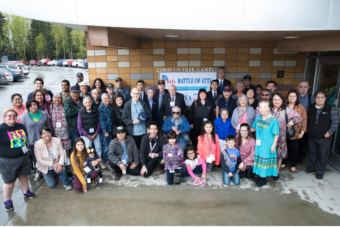
Aleutian veterans, Attuan survivors and descendants, and the families of Japanese soldiers gathered to commemorate the 75th Anniversary of the Battle of Attu in 2018. (Photo by Lisa Hupp/USFWS)
It’s been 75 years since thousands of young soldiers lost their lives fighting over the westernmost point of the United States. Seventy-five years since the Alaska Native people of Attu were taken from their homes never to return again.
This weekend, former Attu residents, as well as veterans of the Aleutian campaign and descendants of the Japanese soldiers joined together to commemorate the tragedy and honor the legacy of those lost.
In war, no one walks away unscathed. The Battle of Attu was no exception.
But 75 years after one of the deadliest battles fought on north American soil, representatives from all affected parties joined together to ensure this history is never forgotten.
The closing ceremony was held in an airplane hangar at the Alaska Aviation Museum.
While the Aleutian campaign is not well known and often called the forgotten war, Mayor Crystal Dushkin said that’s not true for her.
Crystal Dushkin speaks at the closing ceremonies of a 75-year anniversary commemoration of the Battle of Attu in 2018. (Photo by Lisa Hupp/USFWS)
“I’m here to tell you that for our people – the Unangax people of the Aleutian islands and those descendants of the people of Attu — it has never been forgotten and it never will be.”
Dushkin’s grandmother Mary Snigaroff, née Prokopeuff, was born on Attu and later moved to Atka.
Forty-two Attu residents were taken to Japan and held as prisoners of war. Nearly half died of malnutrition and starvation. After the war, the U.S. government would not allow them to return home to their island.
Unangax from other Aleutian communities were rounded up by the federal government and placed in internment camps in southeast Alaska.
Dushkin said during World War II, Unangax were caught in a crossfire between the U.S. and Japan.
“It was not our fight to begin with, not our battle, not our war,” Dushkin said. “Yet our people suffered immeasurably both at the hands of the Japanese and at the hands of the U.S.”
Dushkin hopes that the commemoration can help ensure the Aleutian campaign does not continue to be the forgotten war – in Japan or in America.
Retired Lt. Col. Bob Brocklehurst agrees. He was the first fighter pilot on Attu, but he didn’t learn about what happened to the Unangan people until last year.
He wants the documentary film, When the Fog Clears – which premiered at the commemoration – to be widely distributed. It showed him that the opposing Japanese soldiers weren’t any different from him.
“The film showed the Japanese with the same love for family. The same worries about their son in combat and army units, and the same respect that the son in uniform had for his wife back home,” Brocklehurst said. “Exactly identical to an American family.”
Motoaki Asano came from Japan to attend the commemoration. His father Hiroo Okazaki died on Attu and is still buried there alongside more than 2,000 other Japanese soldiers. He spoke through a translator.
“My father’s body is still on Attu, so I would like to bring him back as soon as possible,” Asano said.
Joseph Sasser and Helen Ford share Attu mementos at a 75-year anniversary commemoration of the Battle of Attu in 2018. (Photo by Lisa Hupp/USFWS)
Asano said he learned about the suffering the Attu people endured during WWII, and is honored to work to make sure future generations never forget the forgotten war.
“Some people in Japan are just looking toward the future and they’re not trying to look towards the past, so I have to work hard to keep this memory alive,” Asano said.
This request to return the Japanese soldiers remains to Japan has been made of the Japanese government three times.
Returning the remains would be complicated, but Alaska Maritime National Wildlife Refuge manager Steve Delehanty said not impossible.
After the closing ceremonies, the U.S. Fish and Wildlife Service got their own request from Attu Descendant Helena Schmitz.
“I want my children’s, children’s children to be able to go back to Attu with no cost to us,” Schmitz said. “That’s the justice that needs to be done on our people. The U.S. government, the Japanese government, and the Russian government, took our culture away. And we need your help since (the USFWS) owns the island.”
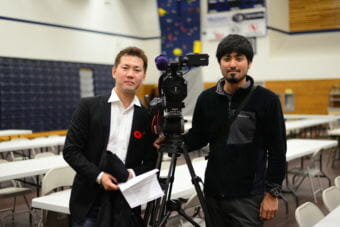
Tadashi Ogawa, left, visited Kiska and Attu last summer to shoot footage for “When The Fog Clears.” (Photo by Berett Wilber/KUCB)
The Aleutian Islands served as the battleground for some of the bloodiest conflicts on American soil since the Civil War. But most people have never heard of the Battle of Attu, the invasion of Kiska, or even the Aleutian campaign.
The Japanese filmmaker has produced a new documentary on World War II.
Growing up in Yokohama, Tadashi Ogawa learned a bit about the Battle of Attu in school. More than 2,300 Japanese soldiers lost their lives.
A decade ago, he stumbled upon a story in a newspaper that motivated him to dig even deeper.
The article was about a Japanese woman whose husband served on Kiska Island during WWII.
“He died there because a U.S. submarine attacked his ship,” Ogawa said. “But before that happened, he wrote a letter to his wife. He picked up a flower off Kiska Island, and he enclosed it with his letter.”
The man’s wife, Chiyo Shinoda, treasured the flower and kept it all her life.
Sixty-seven years later, when she was 98, she received another Kiska flower in the mail.
“But of course, it’s not from her husband,” Ogawa said. “This time, it was an American who was the son of (the captain of) the submarine that attacked her husband’s ship.”
Ogawa considers it a miracle — this connection between Japanese and American families who both lost loved ones in the war.
He wants to use their story of transcontinental friendship to explore the Aleutian campaign.
Last summer, Ogawa visited Kiska and Attu to shoot footage of the Kamchatka lily, the flower that started it all.
In the course of his research, he also learned about the Attuans’ captivity in Japan, which he was never taught as a child in school.
“I was pretty shocked when I knew that some Aleut people were taken as prisoners of war to Japan,” Ogawa said.
Seventy-five years after the war, Ogawa hopes his documentary will help Americans and Japanese better understand the atrocities people faced on both sides of the conflict.
“Now, many people have started talking about what happened,” Ogawa said. “I think they’re feeling like they are running out of time. If I can make a film, it’s going to be great to help them tell a story.”
Damian Lopez Plancarte, Mary Heimes, and Ronan Gray pulled a child out of a crevasse at Portage Glacier. (Photo courtesy Ronan Gray)
Three Unalaska residents will be honored by the Anchorage Municipal Assembly.
On April Fool’s day, Ronan Gray, Damian Lopez Plancarte, and Mary Heimes helped rescue a child from a crevasse on Portage Glacier.
Their flight home had been cancelled, so they went for a walk. And they were approached by a man who said his son was trapped in the ice.
“When I got to the crevasse and looked down it was just black. You couldn’t really even see anything,” Gray said. “I heard whimpering and then I saw movement. I saw the top of his head. That was when the extremity of the situation really hit me because I was frightened. I couldn’t even fathom going down there myself.”
But Gray did climb into the crevasse. He says it was less than two feet wide. The responders set up a rope and three people served as a human anchor while Gray was lowered 30 feet into the chasm.
Ronan Gray climbed 30 feet into the crevasse to pull out Jack Crockett. (Photo courtesy Ronan Gray)
“Once I got down into the hole, we got him out in about an hour,” Gray said. “He’d been down there about an hour before I got there.”
Gray says Jack Crockett was just wearing a t-shirt, so by the time he was pulled out of the glacier, Crockett had mild hypothermia.
Search and rescue volunteers took him to an ambulance where he warmed up. Crockett walked away with a few bruises.
Gray is an experienced climber and alpinist, but this was his first time participating in an ice rescue and he has no first aid training. This event, he says makes him want to learn more about those things.
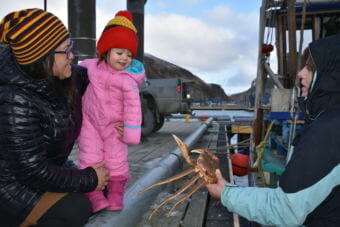
Buying local crab gave Rubi Warden an opportunity to show her daughter Pia where their food comes from. (Zoë Sobel/KUCB)
Unalaska is America’s fish capital. More seafood is hauled into Dutch Harbor than anywhere in the country, but for residents it’s not easy to find fresh fish unless they catch it themselves.
At the local grocery stores even seafood caught in the Aleutians is exported before landing in freezer cases. But it’s getting a little easier to get locally caught seafood on the dinner table.
It doesn’t happen often in Unalaska, but fishermen can sell their catch directly to customers. If you’re imagining a fish market, wipe away that image.
Buying fresh seafood means going directly to a boat like Roger Rowland’s. On a weekday in January people like Rubi Warden are crowding onto the dock to pick out tanner crab.
“Can you help me to carry it to my truck?” Warden asked.” “I’m buying $400 worth for three families.”
Warden and her daughter Pia are buying 48 crab. She’ll serve some of it to her parents when they visit from Hawaii.
Fishing is a family affair for Roger Rowland. Here his daughter helps fill an order. (Zoë Sobel/KUCB)
Local crab hasn’t been sold on the dock in two years.
This is Rowland’s second time selling crab this season. The first time they took pre-orders, but today anyone can buy. It’s $12 a crab or 12 for $100.
“This year they’re very nice, very big,” Rowland said. “It’s really encouraging to see the really nice product.”
Selling fish off a boat doesn’t involve too much paperwork. The Alaska Department of Fish and Game requires a catcher seller permit to be completed along with a $25 processing fee.
Another way it’s getting easier to find local fish in Unalaska is at restaurants – at least at all the dining establishments owned by UniSea, one of the big processing plants in town.
Vic Fisher looks forward to Taco Tuesday the way most people look forward to the weekend.
“I’m sitting on Monday and I’m thinking about Taco Tuesday,” Fisher said.
He’s excited to try tonights’ menu: Alaska cod “just off the boat” marinated in chili lime sauce with cabbage slaw, and chipotle creme fraiche.
“I love fresh caught anything,” Fisher said. “This is fresh cod and this is absolutely a new thing. I’m down for it.”
The person responsible for all this fresh fish at the restaurant is Brett Richardson, the general manager of the Grand Aleutian Hotel. He’s been around for six years and says previous managers served fish from Asia.
“I was wondering why we weren’t serving fish that we caught. If only, not having to pay shipping costs,” Richardson said. “Something that’s local and something that I think tastes pretty good should be on the menu.”
His first move was to shift the hotel’s weekly seafood buffet from a cornucopia of products from around the world to just Alaska fish — cod, pollock, salmon, and scallops.
All the restaurants at the Grand Aleutian Hotel are serving fresh, local fish seasonally. (Zoë Sobel/KUCB)
In some ways it makes his job more difficult. He’s responsible for picking up the fish.
“We don’t have a delivery structure,” Richardson said. “I literally just drive my little car over, put it in the trunk, and bring it on over.”
He can get fish so fresh it’s been off the boat for less than an hour. Workers process the fish on a slime line and instead of taking it to the freezers as they would for international customers, they walk it out to Richardson.
Even with Richardson’s three restaurants at the hotel and a few more nearby starting to serve local seafood, it’s still not easy to find fresh fish on the island.
Why is it so challenging? Richardson says it could be similar to why you can’t get good coffee in Java, Indonesia.
“The only thing they had there available for anybody was Nescafé,” Richardson said. “They export all of their coffee because other markets will pay much more premium products for that.”
Because of the seasonal nature of Alaska’s fisheries, there won’t be fish this fresh available year round. Richardson says the prime season is at the beginning of the year, but he thinks they’ll likely still have local cod through the end of April.
Close
Update notification options
Subscribe to notifications
Subscribe
Get notifications about news related to the topics you care about. You can unsubscribe anytime.