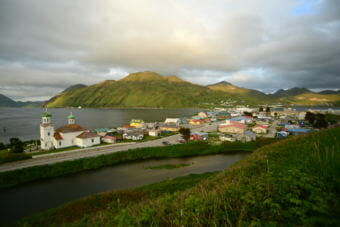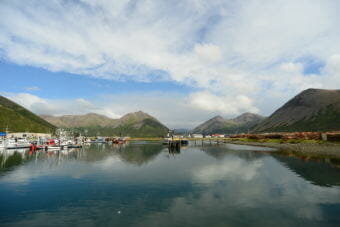
A view of King Cove, which may be allowed to build a controversial road under the Trump administration. (Photo by Berett Wilber/KUCB)
The Aleutians East Borough plans to join the legal battle over a land exchange that would allow construction of a controversial road between King Cove and Cold Bay.
In January, Interior Secretary Ryan Zinke signed a land exchange agreement with the King Cove Corporation that would allow for a road through the Izembek National Wildlife Refuge.
Assembly members voted unanimously last week to intervene on the side of the federal government in the lawsuit environmental groups brought against the Interior Department to stop the road.
The Borough approved spending $61,875 to hire a law firm to help them join the case.
That money will also help four other local entities trying to intervene on behalf of the federal government, the King Cove Corporation, The City of King Cove, the Agdaagux Tribe, and the Native Village of Belkofski.
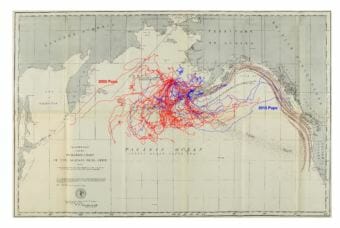
This map shows contrasts in travel between tagged seal pups in 2005 and 2015. These are portions of the pup tracks in November-December, after they left their birth islands. The tracks are overlaid on an 1895 chart displaying the understanding at that time of where northern fur seals traveled during their migration. (Courtesy Noel Pelland/Proceedings of the Tribunal of Arbitration at Paris, Volume 7.)
In the late 1800s, the U.S. Secretary of the Treasury sent Captain C. L. Hooper to the Pribilof Islands to learn as much as he could about the northern fur seal from the Alaska Native people who lived there. At the time, the fur trade was big business.
One of the lessons he recorded was that the seals are known to travel with the wind when possible. Now scientists have the data to back up that traditional knowledge.
“We have this amazing technology that really allows us this very cool look at the lives of an individual animal and where it goes and what it does,” said Noel Pelland, physical oceanographer and postdoctoral researcher at NOAA’s Alaska Fisheries Science Center. “That’s helping us to quantify some of those things that have been discussed by the Aleut hunters.”
Pelland is studying how climate affects the survival of northern fur seals in the Bering Sea, and wind may be an important factor.
After pups leave the Pribilof Islands in late fall, they can migrate thousands of miles. Varying wind conditions mean pups can end up in a range of locations from the Aleutian Islands to the Gulf of Alaska.
Pelland wants to know if the way the pups migrate, and where they end up, is affecting their survival.
“In the best years about 50 percent of the pups that leave on their migration will make it to age two,”Pelland said. “In the worst years only about 20 percent of the pups will make it through their migration.”
So far, Pelland and his colleagues have compared data from satellite tagged pups with weather models. Now, they want to compare year-to-year changes in the survival of the pups with where the pups end up.
And he says the research helps make the case for all scientists to take traditional knowledge into account.
“There’s this idea of a separation between ‘scientific knowledge’ and traditional knowledge. I think a much better way to look at it is as an continuum,”Pelland said. “There isn’t this formal separation. It’s all knowledge.”
Wind might not be a factor in the fur seal decline, Pelland says but a better understanding of its role is important.
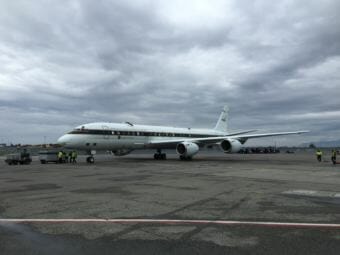
A NASA DC-8 was used to sample the uranium particle. (NASA)
Scientists found an enriched uranium particle over the Aleutian Islands and don’t know where it came from. In 20 years of aerial surveys, it’s the first time researchers have detected a particle like this. It’s not naturally occurring uranium – it’s the kind that might be found in nuclear bombs or fuel.
Dan Murphy wasn’t looking for uranium in August 2016. He wasn’t attempting to sample any radioactive material. He was looking into what particles are in the atmosphere as part of a global survey that could help people better understand air pollution and the climate for the National Oceanic and Atmospheric Administration.
During the flight from Anchorage to Hawaii, Murphy collected thousands of particles and it wasn’t until he was analyzing the samples back on the ground that he realized what he had.
“We have this mystery particle that we have no way of making that we know about,” Murphy said. “Right now it’s sort of an interesting mystery.”
The mystery particle is enriched uranium — the type of uranium associated with nuclear fuel or bombs, but Murphy says people of the Aleutians do not need to be worried about one atmospheric particle of uranium.
“It’s not going to change world politics,” Murphy said.
The particle was so small that it can’t be seen even with a small optical microscope.
What Murphy can tell is that the uranium probably came from somewhere in Asia. But even using wind trajectories and particle dispersion models, he can’t pin it on a specific country. Murphy says this discovery won’t change how he does his research.
“This was rare enough that I don’t think if I did more flights I would see another one,” he said.
Murphy recently published a paper about the particle with the hope that another scientist – maybe one who knows a lot about uranium will help solve this mystery.
When Unalaska last looked into wind power there was no technology strong enough to withstand the island’s wind. (Photo by Berett Wilber/KUCB)
Unalaskans know the island’s wind is strong — it can blow over 100 miles per hour.
Back in 2005, the city council funded a study to see if that wind could be used for power generation. The former city manager, Nancy Peterson, said that they basically concluded that it wasn’t possible because there was no technology strong enough to withstand Unalaska’s wind.
“We are now 12 years later,” Peterson said. “A lot of technology has changed. There have been a lot of tried and true wind projects throughout the state.”
In October 2017 the city decided to look into it again, and they sought out the help of Josh Craft of the Alaska Energy Authority.
“We all know that it is very windy here,” Craft said. “But we have to find the right wind resource and the quality of wind resource is very important.”
Craft has been advising the city since last fall.
During a recent visit to Unalaska, Craft drove around to look at places the city is considering placing wind turbines. He thinks there’s definitely potential here, but the crazy topography of this volcanic island does pose some challenges.
“The wind is very different even 100 yards away from you at any given time,” Craft said. “We really have to be site specific and figure out where the best place is.”
Sometimes Craft says, the best place to put a windmill isn’t necessarily where the winds are strongest; it’s a combination of finding a place with consistent wind that is not turbulent. A location like that will help protect the turbines.
The city needs to study the wind for at least a year. Craft recommends that multiple towers are set up around the island to get a better idea of which way the wind is blowing — and more importantly how consistently it’s blowing.
With lots of community interest in renewable energy, city councilors and residents are eager to find out if wind will be Unalaska’s ticket to a greener future.
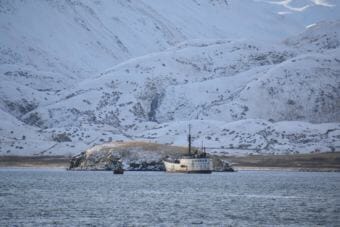
The F/V Akutan was moored in Unalaska’s Captains Bay for six months. (Photo by Zoë Sobel/KUCB)
The City of Unalaska will pay $36,000 to help sink a boat that’s already on the ocean floor.
The state scuttled the F/V Akutan last month with help from the U.S. Coast Guard, but they moved forward before collecting funds from the city. That’s left councilors debating whether they should chip in at all. The final vote was almost unanimous.

Councilor James Fitch was all for it.
“We are obligated to pay this because the job has already been done,” Fitch said.
The F/V Akutan was abandoned in Captains Bay in September – following a disastrous fishing season in Bristol Bay, in which the ship’s owner went broke, the crew went unpaid and it’s 80 ton haul of salmon was declared unfit for human or animal consumption. The Coast Guard assisted the state in performing an emergency scuttle of the processor in late January.
Councilor Roger Rowland was the sole objector — a position he has held for weeks. He says funding this will set an expensive precedent if other mariners decide to abandon boats near Unalaska.
Plus, he says state officials hired Resolve Magone Marine to help with the scuttling before securing municipal funds.
“This contract was let without any guarantee from the city,” Rowland said. “We are not obligated to pay this money.”
It’s unclear how much the disposal cost. The Alaska Department of Natural Resources has not responded to multiple requests for comment.
Councilors are also taking steps to avoid future problems with abandoned vessels. They unanimously passed a resolution Tuesday night supporting Senate Bill 92, which would create a statewide derelict vessel prevention program and fund.
Vice Mayor Dennis Robinson also expressed interest in reviewing the city’s status as a “potential port of refuge” — the designation that brought the Akutan to Unalaska.
Currently customers at Unalaska’s Safeway can choose to have their groceries packed in plastic bags, paper bags, cardboard boxes, or purchase reusable bags. (Berett Wilber/KUCB)
Some Unalaskans want the city to ban single use plastic bags. Twenty-five residents met last week to strategize on how best to make their case to the city.
Mary Heimes says for a community that relies on the ocean, eliminating the bags should be a no brainer.
“You know we pull a lot of money out of the ocean in this community and we have a social responsibility to take care of the environment,” Heimes said.
This is not Unalaska’s first attempt to ban single use bags. In 2013 a petition asking the city council to “eliminate the use of plastic bags by Unalaska stores” circulated around the community, but went nowhere. In Alaska, the bags have been banned in Kodiak, Wasilla, Bethel, Cordova, and Hooper Bay. Homer briefly prohibited the bags, but the ban was overturned by voters.
This group is prepared for pushback against their efforts — from stores and restaurants.
“I’m all for the environment,” said Safeway store manager Abe Palmer. “I’m not against the plastic bag ban, but when you look at the overall picture the people who are going to suffer are the people in the community.”
Without plastic bags, Palmer worries it will be difficult for people who walk with their groceries. He says rainy weather would destroy paper bags. And Palmer says a plastic bag ban would make groceries more expensive.
“The elevated cost of what a paper sack is is five times what it is for a plastic sack,” Palmer said. “All those costs would not be absorbed by the company. It would be absorbed going out into the customers’ market.”
He thinks education and reestablishing the recycling program could have the same effect as a plastic bag ban.
Vice Mayor Dennis Robinson says whether it actually is more expensive to eliminate single use bags is a matter of weighing immediate versus future costs.
“It may be expensive to me to get rid of my garbage, so I’m going to pass that on to future generations,” Robinson. “That’s what we’re faced with on this island. [Our] landfill is filling up a bit quicker than they expected.”
Robinson says he has asked for the issue to be scheduled for discussion at a city council meeting next month.
Close
Update notification options
Subscribe to notifications
Subscribe
Get notifications about news related to the topics you care about. You can unsubscribe anytime.