Zoë Sobel, Alaska's Energy Desk

Invasive species haven’t made the Bering Sea their home…yet

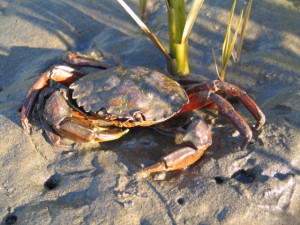
European Green Crab.
European Green Crab. (Public Domain photo courtesy of Washington Sea Grant)

Native species are well adapted to living in the challenging environment of the Bering Sea, but increased shipping means there are more opportunities for invasive species to hitch a ride in. And as the waters warm, the ecosystem will become more hospitable making it easier for them to settle.

Zoologist Jesika Reimer is part of a team studying the threat.

“What we really wanted to do was look at what invasive species have the potential to arrive,” Reimer said. “We wanted to know where should we be looking for them — so, what ports are getting a lot of traffic? And we wanted to know if a species arrives, can it survive?”

The reason to focus on the Bering Sea was twofold — first, there aren’t really invasive species there yet and second, it’s one of the largest commercial fisheries in the world and serves as a link to the Arctic.

For the past three years, the team at the Alaska Center for Conservation Science has been compiling data to identify the largest threats. At the top of the list researcher Amanda Droghini says are species that are geographically nearby, reproduce quickly, change their environment or are in direct competition with existing species.

One of the biggest threats is the European green crab.

“The European green crab tends to be a very voracious hungry predator with a high reproductive rate,” Droghini said.

While the green crab can survive in the Bering Sea right now, Reimer says it can’t reproduce.

“It’s not warm enough for them to have offspring and for those offspring to survive, grow, become adults and go on to reproduce themselves, Reimer said. “But when we do look at the climate models and we look in the future we see that as things are warming up we jump over this threshold where European green crab weren’t able to reproduce, where now it opens up so they can.”

Removing invasives once they have taken root is challenging on land, but it is especially difficult in marine environments. So the researchers believe taking a proactive approach will help keep non-native species at bay.

Ideally all of Alaska’s coastline would be monitored — scientists would keep tabs of what organisms exist in a given area and look for changes. And Droghini says there is some monitoring right now being done in Dutch Harbor, Nome, and the Pribilof Islands, but the efforts are patchy and dependent on funding.

“Without a consistent monitoring program how will we ever be able to detect the species when they arrive?”Droghini said. ” We know that the earlier we detect them the greater chance we have of eradicating them”

The next step for the science is fine tuning the modeling to imagine if invasives arrive how they might spread through the Bering Sea and might interact with the existing ecosystem.

Without strict international regulations, ships may continue to — knowingly or unknowingly — transport non-native species wherever they travel.

The Bering Sea has kept invasives at bay for now, but warming waters look to make it a more welcoming environment in the future.

State sinks abandoned F/V Akutan after disastrous season

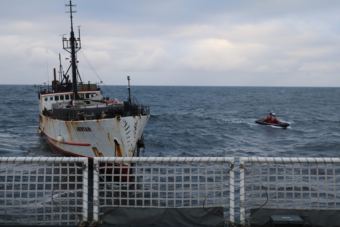
The crew of the Coast Guard Cutter Alex Haley prepares to break tow with the F/V Akutan northwest of Dutch Harbor, Alaska, (Photo courtesy U.S. Coast Guard District 17)

The abandoned boat that plagued western Alaska for months is now on the bottom of the ocean. The U.S. Coast Guard assisted the state by performing an emergency scuttle of the F/V Akutan Thursday, three miles outside U.S. waters.

The processor was abandoned in Unalaska in September following a disastrous fishing season in Bristol Bay where the ship’s owner went broke, the crew went unpaid, and it’s 158,318 pound haul of salmon was declared unfit for human consumption.
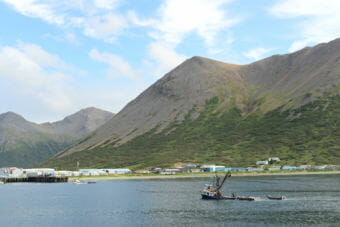
The Alaska Department of Natural Resources (DNR) took custody of the derelict vessel in mid-January. In a press release, the Coast Guard says the scuttle was warranted “given the vessel’s condition and the tumultuous Bering Sea maritime environment this time of year.”

It is unclear how the state funded the disposal. This week, the Unalaska City Council was informed that DNR had asked them to help pay for the removal, but the state and Coast Guard sunk the F/V Akutan before the city had come to an agreement.

Interior Department reaches deal with King Cove for controversial road

King Cove residents argue they need the road to access the all-weather airport in Cold Bay, but environmentalists believe it will do irreparable harm to critical wildlife habitat. (Photo by Berett Wilber/KUCB)

The city of King Cove says it has reached a deal with the Trump administration to build a road through the Izembek National Wildlife Refuge. King Cove residents argue they need the road to access the all-weather airport in Cold Bay. But environmental groups believe it will ruin critical wildlife habitat.

Now, city administrator Gary Hennigh says they have reached an agreement with the Interior Department for a land swap — between the King Cove Corporation and the federal government. He expects the deal to be signed January 22nd in Washington D.C.

“The whole community is excited because after 30 years we do believe this can now happen,” Hennigh said.

King Cove residents say they need the road because bad weather can leave people stranded during medical emergencies. But the 12 mile gravel road would pass through what now is designated wilderness — the highest level of conservation given to federal lands.

“Izembek’s lagoon complex is a globally important ecosystem that contains one of the largest eelgrass beds in the world,” said Nicole Whittington-Evans, Alaska regional director of The Wilderness Society. “There is no question that building a road through the isthmus of this lagoon complex will have significant impacts.”

The Wilderness Society, will challenge the agreement in court, along with other environmental groups. Whittington-Evans says she thinks they will have a good case

“There have been prior land exchanges that have been deemed unfit by the courts and we will be reviewing everything that this agreement puts together,” she said.

In 2013, Former Interior Secretary Sally Jewell rejected the idea of the road saying it would cause irreparable harm to the refuge and the wildlife that depend on it.

But Hennigh isn’t worried about legal battles with environmental groups.

“We have known that that is going to be there. It has always been there,” Hennigh said. “We are comfortable in believing once it is known what the agreement has in it, we are confident that we will prevail.”

The Interior Department didn’t respond to a request for comment.

Once the deal is signed, Hennigh believes it will take up to six months to study the best route for the road and appraise the land.

Then Hennigh says King Cove will be looking to the State of Alaska to fund construction of the road, estimated at $22 million. In a best case scenario, he says the road would be completed by 2020.

Come 2018, the state plans to dispose of F/V Akutan

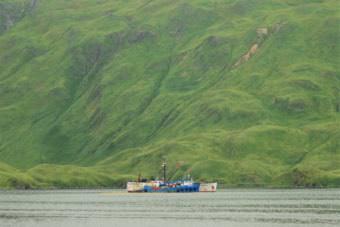
The F/V Akutan is moored in Unalaska’s Captains Bay. (Berett Wilber/KUCB)

After months sitting abandoned in Unalaska, the state announced Friday its intention to dispose of the fishing vessel Akutan.

The processor was abandoned in Unalaska’s Captains Bay in September following a disastrous fishing season in Bristol Bay where the ship’s owner went broke, the crew went unpaid, and its 158,000 pound haul of salmon was declared unfit for human consumption.

The state is looking for buyers interested in the vessel. If there are two or more prospective buyers, they will conduct a public auction, or the Akutan will be donated for scrap or destroyed.

The U.S. Coast Guard has removed all environmental threats from the fishing vessel. Chief Marine Science Technician Nathan Hatfield monitored the removal.

“We removed all of the petroleum based products as well as any other hazardous materials on board,” Hatfield said.

He says that includes portable chlorine tanks, lead batteries, and ammonia from a refrigeration system.

Unalaska city clerk says mayoral recall petition does not have enough valid signatures

A group of Unalaskans is trying to recall Mayor Frank Kelty. To force a recall election, they must collect 168 signatures. (Photo by Berett Wilber/KUCB)

Updated | 10:55 a.m. Tuesday, Dec. 26, 2017

A clerk for the City of Unalaska says a petition to recall Mayor Frank Kelty does not have enough valid signatures. But one day after being informed, the petitioners say they have the signatures they need to move forward.

The petition charges Kelty with “attempting to sole-source land use agreements for the Unalaska Marine Center positions 5-7.” It was submitted to the clerks office on Dec. 15 with 172 signatures and rejected Thursday.

City Clerk Marjie Veeder says because 14 of the signees were not registered to vote in Unalaska, they could not count towards the required 168 signatures.

Petitioners have until Jan. 2 to round up 10 more signatures or the recall effort dies.

Original story | 10:05 a.m. Dec. 20, 2017

Unalaska mayoral recall petition delivered to city hall

The Unalaska City Clerks department is checking signatures on a petition to recall Mayor Frank Kelty.

The petition, which charges Kelty with “attempting to sole-source land use agreements for the Unalaska Marine Center positions 5-7,” was submitted to the office Friday.
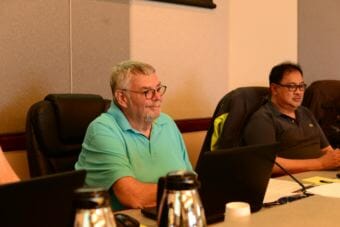
City Clerk Marjie Veeder said the office is in the process of making sure at least 168 of the signees are registered voters in Unalaska. They have until Dec. 26 to make that determination.

If there are enough valid signatures, Veeder will schedule a recall election within 75 days of the verification. She says a simple majority would be enough to recall the mayor.

King Cove closer to goal of 100 percent renewable electricity

Two hydro facilities cover most of King Cove’s 4.5 megawatt power demands. (Photo by Berett Wilber/KUCB)

A small eastern Aleutian community is now getting nearly all of its electricity from renewable sources. With a second hydro facility that began producing power late this spring, the city of King Cove has dramatically reduced its dependence on diesel.

Gary Hennigh has been focused on renewable energy ever since his first city council meeting as King Cove City Administrator in 1989.

“The council said, ‘hey, you’re the new guy and we’re starting to learn something about this hydroelectric potential that we have in the Delta Creek Valley. Can you help us figure out is it something real? Is it good for the community?’” Hennigh said.

Diesel was relatively cheap back then, but Hennigh says the community got fired up when they found out hydro looked like a promising power source for King Cove. In 1994, Delta Creek came online and pretty soon the community was getting half of its power from renewable energy.

But the project was risky. Hennigh says Delta Creek cost $5.7 million. Grants covered a lot of the cost, but the city still had to borrow a couple million dollars to pay for it. He says back in the early 90s that was a big deal for a community the size of King Cove and it paid off.

“Within a couple of years of Delta Creek getting built, it was easy to look back and say, ‘wow’,” Hennigh said. “We were either pretty lucky, pretty smart or a combination of both.”

After seeing Delta Creek’s success, Hennigh says the city started looking into building a second hydro facility. Financing was a challenge. It took more than a decade to finalize the permitting and round-up nearly $7 million. In the end, the city pieced together the funds from a combination of grants, loans and money from their own budget.

Even though it was expensive, Hennigh doesn’t think residents will bear the burden of paying it off in the form of higher utility rates.

“We believe it’s quite the contrary that they’re going to end up paying less,” Hennigh said. “I would hope to be in a position in the next six to 12 months to be able to go to the city council with a rate decrease.”

Right now, one kilowatt hour costs 30 cents in King Cove. It’s one of the lowest rates in rural Alaska. Hydro power covers nearly all of the city’s 4.5 megawatt demand — which includes two boat harbors, public facilities and all homes.

Overall, Hennigh says the community is happy with their commitment to green power.

“We’ve come to know that Mother Nature can be our friend and that renewable energy, at least in King Cove, Alaska, gives us confidence about survivability in the future for all things energy related,” Hennigh said.

But is it possible for other small rural, communities to follow in King Cove’s footsteps?

For the Waterfall Creek project, King Cove got a lot less money than expected from the state. Funding for renewable energy projects has dried up; for the past two budget cycles there have been no grants from the state’s renewable energy fund.

But Cady Lister, of the Alaska Energy Authority, says King Cove made it work, partly because the city has some financial advantages.

“They are small. They are remote,” Lister said. “But they do have sort of an active cash economy in the fishing industry that kind of allows them to access other resources outside of their community that other places might not have the ability to.”

Even so, Lister believes other communities can replicate King Cove’s energy funding. She says King Cove has proved it’s possible to pay for energy projects with more than just grants.

Hennigh says this is likely the end of bolstering King Cove’s hydro facilities, but he’s pushing for 100 percent renewable electricity — like another community in Alaska.

“We have certainly talked about couldn’t we be even better and be like a mini Kodiak,” Hennigh said. “That’s the new challenge”

With strong winds, Hennigh thinks that’s what King Cove will look to next. But they plan on taking it slow with another year of measuring the wind and looking into the economic feasibility of a project.

Correction: This story has been edited to note that King Cove gets most of its electricity from renewable sources, not most of its energy, as a previous version stated.

Site notifications
Update notification options
Subscribe to notifications