Zoë Sobel, Alaska's Energy Desk

Teaching the next crop of whale entanglement responders

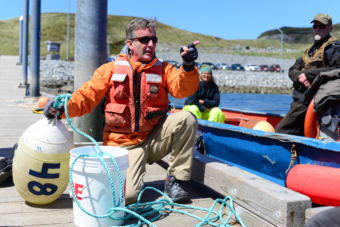
Ed Lyman is in Unalaska teaching the next crop of large whale entanglement responders. (Berett Wilber/KUCB)

On a sunny Tuesday night, about a dozen people are gathered on a dock. They’re practicing the skills needed to free a stranded whale.

Ed Lyman is up from Hawaii to lead the course. He has a lot of experience freeing entangled whales. He’s in town for the National Oceanic and Atmospheric Administration (NOAA) — working to build Unalaska’s response team.

“Here we are in Dutch Harbor, fishermen galore, capital of fishing, in many ways in the U.S.,” Lyman said. “So you have a lot of skill sets there already. But having to cut free a 40 ton whale is unique.”

Emily Gibson takes a practice throw. (Berett Wilber/KUCB)

Reports of entangled whales are increasing nationwide. According to the National Marine Fisheries Service, last year there were 20 confirmed entanglements in Alaska compared to three in the year 2000.

Until now, there was only one person in Unalaska trained to approach distressed marine mammals. That means if more help was needed, a team from the Marine Mammal Stranding Network would have to fly in.

Emily Gibson is part of the new crop of responders. She’s an environmental compliance manager at a local seafood processor, but says she’s taking part in the class as a fisherman and resident.

“We spend a lot of time on the water in the summer and interact and see whales, so we’re kind of the first line of defense against these entanglements and trying to mount a response to help whales that might be in trouble out here,” Emily Gibson said.

Because of the potential risks to humans and marine mammals, NOAA Fisheries approves responses on a case-by-case basis.

Having responders from different areas of expertise, Lyman says, is key to success.

“Boy, throw a whale biologist and a fisherman together — it’s the perfect team to cut a whale free,” Lyman said. “The whale biologist knows the whale behavior. The fisherman knows gear, knows the ocean, knows boats, and things of that nature. You’re putting two skill sets together to make a great team. It works. Believe me.”

By sharing his knowledge, Lyman hopes to protect whales while keeping humans safe.

If you see a marine mammal in distress, you should report the sighting to the Marine Mammal Stranding Network at 1-877-925-7773.

After a rocky start, Unalaska’s subsistence salmon run hits target escapement

So far more than 11,000 sockeye have passed through Unalaska’s McLees Lake weir. (KUCB)

While Unalaska’s biggest subsistence salmon run got off to a slow start this season, it’s now at a sustainable level.

The start of the McLees Lake run was so low, the Alaska Department of Fish and Game issued an emergency order early this month to protect the area around the mouth of the creek.

While there are a lot of factors at play, biologist Colton Lipka says low water could have affected the run and they are seeing that in places like the Orzinski Bay Weir near the Shumagin Islands.

“They’re facing a similar situation as far as kind of low water,” Lipka said. “The fish are doing a trickle in rather than big pulses and pushes.”

In Unalaska, the McLees run met the goal for minimum escapement on Friday and restrictions have been lifted. So far more than 11,000 sockeye have passed through the weir.

While Lipka says this year’s run is below average, it is not the lowest recorded. For now, Fish and Game has opened subsistence salmon fishing in the waters of Reese Bay up to the McLees Lake stream output.
Lipka says this is the department’s final year using Alaska Sustainable Salmon Fund money for the project. The Alaska Department of Fish and Game is in the process of securing other funds, but if they are unsuccessful Lipka says the weir won’t operate next year; instead, they would monitor the run through aerial surveys.

Eruptions can’t stop sealife from calling Bogoslof home

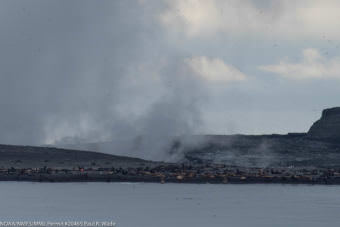
Marine mammals are hauled out on Bogoslof island on July 3, the day after an eruption. (Courtesy Paul Wade, NOAA Fisheries)

Before Bogoslof volcano started erupting, it was a haven for endangered Steller sea lions, fur seals, and sea birds. But scientists did not know when and if animals would return to the eastern Aleutian Island.

In the last year, Bogoslof volcano has erupted more than 50 times and is giving no indication of slowing down. This means even though scientists like Tom Gelatt would like to set foot on land, they can’t.

But with powerful camera lenses, they can check for wildlife on the island even from miles away.

“It was interesting because it was still steaming quite a bit of course,” Gelatt said. “The whole island was still covered in ash, but there were sea lions and fur seals all along the shoreline. A lot of animals. A lot of birds.”

The National Oceanic and Atmospheric Administration biologist was expecting to see animals on Bogoslof.

“Those animals have evolved with volcanoes for a long time,” he said. “It’s only speculative, but you can imagine when [Bogoslof] starts to rumble and go those animals that can move get in the water.”

When he passed by it was the day after an eruption and there’s been more since then. At this point, it’s too soon to tell what effects the eruptions will have on animals.

But researchers can tell the island has grown in size. If it stays large, Gelatt says that could mean more space for Steller sea lions, fur seals and seabirds to call home.

Aleutian tsunami advisory canceled after 7.8 earthquake in Russia

Updated | 11:16 a.m. July 18

No tsunami is expected in the Aleutians, after a large earthquake near Russia’s Kamchatka Peninsula.

The National Tsunami Warning Center briefly issued a tsunami advisory Monday for the western Aleutian Islands.

“There was a magnitude 6.5 (earthquake Monday) morning and this was a magnitude 7.8,” said tsunami science warning officer Paul Huang. “In theory, we don’t know when the next one will come. It could be a few minutes from now. It could be another 100 years.”

The Palmer, Alaska-based scientist says it’s always better to be safe than sorry.

“It’s always safer when you are alive,” Huang said. “You never know, we’re scientists. We cannot predict nature. We just do our best guess.”

Even though the advisory has been canceled, Huang recommends people stay alert and keep away from beaches for the next day.

— Zoe Sobel, KUCB-Unalaska


Original story | 5:57 p.m. July 17

A strong earthquake on the Russian side of the Bering Sea briefly prompted a tsunami advisory for parts of the Pacific, including Alaska’s remote Aleutian Islands and Russia. The National Tsunami Warning Center in Palmer canceled the advisory because the tsunami no longer posed a threat.

Officials at the warning center had cautioned waves could reach up to 3 feet above the tide level. But waves later Monday were reported only 6 inches above tide at the sparsely populated Shemya, the site of a remote Air Force station in the extreme western Aleutians.
The quake was initially measured at magnitude 7.4 when it struck just after 3:30 p.m. Alaska time in the Komandorskiye Ostrova region of Russia, roughly 1,400 miles east of Anchorage.

The Associated Press

New equipment helps scientists keep tabs on Bogoslof now and study it later

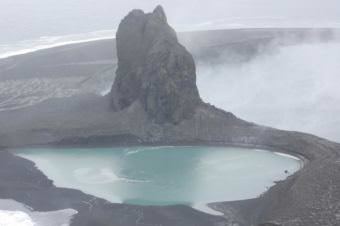
Bogoslof island has changed dramatically since the volcano started erupting in late 2016. (Max Kaufman/Alaska Volcano Observatory/University of Alaska Fairbanks, Geophysical Institute)

Scientists have had a hard time monitoring Bogoslof volcano since it started erupting in December. The island is so small, there is no equipment on the volcano, making it difficult to predict eruptions.

No one lives on Bogoslof – the closest human neighbors are 60 miles away in Unalaska. Scientists monitor from afar and they’ve had a lot to monitor lately. The volcano has erupted more than 40 times since December.

Geophysicist John Lyons says there aren’t many volcanoes like Bogoslof in the world so he doesn’t want to miss anything.

“The interesting thing about the eruption at Bogoslof is that it’s happening underwater and then the eruption breaks the surface and goes into the atmosphere,” Lyons said.

He installed two hydrophones underwater near the island — they’re essentially microphones that listen and record seismic waves during an eruption.

“Right now, we can only detect the most energetic activity from the volcano,” Lyons said. “So hopefully with these two instruments that are much closer we’ll be able to detect, understand, and study the eruption in much more detail.”

Lyons says these recordings are unprecedented. Because the hydrophones are so close to the island and in the water column, they’re especially good at registering the low level activity at Bogoslof that the faraway monitoring network has missed. He’ll have to wait a while to study them, since the hydrophones don’t transmit their data.

But there’s another piece of equipment volcanologist Alexa Van Eaton installed that will help right away – they track lightning, including volcanic lightning, which happens when static electricity builds up in ash clouds.

“Unlike ground shaking and unlike acoustic energy that can happen when there’s not a lot of ash getting into the atmosphere, lightning is unique to ash,” Van Eaton said. “That’s relevant because it’s important to aviation hazards and communities like Dutch Harbor which could be downwind.”

The new sensors are part of a global lightning system called the World Wide Lightning Location Network. The stronger network makes it easier to warn pilots that eruptions are underway. And it could help scientists understand if lightning at Bogoslof means there’s a lot of ash in the atmosphere and planes should avoid the area.

For now, the scientists are relishing every bit of eruptive activity at Bogoslof. The more it erupts, the more they can learn.

Federal officials make formal apology for WWII internment of Unangan people

(Photo by Scott Burton/KTOO).

Federal officials apologized Wednesday for their role in the World War II internment of the Unangan people.

Jim Kurth, acting director of the U.S. Fish and Wildlife Service, traveled to St. Paul Island to speak with survivors and descendants.

“As much as we wish, we cannot take back the course of history,” Kurth said. “But what we can do now is heal together. We can work together.”

Fish and Wildlife agents oversaw the internment of the people of the Pribilof Islands. They were sent to inhumane camps in southeast Alaska where many perished due to illness and starvation — after the Japanese bombed Dutch Harbor in 1942.

In all, almost 900 Alaska Natives were evacuated from the Aleutian and Pribilof Islands.

Site notifications
Update notification options
Subscribe to notifications