Zoë Sobel, Alaska's Energy Desk

EPA retiree has advice for Scott Pruitt on his way out the door

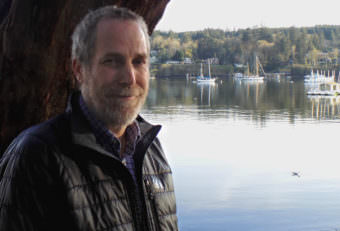
Michael Cox was planning on retiring from the EPA, but sending a letter to Scott Pruitt? That wasn’t always part of the plan. (Photo courtesy of John Ryan/KUOW)

For most people, the last day on the job before retiring is a celebration. But Michael Cox capped off his career at the Environmental Protection Agency (EPA) with a scathing letter to agency head Scott Pruitt.

Since 1987, Cox has worked for the EPA. Most recently he served as climate advisor for Region 10 — which covers Alaska, Washington, Oregon and Idaho.

He was planning on retiring — but not like this. He says he wants the agency to be successful.

“You know when you work for any organization — I don’t care if it’s a government organization or a business — if you put over 25 years of your life in that organization, you want to see it succeed,” Cox said. “That’s really what I want, to see EPA succeed. And to do that the administrator needs to succeed. So I hope he can.”

What concerns Cox is the overwhelming lack of confidence in EPA leadership. He has worked under six administrations and says morale is at an all time low.

In the letter, Cox suggests four ideas that could help Pruitt be a better leader including using science as a guiding principle, listening and learning from EPA career staff, and visiting Alaska.

“I said come and visit,” Cox said. “Come and go to Alaska and people will show you climate change is happening. It’s right here. It’s not something made up.”

The Trump administration’s proposed budget would slash 31 percent of the EPA’s funding.

Those programs could be taken up by local, state or tribal entities. In theory Cox thinks that’s a good idea.

“In Alaska, where the budget deficit is so enormous to take on additional programs right now and make up the slack — for example, for what EPA might not be providing, is going to be a real challenge,” Cox said.

One program Trump has put on the chopping block helps build wastewater and drinking water infrastructure in rural Alaska. Senator Lisa Murkowski wants to keep it. She chairs the subcommittee that writes the EPA’s spending bill, and Congress has the final say on the budget.

Unalaska receives surprise visitor from the deep

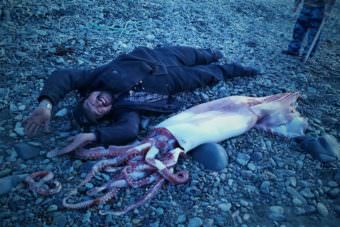
An Unalaskan sees if he is as long as the beached squid. (Zoë Sobel/KUCB)


Carlin Enlow has lived in Unalaska her entire life, all 22 years. This is the first time she’s seen a squid washed up on the beach.

“The only time I’ve seen something this big is down in the Seward Sea Life Center,” Enlow said. “They have a giant squid that I think they caught up here or washed up here.”

Enlow found out about the squid on Facebook and made her way down to the beach after 10 p.m.

A more than six-foot long squid washed up in Unalaska. (Zoë Sobel/KUCB)

“It’s kind of one of those things where it’s like, ‘That’s awesome!'” Enlow said “And you think, oh I can rush down right now or is that a photo from a couple days ago? Did I miss it? This is a good little field trip.”

The chance to see the beached squid has brought out a steady stream of Unalaska residents, from on-duty police officers to parents with kids wiping sleep from their eyes.

But how rare is it to see a big squid on the beaches in Unalaska?

According to Sea Grant agent Melissa Good it’s more common to see beached whales or other marine mammals.

“My guess would be because [marine mammals] are living near the surface, whereas large squid are going to spend the majority of their time in the deep sea, so it’s less likely that they would wash up,” Good said.

Although large, this is not a giant squid. Good thinks this squid is a robust clubhook squid.

Although large, this is not a giant squid. Sea Grant’s Melissa Good thinks it is a robust clubhook squid. (Zoë Sobel/KUCB)

Unalaska is in the middle of its natural range, which stretches from Southern California to the Gulf of Alaska through the Aleutian Islands.

But seeing this species in the wild is pretty rare.

As to why it died? Good doesn’t know.

But less than a day after it washed up, it’s gone. She thinks eagles and foxes made a meal out of it.

“It’s become a food source,” Good said. “I like calamari. Other things probably like calamari, too!”

Scientists agree starvation killed hundreds of puffins, but did PSP play a role?

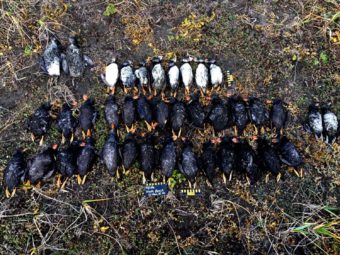
St. Paul residents have seen 300 puffin carcasses wash ashore since mid-October. Scientists say seabirds are good indicators of overall ecosystem health, which means the die-off could be a sign of trouble for all sorts of species. (Photo by COASST Island Sentinels)
St. Paul residents have seen more than 300 puffin carcasses wash ashore since mid-October. Scientists say seabirds are good indicators of overall ecosystem health, which means the die-off could be a sign of trouble for all sorts of species. (Photo by COASST Island Sentinels)

What caused more than 300 puffins to wash up dead in the Pribilof Islands last fall? Starvation.

But one ecologist thinks there may be another factor: Paralytic Shellfish Poisoning (PSP). That’s what Bruce Wright thinks killed the prey of these puffins and thousands of common murres in 2015. Wright is an ecologist with the Aleutian Pribilof Islands Association (APIA), and he knows he’s mostly on his own with this theory.

“My colleagues are reluctant to say the things that I am saying because most scientists feel like they have to have rock-solid data in their hands to draw these conclusions,” Wright said.

Even without hard facts, Wright feels comfortable saying PSP is involved because a professor trained him to approach science this way.

“Your job is to make predictions based on your best judgement and the data you have,” Wright said. “You’re not going to be right all the time, but somebody’s got to tell the managers that look, this could be what’s coming down the pipe. We need to plan ahead.”

Warmer oceans promote the growth of toxic algal blooms. As animals along the food web consume them, they can die. Big algal blooms were documented before both of these die-offs and that’s why Wright thinks PSP is a player.

Because the toxins disappear quickly, he admits his hypothesis is more speculation than hard proof.

Lauren Divine is co-director of St. Paul’s Ecosystem Conservation Office. She agrees with Wright to a point. She says PSP could be a part of the picture, but not the whole picture.

For her the most important takeaway is that the puffins died of starvation.

“Whether they missed a cue, or they were in the wrong place, or they were in the right place but the food wasn’t in the right place — is a total mystery,” Divine said.

At this point, Divine says bird carcasses have stopped washing ashore in the Pribilofs. While her team is still on the lookout for dead puffins, they’re shifting gears to writing a paper on the die-off. Plus, they’ve refined their technical skills so they are better prepared to respond to the next event.

“We know why it’s important to collect those carcasses,” Divine said. “We know how to actually [perform] necropsy on island and go through the steps of doing that preliminary determination of the cause of death ourselves.”

Divine believes the big die-off has made other coastal communities more aware that they need to be looking for changes in their environment.

For Bruce Wright, linking PSP to the die-off events is important because the toxins have the potential to transform ecosystems like the Aleutians. And he says PSP does not bode well for the health of the Bering Sea.

“It’s not to say that there won’t be something out there to catch, but it might be different than what we are catching now,” Wright said.

Recently tested samples from the Pribilofs show the highest recorded PSP event happened last summer — before the Puffin die-off. That alone, Wright says, should make people nervous about the future.

Even though fishing in the Bering Sea is a multi-billion dollar industry, Wright says there isn’t much money going into research that could help confirm or disprove his hypothesis.

This story has been updated: An earlier version of this story suggested that Bruce Wright believed PSP killed puffins and common murres in 2015. In fact, Wright believes that the birds’ prey was killed by PSP and that caused the birds to starve. The story has been updated to reflect the correct information.

Who runs the lab? In Unalaska, it’s this woman

Nicole Beier runs NSF International’s smallest branch in Unalaska. (Zoë Sobel/KUCB)

The fishing industry in Unalaska is dominated by men. But behind the scenes, at the local branch of a public health and safety company, there’s a woman running the show.

Nicole Beier works for NSF International, a company responsible for quality testing fish at America’s top fishing port. And now she’s tasked with expanding their capacity.

Beier always knew she wanted to work in science, but never imagined she’d end up in Unalaska.

“I was in a meeting last year in Ann Arbor and the microbiology lab was short people willing to come out here and I volunteered,” Beier said. “Because why not take a free trip to Alaska for 3 months? It would be cool.”

Beier’s employer makes sure products that food and water touch are safe for human consumption.

At headquarters in Ann Arbor, Michigan, Beier spent her days testing things like cutting boards, faucets and coffee makers. In Unalaska, almost everything she tests relates in some way to fish.

These days, Beier is permanently heading up the microbiology, fish inspection and new chemistry lab — which was created to expand NSF’s wastewater testing. This helps guarantee wastewater meets certain environmental standards before it’s released into the ocean.

“Logistically it is really hard to get samples out of here,” Beier said. “There’s not a lot of people here with a rigid science background so we’re pretty much the only lab that does certified through the state microbiology and chemistry testing.”

While there are other labs in Anchorage, Seattle and on the East Coast, Beier says many of those labs specialize in a test or two. But here in Unalaska, NSF is a one-stop shop; they do pretty much every test the fishing industry could need.

Today Beier’s testing a fish oil sample from a processing boat.

This fish oil could be refined into fish oil pills. (Zoë Sobel/KUCB)

“Once you measure out your 10 grams, you just close this and then turn your heater on,” Beier said.

The machine bakes the orange liquid till it’s gone and measures how much water was in it. Less water means higher quality fish oil.

“This fish oil will actually go out to another lab to get more detailed tests done and depending on how those tests go out, they’ll decide it if gets refined for fish oil pills or if it’s just going to go for feed,” Beier said.

This five-person branch is the smallest of NSF’s labs. They test drinking water, salt water, and wastewater for the city of Unalaska, boats and processing plants in the area. Plus, they do fish inspections.

Having an extensive lab in Unalaska is important to the fishing industry. It helps them comply with testing requirements from the State of Alaska and the Environmental Protection Agency and gives them time to make adjustments if there’s a problem with their fish.

The fishing industry doesn’t have a lot of women and Beier says it’s a similar story in science.

“I think over the years most women have been the workhorses in the labs and the men get the bigger roles,” Beier said. “But I think it’s slowly moving towards more women proving that they know their science and they can run a whole facility by themselves.”

Living in Unalaska where there are so many men, Beier is hyper aware of her role as a woman in science and the power she has to share her love of the field with kids. She often makes that point with her team of junior high basketball players.

“I always try to talk up science to tell them that it’s okay,” Beier said. “It’s exciting! It’s not difficult and not to just see it as a negative thing.”

She’s hoping to invite students to her lab to see that science up close.

Fish and Game says crab counts were low this season, fishermen totally disagree

When Captain Daher Jorge and his crew fished for Opilios, they found a surprising number of Bairdi crab. (Laura Kraegel/KUCB)

The Bering Sea Bairdi (or Tanner) crab fishery stayed closed this year, for the first time in four years. State biologists decided there were too few crab to safely harvest. But fishermen are questioning that decision. They say there were plentiful Bairdi when they were fishing for other species.
At a Board of Fisheries meeting in Anchorage this week, commissioners will look into the possibility of opening the fishery even in low abundance years.

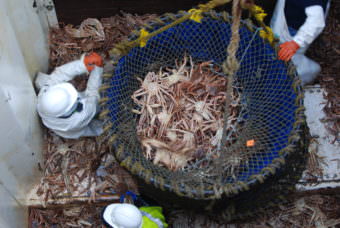
The crew of the Polar Sea stands at a metal table on the deck, sorting through a fresh pot of crab. They’re looking for Opilio (another snow crab related to Bairdi) keepers. Captain Daher Jorge rolls video on his iPhone and asks for a count.

Sorting opilio and bairdi crabs on the deck of the FV Polar Sea (Video courtesy Daher Jorge / Polar Sea captain).


“How many Opies?”

“200,” said a crew member.

“How many Bairdi?” Jorge said.

“100.”

“This is not like we’re faking it,” Jorge said. “This is just one video. It is reality. It’s right there. This is not going to lie.”

Those 100 Bairdi all go back in the ocean. Had the Bairdi season opened, Jorge would have been able to sell them.

“I mean, it’s a no-brainer,” Jorge said. “Instead of throwing over the side, why we can’t we put one species in one tank and a different species in the other tank?”

He says fishing both species would have reduced bycatch — saving fishermen time and money, and saving the crab population a lot of incidental deaths.

Opilio crab is offloaded from the Polar Sea. (Laura Kraegel/KUCB)

But their experience in the ocean didn’t match the predictions from the Alaska Department of Fish and Game. Management biologist Miranda Westphal said the annual crab survey in October showed low numbers across the board for all species — a trend she connected to warmer ocean waters.

“Everything’s just kind of below threshold,” Westphal said. “We’re not seeing a whole lot of recruitment right now. It’s sort of a theme this season.”

Managers reduced the quota for red king crab by 15 percent, cut the Opilio quota in half, and cancelled the Bairdi season entirely.

With crabbing season now wrapping up, Westphal didn’t want to comment on whether the quotas for Bairdi, or any other species, were appropriate.

But Dave Harris thinks the Department of Fish and Game made a mistake. He’s captain of the Arctic Mariner and has hauled pots in the Bering Sea for more than 40 years. In that time, he says he’s never seen the department get the quotas so wrong, and not just with Bairdi.

“You might see it in one fishery or the other,” Harris said. “But not all three fisheries. Something’s wrong with this picture. Something’s wrong with the model or surveys or something.”

Neither Jorge or Harris is able to attend the Board of Fisheries meetings in person. But they’ve shared their thoughts, videos, and pictures in the hopes of bridging the gap between what they’re seeing and what managers are documenting in their surveys.

The meeting agenda includes proposals that might open the fishery even when stocks are low or permit fishermen to keep some of the crab bycatch that’s thrown back when the fishery is closed.

Because the Board of Fisheries works on a region based schedule, the statewide King, Opilio, and Bairdi crab fisheries won’t be on the docket again until 2019.

Steller Watch lets anyone with internet access play wildlife biologist

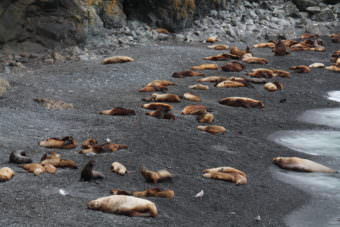
Do you see the marked sea lion? Scientists are asking citizens to comb through photos like this to help understand the species decline. (Photo courtesy NOAA Fisheries, NMFS EPA/MMPA Permit #: 18528 & IUCN # A/NW2013-2)

In an effort to figure out what’s behind the mysterious decline of Steller sea lions, scientists are trying out crowdsourcing for the first time. The project is called Steller Watch. The idea is to convince the public to comb through pictures looking for sea lions.

Scientists from the Alaska Fisheries Science Center have remote cameras stationed in the western Aleutian Islands that take pictures every five to 20 minutes every day of the year. From last year alone, they have nearly 400,000 images.

The cameras go off whether there’s a sea lion present or not. Right now, there’s only one question for the citizen scientists: Do you see a sea lion in this image?

Biologist Katie Sweeney says this information will help scientists analyze images in a timely manner.

“That’s important so we can come up with important population estimates and figure out why the Steller sea lion, which is endangered, is not recovering in the Aleutian Islands,” Sweeney said.

After they’ve built up a pile of pictures that have sea lions, Sweeney says they’ll start another phase to the project — looking for marked sea lions.

By monitoring marked animals, scientists can study sea lion movement, fertility and lifespan. The information could help these researchers identify what’s behind the animal’s decline.

Site notifications
Update notification options
Subscribe to notifications