Zoë Sobel, Alaska's Energy Desk

Harvard class assignment: solve rural Alaska’s fossil fuel woes

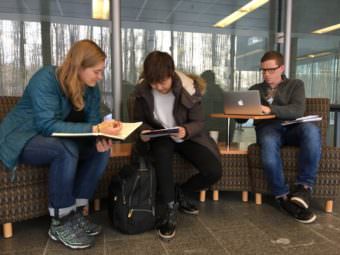
Three members of the team of Harvard graduate students looking for practical solutions to reduce the use of fossil fuels in rural Alaska. (Annie Feidt/Alaska Public)

Rural Alaska runs on diesel. Although many communities are open to alternative energy ideas, they don’t have the funding to even explore them. But help could come in the form of graduate students from Harvard University, who have been tasked with the assignment of solving some of Alaska’s fossil fuel energy woes.

Harvard law student Mike Maruca may sound like he’s describing a spring break trip.

“We also got to drive out to Seward and went skiing at Alyeska,” Maruca said. “We managed to catch the northern lights last night, sort of. They were not very clear.”

But he’s actually in Alaska for a class that’s looking for practical solutions to reduce the use of fossil fuels, especially in low-income, under-served communities.

With Alaska in a multi-billion dollar hole, state funding — including a lot of grant money — has been slashed. Maruca thinks it’s time for Alaskan communities to start looking for funding outside the state.

“Private money such as from a large company or from a university might be able to, in some cases, step in to where public funds used to support such projects,” Maruca said.

The team’s goal is writing a proposal to reduce 50,000 metric tons of carbon dioxide a year. The value of that reduction — measured in carbon credits — could be sold to private companies looking to offset their own carbon footprints.

“The innovation is here,” Maruca said. “All that we are looking into is a way an outside player that might want to capitalize on carbon credits might be able to fill a gap or make something happen that wouldn’t otherwise occur.”

By the way, Maruca says 50,000 tons of CO2 is the average total emissions for a community of 20,000 to 25,000 people for a year.

But most communities in Alaska aren’t that big – which Caroline Lauer – a student studying urban planning – says is one of the biggest challenges for the team.

“The high bench mark has forced us to be creative in figuring out how can we package a bunch of different innovative options to get as close to 50,000 as possible,” Lauer said.

The team members didn’t have the chance to visit rural Alaska, but they were in Anchorage in this month, meeting with energy experts from across the state.

One of those experts is Christopher Emrich, the city administrator and clerk for the Aleutian community of False Pass. He’s totally on board with this project.

“Oh, I think it’s fantastic,” Emrich said. “Sounds like a wonderful idea.”

False Pass is a 73-person community that runs on diesel, which is expensive: Emrich says the city spends around $200,000 a year on it.

“The cost of energy is paramount with these small communities for surviving into the future especially if funding is getting cut,” Emrich said. “If they got to be paying like us, a quarter of our budget for diesel, that’s not sustainable”’

Since 2012, False Pass has been looking into tidal power — which would allow the community to be less reliant on diesel and more self-sufficient. But it comes with a hefty price tag, around$7 million, and the community can’t foot the bill alone.

Right now the Harvard students are just working for course credit. They don’t have any real funds to invest in rural Alaska.

But that doesn’t phase Emrich. He is doing everything he can to make sure False Pass’s energy projects are as ready as possible just in case any outside financing comes along.

Stranded seal gets first-class rescue in Unalaska

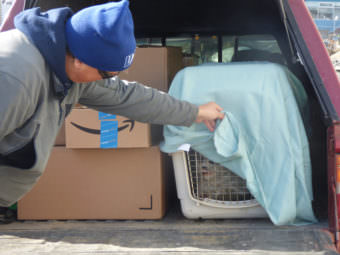
Andy Dietrick checks in on the ringed seal before her flight to Anchorage. (Laura Kraegel/KUCB)

Late on a Friday afternoon, Melissa Good sits on her front step filling out labels for a dog carrier. The crate is not for her dog. It holds a yearling ringed seal.

“He looks like he’d be nice and light and fluffy like a fluff ball, but not the case,” she said. “He’s heavier than he looks. He’s really dense! About two feet long about 30 pounds.”

Good works for SeaGrant and she’d been on the lookout for the sick animal for awhile.

The seal appeared in Unalaska in late February, but before Good had the authorization to pick it up, it vanished. She thinks a fox scared the animal back into the water.

A couple of days later, Good was doing routine water sampling in a bay and there it was. It looked lethargic. Birds were pecking at its fur.

SeaGrant’s Andy Dietrick and Melissa Good carry the ringed seal to a truck. (Laura Kraegel/KUCB)

“I wrapped it in my jacket and carried it down the beach a little way until I had cell phone reception and got someone to come down with a kennel,” Good said. “We’re going to get this seal out on the 4 o’clock freighter.”

A half hour before the flight, Good grabbed the crate off the back porch and carried it to a truck and started the engine.

She drove across town to the airport to check the seal in for the flight.

“He will be flying to Anchorage free of charge — in first class even,” Good said.

Together the seal and carrier clocked in at 49 pounds. Paperwork was filed, labels were stuck onto the crate and he was ready to fly.

While waiting for the flight, Good decided to name the seal Jack.

But at the Alaska SeaLife Center in Seward, veterinarians say Jack is actually a girl.

As with all cargo, the ringed seal is taken to the tarmac before being loaded onto the freighter. (Zoë Sobel/KUCB)

Carrie Goertz is one of the vets there. She says this seal is small for her species.

“She is having some challenges maintaining an appropriate body temperature, so we are giving her limited swims and letting her be dry and warm up,” Goertz said.

Jack is in better shape than a lot of other ringed seals the SeaLife Center has admitted. Even so, Goertz thinks it’ll take Jack at least a couple of months to recover.

Goertz says between five and 15 live animals are admitted to the center for care each year. And Jack is the first one this year.

But what was a ringed seal doing in Unalaska? Goertz doesn’t have an easy answer.

“It could be a matter of just being off course or just looking for a new area to explore,” Goertz said.

Kind of like a kid running off to join the circus. For now, she is focused on getting Jack back to full strength.

As with all strandings, the National Oceanic and Atmospheric Administration makes the final call of what happens to the animal. But in this case, Goertz thinks it’s unlikely she’ll be released into the wild. When she’s healthy, Jack will be sent to live in a marine mammal center.

From fear to fervor, how this millennial is making the outdoors more inclusive

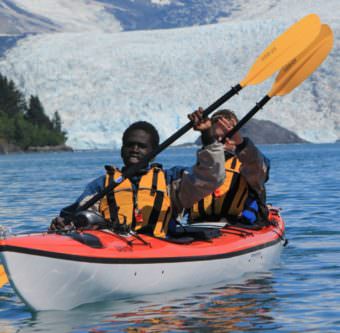
After high school, Reth Duir got the opportunity to explore the outdoors through a kayaking expedition in Prince William Sound. The trip changed how he felt about the outdoors. (Photo courtesy Chugach Children’s Forest)

When you open a REI catalog or page through Outside magazine, what do you see? Do the people on the page look like you? Arctic Youth Ambassador Reth Duir is working to make that imagery more representative.

“When you look at the depiction of what people go outside it’s usually white people,” Duir said. “When you look at these catalogs, you look at Facebook ads, and you go to REI, you don’t see a lot of diversity of people. So I think it can be very tough for someone trying to explore the outdoors because there’s not much commonality.”

But the University of Alaska Anchorage junior hasn’t always been an outdoors enthusiast. His childhood was split between Minneapolis, Minnesota, and Omaha, Nebraska. Playing outside meant playing basketball or cops robbers with his friends.
When he was 8 years old his mom told him a story that made him fear the outside world.

“I noticed there was a wound on the outside of my mom’s ankle and her skin was just completely different,” Duir said. “I was like, ‘how did that happen?’ And my mom was like, ‘I was bitten by a snake.’ She became instantly very sick and she could have died that day.”

Duir had a different childhood than his parents.

Before he was born, they fled East Africa because of political and religious oppression.

When he was 10 years old, his life and his parents’ lives were about to become even more different. They were moving from Nebraska to Alaska.

“I thought they were crazy when they first said that,” Duir said. “I knew Alaska, there was a lot of snow it was very cold. I knew about polar bears. I just had this picture of (the) Ice Age, but with people.”

Landing in Anchorage, his new home, the first thing he saw was the Chugach mountain range.

For a kid from Nebraska, it was the first time he’d ever seen a mountain.

At that moment, Duir began think about starting to explore the outdoors.

After graduating high school, he got that opportunity through a kayaking expedition in the Prince William Sound.

Immediately Duir found his calling.

“Oh yeah, I was hooked for sure,” Duir said. “They definitely had me hooked. They reeled me in.”

“A lot of people don’t understand that this is our public lands. It is for everyone,” he said. “It should be for everyone. I want to get rid of these misconceptions that the outdoors is for a particular audience. There are different ways to explore our outdoors — going hiking, backpacking or fishing with your family and friends.”

He wants to help communities find ways to connect to the outdoors that work for them.

“I know Alaska Native communities they live off the land,” Duir said. “We have Hmong communities that like to go fishing. I think it’s really figuring out what the community needs are and how people enjoy their public lands. How they like to be outdoors. Then creating a way to do that.”

He knows he’s still learning.

“This program has really opened my eyes to different things that are happening in the state of Alaska and why the voices of people in rural communities are important and they should be at the table,” Duir said. “I want to be able to help with that experience.”

Duir will graduate next year with a degree in elementary education. He used to want to be a teacher in a big city — like Chicago or Oakland — but he’s changed his mind. He wants to work in rural Alaska and give back to the place he’s called home for a decade.

Unalaska teen: If you like sushi, you better take care of the environment

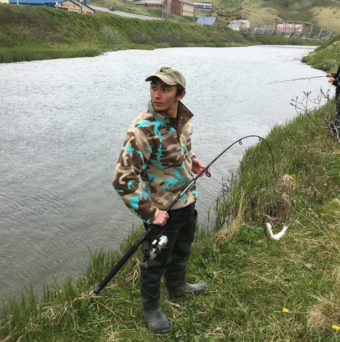
Cade Terada fishing in Unalaska. (Photo courtesy Cade Terada)

Across the state, there’s a cohort of young Alaskans raising awareness for the rapidly changing Arctic environment. Cade Terada is one of 22 Arctic Youth Ambassadors. Growing up in Unalaska, America’s largest fishing port, he was immersed in the seafood industry.

Terada looks like a young, hip politician. Hair gelled back, the 18-year-old sports a grey quarter zip and khaki’s with an earring and a tattoo peeking out from under his sleeve.

He graduated from high school early, back in December.

You might not guess the role fishing has played in his life. Terada’s father grew up in a small town in Northern Japan and the best way to make money was fishing.

“He had to drop out of school in the ninth grade because his family was quite poor at the time,” Terada said. “So, he’s been working in fishing ever since, which is approximately 40-plus years.”

What did he think of fishing as a child?

“I really enjoyed it,” Terada said. “I really enjoyed looking in the tide pools with all the hermit crabs. I thought it was really cool looking at fish. I don’t know what it was about it, but it was an exciting opportunity to see what was out there, what could we catch.”

From a young age, Cade Terada, left, was exposed to the fishing industry by his father. (Photo courtesy Cade Terada)

At what point did he realize Unalaska was pretty unique in the amount of resources it has?

“I kinda started realizing it back when I was beginning my high school career,” Terada said. “It didn’t really hit me that maybe 90 percent of my class has someone working in the fishing industry. My history teacher would always talk about how this town would be a ghost town if we didn’t have fisheries and that really got me thinking that everything is dependent on the fisheries where I’m from.”

Becoming an Arctic Youth Ambassador was a stretch for Terada. He didn’t really excel in high school.

“There’s a lot of other kids like me that have the mindset that if they have a low GPA they aren’t going to be able to do much,” Terada said. “I want to let people know if you have a low GPA that doesn’t mean anything … With this ambassador program I’ve had to opportunity to go to Greenland (and) Canada. I’ve met the prime minister of Canada, Justin Trudeau. I’ve met with countless government officials. That’s not something you’d expect from a kid with a 2.6 GPA.”

Terada has been passionate about protecting the environment for as long as he can remember. He got his start with Alaska Youth for Environmental Action. After a youth organizing summit, he was encouraged to apply to the Arctic Youth Ambassador program.

For Terada, convincing people to care about the environment is simple. He puts it in perspective.

“A lot of people I meet like sushi. And I come from the place that’s the number one fishing port in the nation, so if you like crab, if you like eating fish, you like eating any of this you better take care of the environment,” he said. “People are like ‘Wow, I really like my caviar and if I don’t care about the environment there’s going to be no more caviar or lobster.'”

At only 18, Terada feels like he’s already making a difference.

Next up is college where he’s planning to pursue degrees in political science and environmental studies. Then, he wants to return to Alaska to run for elected office.

After nearly two decades living in America’s largest fishing port, he thinks he’ll be able to bridge the gap between science and politics and continue to advocate for his community and the environment.

After Bogoslof eruption, Sen. Murkowski renews push for enhanced volcano monitoring

Sen. Lisa Murkowski (KRBD file photo)

U.S. Sen. Lisa Murkowski wants to bolster the nation’s volcano monitoring system.

The bill Murkowski is sponsoring, introduced Monday, would modernize existing monitoring networks and create a 24-7 volcano watch office to keep an eye on active volcanoes across the country. Plus, it would create a connected system — the National Volcano Early Warning System — where information from the nation’s five volcano observatories would live.

A press release from the Senate Energy committee says even though the Alaska Volcano Observatory is one of the busiest in the world, it has been underfunded for almost three decades.

There is no estimate for how much the proposal might cost.

This is the fourth time Murkowski has introduced legislation to enhance volcano monitoring, but none have become law.

The current bill is also sponsored by senators from Washington State and Hawaii.

From the ashes: Life returns to Kasatochi volcano

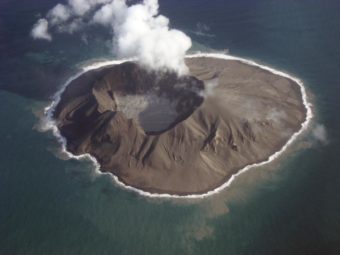
Two months after the eruption, Kasatochi Island looked like the moon. (Courtesy Jerry Morris)

The news may sound familiar: There’s a volcano erupting in the Aleutian chain that’s a refuge for marine mammals and sea birds. But it isn’t Bogoslof, it’s Kasatochi — a volcano near Adak that erupted for the first time in modern memory in 2008. That eruption has given scientists the opportunity to study how life returns after cataclysmic destruction.

Kasatochi Island was an inactive volcano. It wasn’t supposed to erupt.

“That’s one of the reasons why we picked it to study seabirds each year,” said Steve Delehanty. He manages the Alaska Maritime Wildlife Refuge which includes Kasatochi. “We went out and studied them each year for many years and had a tiny little primitive cabin on the island where people stayed.”

Back in 2008, two biologists were living on Kasatochi for the summer studying the island’s auklet colony. In early August, they started feeling tremors. A few days later, the Alaska Volcano Observatory recommended they evacuate. The biologists escaped in a boat less than 30 minutes before the volcano violently erupted. Remember that cabin? It vanished.

The eruption also obliterated the rich ecosystem of Kasatochi, burying the once lush island in feet of ash.

Before the eruption, Kasatochi was lush and a home to seabirds and marine mammals. (Courtesy Jerry Morris)

“We didn’t know if there was a single living thing left on this island,” Delehanty said.

Delehanty says there were no detailed studies in Alaska of how ecosystems respond to volcanic eruptions like Kasatochi’s. So, the refuge formed a team of scientists, from geologists to biologists, to keep tabs on the island’s recovery.

Derek Sikes is part of that team. He’s an entomologist – he studies bugs – at the University of Alaska Fairbanks.

He happened to visit Kasatochi two months before the eruption. When he heard about the opportunity to go back, his first thought was drudgery. He didn’t want to devote time to documenting a lifeless island.

“I didn’t really find the idea of hiking around a lot of mud and ash for years to be very appealing,” Sikes said. “I expected there to be nothing interesting entomologically for a long time. I was however pleasantly surprised.”

He took his first trip back about a year after the eruption. And he found life on the island – including bugs.

“So there were definitely some survivors but the plants were not numerous enough to support insect populations, so all the insects were surviving off of matter on the beaches,” Sikes said.

Organic matter like kelp, driftwood, and dead fish. That was really interesting to Sikes because textbook ecology says new ecosystems start with plants. Definitely not bugs.

He did some research and found more exceptions to the rule. Places like Mount St. Helens and Krakatoa — where melting glaciers reveal barren land primed to be recolonized — also had this unusual structure.

“Kasatochi became another chapter, another bit of evidence, in this exception to the rule that plants are always the first and most interesting things that establish in a new ecosystem,” Sikes said.

A scientists photographs Kasatochi a year after the eruption. (Courtesy W. E. Scott, AVO/USGS)

Nearly a decade after the eruption, life is slowly returning to Kasatochi. But it still looks a lot like the moon. Sikes has found just as many types of bugs post-eruption as he found before. But he’s documenting different species. He doesn’t know if that’s because his previous list was incomplete, because new bugs are hitching rides to Kasatochi, or some combination of both.

“We go back there every year and we want to be able to compare the growth of this ecosystem to other islands in the Aleutians, but no other island in the Aleutians has been as well studied as Kasatochi,” Sikes said. “Our ignorance of the biodiversity is pretty large.”

There’s no going back in time. But with Bogoslof Island erupting, Delehanty says scientists have another opportunity to study life’s return in a pristine natural laboratory.

“I think what we can take from Kasatochi is an appreciation that patches that might be filled with ash on Bogoslof aren’t necessarily devoid of life,” Delehanty said. “That this resilience of life might express itself on Bogoslof as well.”

That said, Delehanty cautions scientists won’t know what’s there until they can visit the island. Assuming it’s safe, the Fish and Wildlife Service is planning a trip to Bogoslof this summer.

Site notifications
Update notification options
Subscribe to notifications