Zoë Sobel, Alaska's Energy Desk

Researchers aim to protect the Bering Sea’s rare blue king crab while preserving fisheries

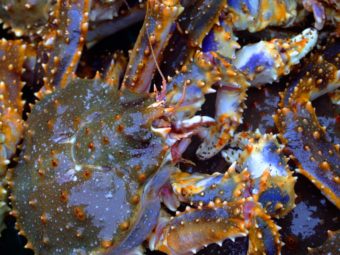
The restrictions in place to protect blue king crab also make it difficult to do research on the species. (Photo by Celeste Leroux/Alaska Sea Grant)
The restrictions put in place to protect blue king crab also make it difficult to do research on the species. (Photo by Celeste Leroux/Alaska Sea Grant)

The last commercial harvest of Pribilof Island blue king crab was in 1999. Extremely low population numbers have kept that fishery closed.

“They’re almost like unicorns in the trawl survey now,” said Lauren Divine, co-director of St. Paul’s Environmental Conservation Office. “There are very, very, very few being found. When you find one it’s kind of unreal. It’s kind of surreal. ”

As the blue king crab population goes down, fishermen on St. Paul Island face more restrictions to reduce bycatch. And when those crab are caught accidentally, that can lower fishing quotas even more. Those precautions are intended to protect crab and help the species rebound.

One idea Divine thinks could help the species recover is outstocking. That’s when female crab are plucked from the wild, flown to a hatchery where their eggs are raised until the young crab are dime-sized, and then they’re all returned to the ocean.

That method is being tested in Kodiak on red king crab and Divine says they’re seeing positive results.

“That gives us a lot of hope to say if it worked with red king crab, we could do this outstocking,” Divine said. “We could put these babies in the wild somewhere where we could go back and check. We could actually track survival, see them molt, and see the success of these crabs surviving.”

But the restrictions in place to protect the crab also make it difficult to do research on the species. The Alaska Department of Fish and Game would have to issue a permit to allow Divine to remove crab out of the water. That permitting process takes a long time, but Divine thinks it’s time to try.

“In the 16 years that we’ve been looking at this species and been trying to rebuild this species, nothing else has worked,” she said. “There is nothing to suggest that simply not touching them is going to do anything for the population in the future.”

At this point, she says scientists have exhausted other ideas. There’s only so much you can take from one population and apply to another.

Divine dreams of the day St. Paul’s fishermen will be able to fish without being limited by blue king crab bycatch.

Mysterious sea lion decline persists in western Alaska

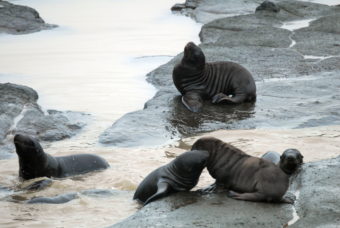
Month old Steller sea lion pups playing on Ulak Island. (Photo courtesy NOAA Fisheries)
One month old Steller sea lion pups playing on Ulak Island. (Photo courtesy NOAA Fisheries)

Alaska’s endangered Steller sea lion population continues its precipitous decline. The 2016 survey by the National Oceanic and Atmospheric Administration (NOAA) shows an overall increase in the number of Steller sea lions across Alaska, but a mysterious drop in parts of the western stock.

The big takeaway from this year’s Steller sea lion survey is this: the farther west you go, the worse it looks for Stellers. At the end of the Aleutian chain, the population is dropping about 7 percent a year.
Lowell Fritz is a biologist with NOAA. He says the outlook for the western stock is bleak.

“The probability of extinction for that western Aleutian population is greater than 50 percent within 50 years,” Fritz said. “We’re down to less than 200 pups produced a year in an area that used to produce thousands. It’s gone down 95 percent since the late 70s.”

Steller sea lions on Akutan. (Photo courtesy NOAA Fisheries)

For nearly 40 years, the western stock has been declining, hitting a low in 2002. But scientists like Fritz are having a hard time pinpointing the cause.

“We don’t see a mass exodus of animals that we’ve marked and tagged from these western Aleutian or central Aleutian areas that are declining,” he said.

One reason may be the western stocks aren’t having as many pups or the pups they do have aren’t getting to breeding age so they can have pups of their own. But without identifying a culprit for the decline, there are poor prospects for the species.

Even though the eastern stock of Stellers is doing better, Fritz says it’s important to maintain populations throughout the animal’s range to reduce the threat of extinction.

More: After decades of research, Steller sea lion decline still puzzles scientists

Charting new courses: student mariners prepare to navigate a warmer Arctic

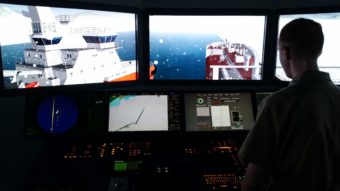
Glenn Burleigh practices piloting a tanker with a damaged rudder. (Photo by Zoë Sobel/KUCB)

In a windowless room at Maine Maritime Academy, Glenn Burleigh is standing calmly at the controls of a massive tanker. He is stuck, encased in a sea of ice, waiting for an icebreaker to break him free.

When help arrives, the rescue doesn’t go as planned.

“I think this is one of the situations where things do go wrong,” Burleigh said. “I seem to have lost my rudder.”

Burleigh is one of nearly 1,000 students studying at Maine Maritime Academy. He hopes to one day captain a ship. Today is a preview of what that job might look like in the Arctic Ocean.

The software is so detailed; you can hear the birds circling overhead. Just like a real ship. But without the danger.

“I mean you can ask the people who ran the Titanic what the risks are associated with ice transit and you would have a pretty good understanding what that’s all about,” said Capt. Ralph Pundt.

He designed this polar navigation course with help from a Department of Homeland Security grant.  The $450,000 grant was awarded to Maine Maritime Academy and the University of Alaska Anchorage’s Arctic Domain Awareness Center.

Before teaching, Pundt served as a merchant marine captain and spent time working at both poles. His time sailing taught him how much he didn’t know. That lack of knowledge was dangerous.

He says practicing in the simulator is a chance for real world experience, kind of.

“There’s nothing like the real thing,” Pundt said. “It’s as close as you can get without being in the real thing. The nice thing is that stop gap between basic book learning and having the responsibility of a multi-billion-dollar vessel. If they make mistakes, let them make the mistakes here.”

This class isn’t the only way to learn arctic navigation. Pundt’s working on a more advanced version and AVTEC, the technical college in Seward, has one, too. These classes will get mariners up to speed for the Polar Code, which goes into effect in January. That international code requires additional training for mariners to protect ships, passengers, and crews operating in the harsh Arctic and Antarctic environments.

Pundt says the Arctic Ocean today is a dramatically different place than when he was there 30 years ago.

“We could not go through most of the ice up there without an icebreaker escort at that time. I talk to my students who transit up there and I say, ‘how is the ice this year?’ They say to me, ‘what ice?’ It’s that open now.”

With less ice, Pundt says there’s a new set of risks. Mariners have to know what they’re up against.

The Northwest passage connects the Pacific and Atlantic Oceans. (NASA)
The Northwest passage connects the Pacific and Atlantic Oceans. (Image courtesy NASA)

That’s what’s great about practicing in the simulator. With the click of a mouse, almost any situation becomes reality.

“From here I can control weather,” Pundt said. “I can make things very nasty, very quickly here. How about some blowing snow? That’s Alaska weather right?”

That’s part of why Burleigh signed up for Pundt’s class. With Arctic ice decreasing, more ships will transit the Northwest Passage. That could mean a growing job market, which Burleigh has his eyes on.

“When that industry does open up more, I can walk in and say I’m already certified for this. You don’t have to send me back to school for it,” Burleigh said. “I’m ready to go right now. I’ve had experience doing simulations with ice and whatnot, so that puts me ahead of a normal third mate who hasn’t done anything with this.”

Right now, the market is small and it’s unclear what the future holds for icebreakers. This summer, the cruise ship Crystal Serenity made a historic transit of the Northwest Passage with a personal icebreaker escort.

Back on the bridge, success. Both ships have broken through the ice.

Burleigh completed the course earlier this year and is one step closer to a future as an Arctic mariner. But his teacher, Pundt, questions if those jobs should even exist.

“I’m not a fan of all this happening in the Arctic or in the Antarctic,” Pundt said. “I think it needs to remain pristine. If we do have to go up into the Arctic, we need to understand it and respect it for what it is.”

With the class, Pundt wants to cultivate a new crop of mariners trained to navigate polar waters with minimal impact, even if he’s hoping they don’t have to go there at all.

Homegrown and hydroponic: Veggies are St. Paul’s new subsistence food

St. Paul's greenhouse is named after an elder. It's called Ludy’s Qalgadam Tagadaa, or Ludy's Fresh Foods. (Zoë Sobel/KUCB)
St. Paul’s greenhouse is named after an elder. It’s called Ludy’s Qalgadam Tagadaa, or Ludy’s Fresh Foods. (Zoë Sobel/KUCB)

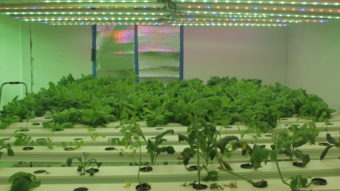
St. Paul’s greenhouse isn’t what you’d imagine. There’s no big glass structure. All the windows are covered from the inside. It’s underneath the city’s grocery store on the first floor of the building.

It’s hydroponic. Blue and red LED lights hang suspended above the plants. Pumps fill the room with white noise.

“Let’s try to find a big one,” said greenhouse manager Dallas Roberts.

He drops by on a recent afternoon to harvest six heads of lettuce.

“These have been growing for close to a month or month and a half,” he said. “They’re fantastic.”

The 19-year-old grew up on the island. He says the availability of fresh produce is a big deal in St. Paul. There’s only one shelf for it at the grocery store.

Bare shelves at St. Paul's grocery store. (Courtesy Lauren Divine)
Bare shelves at St. Paul’s grocery store. (Courtesy Lauren Divine)

Lauren Divine is the co-director of the tribe’s Environmental Conservation Office (ECO). She says problems with cargo shipping mean that by the time vegetables hit the shelves, they’re already rotten.

“We ran out of carrots, potatoes, and onions,” said Divine. “Those are cold-cellar, long-storage type vegetables. They were spoiling and going bad. The store had to throw them away.”

St. Paul’s greenhouse was built with more than $400,000 in federal grant money. The goal is to produce high-quality, affordable food for the community. At first, the idea was to build a traditional all-glass greenhouse.

But when Divine joined the project, she scrapped those plans because she didn’t think it was sustainable.

A box greenhouse kit would have to be barged in and because St. Paul is volcanic, the same would be true for fertilizer and topsoil.

“It took a lot to change everyone’s minds from thinking they would see this glass building to coming into a hydroponics operation and seeing the lettuce grow without soil in this very different, almost alien way,” Divine said.

The cost of running the hydroponic greenhouse is so low that they’re giving away the produce. The electric and water costs are covered by the Aleut Community of St. Paul tribal government.

Plants can grow inside the greenhouse year-round. Right now, they’re producing about 60 heads of lettuce a week. Plus, there’s tomatoes, cucumbers, peppers, cilantro, and more. There’s even an outdoor garden with potatoes and kale.

Divine says kids are some of the biggest advocates for the greenhouse. They even ask their parents to get lettuce.

“When you can sit down and have a meal with rutabaga, seal, potatoes, and carrots — all coming from St. Paul — it really shifts their view of subsistence. It can be all the food that we grow,” she said. “I can grow this at my house, or I can come down to the garden and harvest it. It’s from here and it’s our food.”

Kids in St. Paul sample lettuce. (Courtesy Lauren Divine)

But there have been problems. The heat in the greenhouse is provided by the grocery store above. When the business adjusts the temperature, it can kill the crops.

Still, demand for the produce is so strong that Divine plans to expand. She has her eyes on a new warehouse space that could fit a greenhouse twice the size of the current one. That may allow ECO to sell extra produce to Trident — the local fish processing plant — for its salad bar.

For now, the greenhouse staff gives away the vegetables. They can donate to the food bank and share with elders.

Remember those six heads of lettuce Dallas Roberts cut? A few minutes after he harvests them, he delivers them to the local tavern.

“It’s the best that we’ve got,” he said.

The cooks will use the lettuce for tomorrow’s dinner: Indian tacos.

Salmon fishing in St. Paul: Building a new subsistence resource

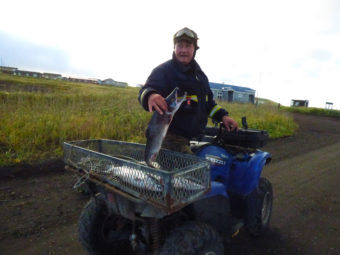
Diodor Stepetin shows off the salmon he caught in St. Paul's lagoon. (Courtesy Lauren Divine)
Diodor Stepetin shows off the salmon he caught in St. Paul’s salt lagoon. (Courtesy Lauren Divine)

Gregory Fratis Sr. isn’t a fan of salmon.

“Fresh cooked salmon, uh, uh. I don’t like it,” said Fratis. “I can taste that fishy taste.”

The 76-year-old says salmon aren’t worth the trouble. It takes too more time to catch and process each individual fish. To fill his freezer for the year, he’d rather catch seal, one of the Pribilof Islands’ traditional foods.

“We are the people of the seal,” he said. “That’s part of our diet. We are recognized through the fur seal. It’s our culture, too. The seal has everything to do with us Aleuts as food, as arts and crafts, as everything.”

But Fratis was also one of the first people on the island to go looking for salmon. Back in the early 1980s, someone told him about a salmon he discovered washed up on the beach. Fratis found a net and set out to see if he could catch some. After a bit of trial and error, he caught his first salmon.

“I took it home, excited,” he said. “Looked at it. Cooked it.”

All five salmon species have been found in the island’s salt lagoon. Now, the Aleut Community of St. Paul’s tribal council is hoping to get more residents interested in salmon fishing for two main reasons. First, salmon is a healthy food. Second, fishing is a great form of exercise.

Tribal council president Amos Philemonoff is onboard with the idea.

“Who can deny catching a salmon isn’t fun?” said Philemonoff. “The reward of going home and baking a whole salmon, it’s wonderful.”

Currently, there are no regulations on salmon fishing in St. Paul. The community doesn’t keep a count on how many fish there are, but Philemonoff estimates there are several hundred in the lagoon. That’s not much for a community of 500.

For the most part, residents get their salmon fix by trading with people off the island.

Philemonoff says the community is looking into enhancing the run to increase the amount of healthy food available on the island.

“All of the junk food they’ve got down at the store is pretty cheap,” he said. “You can buy five or six pizzas for a box of ammunition to go get these sea ducks or reindeer. What are you going to do? Are you going to get five pizzas and feed your family or are you going to buy a box of shells?”

Fratis isn’t ready to add salmon to his diet, but he fishes to stay active. It gets him out of the house. In the summers, he’ll spend eight or nine hours in the lagoon walking and catching up with other community members.

Even though he doesn’t enjoy the taste of salmon, he’s looking forward to developing the salmon resource, too.

“Imagine derbys and everything,” said Fratis. “Recreation starts. That gets you out of the house. Who knows? I may start eating salmon.”

Before that can happen, the community needs to establish if it’s even possible to enhance the resource and settle on the simplest way to increase the salmon in St. Paul.

Denali’s dogs: Protecting the environment and preserving heritage

In the winter, Denali's sled dogs ferry park employees through areas closed to motorized vehicles. (Zoë Sobel/KUCB)
In the winter, Denali’s sled dogs ferry park employees through areas closed to motorized vehicles. (Zoë Sobel/KUCB)

Early on a crisp, fall morning a large white truck sits alone in a dirt parking lot at Riley Creek Campground.

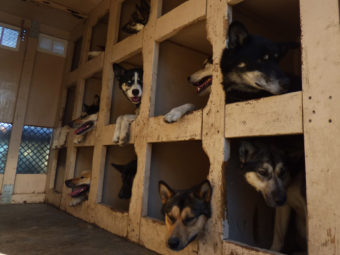
Denali kennel manager Jennifer Raffaeli takes six huskies out of the van, fits them in harnesses, and hooks them to a line attached to a green metal cart that looks like a dune buggy. Raffaeli fastens her helmet.

On the trail, the only sound is the wheels whirring along the ground. The six-dog teams pull two humans around trails that wind in and around the campground.

On this day, each team is running about five miles, and then it’s back to the kennel. By the start of the winter season, the dogs will be doing 20-mile days. Over the course of the winter, they will log around 1,500 miles each.

It may seem backward, but Raffaeli says winter is the easiest time to move cargo through the park.

“Swamps and bogs and thick brush are the norm across Alaska,” said Raffaeli. “That’s challenging and slow going, especially if you are trying to move big heavy objects. When the park is covered with snow and rivers are frozen, you can carry huge loads because you’re not trying to carry them on your back. You’re sliding them over snow and ice, and that’s no problem for these guys.”

Pound-for-pound, Raffaeli says sled dogs are the strongest draft animals on the planet. That makes them the perfect tools for transportation through Denali’s designated wilderness — areas of the park that prohibit motorized vehicles.

Jennifer Raffaeli plays with the kennel's newest members. (Zoë Sobel/KUCB)
Jennifer Raffaeli plays with the kennel’s newest members. (Zoë Sobel/KUCB)

Dogs have been a part of Denali for the entire history of the park. In 1921, Harry Karstens was hired as the park’s first superintendent and insisted on having dogs.

“It made perfect sense as you created a two-million-acre park, which is a huge area to try and cover as one person. You were going to need some dog teams to cover that,” she said.

Back then, Raffaeli says dogs were the only way rangers could traverse the park and protect wildlife, like caribou and Dall sheep, from poaching. But over the years, the role of Denali’s sled dogs has changed.

In 1980, the Alaska National Interest Lands Conservation Act, or ANILCA, labeled the original two million acres of Denali as wilderness — the highest level of federal land protection — and gave renewed purpose to the park’s sled dogs.

The Wilderness Act requires that land managers look at the minimal tool for the task at hand,” Raffaeli said. “We’re always asking: Can we accomplish this project with dog teams?”

And if they can, they will. Over the winter, the teams are out for up to five weeks at a time. They haul supplies, support glacier research, and monitor man-made noise.

Plus, Raffaeli believes meeting a dog team in the field adds to the wilderness experience for park users.

“To encounter only a dog team on the trail — no snow machines, no other forms of motorized transport — is a form of peace and quiet and wildness that’s getting more and more rare,” she said. “It’s more and more valuable that we continue that heritage here.”

That’s a heritage that in many ways is fading. Denali’s huskies aren’t just the best method of winter transport. They help preserve what many people remember as daily life in Alaska.

But in a rapidly changing climate, Raffaeli is uncertain about the future of the dogs.

“If we start to get warmer winters with less snow, how does that affect the dogs?” Raffaeli said. “How do we evolve to face that new environment? I think those are really valid questions. But at the core of it all, I hope the dogs are always part of the story because they are such a special part of it.”

Back on the trail, the dogs are finishing their 30-minute morning workout. Raffaeli pulls into the campground parking lot and eases the team to a stop.

She jumps off and ladles water into one tin dog bowl after another. The dogs lap it up. When they are done, they go back in the van. It’s time for Raffaeli to get the next team ready for its five miles on the trail.

There’s no question, the dogs love their job.

Site notifications
Update notification options
Subscribe to notifications