Zoë Sobel, Alaska's Energy Desk

At a safe distance: Monitoring remote volcanoes from remote locations

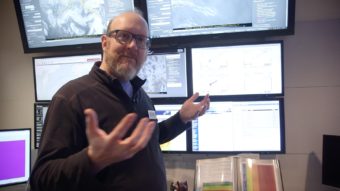
Dave Schneider, a research geophysicist with the USGS, explains how volcanoes around the state can be monitored remotely by satellite from the AVO Operations Room in Anchorage. (Photo by Eric Keto/Alaska’s Energy Desk)

Across Alaska there are monitoring instruments on 31 of the most active volcanoes, but there’s nothing on the one that’s erupting now.

Bogoslof volcano is on a tiny uninhabited island in the middle of the Bering Sea. Since mid-December, Bogoslof has erupted more than two dozen times. With eruptions spraying ash up to 35,000 feet in the air, the Federal Aviation Administration has banned flights from flying over it.

“Typically they’ve happened late at night,” said Dave Schneider, a geophysicist at the U.S. Geological Survey, USGS,  in Anchorage. “Volcanoes are like babies, they never come at a convenient time.”

He says unpredictable and frequent eruptions have kept scientists up around the clock doing status checks.

But technology has gotten to the point where the crew can do most monitoring from anywhere, including their homes, and the team can act quickly when the need arises.

Last year Pavlof, one of Alaska’s most active volcanoes, had a surprise eruption that caught Schneider at the Easter dinner table.

“You know, you sort of move aside the ham, you open up your laptop. and you take a look at what’s going on,” Schneider said. “That’s just what we do.”

But watching Bogoslof is more tricky than Pavlof due to its remoteness and lack of an on-island monitoring network.

Bogoslof belongs to a rare class of submarine volcanoes that have erupted through the ocean surface. There are only a handful around the world, so researchers at the Alaska Volcano Observatory, or AVO, are looking for clues in the history of a similar volcanoes, like Surtsey in Iceland.

Schneider says there aren’t really any options for monitors on Bogoslof because the island is so small.

“It would be difficult to actually put much a monitoring network on there,” Schneider said. “If there had been instruments on there, they likely would have been destroyed by seismic activity at this point.”

The decision on where the AVO places equipment Schneider says is based on how much threat a volcano poses to nearby people and property.

There’s all sorts of different tools the organization can use to monitor volcanic activity, from seismic instruments to satellites to infrasound data. In the case of Bogoslof, they’re not in the business of predicting eruptions.

Schneider has worked in Alaska for two decades and says Bogoslof’s eruption is unlike anything he’s seen in the state.

“We don’t have any other experience with this type of eruption style with a vent through the ocean during my time period in Alaska,” Schneider said. “There were no nearby seismometers, like we have now, that would allow us to do this kind of analysis that we are currently conducting.”

So the ongoing explosions and seismic activity at Bogoslof are writing the history books for what eruptions at this volcano look like. But the distant monitoring instruments, on Umnak Island and in Sand Point, are only picking up the largest seismic events.

Chris Waythomas is a geologist for USGS. While he’s glad there’s a network to support monitoring of Bogoslof — 24 years after its last eruption — he doesn’t think it’s enough.

“I think we’re still missing a fair bit of the story,” Waythomas said. “I think there’s a lot going on out there that we’re not catching, so that’s a little frustrating.”

One thing the team missed was the date of the first eruption back in December. AVO first noticed the eruption on December 20th, after a pilot reported an ash plume. But looking back at the seismic record, they now believe activity began more than a week earlier.

Waythomas says watching the eruption progress is interesting, but he’s more excited for what comes next.

“What we are doing now is the real time volcano monitoring and preliminary interpretation of the data streams,” Waythomas said. “A lot of the story remains to be told.”

Waythomas says hundreds of papers can be written after eruptions like this one. He’s hoping once the volcano cools off and Bogoslof Island is safe, he’ll be able to check it out for himself.

St. Paul’s fur seal pups at lowest level in 100 years

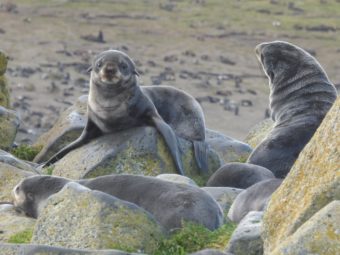
Northern fur seals at St. Paul Island’s Reef rookery. (Photo John Ryan/KUCB)

Northern fur seal pup production on St. Paul Island has hit its lowest level since 1915.

Every other year members of Seattle’s Marine Mammal Laboratory travel to the Pribilof Islands to estimate how many pups are born. Scientist Rod Towell has been a part of the counts since 1992. He says the difference at the rookeries on St. Paul is striking.

“I’m not going to say it was full coverage, but it looked like a moving carpet in a sense,” Towell said. “There was movement all across the rocks. You can see them, but there’s seals moving everywhere. Whereas now it looks more patchy.”

He estimates the seals are covering about half as much land as they did on his first trip to the island.

St. Paul Island’s Reef rookery in 1948. (Courtesy National Marine Mammal Laboratory)

The cause of the decline Towell says is a mystery.

“There hasn’t been commercial pressure on St. Paul island since 1984,” Towell said. “The fur market has gone way down. We haven’t seen any real obvious mortality pressure on this population since then.”

Towell believes a different research project may be the key to solving this mystery.

Every year since the late 2000s, the team has tagged fur seal pups on St. Paul and St. George Islands for a new project.

Towell thinks that data will help pinpoint where the population is suffering most and if there are big variations in the numbers of pups born each year.

No lichen, no problem: St. Paul’s reindeer thrive without essential food

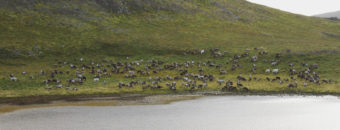
With no lichen left on St. Paul Island, reindeer are grazing on grass and digging up roots. (Courtesy Paul Melovidov)

For a long time, scientists thought reindeer would be big losers in climate change, but the reindeer on St. Paul Island are challenging that theory.

As their main winter food source has disappeared, the St. Paul herd has changed its diet so they can survive on the remote island. This adaptation could have global implications for reindeer facing a warming climate.

If there’s one fact everyone agrees on about reindeer, it’s this:

“No lichen. No reindeer,” said Lauren Divine, co-director of the Aleut Community of St. Paul’s Ecosystem Conservation Office (ECO). “Reindeer all over the world depend on lichen. They’re very high in sugars and starch. They’re considered like a Snickers bar for reindeer in the winter”

Reindeer aren’t native to Alaska. They were brought to rural villages – including those in the Pribilof Islands – in the early 1900s. The St. Paul herd roams free, but like all reindeer, they are domesticated.

When reindeer first came to the small island, there was a lot of lichen, but the reindeer ate it faster than it could regrow and now it’s gone. The reindeer, however, are still there: about 400 of them.

Divine was interested in managing the herd more formally, so in March of 2016 she connected with Greg Finstad, program manager of the University of Alaska Fairbanks Reindeer Research Program, and invited him to visit.

When Finstad got there, he saw something he’d never witnessed before.

“The reindeer are doing something really very interesting,” Finstad said. “They have managed to find other things to eat. They’ve gone underground.”

Greg Finstad (R) examines a reindeer on St. Paul. (Courtesy Lauren Divine/ECO)

When examining the animals, Finstad discovered instead of lichen, reindeer on St. Paul are grazing on grass and digging up roots.

Grass is rich in fiber and their teeth are wearing down faster because they’re eating more of it than typical reindeer. Based on the size of the animals — they’re gigantic — Finstad can tell the herd is consuming a lot of protein.

On St. Paul, the reindeer are responsible for decimating the lichen; they’ve literally eaten it all. Lichen is also disappearing around the world, but there’s a different culprit: climate change.

Finstad thinks what’s happening on St. Paul could be a preview of how more northern herds may adapt to a warmer planet.

“There’s a lot of scientists, researchers, reindeer producers waving their arms in the world, ‘oh climate change, it’s the death of reindeer and caribou,'” Finstad said. “But you know what, we’ve forgotten to tell the reindeer and caribou: things change and they change with it.”

Finstad used to worry about the future of reindeer, but what he’s seen on St. Paul makes him optimistic that reindeer could deal with climate change just fine.

Mark Boyce, an ecology professor who studies caribou at the University of Alberta, isn’t ready to make that leap.

“I would say no,” Boyce said. “It’s an island population and a very small sample of our global populations of reindeer and caribou. The general pattern has been one of decline. So I guess I’m not very optimistic.”

Boyce says he’s happy to hear some herds — like the one on St. Paul — might do better than expected. But he says overall, the picture for reindeer is bleak.

Finstad thinks skeptics like Boyce can be convinced if they visit the island and see the herd with their own eyes. Finstad has seen reindeer around the world and he says the St. Paul herd is exceptional.

“These are beautiful, magnificent animals: Large healthy females, large antlers,” Finstad said. “The antlers are as large as the males. The calves, they are large. Very healthy good looking population.”

Residents of St. Paul are taking full advantage of the herd. The community has mostly subsistence hunted fur seal and seabirds, but Lauren Divine says there are now more reindeer hunters than anything on the island. The thriving reindeer herd is an especially important source of meat in a place where grocery prices are astronomical.

Before and after photos of Bogoslof Island show big changes after recent eruption

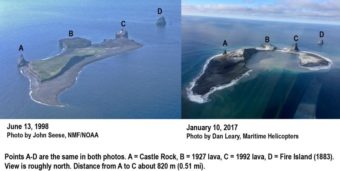
(Chris Waythomas, AVO-USGS)

New photos show the dramatic effect of volcanic explosions on Bogoslof Island. The Eastern Aleutian island is home to a volcano that has been erupting since mid-December. Now, the tiny island is even smaller and it’s shaped like a hook.

Chris Waythomas, of the U.S. Geological Survey, says the photos also show ash on the island.

“There’s ash draping over everything,” said Waythomas. “There’s a layer of fine muddy-looking ash covering what was a partially vegetated island.”

When all is said and done, Waythomas says it’s possible Bogoslof Island could be a lot smaller. He estimates so far about a third of the island has been destroyed from this eruption.

Monitoring Bogoslof: How life responds to volcanic destruction

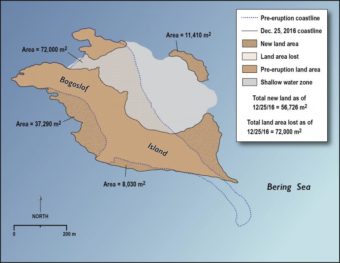
Even with the formation of new land, Bogoslof Island has shrunk. (Courtesy Chris Waythomas, AVO/USGS)

Bogoslof Island is an important breeding ground for marine mammals and seabirds making it the perfect place to monitor how life responds to volcanic destruction.

The island is tiny. But it’s hard to say how tiny because the shape and size of the island are changing almost constantly since the eruptions started December 16. While recent eruptions have added new land, Chris Waythomas of the U.S. Geological Survey says on the whole, the roughly mile-long island has shrunk.

“It looks quite a bit different than it did before,” Waythomas said. “It’s very susceptible to wave erosion, so deposits that formed hours ago are immediately being attacked by the ocean.”

With continued seismic unrest, the island is in a constant state of flux. But Waythomas can document that change with commercial satellite data that he turns into maps, which creates an opportunity to study how an island and its ecosystem respond to volcanic activity.

“When their habitat is altered, what do they do?” Waythomas said. “Where do they go? Does it impact the species significantly? How have these species dealt with these sorts of things?”

Waythomas says research in this natural laboratory applies to both natural and manmade disturbances.

“The big question is: If this happens, how long will it take to recover?” he said. “If we put this mine in here or if this spills, how long does it take to come back?”

For that answer, we’ll just have to wait.

Police arrest two in Unalaska in counterfeit money case

Two men have been charged with fraud for making counterfeit money, Unalaska Department of Public Safety said.

Henry Zablan and Nicholas Hough were taken into police custody over the weekend and later charged with fraud.

Deputy Chief Jennifer Shockley says in her 16 years with the department this isn’t the first case of counterfeit money found in Unalaska.

“Typically nobody has any idea of where it came from,” Shockley said. “You know, somebody paid for something, the counterfeit bill got into circulation, somebody who’s familiar with checking security stuff recognizes it as counterfeit, and then we get told about it.”

Shockley said the police normally don’t have more information than that.

They’ll send the counterfeit bills to the U.S. Secret Service and that’s it.

But this time is different.

“Actually finding people, finding equipment being used for counterfeiting money right here in town is unusual for us,” she said.

Officers were tipped off about the alleged counterfeiting operation while investigating a burglary and theft.

Police found counterfeiting supplies as well as forged U.S. currency at Zablan’s residence.

The equipment police found is commonly available to the average citizen, Shockley said.

The investigation is ongoing.

Shockley said at least one more person of interest is sought in the case.

If anyone has counterfeit money in their possession, then she encourages them to bring it to the police station — especially if they know where it came from.

Site notifications
Update notification options
Subscribe to notifications