Zoë Sobel, Alaska's Energy Desk

Dutch Harbor remains nation’s top fishing port

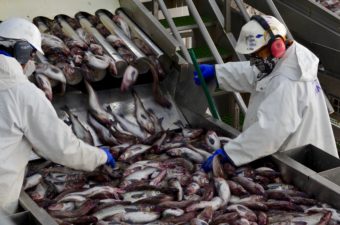
Workers inspect fish unloaded at Unalaska's UniSea plant. (Sarah Hansen/KUCB)
Workers inspect fish unloaded at Unalaska’s UniSea processing plant. (Sarah Hansen/KUCB)

On dinner tables across the country, Americans are eating more fish. The United States is responsible for more fish consumption than all other countries, except for China.

An annual National Oceanic and Atmospheric Administration report shows Americans added almost one pound of fish to their diets in 2015.

For the 19th consecutive year, the port of Dutch Harbor is America’s largest fishing port, hauling in 787 million pounds of seafood. That’s the most seafood ever brought into one port — and more than 250 million pounds above the next port, Kodiak.

(Courtesy NOAA Fisheries)

The $218 million haul is mostly thanks to the large volume of pollock from the Bering Sea, as well as crab and other groundfish.

Frank Kelty was the fisheries analyst for the City of Unalaska, and he says fishing is the community’s main economic engine.

“We have no other main industry,” said Kelty. “Everything feeds off how the fisheries do, and it works its way down through all sectors of the community.”

Although it’s more money than last year, Dutch Harbor’s haul is still behind the nation’s most profitable port, New Bedford, Massachusetts.

As a state, Alaska led the country in volume and value of fish landings — bringing in three times the money and more than five times the amount of seafood as the next largest state.

Bringing science home in St. Paul: Former student becomes teacher

Dallas Roberts shares lettuce from St. Pauls's greenhouse with students. (Photo by Zoë Sobel/KUCB)
Dallas Roberts shares lettuce from St. Paul’s greenhouse with students. (Photo by Zoë Sobel/Alaska’s Energy Desk)

The Pribilof Islands in the Bering Sea are a magnet for scientists who come to study everything from fur seals to migratory birds. When they leave, that research often leaves with them.

But for the last nine years, the local tribe has found a way to bring it back home. Each fall, a group of scientists return — not to do research, but to share its findings with the students of St. Paul and St. George Islands.

For the first time this year, a former student is now a teacher.

Nineteen-year-old Dallas Roberts is in St. Paul’s greenhouse. It’s a couple of rooms in the basement of the island’s grocery store, lined with trays of plants under bright red and blue lights. He’s surrounded by a gaggle of second and third graders.

Roberts is teaching them how a greenhouse works. It’s part of Bering Sea Days. Since 2008, the Pribilof School District has blown out a week of classes to focus on science from the region.

Roberts grew up in St. Paul. He graduated from the high school last year, and he has fond memories of going through Bering Sea Days as a student.

“I thought it was a blast throughout my whole high school career,” said Roberts. “I think we were all excited to get out of school work for a week.”

Roberts has worked for the local tribe, the Aleut Community of St. Paul Island, since high school. After a year of college, he decided to come back.

“I don’t see myself doing anything different right now,” he said. “I mean the greenhouse is a part of me that I can’t easily give up.”

That’s what Aquilina Lestenkof likes to hear. Lestenkof helped create the program. She hoped to get more kids interested in working in environmental fields on behalf of the community. Creating teachers like Roberts is ultimately her biggest goal.

“When you build people that can speak about environment, that’s one thing,” said Lestenkof. “When you build people who can teach about the environment, that’s a whole other ball game.”

As a teacher, Roberts joins scientists from across the country. Program organizer Lauren Divine said Bering Sea Days exposes kids to things they would never learn in a traditional classroom, like rearticulating baby orca skeletons or the chemistry of sea ice, and connects students to their changing environment.

“People are coming in who have studied something specific to St. Paul, Alaska, the Bering Sea, or the Arctic,” said Divine. “Even though the students are in a region where they can see climate change happening, it’s not something they would be exposed to in a traditional science setting.”

The goal is to make sure that some of the research happening in the Pribilofs is shared with the people who live there — maybe even inspiring the next generation of scientists.

When Roberts decided to come back to the community, he worked out a deal with Divine: If he took online classes, he could work for the tribe’s Environmental Conservation Office.

He said Bering Sea Days applies science to daily island life, like the annual fur seal harvest.

“I grew up doing the seal harvest,” he said. “So learning a different side — not just harvesting them, but learning about their whole body — it’s important for our community to know what the seals eat and how certain climates affect them. Because right now, they’re declining, and I think that hurts us.”

He never imagined that he’d be back as a teacher, but now that’s his favorite part.

“It was amazing to teach younger kids about the greenhouse,” he said. “Even if I didn’t know all the answers, I answered them to the best of what I know.”

And he’s keeping an eye out for students who might follow his footsteps and become teachers themselves.

In St. Paul, this Alaskan vows ‘Never Trump’

Bill Briggs is a Hillary Clinton supporter in St. Paul. (Photo by Zoë Sobel/KUCB)

As Election Day approaches, we’re checking in with voters around the state, asking what issues matter to them most — and who they’re supporting for president.

Yesterday we heard from Julie Tisdale, a Trump supporter in Anchorage.

Tonight we hear from Bill Briggs of St. Paul. Briggs is 60. He’s lived in St. Paul for 10 years, and manages the island’s seafood processing plant. And he is definitely not on the Trump train.
He spoke with Zoë Sobel of Alaska’s Energy Desk.

New satellite-based technology aims to crack down on illegal fishing

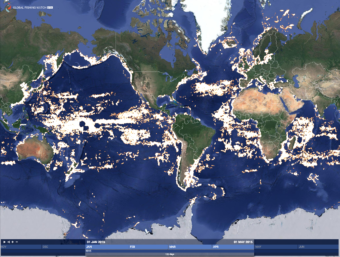
A satellite-based program from Google, Oceana, and SkyTruth hopes to help everyone track the movement of commercial fishing vessels around the world. (Courtesy Oceana.)

Commercial fishing in Alaska is a multibillion dollar industry. But every year, billions of dollars are lost to illegal fishing around the world. A new satellite-based surveillance system makes it easier to track illegal fishing. But some fishermen aren’t ready for Big Brother watching their every move.

Worldwide, overfishing is a huge problem. Jacqueline Savitz, vice president of the conservation group Oceana, says populations of big fish, like halibut, have dropped 90 percent. But the fish can rebound when their habitats are protected.

“We actually see fish stocks coming back and getting to levels where they’re sustainable, so we can continue to live off the interest, if you will, and not fish down the principal,” said Savitz. “But we also have a problem with illegal fishing. It’s about a $23 billion industry globally.”

Now, there’s a new tool for people who want to prevent illegal fishing: Global Fishing Watch. It’s a free, web-based, interactive map of the world’s traceable commercial fishing activity, dating back to January 2012.

It’s based off information gathered from vessels’ Automatic Identification Systems (AIS). The boats broadcast  signals including their location, who they are, and where they’re headed.

Not all boats have to use AIS. Currently, the International Maritime Organization only requires it for large vessels like big oceangoing cargo ships and certain vessels on international voyages

While AIS technology has been around for a while, this is the first time all its information is publicly available.

As ocean traffic increases, Savitz hopes Global Fishing Watch will increase accountability. She points to Alaska’s waters as an example

“There’s a lot of change happening up there with the changing climate and potential new shipping routes through the Arctic and the Bering Strait,” she said. “There are going to be areas that are protected. How are we going to know if they are really being protected?”

That’s what this project hopes to do. But fisherman Roger Rowland doesn’t like the idea that everyone can track his vessel. He wants to protect his fishing hot spots.

“With my salmon fishery, I don’t want people knowing where I am,” said Rowland. “Since I’m not legally required to have it, I turn it off.”

Rowland owns a 58-foot seiner based in Unalaska. Because his boat is small, he isn’t required to constantly run AIS.

Even though Rowland likes his secrecy, he thinks Global Fishing Watch could be helpful for certain fisheries.

“When I’m pot cod fishing, I do have legal areas where I cannot go,” he said. “My boat cannot go inside a ring around a sea lion rookery, and so it’s good for that. Nobody is sneaking in there because someone is watching.”

John Amos is the president of SkyTruth, a nonprofit that uses technology to highlight what’s happening in the environment. He says even though fishermen like Rowland might not want to be tracked, there’s a benefit for people who play by the rules.

“People care about where and how their food is being produced,” said Amos. “Here’s an opportunity for fishing vessel captains to create personal relationships with their consumers at the seafood market or at the restaurant table and say, ‘Look, we are the good guys, and we’re going to show you.’”

There will always be fishermen who turn off their AIS, but Amos believes Global Fishing Watch will help crack down on the amount of unregulated and unreported fishing as well as empower individuals to monitor patches of ocean they care about.

Alaska fisheries escape effects of climate change for now

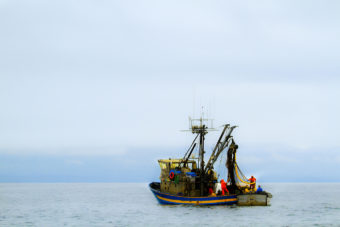
Commercial fishing in Alaska is a multi-billion dollar industry.
Commercial fishing in Alaska is a multi-billion dollar industry. (Aftab Uzzaman/Flickr)

With coastlines eroding, temperatures rising, and sea ice retreating, Alaska is feeling the effects of a warming planet. But a new federal report suggests fisheries in the state haven’t experienced many observable impacts of climate change so far.
Commercial fishing in Alaska is a multi-billion dollar industry. For 18 consecutive years, fishermen have hauled more fish into Dutch Harbor than anywhere else in the country. But at this point, researcher Terry Johnson says climate change isn’t a hot topic in the industry, even though it could affect young fishermen.

“We aren’t talking about next year, but we are talking about within this century or within the working lives of young people who are just coming into the fishery now,” he said.

Johnson says interest in the topic is growing among fishermen.

As a researcher for Sea Grant — an offshoot of the National Oceanic and Atmospheric Administration — he’s synthesized hundreds of scientific papers, interviewed scientists and stakeholders, and combed through popular media to compile this report.

Johnson says climate change will have different effects on different fisheries — salmon might do better in warmer waters, while pollock and crab might fare worse.

Johnson says short-term ocean warming events, like El Niño or the Blob, could preview the long-term effects of climate change on fisheries.

“If 50 years from now, the long-term ambient temperatures are the same as they were last year during a short-term event, you can see how stocks reshuffle themselves,” he said. “Some prosper and some diminish.”

Johnson says so far, observable impacts of long-term climate change on Alaska’s fisheries have been relatively mild. Commercially important fish species are prospering while sport and subsistence resources are within normal ranges. Exceptions like the sweeping decline of Chinook salmon could be tied to climate change or ocean acidification, but the research isn’t there yet.

And Johnson says seeing Alaska’s future is as easy as looking south.

“You want to know what Alaska is going to be like 100 years from now?” Johnson said. “Look at Washington, because the temperatures are warmer there. If nothing changes, eventually we are going to get a similar type of long-term temperature increase here.”

Johnson says fisherman deal with change all the time.

The fishing industry is constantly adapting — from market collapses to advances in technology to shifts in resource management. Johnson says that flexibility has primed them, so they can adjust to climate change.

Unalaska cleans up fish oil spill

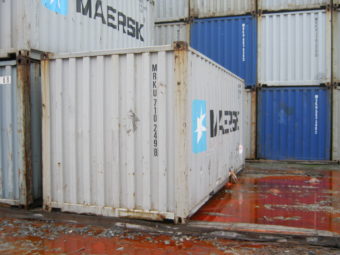
Fish oil pours out of a punctured shipping container. (David Toonan/U.S. Coast Guard)
Fish oil pours out of the punctured shipping container. (David Tonon/U.S. Coast Guard)

A forklift punctured a shipping container filled with fish oil in Unalaska on Thursday, spilling it across a shipyard. Fish oil is considered an environmental hazard, but far less damaging than crude oil. Some of the bright orange oil flowed into a storm drain and into the ocean. Resolve Marine stopped it from spreading more by plugging the drain with gravel and dirt.

A couple hundred gallons of the 5,700-gallon bladder made it into the ocean. But U.S. Coast Guard Lt. Andres Ayure said because fish oil is biodegradable, it’s not too hard on the environment.

“Technically, in large quantities it could be seen as a marine pollutant. But in the quantities that we saw and with the weather we had, it will disperse, emulsify very quickly, and not harm the environment,” said Ayure.

Calm seas made it easier to contain and clean up the fish oil. If it had not spilled, the fish oil would have been shipped off the island and processed into products like fish oil supplements.

Shipping company Matson is responsible for the spill and for the cleanup, which Ayure said can be costly. The Coast Guard is also putting together a report on the incident and Matson could face fines and further penalties.

Site notifications
Update notification options
Subscribe to notifications