Zoë Sobel, Alaska's Energy Desk

Plankton population and the power of pink salmon

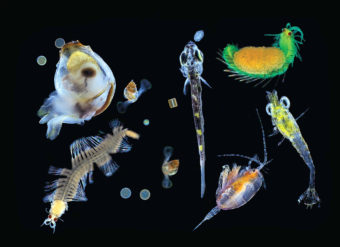
Plankton collected in the Pacific Ocean with a 0.1mm mesh net. Seen here is a mix of multicellular organisms — small zooplanktonic animals, larvae and single protists (diatoms, dinoflagellates, radiolarians) — the nearly invisible universe at the bottom of the marine food chain. Christian Sardet/CNRS/Tara Expeditions
A variety of plankton from the Pacific Ocean. (Christian Sardet/CNRS/Tara Expeditions)

After combing through data from the Aleutian Islands, a scientist has discovered an unexpected relationship between plankton and pink salmon. Although plankton might seem like an ecological afterthought, biological oceanographer Sonia Batten disagrees. She calls them the most important organisms in the ocean.

“They’re the basis of every marine food chain pretty much,” said Batten. “They support directly, or indirectly, the resources that we value.”

That means even if a species isn’t eating the plankton itself, its food source probably is. Scientists consider plankton good indicators of what’s happening in the environment.

“Because they have short life cycles, they have very limited ability to move, and they’re not commercially fished,” she said. “They react very quickly to changes in their environment in a relatively unambiguous way.”

Batten has 15 years of data from plankton pulls in Alaskan waters. That involves dragging a net behind commercial cargo ships. When there are a lot of pink salmon, they eat up a lot of animal plankton. But when pink salmon numbers are low, the animal plankton flourish.

Those impacts permeate the entire food chain — past their immediate prey. And if the pink salmon eat a lot plankton, there may not be much food left for other predators.

In 2013, Batten started seeing something unusual.

“This was the first time that I’ve seen that the fish are actually influencing the plankton,” she said.

2013 was a bumper year for pinks, and the data began to look different. Batten didn’t see that big decrease in plankton. And now she’s left with a question: What changed?

“Pink salmon were supposedly in really high numbers in 2013, so I would have expected to see the same numbers,” she said. “But I didn’t, so that suggests that something’s going on in the environment that I don’t know about yet.”

Batten says it could be that the salmon are eating something else. She’s planning to continue looking for answers.

Correction: A previous version of this story indicated that plankton pulls were done using commercial fishing boats. In fact, scientists used commercial cargo ships.

What killed St. Paul’s woolly mammoths?

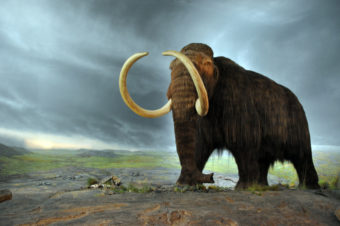
A wooly mammoth on display in the Royal BC Museum. (Photo by FunkMonk/Wikimedia commons)
A woolly mammoth on display in the Royal BC Museum. (Photo by FunkMonk/Wikimedia commons)

What killed the woolly mammoths on St. Paul Island? Thirst. For the first time, scientists have pinpointed the date — 5,600 years ago — and a likely cause of extinction. They believe the environmental changes that killed the animals mirror today’s climate changes.
Six thousand years ago, St. Paul Island looked about the same except for one big difference: There were mammoths. And it’s not like they swam there. Penn State University’s Russell Graham says they walked on the Bering Land Bridge.

“As the glaciers melted, the water in the ocean started to rise,” said Graham. “In this process, a group of mammoths was isolated on the island.”

For a while, it was a good strategy for survival. Without predators, mammoths on St. Paul survived thousands of years longer than many other mammoths around the world. But eventually, they met their end. And Graham and a team of scientists wanted to know exactly when that happened.

“We were able to actually pinpoint when the mammoths actually went extinct,” he said. “It wasn’t like, ‘Well, we think it was this time.’ We actually know!”

Graham’s team analyzed a sediment core from a lake on the island. They examined ancient DNA and three species of fungal spores that grow on the dung of large animals.

Matthew Wooller cores Lake Hill Lake, St. Paul island. (Photo courtesy Jack Williams)
Scientist Matthew Wooller cores Lake Hill Lake on St. Paul Island. (Photo courtesy Jack Williams)

All the evidence pointed to one culprit in the mammoths’ extinction: not enough fresh water. As the sea level rose, St. Paul shrunk. Some lakes were lost to the ocean and a more arid climate caused other freshwater sources to evaporate. As island dwellers, Graham says these mammoths were especially vulnerable.

“A change in the climate of the magnitude that caused this extinction on the mainland probably would have been insignificant,” he said. “But because the animals and plants are restricted to the island — and particularly smaller islands — this little change came together with a whole series of things to create a perfect storm that then caused the extinction.”

In the small world of paleoecology, the findings are a really big deal.

“What is especially powerful about this study is that you have completely independent lines of evidence that back up the same story,” said Jacquelyn Gill of the University of Maine.

As an Ice  Age ecologist, she studies the past to put modern-day environmental problems — like climate change — in context. Since climate change and extinction have happened before, scientists can use what they know about various species responses to help protect today’s biodiversity.

Some might say 6,000 years ago is ancient history. But in geological time, it isn’t. While mammoths roamed St. Paul Island, Gill says ancient Egyptian civilization was well underway.

“When you tell someone, ‘You could have had a mammoth-drawn chariot if things had gone differently,’ I think it makes them think a little bit differently about Ice Age ecology and how relevant this work is to the environmental problems we’re facing right now,” said Gill.

The changing climate that claimed the mammoths of St. Paul has struck again. But this time, it’s human-driven. In June, a small Australian rodent became extinct, driving home Graham’s point that island populations are especially vulnerable.

And Graham says it’s not just the rising sea levels that should concern islands and coastal communities. Take a look at Florida.

“They may be waiting for the water to come up and inundate the peninsula,” Graham said. “But in reality, they maybe should be looking behind themselves because they’re probably going to face other issues — like fresh water availability — before that actually happens.”

The vulnerability of island populations is one lesson from the 72-foot-long sediment core. There could be more. Right now, scientists are hard at work analyzing the rest of it — all 18,000 years.

Shell returns to Unalaska

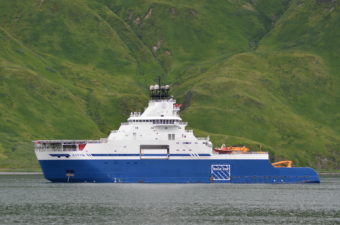
The Aiviq in Unalaska. Photo: Sarah Hansen/KUCB

UPDATE, 8/8/16:

A fourth vessel associated with Shell’s Arctic efforts has docked in Dutch Harbor. The Nanuq arrived late Friday evening.

ORIGINAL STORY, 8/5/16: 

Shell is back in Unalaska. Dutch Harbor was a staging area for Shell’s unsuccessful search for oil in the Arctic Ocean last year. This week, three ships — the Aiviq, the Dino Chouest, and the Ross Chouest — associated with Shell’s Arctic efforts arrived in Unalaska on a mission to remove the last signs of that effort.
A Shell representative says the vessels are “tasked with retrieving more than 50 anchors from the Chukchi and Beaufort seas” and “completing required environmental science monitoring and reporting.”

Meanwhile, a Coast Guard investigation released this week confirms that inaccurate charts are to blame for one of Shell’s major mishaps last summer. The icebreaker Fennica hit a pinnacle of rock near Dutch Harbor, tearing a three-foot hole in its hull and causing the boat to take on water. The original damage was estimated at $100,000 and repairs set back the Fennica’s arrival in the Arctic Ocean by a month.

Coast Guard Lieutenant Rven Garcia said the charts had last been updated in 1935.

“They did have charts, but the actual water depth was significantly shallower than indicated on the chart,” Garcia said. “So the pilot had the proper tools on board, but the chart wasn’t as up-to-date because the survey had not been conducted for that area.”

After the incident, the National Oceanic Atmospheric Administration conducted a new hydrographic survey to map the area.

ICYMI: New effort shines a spotlight on ocean acidification

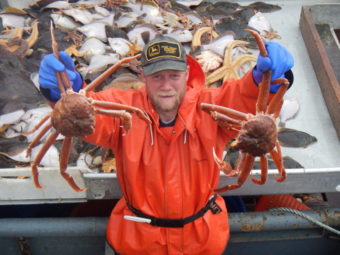
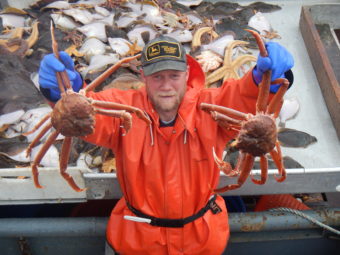
Bob Foy, director of the NOAA lab in Kodiak, holds up tanner crab, a species expected to be impacted by ocean acidification. (Photo courtesy NOAA’s Fisheries Science Center)

A growing chorus of Alaskans, from shellfish growers to fishermen, are fretting about the potential impacts to the state’s waters. Now a new collaboration is aiming to bring ocean acidification into the spotlight — with the hope that better understanding it will better prepare the state to adapt. Read more at http://bit.ly/2aJKCq4

New effort shines a spotlight on ocean acidification in Alaska

Bob Foy, director of the NOAA lab in Kodiak, holds up tanner crab, a species expected to be impacted by ocean acidification. (Photo courtesy NOAA's Fisheries Science Center)
Bob Foy, director of the NOAA lab in Kodiak, holds up tanner crab, a species expected to be impacted by ocean acidification. (Photo courtesy NOAA’s Fisheries Science Center)

Climate change may get all the attention, but it has a less-talked-about but no less troubling twin: ocean acidification.

A growing chorus of Alaskans, from shellfish growers to fishermen, are fretting about the potential impacts to the state’s waters. Now a new collaboration is aiming to bring ocean acidification into the spotlight — with the hope that better understanding it will better prepare the state to adapt.
Historically, oceans are basic — that means not acidic. But about a quarter of the carbon dioxide released each year into the atmosphere is absorbed by the world’s oceans. That changes the chemistry of the sea water, making the oceans more acidic. That, in turn makes it harder for ocean-dwellers like crab, oysters, clams, and plankton to form shells  — seriously threatening those species.

Darcy Dugan is coordinator of the brand new Alaska Ocean Acidification Network — whose goal is to educate Alaskans and connect scientists across the state. Since the Industrial Revolution, she said, there has been an estimated 30 percent increase in the acidity of waters globally.

“If you assume a “business as usual” scenario for emissions, we’d be looking at the oceans being 150 percent more acidic in 2100,” Dugan said. “That’s also more acidic than they’ve been in the last 20 million years.”

The rapid change may be outpacing sea creatures’ ability to adapt. And Alaska is expected to experience acidification faster and more intensely than its global neighbors because the water here is, as scientists say, ‘cold and old.’ That is, cold water and water from the deep sea is already more acidic.

“These waters naturally store more [carbon dioxide] year round, which means we’re closer to a dangerous threshold to begin with,” Dugan said. “And then as winter storms bring colder water and older water to the surface, the state can intensify.”

A buoy in Seward's Resurrection Bay measures ocean acidification parameters every three hours. (Photo courtesy Alaska Ocean Acidification Research Center)
A buoy in Seward’s Resurrection Bay measures ocean acidification parameters every three hours. (Photo courtesy Alaska Ocean Acidification Research Center)

Alaska’s Bering, Chukchi and Beaufort seas are all expected to move out of their historic range of variability in the near future. Dugan said the Beaufort Sea is expected to leave its natural range this decade. And that could affect Alaskans’ way of life — because the species most affected by acidification, like plankton, support the state’s most important fish, like salmon

“Right now we have a $5.8 billion seafood industry and the concern is it’s not just commercial species that might be affected by ocean acidification, but the species they eat,” Dugan said. “So once you knock one part of the food chain, the whole food chain could feel the effects.” Plus, she said, about half the seafood in the U.S. comes from Alaska waters.

Dugan hopes a better understanding of the chemistry and ecology of ocean acidification will help the state respond to future changes. That’s where the Alaska Ocean Acidification Network comes in: they are working to connect scientists and communities, from Kotzebue to Sitka, to share best practices for monitoring changes, so the state can respond and adapt to major shifts in the ecosystem.

In August, the Network will host a webinar explaining ocean acidification and its impact in Alaska and present research at the Aleutian Life Forum.

St. George considers applying for national marine sanctuary status

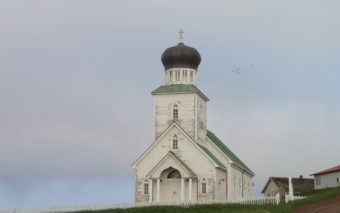
The Russian Orthodox Church in on St. George Island, Aug. 8, 2012. (Creative Commons photo by D. Sikes)
The Russian Orthodox Church on St. George Island in August 2012. (Creative Commons photo by D. Sikes)

St. George Island is taking steps to protect the marine environment in their backyard. The city council passed a resolution earlier this month that could establish a National Marine Sanctuary. Eighty people live on the island of St. George. They’re primarily Unangan and many rely on ocean resources for subsistence.

Mayor Patrick Pletnikoff says over the past five years the community has noticed a significant decline in the population of fur seals and seabirds and they need to take action now.

“There is no need to extract everything in the Bering Sea or get it down to the point where animals such as seals and seabirds can’t sustain themselves,” Pletnikoff said. “I mean, when you start seeing these kinds of die-offs you wonder if we may have allowed it to go too far without saying anything about it.”

Pletnikoff says the first step is to raise money and hire experts who will help decipher research done in the area by government agencies like the U.S. Fish and Wildlife Service and the National Marine Fisheries Service.

Then, the city will look at how best to safeguard the ocean resources. Right now, they’re considering applying for federal marine sanctuary status that would offer the area some level of protection.

“It at least makes all stakeholders have a seat at the table,” Pletnikoff said. “Everybody that has any interest in what we’re thinking about doing is welcome to that table to sit down and discuss it with us.”

The transparency of applying for marine sanctuary status appeals to Pletnikoff. Plus, he says it would protect the marine environment without automatically prohibiting fishing or reconstructing the island’s port.

Site notifications
Update notification options
Subscribe to notifications