Zoë Sobel, Alaska's Energy Desk

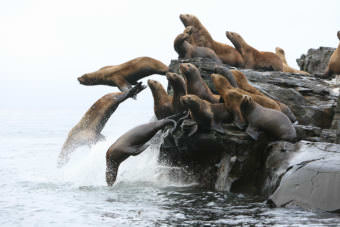
Sea lion feeding hot spots have reliable, not necessarily abundant, food

Reliable food sources are more important to Steller sea lions than abundant prey. (Vladimir Burkanov/NOAA)

New research could help wildlife managers better protect declining Steller sea lion populations. The study looks at why sea lions zero in on specific hunting hotspots.

For humans, knowing where to find food is easy. But biologist Mike Sigler says for Steller sea lions, it’s a different story.

“I wondered for sea lions what they did when they had to find food,” Sigler said.” They’re not fortunate like humans that they can know where the nearest restaurant or corner store is.”

This has been a hot topic for researchers who have watched western Steller sea lion populations decline, hitting a low in 2002. The decline is linked to a lack of food.

So Sigler, who works for the National Oceanic and Atmospheric Administration, set out out to track sea lions’ seasonal pattern of foraging in sheltered southeast Alaska. He believes it’s probably the only place in the state where this study could have happened, because of harsh conditions in places like the Aleutians. But the conclusions can be applied to other populations.

Sea lions are looking for reliable sources of food. Sigler says that’s even more important than finding a place that has the most food.

“For sea lions, I think what good translates to for them is something that is reliable,” Sigler said. “In other words, it’s persistent. Persistence mattered more than how abundant the prey were.”

It may seem obvious, but the more consistent prey is in a given location, the more sea lions can thrive there. Understanding that dynamic gives scientists and managers a better idea of the impact temporary fishing closures might have on sea lion populations.

The one percent: Murre colonies struggle to reproduce following die-off

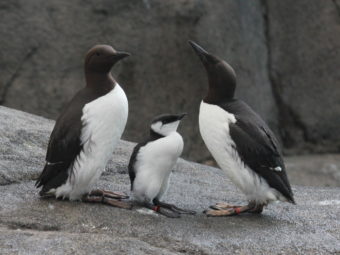
Common Murre ( Uria aalge), also known as Common Guillemot. Photographed at Alaska SeaLife Center in Seward, Alaska. (Creative Commons photo courtesy of <a href="https://commons.wikimedia.org/wiki/File:Common_Murre_RWD1.jpg">Dick Daniels</A>)
Common Murre ( Uria aalge), also known as Common Guillemot. Photographed at Alaska SeaLife Center in Seward, Alaska. (Creative Commons photo courtesy of Dick Daniels)

The massive murre die-off that left tens of thousands of dead birds on Alaska’s coast in 2015 and 2016 may be over, but the population is still struggling. In the Gulf of Alaska and Bering Sea, surviving murres are failing to reproduce.

“When we got to most of the breeding colonies last summer we found that very few birds were attending the cliffs and almost complete reproductive failure at most of the colonies we looked at,” said Heather Renner, a biologist for the Alaska Maritime Wildlife Refuge.

That means in some places less than one percent of the chicks survived.

While reproductive failure is common for some species like black-legged kittiwakes, it isn’t for murres.

With 30 plus years of monitoring data, Renner says they’ve never seen anything like this. Still, she says one year of reproductive failure doesn’t necessarily mean the species is doing poorly.

It’s important to study murres because they’re a sign of ecosystem health. Renner calls them sentinels of change.

“They tell us something about what’s happening underwater,” Renner said. “So seabirds are great indicators to us of things that are taking place in other parts of the ocean.”

Renner says it’s too early to tell if the reproductive failure will continue into this summer’s breeding season.

Decades of trawl surveys help Bering Sea climate change research

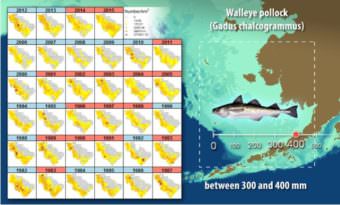
Maps show changes in where Bering Sea Pollock are from year-to-year. (Graphic courtesy NOAA/Alaska Fisheries Science Center)

There’s a new tool to help scientists and others interested in monitoring how Bering Sea fisheries respond to a changing climate.

Biologist Steve Barbeaux of the Alaska Fisheries Science Center has created hundreds of graphics mapping where 22 species of fish spend their time during different life stages.

The data comes from annual trawl surveys dating back to 1984, but Barbeaux says that information was hard to analyze as a whole.

“To understand the true impacts of climate change we have to look across all of these life stages to get a true picture of what’s going on,” Barbeaux said. “It potentially could be beneficial at one stage of life, but harmful at another stage of it’s life.”

Barbeaux started small — looking at greenland turbot, a species that is greatly impacted by temperature changes. When the fish develop from larvae to juveniles, they depend on a cold pool in the Bering Sea. But without it:

“You get high natural mortality,” Barbeaux said. “So for [the greenland turbot] the impact really is at that settlement stage. Versus pollock where that impact has more potentially to do with their midlife stage.”

The graphics Barbeaux created allow him to see the distribution of the greenland turbot through time and location or through temperature and depth.

When other scientists saw what he’d done, they wanted it for their species too. Now the tool is available for 22 species in the Bering Sea. Barbaeux plans on updating the document as long as annual surveys continue.

Two dead squid in two weeks: Coincidence?

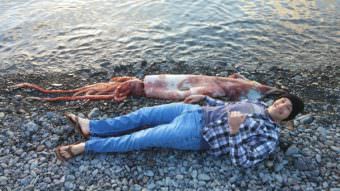
Larry Schmidt poses next to Unalaska’s second squid visitor in as many weeks. (Courtesy Larry Schmidt)

The novelty of seeing a jumbo squid in Unalaska is not wearing off: a second one washed ashore Monday night.

David Tonon of the U.S. Coast Guard was excited to check it out — he’s never seen anything like it.

This squid has a couple feet on six-footer David Tonon. (Courtesy David Tonon)

“I’ve seen little squid, squid we use for bait, squid at aquariums, and when I was diving in the Caribbean,” Tonon said. “But nothing that big. The thing had to weigh 50 pounds or so, probably more.”

This squid is bigger than the last one, which turned up on the beach on April 10. Tonon is six feet tall and estimates this squid is about 10 feet long.

At this point it is unclear if the two dead squids are an unrelated coincidence or if they’re a sign of something more significant.

Alaskan scientists prepare for worldwide march

Veronica Padula gets to work on her “There Is No Planet B” sign. (Zoë Sobel/KUCB)

Though markers, stencils and stamps clutter the living room floor, this is no art class. Days before the March for Science, seven scientists are spending their evening making signs like “Science Saves Lives,” “Make America Smart Again,” “There Is No Planet B” and more.

The march is billed as a celebration of science. Veronica Padula is a PhD student in marine biology. She says the idea of the March is to increase awareness that science plays a role in everyone’s lives.

“The mic in your hand — there’s science behind the sound that is being collected and recorded in your mic,” Padula said.

After the presidential election, she spent thirty days on a ship sailing from Germany to South Africa with graduate students from around the world. A turning point for her was realizing what her instructors meant when they referenced “global databases.”

“Very often they were accessing data that were connected by NASA or NOAA,” Padula said. “Organizations that are federal U.S. agencies. And I was like, oh we are playing a big role here with what we are doing as scientists in the U.S.”

Stepping outside her American bubble she realized other countries take note of what the U.S. does — in terms of collecting data or supporting politically charged science topics — and it has international ripple effects.

Padula doesn’t think science should be political. But with fears of major budget cuts to agencies and of data being wiped from the public record, she feels pushed to be more active.

“It’s frustrating,” Padula said. “It almost feels like it can’t not be political at this point. Like we’re kind of stuck in this moment where science has to be politicized and you have to pick what you stand for.”

Ecologist Kathy Kelsey shares a lot of the same views as Padula, but she’s less political.

“Science is something that politics can’t touch and beliefs can’t touch,” Kelsey said. “It’s just the way we understand the world.”

The way Kelsey sees it, science has a process — you ask a question, collect data, and come to a conclusion that’s vetted by the scientific community. So when that research is published, she says it shouldn’t be undermined because people don’t like the conclusion.

The March for Science is only the second time Kelsey has joined a rally.

“And I think the big thing that has changed for me is moving into an era where I no longer feel like somebody else is going to take care of it,” Kelsey said. It meaning “maintaining high quality scientific information that is available to the public and is respected by the public,” she said.

Both Padula and Kelsey are looking beyond the weekend’s march. Through education and communication they want to reach out to non-scientists and expose future generations to the field.

Air pollution violations will cost seafood processing plant $3.2 million

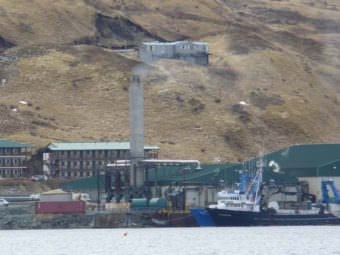
Westward Seafoods is required to install a new electronic monitoring system. (Photo courtesy EPA)

A seafood processing plant in Unalaska is on the hook for $3.2 million for breaking air pollution regulations.

The settlement reached Thursday with the Environmental Protection Agency comes eight years after employees at Westward Seafoods turned off air pollution controls and falsified records to cover their tracks.

Westward is required to install a new electronic monitoring system and $1 million will be spent on air pollution reduction.

Site notifications
Update notification options
Subscribe to notifications