Zoë Sobel, Alaska's Energy Desk

Eighty tons of contested Bristol Bay salmon trashed in Anchorage landfill

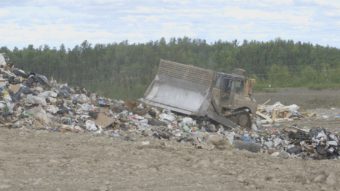
All 158,318 of highly contested Bristol Bay salmon from the F/V Akutan has been thrown away in the Anchorage landfill. (Photo by Eric Keto/Alaska Public Media)

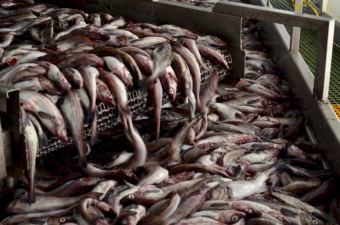
Some 158,318 pounds of highly contested Bristol Bay salmon from the F/V Akutan have reached their final destination: the Anchorage landfill.

This summer, the custom processor was supposed to process up to 100,000 pounds of salmon a day for Bristol Bay Seafoods LLC, a small group of fishermen.

But nearly everything that could go wrong did. The vessel’s owner went broke, the crew wasn’t paid, and when 158,318 pounds of fish came off the boat in early September, the third-party testing group NSF declared it unfit for human or animal consumption.

Capt. Steve Lecklitner said the only test NSF ran on the fish was a sniff test, meaning the tester smelled the fish to determine it was bad.

“I kind of chuckled a little bit, but that’s how they’re certified,” he said.

Lecklitner said a representative from Bristol Bay Seafoods selected the four 50-pound bags that NSF tested. That means less than a tenth of one percent of all the fish was tested.

Because the fish was so highly contested, Lecklitner said he suggested to the NSF tester that additional testing be done.

“She told me that full testing could be done, but it had to be contracted,” said Lecklitner. “Bristol Bay Seafoods LLC did not pay for that. They didn’t want the report released.”

NSF officials declined to comment for this story, saying they want to keep the testing confidential.

Pallets of detained fish from the F/V Akutan await transport to Anchorage. (Photo courtesy of William Earnhart/Birch Horton Bittner & Cherot)

In a statement, a lawyer representing Bristol Bay Seafoods said the company believes the fish was polluted sometime between an Alaska Department of Environmental Conservation (DEC) inspection in mid-August and when the fish was removed from the processor in early September.

“When the fish was unloaded, 25,000 pounds were visibly saturated with fuel,” said the lawyer. “[NSF] inspected the remaining fish and found all samples to be positive for diesel.”

The lawyer said it’s unclear whether the Akutan’s crew contaminated the fish on purpose or through negligence.

But Chief Engineer Decio Andrade said it wouldn’t make sense for the crew to destroy the fish, because their pay hinged on the fish going to market.

“To say that all the fish is condemned — that all the fish has diesel in it — that’s b.s.,”said Andrade. “There’s no way the diesel ever touched the fish.”

Both Andrade and Lecklitner believe Bristol Bay Seafoods wanted the fish to be found unsafe for consumption, because it allows the company to collect on an insurance claim for the fish’s full market value.

“If the fish is condemned, then Bristol Bay Seafoods has an insurance claim. They would receive all of it,” said Lecklitner. “If it went that way, then the crew would not get paid.”

Lecklitner said the U.S. Department of Labor (DOL) had liens on the fish. If it had sold, he said Bristol Bay Seafoods would not see any money. Instead, the funds would be used to pay the crew. The DOL has declined to comment until the case is closed.

In Alaska, DEC officials said it’s not unprecedented to have this much fish go to waste. Since 2014, the department has ordered more than 100,000 pounds of fish destroyed at least two other times.

In this case, Bristol Bay Seafoods said the Anchorage landfill was the only available disposal option in the state.

In Unalaska, the F/V Akutan is everyone’s problem…but nobody’s responsibility

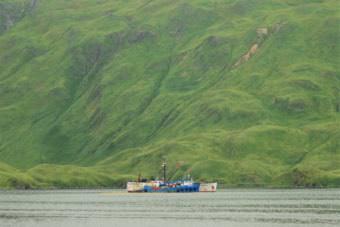
The F/V Akutan is still moored in Unalaska’s Captains Bay. (Photo by Berett Wilber/KUCB)

The Coast Guard is working to remove fuel and other hazardous materials from an abandoned fishing vessel in Unalaska’s Captains Bay.

The F/V Akutan arrived in August after a disastrous fishing season in Bristol Bay. Since then, more than half a dozen state and federal agencies have been monitoring the vessel, but to the frustration of city leaders, none are willing or able to remove it from the bay.

Fall in the Aleutians means strong winds – so strong they can cause a ship to drag anchor. That’s exactly what happened on Oct. 5, when Unalaska Ports Director Peggy McLaughlin received a call that the F/V Akutan was headed towards the beach.

“It was roughly 200 yards off the beach,” McLaughlin said. “We were able to work with Dunlap Towing and they went out and got a line on it, kept it off the beach, and kept it from potentially breaching its hull.”

That prompted the Coast Guard to take another look at the abandoned vessel. Officials determined the vessel was in imminent danger of polluting the bay.

So the Coast Guard hired a salvage company to remove the remaining fuel and other hazardous substances from the Akutan. So far, the company Resolve Magone Marine has offloaded 14,000 gallons of fuel, said Coast Guard Lt. Abbie Lyons.

“When it’s not raining sideways and blowing 75 knots outside, they’ve been working on the Akutan to remove all the fuel,” she said.

With unpredictable weather, Lyons said she doesn’t know when the cleanup will be completed. But she estimates there are at most 20,000 gallons left on the vessel.

“As a result of going on board and going into some of the tanks, they’re finding that there is fuel and oily waste in places that it wouldn’t normally be or shouldn’t be held,” Lyons said.

The Coast Guard has spent almost $2 million on the clean up to date. McLaughlin, Unalaska’s Ports Director, is glad to see the fuel removal taking place, but said it doesn’t solve the problem of having a large ship abandoned in a busy, ecologically important bay as winter sets in.

Removing the heavy fuel will cause the Akutan to sit higher in the water, making it more susceptible to strong winds. Even with additional efforts to secure the boat, McLaughlin is concerned the ship may run aground or sink.

“Captains Bay in the wintertime can be absolutely crazy with wind,” McLaughlin said. “We’ve seen it time and time again where anchorages don’t hold.”

Ultimately, McLaughlin would like to see the boat out of Unalaska waters. But there’s no indication the Akutan will be moving any time soon.

After the Akutan’s owners abandoned the vessel, the city was hopeful a state or federal agency would step in to remove it. But McLaughlin has found that unless there is immediate danger, like an environmental threat, there’s not much that any party will do.

“There’s at least half-a-dozen-plus agencies involved with the Akutan,” McLaughlin said. “Yet not one of those agencies has an opportunity or a mechanism to enact any kind of jurisdiction over dealing with the vessel itself. The Coast Guard can come in and remove some of the contaminants, but the vessel remains where it’s at.”

McLaughlin and community members were under the impression that once the crew abandoned ship, the Alaska Department of Natural Resources (DNR) would declare the Akutan a derelict vessel and gain jurisdiction to take steps to move the ship before it sinks or runs aground. But DNR’s Clark Cox said that’s not the state’s responsibility. Even if it was, he said, they don’t have the money.

“Our staffing and funding resources are quite limited and we certainly don’t have them for a large vessel in a remote location like this,” Cox said. “We’re often left just as incapable of dealing with these issues as local municipalities and state agencies.”

While DNR often takes the lead because they own state tidelands and are responsible for waterways, Alaska Statute does not specify who is responsible for taking over derelict vessels.

With no one taking responsibility for the ship, it’s unclear what will happen to the Akutan. The city is adamant that it needs to move. But for the foreseeable future, it will remain anchored, ghost-like, in Captains Bay.

King Cove and feds exploring options to build road without Congressional approval

Former Interior Secretary Sally Jewell (center) gets a tour of King Cove in August, 2013 from Gary Hennigh (left). (Annie Feidt/Alaska Public Media)

The city of King Cove is working closely with the Trump administration to find a way to build a road to Cold Bay through the Izembek National Wildlife Refuge. But city leaders are taking issue with a recent Washington Post article that describes the administration attempting to conceal a behind-the-scenes deal to build the road.

Gary Hennigh has been working for the City of King Cove for decades and he’s focused on making the road to Cold Bay a reality. He says the community needs the road to provide access to Cold Bay’s all weather airport, so people aren’t left stranded in medical emergencies.

Hennigh acknowledges that the Department of the Interior is working on an agreement to allow the road with the King Cove Corporation. But he says it isn’t a backroom deal.

“It’s not like we’ve said, ‘oh, let’s meet in a dark alley at some point late at night,’” Hennigh said.

When Donald Trump was elected president last November, Hennigh says community leaders representing the City of King Cove, the Aleutians East Borough, the King Cove Corporation, the Agdaagux Tribe, and the Native Village of Belkofski, immediately started discussing ways to reach out to the new administration. The conversation with the Interior Department got underway at the beginning of this year.

Like other proposals, this deal would involve swapping land, this time between the King Cove Corporation and the federal government. The Corporation would then own a land corridor where the road through the refuge could be built.

Other deals have included some element of Congressional approval. In 2013, after Congress directed then-Interior Secretary Sally Jewell to look into the road, Jewell rejected the idea saying it would irreversibly damage the Izembek Refuge and the wildlife that depend on it.

This time around Hennigh thinks the deal could avoid Congress entirely.

“We’ve come to be realistic, to know that the legislative world is a pretty big challenge,” Hennigh said. “If we don’t have to go there, we don’t want to. We want to see if that administrative agreement will work for us”

That administrative agreement Hennigh mentions would be between the Interior Department and the King Cove Corporation. As he understands it, Congress approved administrative power in the Alaska Native Claims Settlement Act (ANCSA) and the Alaska National Interests Lands Conservation Act (ANILCA) that could allow for land exchanges between the federal government and eligible Alaska Native Corporations. So there would be no need for additional congressional approval.

Hennigh is hopeful this approach will work. But environmentalists, like Nicole Whittington-Evans of The Wilderness Society, are angry.

After so many public processes that all concluded the King Cove Road would significantly impact wildlife in the Izembek Refuge, Whittington-Evans is frustrated it’s up for discussion again.

“The federal government has exhaustively studied this numerous times and always concluded the road would have significant impacts to the refuge and it’s wildlife, which the refuge was established to protect,” she said.

Whittington-Evans believes because Congress decided the Izembek Refuge should be a designated wilderness area, the highest level of conservation given to federal lands, it’s only right that Congress would have to review any proposal to build a road.

“For an administration to come along now and ignore congressional action and disregard all the public input on this issue to now,  shows a brazen disregard for existing laws and our nations framework around public input,” Whittington-Evans said.

She’s worried the potential deal could undercut bedrock environmental laws like The Wilderness Act, The National Environmental Policy Act and ANILCA.

The Interior Department did not respond to a request for comment. Alaska’s congressional delegation has advocated for a road to Cold Bay over the years. But if a deal is imminent, Senator Lisa Murkowski isn’t dropping any hints. Here’s Alaska Public Media’s Liz Ruskin talking to the Senator.

“Have you been hearing anything about it that was going to break this week?” Alaska Public Media’s Liz Ruskin asked the Senator.

“I’ve been hoping that it would break months ago,” Murkowski said.

Hennigh also isn’t giving any indication of when a deal may become public. But he says the community is optimistic that a deal under this administration represents their best shot at the road in a very long time.

Unwanted Unalaska fishing nets find second life in Denmark

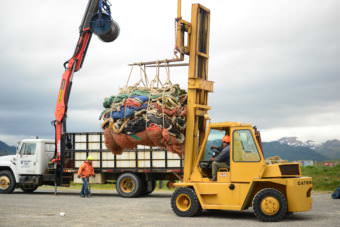
Captains or fishing companies are responsible for packing the nets small enough to fit into shipping containers. (Photo by Berret Wilber/KUCB)

There’s no easy way to get rid of old fishing nets in Unalaska. America’s top fishing port is remote and nets can weigh thousands of pounds.

Now, for the first time, about 80 retired nets are on their way to a recycling program halfway around the world.

It all starts outside Unalaska’s Grand Aleutian hotel. The view is almost always the same — men moving piles of fishing nets. This day is no exception.

With the help of a crane, Andy Pirrello is part of a team hoisting huge nets into the back of a flatbed truck. His job? Compressing the nets, so they can fit tightly into shipping containers to be sent to Denmark. It’s not easy.

“You know you’re getting showered by rust, dirt, jellyfish, anything can fall off the back of the crane,” Pirrello said.

Pirrello has been coming up to fish in Unalaska for three years. Today, he’s happy to be helping clean up the island for the people who live here year round.

He has one person to thank for coordinating this project — Nicole Baker. In 2010, Baker started coming up to Unalaska as a fisheries observer and the piles of nets caught her eye.

When Nicole Baker first came to Unalaska, she was shocked to see piles of junky nets everywhere. (Photo by Berett Wilber/KUCB)

“I just noticed that there was a lot of old, junky nets lying around,” Baker said.

The nets are monstrous, from 5,000 to 20,000 pounds each. The industrial gear was used for catching pollock and cod.

Finding a way to remove and repurpose the nets became Baker’s passion project. For the past two years, she’s been looking for organizations capable of recycling the worn out gear. She sent samples to companies like Parley for the Oceans — which was working to make sneakers with Adidas out of nets confiscated from illegal fishing.

“And so I wrote those guys and emailed and said, if you’re interested in unused fishing nets, I know where you could possibly get some,” Baker said.

The problem was, they only wanted nylon nets and most of the nets in Unalaska are made of polyethylene or polypropylene.

About 80 retired nets have been baled up and are on their way to a recycling program halfway around the world. (Photo by Berett Wilber/KUCB)

So, Baker kept looking. Eventually she found the Global Ghost Gear Initiative, an organization focused on dealing with abandoned fishing gear, and they suggested a company capable of recycling the nets.

Plastix is based in Copenhagen, Denmark. CEO Axel Kristensen is focused on recycling unwanted fishing gear into high quality plastic pellets.

“It seems so unreasonable and not logic[al] to just throw it away when we know that if handling plastics right — if sorting and homogenizing it — you can actually reuse it over and over and over again,” Kristensen said.

According to Kristensen, Plastix is the only company in the world recycling fishing nets in this way. Once the nets arrive at the plant, they’re cut into smaller pieces, sorted by material type – be it polyethylene, nylon or polypropylene – and processed.

“You cannot produce a quality recyclate, if you don’t ensure that you get the right input,” he said. “If you get a lot of, excuse me for the word ‘crap,’ then you get crap recyclates.”

For now, Plastix is selective about who they work with. The company is small and they want to be sure they are only sent products they can recycle. If a container is loaded with unusable waste, it will end up in a landfill in Denmark.

Plastix is a Danish cleantech company that turns unwanted fishing gear into high quality plastic pellets. (Photo courtesy of Plastix)

Kristensen was happy to work with Baker to recycle the nets from Unalaska.

“We cannot do this alone,” he said. “We need someone like Trident [Seafood], Nicole Baker, all kinds of stakeholders to take part in this project.”

This is the first time the company has recycled nets from the United States and it involves buy-in from multiple parties. The boat captains or fishing companies are responsible for packing the nets small enough to fit into shipping containers. With the help of Trident Seafoods, Plastix is paying for the containers to be shipped directly to Denmark.

This is the first year of the collaboration, but Baker says there was high demand from fishermen looking to find a new use for their nets.

“I hope to keep this going somehow,” Baker said. “So we we’ll see.”

Continuing the recycling project will take more than just Baker. It will require investments from multiple people and organizations — from the fishermen to Plastix.

Crew Abandons F/V Akutan in Unalaska’s Captains Bay

The F/V Akutan is still moored in Unalaska’s Captains Bay. (Berett Wilber/KUCB)

The F/V Akutan no longer has a crew and the ship’s 130,000 pounds of salmon has been offloaded.

The processor has been anchored in Unalaska’s Captains Bay since late August and there’s no indication the boat will be leaving soon.

“The reality of it is, there’s just a huge legal ball that needs to be worked through before any real decision can be made,” said Unalaska Ports Director Peggy McLaughlin.

After a disastrous fishing season as a processor in Bristol Bay, the vessel’s owner went broke, the crew went unpaid. and now the ship is disabled and unable to move.
McLaughlin says the interagency task force that united to prevent the boat from spilling fuel, oil and other chemicals into the bay are in limbo unless the situation turns dire.

“Right now — with the exception of the possibility that the responsible party is willing to step up — there’s kind of this big gaping hole of no jurisdiction until something more dramatic happens with the vessel,” she said.

McLaughlin thinks the boat is stable for now and not in danger of sinking. But there is still fuel on board and the ship is in a precarious location for the environment.

“It’s in front of salmon streams, it’s in front of native allotment land,” McLaughlin said. “It’s also in close proximity to Westward Seafoods’s intake. It’s not in a good place to have a problem.”

In late August, responders removed almost 16,000 gallons of oil and sludge from the Akutan. The Alaska Department of Environmental Conservation estimates 20,000 to 23,000 gallons of marine diesel and other chemicals remain on board.

McLaughlin says the city’s ultimate goal is to keep the vessel intact and get it out of Unalaska waters. A team of responders is monitoring the vessel.

Want the freshest Unalaska fish? You’ll have to go to Europe.

Unalaska brings in more fish than anywhere in America. All of it is for export. (Sarah Hansen/KUCB)

Unalaska is America’s most productive fishing port – hauling in over 780 million pounds of seafood in 2015. That fish gets shipped all over the world and eventually — after processing — some of it comes back to Unalaska.

But you can’t buy fresh fish in town.

At one of Unalaska’s grocery stores, the frozen fish section is almost entirely fish from Asia.

There’s whole rabbitfish from Vietnam. Baby tuna wrapped in plastic from Vietnam. A bunch of mussels from New Zealand.

Down the street at the Safeway, you can buy fish from Alaska, but it has some stamps in its passport.

Safeway sells fish that was caught in Alaska, but it leaves the state before coming to Unalaska . (Zoë Sobel/KUCB)

Like wild Alaskan cod fillets originally caught in Alaska, then sent to Asia for processing and then coming back to Unalaska frozen and packaged up.

Even though Unalaska brings in more fish than anywhere in America, it’s all exported, so you can’t buy it fresh.

Jörn Scabell is visiting from Bremerhaven, Germany – he’s the head of the seafood purchasing department at FRoSTA, a European frozen food manufacturer.

“We’re always trying to buy from certified fisheries that are really sustainable,” Scabell said.

FRoSTA buys Pollock fillet blocks to make fish fingers and breaded fillets. For this season, FRoSTA is snapping up 3.3 million pounds — roughly half of what they’ll buy over the course of the year.

“It’s really big business and of course we need more,” said Scabell

According to Michael Coleman — general manager of Coastal Alaska Premier Seafoods — the pollock gets sent all over the world.

“The fillet block goes to Germany and a little bit goes to McDonald’s users,” Coleman said. “The other roughly half of the product goes to Japan for surimi and Korea for surimi products.”

In all it takes about 80 days from the fish being caught in the Bering Sea, processed, packed up in Unalaska, and shipped to Germany. Then the fillet blocks get turned into fish products that can be bought across Europe.

So I asked my brother, Eli, who lives in Amsterdam to look for it the next time he was at the store.

These fish sticks were made with fish from the Bering Sea. (Courtesy Eli Sobel)

“I’m at the fish station now,” Eli said. “It does look as if there are fish sticks that are from Alaska.”

The fish sticks Eli found were made with fish from the Bering Sea. He took them home for dinner.

“It doesn’t necessarily bring up memories of being in the U.S., but it’s nice,” he said. “It’s surprising. Maybe it’s kind of American because of the breaded parts.”

Eli prefers fresh fish, but the frozen Alaska fish he gets is still fresher than the fish I can buy in the grocery stores.

To get fresh fish in Unalaska, you have to catch it yourself.

Site notifications
Update notification options
Subscribe to notifications