Zoë Sobel, Alaska's Energy Desk

Scientists record volcanic thunder for the first time

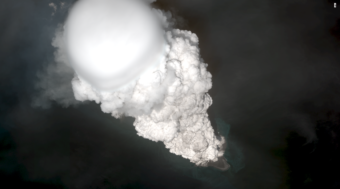
This satellite image shows a May 28, 2017 eruption at Bogoslof volcano. The cloud rose more than 40,000 feet above sea level. (Dave Schneider/Alaska Volcano Observatory & U.S. Geological Survey)

To the untrained ear, volcanic thunder sounds like the rumble of a plane engine or a distant river. But scientists are really excited about the low hum, clicks and pops that were recorded during a March 2017 eruption at Bogoslof volcano.

That’s because it’s the first time a team has recorded the sound of volcanic thunder. The recordings come from Bogoslof volcano in the Aleutian Islands. Scientists say the recordings are just the beginning of a treasure trove of clues scientists are exploring in the wake of Bogoslof’s nine month eruption. One thing they’re learning is that lightning and thunder may help predict the risk ash clouds pose to aircraft.

John Lyons, a geophysicist at the Alaska Volcano Observatory, says scientists weren’t sure if volcanic thunder was loud enough to hear over the roar of an eruption.

“It wasn’t that we didn’t think it was happening,” Lyons said. “It was that we didn’t know if we could record it.”

Sensors picked up the thunder from 40 miles away. Volcanic lightning and thunder occur when bits of ash and ice collide during an eruption.

Isolating the sound of thunder could help scientists better understand ash plumes — which pose a threat to airplanes.

Lyons says it’s a big deal because scientists are getting more out of their infrasound sensors than they imagined, even after an eruption has stopped.

“Maybe there are some signals you disregarded previously as noise, but those might actually be telling you something about processes happening in the eruption cloud as it moves away in the atmosphere from the volcano,” he said.

Lyons says the recordings show infrasound sensors can be used to detect volcanic lightning, especially smaller sparks that might not register on global lightning monitoring networks.

At Bogoslof, scientists had another tool specifically designed for lightning detection. Last spring, Volcanologist Alexa Van Eaton helped install new lightning sensors that can help signal when eruptions begin.

Although the Aleutians have a lot of rain, thunderstorms are rare — making lightning a prime tool for forecasting eruptions. In fact, Van Eaton says this is first time lightning was used as a near real-time monitoring tool.

“The World Wide Lightning Location Network (WWLN) was putting out rapid alerts that were triggering whenever there was lightning around the volcano and that was sending text messages to the AVO scientists and letting them know, ‘dude, lightning. There’s probably an eruption,’” said Van Eaton.

She says lightning is one clue that helps scientists understand volcanic eruptions. It can make a difference in determining how big eruptions are and alert researchers that eruptions may be happening.

From when Bogoslof started erupting in December 2016 to when it stopped in August 2017, Van Eaton says half of the 60 or so eruptive events produced globally detectable lightning.

While volcanic lightning has been noted for well over a hundred years, the number of scientists in the field is small. Van Eaton says it’s gone from people thinking volcanic lightning was just a cool phenomenon to realizing that understanding it can help keep people safe from ash.

And she says the data from Bogoslof is a windfall.

“It’s letting us ask cool questions like what happens if the eruption shoots seawater into the atmosphere along with the ash?” Van Eaton said. “Does that make more lightning or less lightning?”

They found that wetter eruptions had less lightning overall. Van Eaton says that was the opposite of what they expected. She says that’s important because it could help further refine predictions for when ash may pose a risk to health and safety.

“Being able to use the lightning to figure out if the eruption was wet or dry is potentially really important for thinking about how long the ash is going to be in the atmosphere and how quickly it might reach Dutch Harbor, or any of the airports, and how long aircraft are going to have to avoid the area,” she said.

Van Eaton says dryer eruptions — eruptions with lots of lightning — tend to have ash particles that stick around longer and have the potential to travel farther.

She believes volcanic lightning should be used with seismometers, infrasound sensors, and satellite data to help keep the people who live near volcanoes safe.

New vessel will bolster oil spill response in Western Alaska

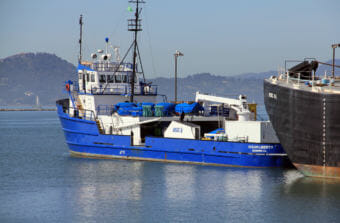
The OSRV Ocean Liberty should arrive in Unalaska by mid-April. (Photo courtesy Paradigm Marine)

Western Alaska will have better oil spill response capabilities with a new vessel. The OSRV Ocean Liberty was expected to arrive in Unalaska by the end of March, but the ship is awaiting modifications and clean up of an oil spill in Shuyak Straight near Kodiak has delayed the process.

Unalaska Mayor Frank Kelty is excited for the added layer of safety the vessel will bring to the region. In a given year at America’s top fishing port, he says local fuel docks can pump up to 60 million gallons of fuel. Plus, large vessels pass through the region on major shipping routes.

“We all know of the catastrophes we’ve had with the Selendang Ayu, the Kuroshima, and vessels transitioning this area,” Kelty said. “If something happens closeby, this vessel would be able to respond and help assist with any cleanup work.”

The Ocean Liberty was built specifically to respond to spills. It will be the only boat like this in Western Alaska. It is contracted by the Alaska Chadux Corporation.
A similar vessel, the OSRV Sea Strike is based in Kodiak and covers the Alaska Peninsula. The Ocean Liberty should arrive in Unalaska by mid-April.

The Cost of Cold: Keeping warm in Unalaska

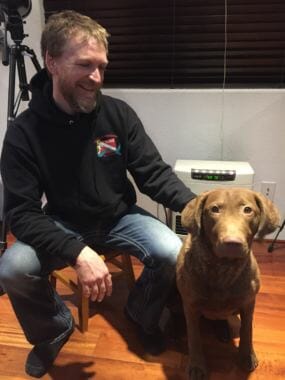
Unalaska resident Travis Swangel heats his small home with a Toyo stove. (Photo by Zoe Sobel / Alaska’s Energy Desk)

In Unalaska, it can cost more than $500 a month to heat a typical home in the winter. Because the treeless island is 1,000 miles from Anchorage, everything is shipped in — including heating oil. It’s the source of heat for the vast majority of houses in the city.

Unalaska resident Travis Swangel heats his small home on the island with a Toyo stove.
The Cost of Cold is a series from Alaska’s Energy Desk about how Alaskans around the state heat their homes. Reporter Zoe Sobel produced this story.

Japanese tsunami litters North American shores with 10 times the trash

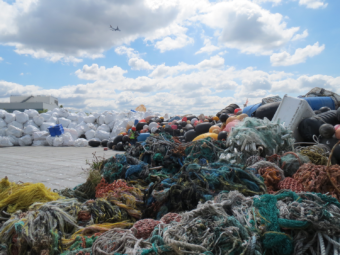
A football-field sized barge carries marine debris from Alaska and British Columbia. Scientists estimate the amount of marine debris increased at least 10-fold due to the 2011 Japan tsunami. (Photo courtesy of National Oceanic and Atmospheric Administration)

Seven years ago this week, a magnitude 9.1 earthquake stuck off the coast of Japan, triggering a tsunami with waves up to 30 feet high. The event ravaged communities, and its after effects have been felt across the Pacific.

Now, scientists estimate that following the tsunami there was more than 10 times as much debris washing ashore in North America than what was measured before.

People don’t enjoy seeing garbage in their outdoor spaces. Dr. Cathryn Murray says that’s especially true in places like Alaska that can end up with other countries’ trash.

“There’s not much you can do about it on a local scale. You can’t say to your own community let’s stop using plastic bags and then we’ll stop seeing it on the beaches,” Murray said. “In those cases, it’s not often true because it’s coming from very far away.”

Following the tsunami in Japan in 2011, researchers noted that there seemed to be more marine debris than usual. Over four years of monitoring, the team recorded that nearly 100,000 items washed ashore from Alaska to Oregon.

In Washington and Oregon, it was easier to respond to reports of debris. But it was a challenge to figure out how much debris there was in more remote and pristine places like Alaska or British Columbia.

Following the tsunami, boats, like this one, were found on North American shorelines. (Photo courtesy Amy Hurst)

Aesthetics isn’t the only reason to be worried about the debris. It can impact wildlife and human health. And now Murray says they think sea creatures from Japan have managed to cross the ocean with the trash.

“Because they had rafted such a long way away and they took a very slow journey across the ocean, a lot of the species ended up in quite good condition,” Murray said. “Some of them were reproductive when they landed. Some of them were growing at sea.”

Species have always had the ability to raft on natural items like wood or pumice stones.

“But now we enter plastic, which doesn’t degrade and allows for these long, long journeys,” Murray said. “Whereas before, the raft would have degraded and left them in the ocean.”

Increasing storm intensity may mean natural disasters like tsunamis will be bigger and have greater impacts. Murray is worried that will mean more plastic — and maybe even more hitchhikers — will be able to cross oceans.

Trident Seafoods agrees to six figure settlement for violations at Alaska plants

In the settlement, Trident Seafoods will clean up a 3.5 acre waste pile near their Sand Point plant. (Photo by Zoë Sobel, KUCB)

Trident Seafoods will pay $297,000 in a settlement with the federal government for Clean Water Act violations at plants in Sand Point and Wrangell.

In both locations, the fines are the result of Trident discharging more fish waste than they were legally allowed to.

Environmental Protection Agency spokesman Bill Dunbar says in Sand Point, Trident will remove nearly 3.5 acres of waste from the seafloor near their plant.

“These are enormous numbers of fish that are being processed in one place. All of that fish water gets deposited in enormous volumes in essentially still water,” Dunbar said. “The currents don’t take that fish waste away. That waste piles up on the seafloor.”

Those piles create a gelatinous goo, Dunbar says, that carpets the seafloor, killing anything underneath it. And it has been around for awhile.

Trident attorney Joe Plesha says the pile is leftover from cod processing from 1987 to 1994. He says he told the EPA about the fish waste around the time of a 2011 settlement.

“I actually left it up to them. I said if you want us to remediate this, we of course will,” Plesha said. “But for reasons I’m not really certain of they didn’t bring it up again. And I candidly didn’t remind them so it wasn’t part of that 2011 consent decree.”

Trident paid a $2.5 million fine to settle the 2011 case and committed to spending up to $40 million to prevent future Clean Water Act violations.

Dunbar agrees these violations are very similar and could have been lumped in with the 2011 settlement.

“For reasons I can’t explain to you, they weren’t,” Dunbar said.

Plesha is confident that this type of violation will not happen again because Trident built a meal plant in Sand Point and all waste is screened. The company has also agreed to limit the amount of fish waste discharged from the Wrangell plant.

Scientists don’t know why ice seals are appearing in ice-free Unalaska

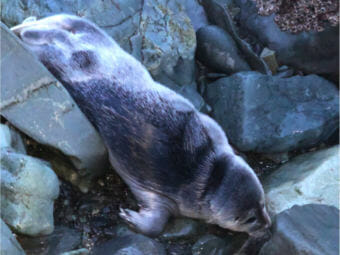
In early February, a yearling ringed seal turned up in Unalaska. (Photo courtesy of Melissa Good)

In the past year, two ice seals have turned up in Unalaska — way outside their natural range. The first was spotted in late February 2017 and less than a year later another was photographed near town.

Melissa Good, with SeaGrant, says ringed seals don’t belong in Unalaska.

“Ringed seals are ice associated seals so they live and kind of work around the ice,” she said. “They want to haul out on the ice for pupping, molting, and resting.”

Good has lived in Unalaska for seven years, and has only seen two ringed seals — both in the last year. She was able to send last year’s seal to the Alaska Sealife Center in Seward where the animal made a full recovery.

But the most recent seal was not as healthy.

“If you see a seal out of the water laying on a rock, it looks kind of like a sausage. It’s fat and it’s round,” Good said. “When you start being able to see it’s hip bones and you start seeing a hump on its back, that usually means it doesn’t have a lot of fat on it.”

By the time Good was able to recover this seal, it was too late. The yearling had died. Results from a necropsy may shed some light on why there seem to be more ringed seals popping up in Unalaska.

The pathologist will look for unusual bacteria, parasites, or viruses. Good thinks parasites might be the key.

“A lot of the marine mammals that they are getting in to the [Alaska Sealife] center have heavier parasite loads then they have normally seen in the past,” Good said. “They are contributing a lot of these parasite loads to warmer water conditions.”

It’s too soon to know exactly what’s happening, but Good says it could be a combination of things. At this point though, she isn’t too concerned. Good’s optimistic that with more community interest and awareness of marine visitors, she’ll be able to respond faster to stranded animals and better note changes in the environment.

Site notifications
Update notification options
Subscribe to notifications