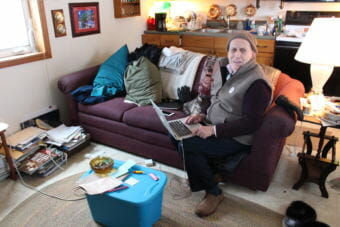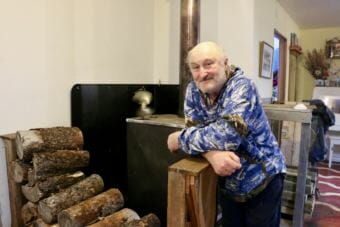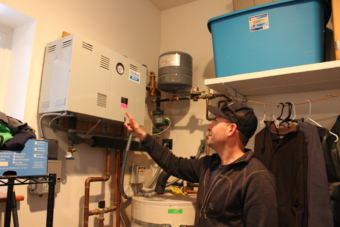
Philip Richards points to his electric boiler. (Photo by Elizabeth Jenkins/Alaska’s Energy Desk)
Alaska’s capital city doesn’t have a natural gas distributor. Most people in Juneau burn heating oil. But a growing number of residents are looking for alternative ways to stay warm.
Philip Richards chose an electric boiler out of necessity. He says it keeps costs low in his energy efficient home.
The Cost of Cold is a series from Alaska’s Energy Desk about how Alaskans around the state heat their homes. Reporter Elizabeth Jenkins produced this story in Juneau.
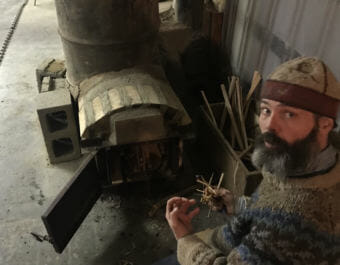
Lasse Holmes, of Homer, stands in front of his Rocket Mass Heater. Photo by Aaron Bolton/KBBI
Many Alaskans heat their homes by burning wood, and a relatively new take on wood and masonry stoves aims to make wood heat more efficient. Lasse Holmes, who lives in Homer, builds what are known as Rocket Mass Heaters.
He says they’re basically a masonry stove, do-it-yourself style.
“In simple terms, it’s like a wood stove connected to a masonry bench,” Holmes said. “It has the pipes going through this bench, you have a wood fire and you just extract the heat into this dense mass and it slowly releases the heat.”
Lasse says it heats your space and you can cook on it. As part of the Cost of Cold series from Alaska’s Energy Desk, Holmes explains why he likes Rocket Mass Heaters.
The Cost of Cold is a series from Alaska’s Energy Desk about how Alaskans around the state heat their homes. Reporter Aaron Bolton produced this story in Homer.
Richard Beneville rents his house in Nome. He shares the space with his cat, Ollie. (Photo by Elizabeth Jenkins/Alaska’s Energy Desk)
In Nome, people stay warm in a variety of ways. They collect driftwood along the beach in the summer months, shipping pallets are burned in stoves and heating fuel arrives by barge in the summer and fall.
In 2012, an early storm prevented an oil tanker from making that delivery. But as the Bering Strait becomes more accessible, the mayor of Nome says there’s an upside to less sea ice.
Richard Beneville spends $250 dollars heating his house every month of the year with diesel.
The Cost of Cold is a series from Alaska’s Energy Desk about how Alaskans around the state heat their homes. Reporter Elizabeth Jenkins produced this story in Nome.
The home of Jeremy Eberhardt and Ember Kalama, located in Fox, just outside Fairbanks. Eberhardt says that for him, using wood for fuel is about more than just saving money; it’s part of his Alaskan upbringing. (Courtesy of Jeremy Eberhardt).
Interior Alaska is known for extreme cold in the winter. But because Fairbanks doesn’t have easy access to natural gas, most people use pricey fuel oil to heat their homes. And as a result, many families turn to a cheaper local resource to bring down their heating bills: wood. But wood contributes to an air quality problem that has Fairbanks in trouble with federal regulators.
Even with the downsides, one family says that wood is still their best option.
Jeremy Eberhardt and Ember Kalama live about 10 miles outside of Fairbanks with their four kids.
Kalama moved here from Hawaii when she was in her teens, but Eberhardt was born and raised here. He calls 20 below “T-shirt weather.” And he says burning wood for fuel is about more than just saving money; the whole process of chopping, drying, and hauling it is part of his Alaskan upbringing and something he’s teaching his kids.
“I don’t know what the kids think, but I think it’s a pretty good activity,” Eberhardt said. “It’s something that you kind of hand down… I did it with my parents and… my grandfather. And… I guess I’m passing the torch as you would say to them.”
But money is definitely part of it too. Kalama works in the plumbing industry, and Eberhardt is a mechanic.They say their income varies year to year, and it would take a real bite out of their budget if they were paying for heating fuel.
They did heat their home that way several years ago and Eberhardt says it cost them at least $700 a month.
The price of oil has gone down a bit since then, but Eberhardt says wood is still a lot cheaper. The only money they spend is on chainsaw and truck fuel and minor maintenance costs — less than $1,000 a year. They get the trees from their property or a nearby homestead that belonged to Eberhardt’s grandfather.
“I do all the chainsaw work,” Eberhardt said. “So I’m always cutting it or stacking with the Bobcat, moving it around. And the kids and Ember helped me haul it.”
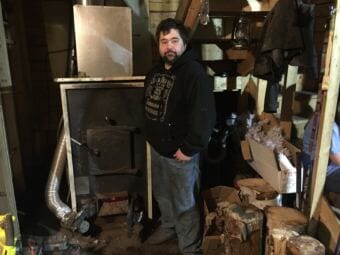
Jeremy Eberhardt standing next to his family’s forced air furnace – it burns wood and distributes the warm air throughout the house. (Ravenna Koenig/ Alaska’s Energy Desk).
The part of the Fairbanks area where Eberhardt and Kalama live is a bit north of town — it’s not where the air quality issue is the worst. Even so, Eberhardt acknowledges that it’s a problem.
But he also says that part of what makes the situation so bad is that people are burning wet wood. “We have a lot of people that sell wood in the Interior that… aren’t taking care of it, and aren’t seasoning it properly,” Eberhardt said.
“And in the midst of the winter when it gets cold and there’s a lot of people begging for firewood, these people are popping up going ‘oh, I got all this dry wood’ you know and it really isn’t,” he said.
He wishes more wood sellers and users would take the time to properly dry the wood.
Eberhardt and Kalama don’t use an average wood stove to heat their home. On the bottom floor of their house they have a forced air furnace — a big hulking thing about the size of Eberhardt himself — connected to a duct, which distributes the warm air throughout the house.
On a typical day, Eberhardt says he adds wood to the furnace about three times. He says on the days when the temperature dips well under zero, he gets a feeling of satisfaction, knowing how hard he worked to keep the house warm.
Jeff Sanders exclusively heats his 3,000 square foot home in Bethel with wood he scavenges around town. (Photo by Christine Trudeau / KYUK)
More than 90 percent of households in Bethel use heating oil to keep warm, according to census data. But a lot of people supplement with wood, even though there are no trees on the tundra.
And then there’s Jeff Sanders, who exclusively heats his 3,000-square-foot home in Bethel with wood he scavenges around town. Sanders says he hasn’t used heating fuel since 1974.
The Cost of Cold is a series from Alaska’s Energy Desk about how Alaskans around the state heat their homes. Reporter Christine Trudeau produced this story from Bethel.
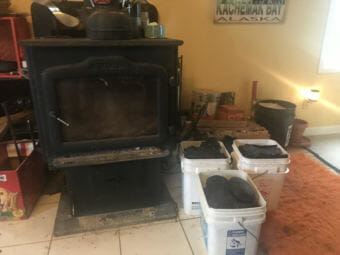
Homer resident Laura Upp keeps buckets of coal next to her stove. Photo by Aaron Bolton/KBBI
Karen Hamm is walking along the tide line at a popular beach on the Homer Spit, five gallon bucket in hand. She reaches down to collect chunks of coal. Some are pebble sized. Others are a large as a loaf of bread.
Hamm says it’s not an ideal day to scavenge.
“It’s always better after a storm, first of all,” she said. “Secondly, the wind has to be coming from the west because if it’s coming from the east, it’s going to blow it out instead of in.”
Hamm would know. She’s been scavenging for coal with her husband for seven years. The coal that washes up on Homer beaches comes from veins in the bluffs that line Cook Inlet and overlook town. Boulder-size sections of coal break off the cliffs, are churned up in the ocean and wash onto area beaches in smaller pieces.
And Hamm needs about 9,000 pounds of coal to heat her home every winter. She and her husband typically drive onto the beach and fill the bed of their truck about nine times every year.
“You go to the beach, you get cold and you go home and stand next to the coal fire,” she said.
Back at her home, Hamm pulls brick size pieces of coal from a trailer and brings them inside.
But before she burns anything, she needs to empty out the ash box. She says it’s not exactly a clean fuel.
“There’s a lot more ash with coal than there is with wood,” she said. “Not only that, but it gets in the air. It’s messy.. but it’s cheap. You can afford to hire a maid.”
Those savings drove Karen Hamm and her husband George to ditch their wood stove and install a coal stove instead.
George Hamm, who is 80 years old, used to gather wood and says it would take about five cords to heat his 2,500 square foot home each year. He also supplements with heating oil when they’re not home.
“You can just figure if you burn 100 gallons of oil, you’re going to burn a cord of wood or you’re going to burn a ton of coal,” he said. “Those are not accurate figures, but it gives you a round figure to work with.”
Coal is scattered across beaches in Homer, especially after a storm. Photo by Aaron Bolton/KBBI
No one knows exactly how many people burn coal in Homer, but it seems to be getting more popular, likely because it’s free. After a big winter storm, you can see a number of people on the beach collecting coal.
Hamm says there’s been more competition on the beach recently.
“I think it has a lot to do with our economy right now,” said Laura upp, who says the economy was certainly a factor.
She switched to a coal and wood burning stove about five years ago after wood became too expensive.
“Cords of wood, cut and split, for you are almost near $200 delivered anymore,” Upp said. “So, that’s a lot of money… if I was only burning wood, I would go through a cord of wood in a month.”
Upp still uses some wood and supplements with oil.
Both Hamm and Upp acknowledge that burning coal isn’t ideal. They worry about the air quality. But they say the savings and convenience drives them and others to the beaches.
“I think people are just trying to find cheaper alternatives,” Upp said. “I know it’s not the best thing for the environment, but right now, it’s just what I have to do.”
Upp says she would consider other options such as natural gas if it was available, but for the foreseeable future, she will continue beach combing for coal.
Close
Update notification options
Subscribe to notifications
Subscribe
Get notifications about news related to the topics you care about. You can unsubscribe anytime.