Ravenna Koenig, Alaska's Energy Desk

As sea ice changes in a warming Arctic, new challenges for polar bear research

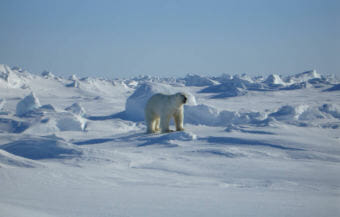
A male polar bear near Kaktovik. (Photo courtesy U.S. Fish and Wildlife Service)

Research on polar bear health and abundance is critical to understanding how the animals are responding to declining sea ice in the warming Arctic.

But changes in the ice are also presenting challenges for researchers, who go out and collect information on the bears. So they’re trying to adapt.

For eight seasons now, wildlife biologist Todd Atwood has been part of a team that’s flown over the Beaufort Sea during the spring in a helicopter, looking for polar bears.

When they see one, and the conditions are right, they dart it with a sedative and land on the sea ice to collect information from the animal. They weigh the bear, age the bear, and collect a variety of biological samples.

Atwood works for the U.S. Geological Survey — one of the agencies that does research on polar bears in Alaska. Their research informs management decisions made by other government agencies.

The information they get through this research helps them come up with an estimate for the bear population. It also helps them determine if the animals are getting enough food, or if they have any other health issues.

But changes in the sea ice are affecting USGS scientists’ ability to do that kind of bear capture research.

“What we’re experiencing more recently is that the ice conditions are just terrible,” said Atwood.

For one, he said they’re increasingly encountering a lot of open water during their research season in March and April. That creates complications for flying, and they also worry about a sedated bear trying to escape to open water and drowning. Ideally, they try to find a large, stable pan of ice where they can spend about an hour getting data from the bear.

Of the ice they do find, a large part of it is now rubble ice — as Atwood put it: “Ice that looks like it just went through a blender.”

Ice is more likely to look like that if it’s first-year ice — meaning it melted completely in the summer and grew back over the course of one winter. First-year ice is increasingly common in the Arctic, where warming has lead to a decline in thicker, multi-year ice.

Atwood said that rubble ice makes it harder to see the bears from the helicopter because they kind of blend into it. It also limits where they can land.

These challenges mean they’re sampling fewer bears, and that will affect the conclusions they can draw from their research.

“There’s probably going to be a greater amount of uncertainty with some of the information that we’re able to provide, because it’s simply not going to be as precise as it used to be,” said Atwood.

USGS is already changing the way they collect data for population estimates. They’re relying more on making observations of bears from the air without landing, and on methods like biopsy darting — where they shoot a dart that collects a small tissue sample from the bear and doesn’t require them to sedate it. They can also collect DNA samples from tufts of hair they snag at hair snare stations.

And other researchers are looking into other methods.

“There’s some interesting work out there that suggests that collecting DNA from tracks left by polar bears in the snow might be a way to move forward,” said Atwood.

But Atwood said that when it comes to things like the bears’ weight, age and detailed health information, there’s still really no replacement for bear capture.

Village of Igiugig one step closer to replacing diesel electricity with hydrokinetic system

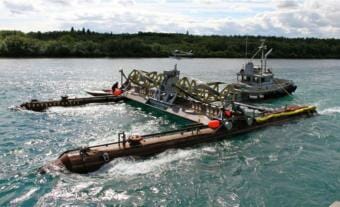
The RivGen operating in the Kvichak River in 2015.
The RivGen operating in the Kvichak River in 2015. (Photo courtesy Ocean Renewable Power Company)

In the southwestern village of Igiugig, a renewable energy project recently got one step closer to helping the village move off expensive diesel-generated electricity.

The experimental device is placed in a river and uses the current to create electricity.

In late May, the Federal Energy Regulatory Commission gave the project a key approval that will allow them to install and test the technology for up to 10 years. After that, they could apply for a commercial licence.

AlexAnna Salmon is the president of Igiugig Village Council.

“It’s a hope for our village to achieve the sustainability we’re looking for,” she said. “It’s environmentally friendly. And we’ve just come a long ways in developing it.”

The council has been collaborating on the project with the Ocean Renewable Power Company of Maine since 2009.

The federal approval will allow them to conduct their first year-round test of the system in Igiugig. Among other things, they will be closely monitoring how the technology interacts with local fish as well as river ice.

“One year from now, we’ll know whether the community would like to own this device,” said Salmon. “If it really is going to prove itself to be an effective option for providing power.”
She said that, in the best case scenario, the village could be completely off diesel electricity by 2021.

If the project pans out, she added, it can provide a useful blueprint for many villages in rural Alaska looking to move toward renewable energy.

‘Pretty unbelievable,’ says Kotlik hunter who helped document recent spike in seal deaths

A hunter from Kotlik counted 18 dead seals along 11 miles of shore, north of Kotlik. Photo from May 7, 2019 (Photo courtesy Harold Okitkun)

A hunter who helped confirm the unusually high number of dead ice seals in the Bering Sea region says he’s never seen anything like it near his village.

Harold Okitkun, a hunter from the southwestern village of Kotlik says the tribal council was concerned after they heard reports of dead seals and had him go out to document the deaths. He’s the environmental director for the tribal council.

“Let’s say about 16 miles north of Kotlik, that’s when we started seeing the dead seals along the beach,” he said.

Yesterday, NOAA Fisheries announced they’d heard reports of at least 60 dead seals in different places along the coast of the Bering and Chukchi seas.

Okitkun counted 18 dead seals — a number he says he’s never seen or heard of other people seeing in Kotlik.

“It’s pretty unbelievable to see a whole bunch of dead seals on the beach where usually we’d only like find one or two carcasses,” he said.

Okitkun added that a lot of the seals looked skinny.

He says the deaths are worrying given how much people in Kotlik rely on seals and other marine species for food.

“A lot of people use parts of the seal every day in what we eat, so it really hurts to see dead animals washing up and wondering what’s going on with our oceans,” he said.

NOAA Fisheries is aware of sightings in the area including Kotzebue, St. Lawrence Island, Kivalina and Point Hope.

The agency says they don’t know yet what’s causing the deaths, and anything from lack of sea ice to harmful algal blooms could be a factor. They are currently mobilizing a team to collect samples to get more information.

Unusually high number of seal deaths reported along the coast of the Bering and Chukchi seas

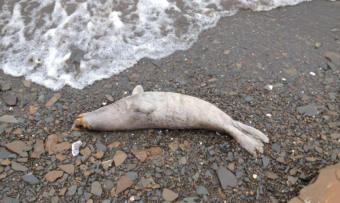
A hunter from Kotlik counted 18 dead seals along 11 miles of shore, north of Kotlik. Photo from May 7, 2019 (Photo courtesy Harold Okitkun)

An unusually high number of ice seals have been found dead in the Bering Sea region.

That’s according to NOAA Fisheries, which announced today that the agency has received reports of at least 60 dead seals, including bearded, ringed, and spotted seals, along the coast of the Bering and Chukchi seas. The agency says that between 2014 and 2018, the average number of ice seal deaths reported in a given year between January and June was 18.

The recent reports have come from multiple sources, including a hunter from the southwestern village of Kotlik and a biologist with the National Park Service in Kotzebue. NOAA Fisheries is aware of other sightings near Kivalina, Point Hope and St. Lawrence Island.

Julie Speegle with NOAA Fisheries says the agency received the bulk of the reports on Monday.

“We did have some reports that some were skinny,” she said. “So that’s interesting, especially given what is going on with the gray whales.”

This year, there’s been a spike in gray whale deaths along the Pacific Coast, many of which appeared to be starving.

The agency is currently mobilizing a team to collect samples to help determine the cause of the deaths.

“We don’t know if it’s lack of sea ice, or if there was a harmful algal bloom,” said Speegle. “There’s quite a range of factors.”

She said that the samples collected in the field will have to be sent to a lab, and it may be several months before they have results.

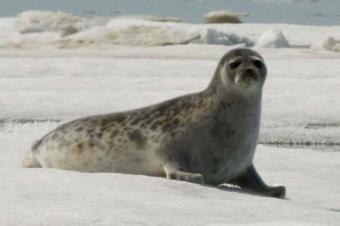
Ringed seal
A ringed seal. (Public domain photo by NOAA Fisheries)

Goat yoga? In Fairbanks, there’s a new animal to flow with: Reindeer.

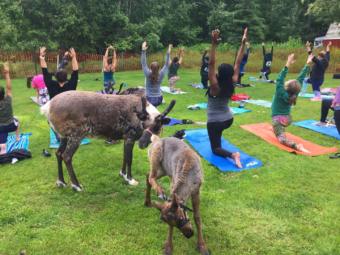
Rocket the reindeer takes a rest during a yoga class at Running Reindeer Ranch in Fairbanks. June 10, 2019. (Ravenna Koenig/ Alaska’s Energy Desk).

If you want to incorporate quality time with animals into your yoga practice, you have a lot of options these days. There’s puppy yoga, cat yoga, and (perhaps the most famous) goat yoga.

Now, in Fairbanks, there’s a new offering: a yoga class with fauna particular to the cold northern climes of the sub-Arctic — reindeer.

In a grassy pen at the Running Reindeer Ranch, a mix of adult and baby reindeer are milling around — grazing, nosing curiously at water bottles and pawing yoga mats as people shake them out for class.

The air is buzzing with mosquitoes, and the sky is threatening rain, but a good two dozen or so people have shown up for this petting zoo/exercise experience.

“I’ve wanted to do goat yoga but this is one step up,” said Tarah Hoxsie, one of the women who came to the class. “While everybody’s doing goat yoga in the lower 48, we’re doing reindeer yoga, which is way cooler.”

This is a brand new thing for the ranch; it’s only the third class they’ve done. They usually give natural history walking tours with the animals.

Jane Atkinson is one of the owners. She does yoga herself, and she thinks that reindeer are particularly well-suited to it. They’re twisty creatures — especially in the springtime when their antlers are growing and itchy, and they scratch them with their back hooves.

“So you’ll see the reindeer getting into these amazing poses,” she said.  “And it’s like wow….  Look at this little yoga move that they do!”

A reindeer calf scratches it’s head with its hoof. Their ability to move their bodies into extreme positions was one of the reasons owner Jane Atkinson thought that reindeer would be a great fit for a yoga class. June 10, 2019. (Ravenna Koenig/ Alaska’s Energy Desk).

One of Atkinson’s employees at the ranch, Elsa Janney happens to also be a yoga instructor, so they decided to try it out.

The class starts with a safety talk — things like, don’t touch the reindeer’s sensitive antlers because it could hurt them. These animals don’t kick or bite, and are used to being around humans, but Atkinson and some of her staff stay on the edges to usher the reindeer away from people if they feel uncomfortable.

From there, much of the class follows a typical yoga class script, but there is some extra reindeer stuff mixed in. Like when Janney asks us to bring our attention to the sounds around us.

“Reindeer make a click when they walk,” she said. “That is a ligament connected to two different ankle bones. That is unique to both caribou and reindeer.”

At the start of class, most of the reindeer are standing up or slowly wandering around the mats.

But as it goes on — one by one they all lie down. Rocket — an elegant male reindeer — spreads out between the first and second rows and spends most of the class making a noise that sounds like snoring. 

By the end of the yoga class, all the reindeer are lying down.  June 10, 2019. (Ravenna Koenig/ Alaska’s Energy Desk).

We spend about an hour going through our yoga poses and all the while, the reindeer are just living their peaceful lives around us: chewing on weeds, making funny grunting noises from time to time, and at least once, availing themselves of the grass toilet.

The whole thing is pretty surreal and there’s a lot of giggling.

After it’s over I ask a few people for their reviews. 

“It was awesome,” said Beth Ann Chase, who was basically sharing a mat with the lounging Rocket.  “I could hear him snoring the whole time that I was doing it… It definitely brought me to like, a peaceful place,” she said, laughing.

And my friend Diana Saverin joked that the class was sort of a unique workout for the focus.

“As the rain came down, the mosquitoes buzzed, and the reindeer snored it was like, can you stay with your breath? It’s good hard work.”

Plus, I think now we have some kind of animal yoga bragging rights.

Can the youth climate lawsuit go to trial? A federal appeals court will rule.

Nathan Baring, third from right, at the March for Science in Washington D.C. in April of 2017. He’s one of 21 plaintiffs in a case trying to prompt federal government action on climate change. (Photo courtesy Robin Loznak/Our Children’s Trust)

Tuesday marked a key moment for the landmark climate change lawsuit brought against the U.S. government by a group of young Americans.

That case argues that the government has violated the constitutional rights of the plaintiffs by actively supporting a fossil fuels system that is destabilizing the climate. It was started by the nonprofit legal organization Our Children’s Trust.

Lawyers on both sides of the lawsuit — known as Juliana v. United States — made their case in front of three judges from the 9th U.S. Circuit Court of Appeals in Portland, Oregon, on Tuesday. The judges will decide if the lawsuit can go to trial.

The trial was supposed to start in a lower court last October, but that court granted the Trump administration a pretrial appeal.

Sean Hecht is an environmental law professor and the co-executive director of the Emmett Institute on Climate Change and the Environment at the University of California, Los Angeles. He said that pretrial appeals like this are extremely rare, but in this case, higher courts including the U.S. Supreme Court and the 9th Circuit had signaled support for it.

“The courts’ view of it is that the case is unusual enough and novel enough that it would be wise to resolve some of the legal uncertainty before trial rather than after trial,” he said.

Hecht said ultimately the 9th Circuit could allow the case to go to trial, or dismiss it. Whatever the result, either side could then petition the Supreme Court to take it up.

One of the plaintiffs in the case is 19-year-old Nathan Baring from Fairbanks, who attended the hearing. He said the challenge the case faces doesn’t impact his commitment to it.

“I want to be able to look back in my future and say that I put my best foot forward when it came to preserving this climate system that I’m going to rely on so much; that I already do,” he said.

It’s unknown when the 9th Circuit will make its decision.

Site notifications
Update notification options
Subscribe to notifications