Ravenna Koenig, Alaska's Energy Desk

Remove your rings and get out your card blanket: A table-side view of one of Utqiaġvik’s most animated card games

From left to right: snerts players Christina Kanayurak, Lilly Kanayurak, Karen Hopson, Clara Oenga and Nora Jane Adams. April 17, 2019. (Photo by Ravenna Koenig/Alaska’s Energy Desk)

There’s a card game played all over Alaska that’s chaotic, competitive and lightning fast. It goes by many names — but on the North Slope it’s known as “snerts.”

And in Utqiaġvik — where a snerts tournament is even part of Piuraagiaqta, the local spring festival, and groups of die-hard enthusiasts play on a regular basis — it’s one of the most popular games in town.

On a sunny evening in Utqiaġvik, six women gather at Karen Hopson’s house to play. Most of them are related to each other, and most of them grew up playing snerts. Lilly Kanayurak — Hopson’s mother — remembers playing with her grandparents and their friends when she was a little kid.

“There would be tea and homemade bread and candy, hard candy on the sides,” she said. “And just a lot of fun and competition.”

This group started getting together to play on a regular basis a few years ago, but the frequency of their games varies. In the winter they might play three games a week; other times they might go a few months without playing; one time they played 14 days straight.

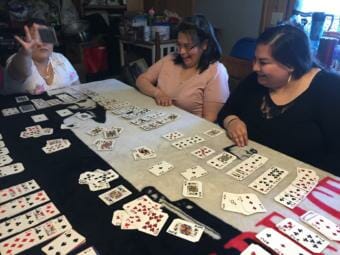
Christina Kanayurak (left) mid-discard during a game of snerts with her mother, Lilly Kanayurak, (center) and sister, Karen Hopson (right). April 17, 2019. (Photo by Ravenna Koenig/Alaska’s Energy Desk)

The first step to playing the game is spreading a blanket over the big kitchen table. This one happens to be emblazoned with Al Pacino’s gun-toting silhouette from the movie “Scarface.” The intention is to keep the cards from sliding all over the place. “We’re going to be throwing the cards very fast,” said Corrine Danner by way of explanation.

The group settles themselves around the table as kids play happily in the background, and each lays out a deck of cards in front of her.

Snerts is a technical game that’s impossible for a casual observer to make sense of. But the easiest way to describe it would be a kind of competitive solitaire, where everyone is playing their hand simultaneously, either with a partner or by themselves.

There are different ways to play it, and a long list of different names it’s known by, including “nertz,” “peanuts,” “squeal,” “scrooge” and “racing demon.”

It didn’t originate in Utqiaġvik, but it’s very much of this place. David Parlett, a card game expert, says it’s a widespread game that’s been played for well over a century — adding that the variety of names is living proof of its popularity. And in Alaska it’s played all over the place — an informal Twitter survey looking for players of the game drew responses from areas in the Northwest Arctic, the Interior and Bristol Bay.

The game is played at high velocity — with people slinging cards across the table and trying to discard ahead of their competitors. And of course, there’s the possibility of some turbulence along with that: “I have to take my wedding ring off because it can scratch somebody really bad,” said Danner.

Different versions dictate different ways to win the round — but you always say the same thing when you do: “Snerts!”

This is one version of the card game known as snerts. It’s the one that Lilly Kanayurak says she grew up playing, and is more commonly played in Utqiaġvik. (Video by Ravenna Koenig/Alaska’s Energy Desk)


This is a variation on the more commonly played Utqiaġvik snerts game, where the game starts with all 52 cards in the deck distributed to seven columns with three floating cards on the bottom. (Video by Ravenna Koenig/Alaska’s Energy Desk)

In Utqiaġvik, it’s mostly women who play. And this group convenes more in the wintertime, during the long stretches of cold and dark. But they get together whenever their schedules allow.

“At times our husbands, or their husbands and their uncles and brothers will be hunting,” said Danner. “We get bored and we try to either sew or play cards.”

Some men do play, said Hopson, “and some of them are really fast.”

“But … they don’t like people to know that they’re playing,” joked Lilly Kanayurak.

“Don’t post it on Facebook!” added Danner.

It’s easy to see why these women love the game: It’s quick and competitive, with lots of opportunities for teasing and laughter.

But it’s also just about seeing each other, getting a chance to catch up and check in.

Sometimes they share happy news or funny stories. But it also helps them get through hard times — like when they lost a close family member.

“I think we found a lot of strength in getting together, and joy,” said Lilly Kanayurak. “Finding that happiness again.”

Again and again they come back to this table, where they sit in a circle facing one another — laughing, sharing stories and talking through what’s going on in their lives, one snerts game at a time.

To get a count on bowhead whales, North Slope scientists head out onto the sea ice

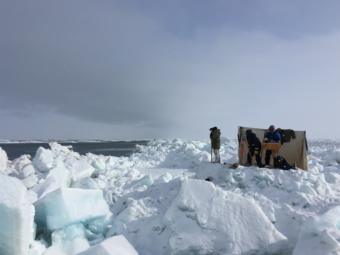
The “perch,” which from which rotating shifts of observers look for whales as part of the North Slope Borough’s bowhead whale census, April 16, 2019. (Photo by Ravenna Koenig/Alaska’s Energy Desk)

This spring, the North Slope Borough conducted a census — not of people, but of the western Arctic bowhead whale population. They do the count with their own eyes out on the sea ice off Utqiaġvik, where surveyors have to remain on high alert for polar bears and shifts in weather and current that might break up the ice under their feet.

It’s one of the best ways scientists have to get a whale count that helps forms the basis of Alaska Native hunters’ subsistence quota.

Craig George stands high up on a mound of sea ice overlooking the Chukchi Sea, his back to a moonscape of white and blue shards of ice. He’s scanning the horizon with a pair of binoculars and using a small wooden podium to write down weather conditions and whale sightings.

So far this shift, he’s seen exactly zero whales.

“Pretty quiet guys, I’m surprised,” he says to the other two men standing next to him at the perch.

“Seeing some seals,” says Darren Kayotuk.

“Yeah let’s start counting seals,” George jokes dryly.

George is a wildlife biologist with the North Slope Borough, and the census coordinator. He’s been participating in the census a long time — the first one he helped with was all the way back in 1980.

Craig George has been working out on the ice as part of the whale census since 1980. April 16, 2019. (Photo by Ravenna Koenig/Alaska’s Energy Desk)

The census started back in the 1970s, when the international commission that regulates whaling was concerned that there weren’t enough whales to support a traditional subsistence hunt.

In those early days, there were a lot of things scientists didn’t know about how the whales behaved. That made it hard for them to get an accurate count.

For example, says George, they didn’t know that whales could swim under heavy ice cover and would also travel far offshore where they couldn’t be seen.

“That was a real eye-opener,” says George, “realizing that there’s times when we only see a small fraction of the whales.”

Scientists learned about that and other whale behaviors from Iñupiaq whalers. And they documented it by putting hydrophones down in the water — which meant they could show that whales were going by, even when they couldn’t see them.

They still use those techniques today. As George stands looking out at whale-free water, Kate Stafford, an oceanographer at the University of Washington, clamors down to the edge of the ice and drops a microphone below the surface. Sure enough, she can hear bowheads off in the distance.

Kate Stafford climbs down to the water edge to put a hydrophone into the water and listen for whales, April 16, 2019. (Photo by Ravenna Koenig/Alaska’s Energy Desk)

In addition to whale behavior, there was a whole other set of lessons the census takers needed to learn — namely, how to stay safe on the ice. And that, says George, is almost impossible to figure out anywhere but out on it.

“There’s not like a formal Iñupiaq classroom, you sit down, ‘Today we’re going to discuss the principles of sea ice and sea ice safety,'” he says. “That doesn’t happen. It’s like, ‘Malik,’ you know? ‘You follow.'”

Over the decades, George has spent many, many hours out on the ice learning from whaling captains about how the ice forms, how it moves, how to recognize when it’s safe, and when it’s about to get dangerous.

“You don’t learn anything unless something goes wrong,” he says. “I mean, that’s not entirely true, but that’s where you really learn.”

He’s seen plenty of things go wrong. The most memorable, he says, was back in 1985, when a heavy piece of ice floating out on the ocean hit the shore-fast ice a considerable distance from where they were camped.

“The force transmitted through the ice, and then suddenly this big pan we were on — I don’t know, quarter-mile wide — it started breaking up,” he remembers. “And it shattered, broke down the middle. … It kept breaking up more and more, and then it started folding and water was rushing up between the pieces.”

Scary as that sounds, they did make it to safety.

George refers to this event pretty nonchalantly — he says it was a good learning experience.

The view of the ice and the ocean from the “perch,” April 16, 2019. (Photo by Ravenna Koenig/Alaska’s Energy Desk)

It also helps that they stay in regular communication with the whalers who are out on the ice doing their spring hunt.

“If we see something happening, we get on the radio, on the whalers’ channel … or they call us,” he says. “We become part of the community on the ice when we’re out here.”

If things get dicey, the group pulls back. That, along with weather and ice conditions that sometimes get in the way of seeing whales, means that some census years they don’t get a good estimate out on the ice.

“One out of 3 of these counts actually works,” says George.

But the estimate plays a critical role in northern Alaska communities’ continued ability to whale.

Subsistence hunters have a quota, and even though they only harvest an average of 40 whales out of a population that was estimated at around 17,000 the last time they did the count, the quota is dependent on a good population estimate every decade.

There are other ways to do that count, like aerial surveys. One is actually being done independently by the federal government this summer. It was planned as sort of insurance — in case the ice-based census didn’t yield a good count. But the ice-based method is more precise, so they’d like to have both.

Plus, despite the fact that being out here requires some vigilance, it’s also really beautiful.

The view of the ice looking back toward shore, April 16, 2019. (Photo by Ravenna Koenig/Alaska’s Energy Desk)

And for George, it’s the best part of the job. He loves watching bowhead whales.

“They’re just so graceful and beautiful. Every time I see a whale I get excited,” he says.  “I’ve seen thousands and thousands,” he goes on, “it’s always like seeing a bowhead for the first time.”
The ice is changing as temperatures warm in Utqiaġvik, and George says he doesn’t know exactly what the census will look like in the years ahead. They may shift to using more aerial techniques as the ice gets less stable, or maybe they’ll figure out how to do a count using satellite images.

But for now at least, the census remains part of the “community on the ice.”

In Utqiaġvik, learning about climate change includes studying your backyard

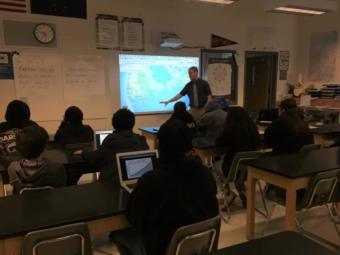
Science teacher Kevin Neyhard spends the end part of each school year teaching his eighth grade science students in Utqiaġvik about climate change. (Photo by Ravenna Koenig/Alaska’s Energy Desk)

In Utqiaġvik, the average temperature has risen over 7 degrees Fahrenheit in the past 50 years. That’s among the biggest jumps in Alaska and the world.

People in Utqiaġvik are already experiencing impacts from that warming, like changes in the sea ice they hunt from, and increased coastal erosion as the period of time when the shoreline is protected from storms by sea ice has gotten shorter.

And in eighth grade science, students in Alaska’s northernmost town study climate change in a way that encompasses the global picture, but pays particular attention to what’s going on in their own backyard.

Third period is about to start at Eben Hopson Middle School, as science teacher Kevin Neyhard stands at the door to his classroom and ushers in the last stragglers from the hallway.

Graph showing long-term warming trends in Utqiaġvik, Alaska.
Graph showing long-term warming trends in Utqiaġvik, Alaska. (Graphic courtesy Alaska Center for Climate Assessment and Policy)

Neyhard has a lot to get through in this class period. The section he’s teaching right now sometimes gets a bit squeezed, since it’s at the end of the year. But for the past six years he’s been teaching here, he always gets to it eventually.

This is the part of eighth grade science where students in Utqiaġvik learn about climate change.

In today’s class, Neyhard is showing the class data reflecting how carbon dioxide levels and temperatures are rising, and how that corresponds with a decline in Arctic sea ice.

Just half a degree Celsius of warming could mean an ice-free summer on the Arctic ocean, he explains, which would lead to even more warming.

“Why else is the ice important?” he asks his students.

People shout out answers: “Polar bears!” “Seals!” “Walrus!” “Whaling!”

Climate change is personal to the students here, where many people use the land and ocean to access subsistence resources, and even residents as young as these 13- and 14-year-olds have seen a change in the coastline due to erosion.

Neyhard’s approach to this subject gets personal too. He usually starts this unit by handing out a homework assignment where students have to ask an adult outside of school a series of questions about climate change.

Graph showing long-term warming trends in Alaska.
(Graphic courtesy Alaska Center for Climate Assessment and Policy)

“Have you seen anything in your life that you would say is a result of climate change?” he reads out loud to the class, as he goes over the homework. “You know, examples,” he continues. “What have they seen change, if they’ve seen things change?”

Neyhard tells the students what he doesn’t want is for them to go home and say, “Here Mom, you have homework.”

“I want you to talk to people,” he tells them. “That’s the whole point, is to get you to actually talk and learn from people in the community.”

When students come back to class with stories from parents, grandparents, aunts, uncles and other adults, it becomes a sort of crowd-sourced teaching tool. Neyhard puts the answers in a database, and they go over it in class.

His curriculum is largely shaped by a growing national model for science education called the Next Generation Science Standards, which the North Slope Borough School District has adopted. The state of Alaska hasn’t adopted the next generation science standards yet, though they’re considering a framework incorporating it. The standards say students should be able to “ask questions to clarify evidence of the factors that have caused the rise in global temperatures over the past century,” with emphasis on “the major role that human activities play.”

An illustration of the greenhouse effect on the wall of Kevin Neyhard’s classroom. (Photo by Ravenna Koenig/Alaska’s Energy Desk)

There is also a set of locally-developed Iñupiaq standards that relate to the environment and influence how Neyhard teaches this course. For example, they include an expectation that students show responsibility toward the environment by “comparing and contrasting conservation-oriented behaviors with irresponsible behaviors.”

But Neyhard also takes cues from the responses he gets to the annual survey.

“Basically, I want to try to teach in accordance with what this community is feeling and thinking,” he said.

The majority of the responses to the survey reflect a belief that human activity is either partly or fully responsible. So that’s the way he teaches it.

“I do lean towards the human influence of things,” he said.

He also gets the students out of the classroom for their climate change education. Each spring he takes them out onto the shorefast sea ice for a day-long field trip.

“They get the traditional, ecological perspective on sea ice and how it’s changing and shifting from the whaling crews and whaling captains,” Neyhard said. “And then they come back to a home base area … and we drill cores through the ice to learn about it from that perspective.”
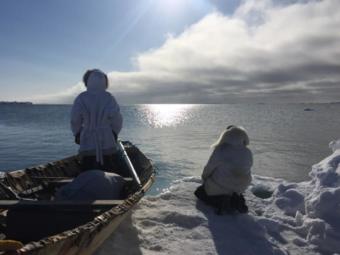
The shorefast sea ice off Utqiaġvik, which local whalers use as a platform for their spring hunt, April 21, 2019. (Photo by Ravenna Koenig/Alaska’s Energy Desk)

He also brings in area scientists to answer student questions.

“They ask about how it’s affecting a lot of the animals: seals, bowhead of course is a big one, polar bears, caribou,” he said.

Neyhard does talk about the challenges and potential consequences of climate change in this class — and that can be scary to some students. But he ends by talking about the ways that people are trying to address some of those challenges.

He keeps track of the adaptations that are being discussed in Utqiaġvik, and shares them with his students — like the idea of building a rock wall along the beach to slow erosion. Neyhard also has students do a final project where they research a particular approach to a climate change problem.

He wants them to walk away from this class not just with a better sense of how their world is changing, but also how people are trying to respond to that change — both globally and here at home.

In Utqiaġvik, temperatures are warmer, and the ice is changing. What does that mean for whalers?

Members of Gordon Brower’s whaling crew scan the horizon for bowhead whales, April 21, 2019. (Photo by Ravenna Koenig/Alaska’s Energy Desk)

On the North Slope of Alaska, the Iñupiat tradition of hunting bowhead whales has an ancestry over 1,500 years old.

Today in Utqiaġvik there are two annual hunts when the whales pass by on their migration. The fall hunt has historically been done on open water, and the spring hunt from the ice that attaches to the coast each winter.

But as temperatures have risen in the Arctic, the ice that serves as the platform for spring whaling has changed dramatically.

And even though whalers in Utqiaġvik say that they’re adapting to that change, some also say the ice is less stable than it used to be — and more dangerous.

Whaling captain Gordon Brower’s camp at the edge of the ice looks very similar to how his father’s looked when Brower first started going out whaling with him back in the late 1960s: a sealskin boat perched at the edge of the ice, along with a simple canvas windbreak and a wooden sledge covered in caribou skins that serves as a makeshift bench.

Around the boat, a handful of whalers, including Brower’s brother, nephews and grandson, joke and talk as they watch the open water — waiting for the arcing backs of bowhead whales to come close enough for them to chase.

Gordon Brower, second from left, has been whaling since he was a kid in the late 1960s. Iñupiat whalers still use many of the same tools in their spring hunt, including the sealskin boat, or umiakpictured here on April 21, 2019. (Photo by Ravenna Koenig/Alaska’s Energy Desk)

Though parts of this traditional hunt are the same as when Brower was a kid, there are some big differences. Chief among them: the ice.

For starters, the extent of the ice that attaches to the coast is shorter than it used to be. Walk a few dozen paces back from the ice’s edge, and you can see the buildings of downtown Utqiaġvik.

“I guarantee you, somebody’s looking at us with binoculars,” said Brower, laughing.

He said that even a decade and a half ago, the ice could extend 10 or 15 miles out from shore. Nowadays it’s usually more like a mile or two.

At least part of that has to do with the fact that Utqiaġvik’s winters have gotten milder.

“Certainly the weather has been very different about creating ice,” said Brower. “Not the very long, sustained 40 below, 30 below type weather.”

The view of downtown Utqiaġvik, from a spot close to where Gordon Brower’s crew set up at the ice’s edge, April 21, 2019. (Photo by Ravenna Koenig/Alaska’s Energy Desk)

It also means that the ice is thinner.

“I think it’s changed quite a bit,” he said. “I mean, it looks the same, it’s just a different size. The ridges are different sizes.”

Brower is talking about pressure ridges: the mountains of this landscape created by the colliding plates of the ice. They not only rise into the air above the ice, they also go down below the water. If they go down far enough, they act like anchors, holding the ice in place on the ocean floor.

The thick ice of the past made bigger pressure ridges, Brower said, which meant bigger anchors and safer ice.

“I think it was a little more stable, and there was a little bit more assurance that the ice you were on was not going to disintegrate on you that easy,” said Brower. “Today you gotta think about it. And be more prepared and be more vigilant about your surrounding.”

Poorly-grounded ice can lead to what’s called a “breakout event” — a phenomenon where a piece of ice (potentially one that people are camped on) breaks free and starts floating away. Sometimes without the people on it even knowing it’s happening.

This past year, the temperatures in Utqiaġvik in the fall and early winter when the ice was forming were some of the warmest on record. And in early February, something really abnormal happened: At least 10 miles of shorefast ice in front of Utqiaġvik broke away, including in places that are typically very well-grounded.

Few people were going out on the ice at that time, and no one was hurt. But Brower said that if the ice wasn’t grounded well enough then, it gives him pause about trusting it now.

“So it’s kind of, like, iffy still,” he said. “If you had a good west wind and the water table came up, it can dislodge it and move it around.”

A small pressure ridge close to Gordon Brower’s whaling camp, April 21, 2019. (Photo by Ravenna Koenig/Alaska’s Energy Desk)

Talking to whalers in Utqiaġvik, they point to different ways that the ice is changing and different ways that impacts what they do.

Some talk about the ice being more susceptible to breakouts. Others say that it’s harder now to find ice thick enough to pull whales up onto.

Some call the ice conditions more “dangerous” than they used to be and speak about it with concern. Others say it doesn’t worry them; that they have the skills and knowledge to navigate the changes.

The thing you hear pretty much across the board is that whalers are finding ways to adapt.

Those adaptations are things like being more alert to how the ice is moving, and being more cautious about places where it might be thin. But it also could include replacing the traditional skin boats with motor boats when ice conditions deteriorate, so that if there is a breakout event, whalers can get back to the safe ice more quickly.

I asked Brower’s 35-year-old nephew Jack Frantz if all this change — and potentially more in the years ahead — makes him worry about the future of whaling in this community. He said it doesn’t.

“I’m always going to be out here hunting,” he said. “The ice conditions could be here or could not be here, but we’re going to find a way to hunt. … Even if the ice wasn’t here, we’d be waiting on the edge of the beach I guess for whales to show up.”

Whalers in Utqiaġvik describe whaling as their “life,” their “pride,” one of the things that brings their community together and connects them to their culture.

As long as there are bowhead whales swimming off the coast of Utqiaġvik in the spring, many hunters say they will find a way to get to them, no matter what happens to the ice.

Marie Adams Carroll became a ‘folk hero’ fighting for Iñupiat whaling rights. Now she’s in the Alaska Women’s Hall of Fame.

Marie Adams Carroll has worked in various leadership roles in her 40-year career on the North Slope. She was recently inducted into the Alaska Women’s Hall of Fame. (Photo by Ravenna Koenig/Alaska’s Energy Desk)

On Tuesday, 10 women were inducted into the Alaska Women’s Hall of Fame.

One of them was Marie Adams Carroll from Utqiaġvik. She stepped into a leadership role as a young woman on the North Slope during a time of crisis — when subsistence activities were threatened — and has been involved in public life ever since.

She’s been called a folk hero. And people who have worked with her over her 40-year career — or have seen the fruits of her labor — consistently praise her leadership.

On a recent evening in Utqiaġvik, Carroll sat at her sister’s kitchen table and pulled out silky, crimson-red cuts of fabric for her sister Diana Martin to look at.

“This is real pretty!” Martin exclaimed, “My favorite color.”

Carroll and Martin were working on an atikluk — a traditional Iñupiaq formal shirt that Carroll planned to wear to the Alaska Women’s Hall of Fame induction ceremony.

Marie Adams Carroll and her sister Diana Martin work on an atikluk. (Photo by Ravenna Koenig/Alaska’s Energy Desk)

This house is where the two women grew up, along with nine brothers and sisters. And — you could say — where Carroll’s role as a leader began.

“We’d get all these chairs together and form a train, and play and play,” she remembered, “and about half-hour before mom would come home, I would become a queen.”

“I remember that!” said Martin, and the two women burst into laughter, reminiscing about how Carroll would command her siblings to do various cleanup activities.

Her leadership inclinations may have been sharpened in the clamor of sibling games. But she traces her interest in finding meaningful work back to a serious moment in her childhood: an illness she had when she was 6 or 7 years old.

“I felt like I was in and out of my body,” she said. “As I saw my body drifting away, I thought, ‘But God, I haven’t done anything with my life. I need to do something.'”

She recovered from that illness. But the feeling of needing to make her life mean something — that didn’t go away.

She saw education as a path to that, and she became the first person in her family to go to college.

But in 1977 — before she’d finished her bachelor’s degree — the North Slope was hit by some seismic news: The International Whaling Commission was concerned that the population of bowhead whales was too low to support a subsistence hunt, and had put a moratorium on it. That kicked off a huge fight in northern Alaska for the right to whale.

It was this moment that marked the real start of Carroll’s public career.

Her brother Jacob Adams was serving as chairman of the organization that formed to advocate for the whalers — the Alaska Eskimo Whaling Commission — and he and her and cousin Oliver Leavitt recruited her to work for the organization. A few years after she started, Adams and Leavitt proposed that she lead AEWC, and she became executive director.

At first, some whaling captains didn’t think a woman should be their representative. But that changed before too long, according to Leavitt.

“Marie became central around our life, because she represented us for the whale, and the ability to whale,” he said. “She was kind of the folk hero around here.”

Leavitt said that Carroll led with integrity and intelligence, and was instrumental in preserving the rights of northern Alaska communities to keep whaling.

Eventually, things settled down enough that Carroll felt she could leave whaling issues to try her hand at other things.

She worked in local government for a while — as the city manager for Utqiaġvik, and later as a top deputy for the mayor of the North Slope Borough.

And then another colossal task came her way. The tribal nonprofit health organization on the North Slope — Arctic Slope Native Association, or ASNA — wanted to build the region’s first modern hospital, and they asked Carroll to come on board as health director and lead that project. 

At the time, she said, the only medical facility in Utqiaġvik was run down and way too small to serve the needs of the community.

“There were only six exam rooms serving about 5,000 people,” she said. “We had outdated equipment. … When I first started they had duct tape on the nurse’s station.”

It took about a decade to get the new hospital funded, and another few years to build it.

Today, the Samuel Simmonds Memorial Hospital is a large, sleek building in Utqiaġvik, with light filtering into a high-ceiling lobby, and art by Iñupiaq artists decorating the walls.

The lobby of the Samuel Simmonds Memorial Hospital. (Photo by Ravenna Koenig/Alaska’s Energy Desk)

It offers a much better-equipped emergency room than the old facility and a whole list of services that people once had to fly to Anchorage for.

And Carroll is responsible for making that happen. She’s now been with ASNA for 20 years, over a decade of those as president and CEO.

The exterior of the Samuel Simmonds Memorial Hospital. (Photo by Ravenna Koenig/Alaska’s Energy Desk)

Richard Hall — the hospital administrator — said her leadership has had a distinct vision.

“She’s always wanted everyone in this community to have the same type of health opportunities that you have in the big cities,” he said.

Carroll is in her 60s now. She said this is the job she’ll retire from.

But asking around about her in Utqiaġvik — where people speak with pride about her accomplishments and with deep respect for her as a person — it’s clear that the things she’s done on the North Slope will be remembered long after she stops clocking in.

Meet Alice Qannik Glenn, the podcaster who’s trying to get more young Alaska Native voices on the mic

Alice Qannik Glenn, sitting at her kitchen table in Anchorage, where she often records her podcast focused on topics relevant to young Alaska Native people. (Photo by Ravenna Koenig/Alaska’s Energy Desk)

If you look at the stories being told in the world, and you don’t see your perspective reflected in those stories, what do you do?

For one young Iñupiaq woman, the answer to that question was: make a podcast.

Alice Qannik Glenn met me at the bottom of the stairs leading up to her apartment in Anchorage, her wiggling, black-and-white mutt named Kumak at her side. Her apartment is cozy: full of light and plants, with colorful paintings and prints on the walls. And for the better part of a year now, it’s not only been her home, but also her makeshift recording studio.

“I’ve done a couple of interviews here where we’re just kind of chilling on the couch,” she said, gesturing at her living room. “Most of the time we talk in here,” she continued, leading me back to her small kitchen, where a french press full of coffee and some snacks were waiting for us on a round glass table in the corner.

It’s fitting that Glenn often tapes her podcast in her kitchen. It’s called “Coffee & Quaq.” (“Quaq” is the Iñupiaq word for frozen or raw meat or fish.)

It’s not a food podcast necessarily, though she does have one episode that focuses on Native foods. The podcast’s purpose is much broader: “To celebrate, share, and explore the collective experience of contemporary Native life in urban Alaska.”

Glenn grew up in Utqiaġvik, but has lived in Arizona, Florida and, for the past few years, in Anchorage.

She wanted the title of her podcast to evoke both the contemporary and the traditional parts of Alaska Native life. But she said that coffee and quaq don’t go together literally, a fact that made her dad skeptical about the name when she told him.

“He’s like, ‘Tea and quaq. We don’t drink coffee with quaq, Alice,'” she remembered, laughing. Still, she liked the symbolism  — coffee has the added connotation of staying “woke,” which she hoped the podcast conversations would help both her and her listeners do — so she kept it.

Alice Qannik Glenn and her dog, Kumak, in her Anchorage living room. (Photo by Ravenna Koenig/Alaska’s Energy Desk)

Glenn just turned 30 this year, and she said she was inspired to make the podcast because she didn’t see stories being told in the media from the perspective of young Alaska Native people.

That’s a big deal, she said, because when you don’t see yourself reflected in the narratives put out into the world, it’s easy to internalize the message that you don’t matter.

She wants “Coffee & Quaq” to provide that missing representation: to spotlight the ideas and conversations of young Alaska Native people. She also wants it to broaden the range of stories that are told about Indigenous experiences.

“We’re often defined by our disparities, some of the struggles that we’re going through, and I don’t want that,” she said. “Yes, those stories need to be told. But also, many of us are happy, many of us are thriving, many of us are doing great things, and hopefully those highlights can inspire other young Native people to do the same.”

In one episode of her podcast, she talks with two young Alaska Native women — one an artist, the other an artist and curator — about cultural appropriation. In another, she digs into why some Arctic Native people don’t like to use the word “Eskimo” to describe themselves, and even find it offensive.

Glenn said these interviews have been a continuing education for her: a way to engage with important topics and deepen her own thinking by listening to the insights of others.

It isn’t her full-time job yet, but she wants it to be.

“It just feels like magic,” she said. “It’s what I think about when I wake up in the morning, and it’s what I think about when I go to sleep.”

Glenn has a range of interests career-wise: She went to college for aerospace studies, which she said she might go back to one day. But for right now, she’s looking for ways to make the podcast the thing she does 24/7.

Site notifications
Update notification options
Subscribe to notifications