The Arctic Slope Regional Corporation’s corporate headquarters in Utqiaġvik, Alaska. January 2018. (Photo by Ravenna Koenig/Alaska’s Energy Desk)
An influential Alaska Native corporation has joined the list of critics of a proposal from Gov. Michael Dunleavy that would strip some of the taxing power of cities and boroughs.
The legislation would deprive the North Slope Borough of a major revenue source: property taxes on oil and gas infrastructure. Wednesday, the Arctic Slope Regional Corporation, or ASRC, joined the borough in a joint statement that called the bill “an attack on communities across the region.”
In a written statement, ASRC president and CEO Rex Rock Sr. said: “Trying to balance a state budget on the backs of the Iñupiat people across the Arctic Slope is a wrongsided attack on our region.”
The criticism is noteworthy because it comes from one of the governor’s allies: ASRC endorsed Dunleavy back in October, citing, among other things, his enthusiasm for oil and gas development.
The joint press release yesterday also included a statement from North Slope Borough Mayor Harry Brower Jr.
“For decades, we have supported safe and responsible natural resource development on the Arctic Slope because of the economic benefits the industry brings to our communities,” said Brower. “As written, Senate Bill 57 makes us question that support. Is this what the governor is intending to do with this legislation – pit the Iñupiaq people of the Slope against industry?”
The governor’s plan would cost the North Slope Borough nearly $400 million in property tax revenue.
Before it can take effect, though, it would have to be approved by the Alaska Legislature. House Speaker Bryce Edgmon gave Dunleavy’s House version of the bill a cool reception yesterday by sending it to three different committees for vetting — often a step that the speaker takes to delay or derail legislation.
—Nathaniel Herz contributed reporting from Anchorage.
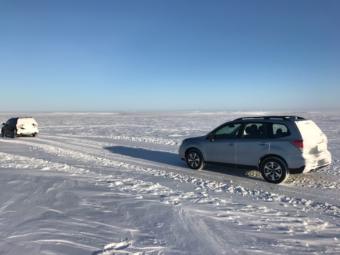
Last April, Robin Mongoyak drove his family’s new Subaru Forester from Prudhoe Bay to Utqiaġvik, using a new trail provided by the North Slope Borough. (Photo courtesy Robin Mongoyak)
If you live on the North Slope of Alaska, you have limited options when it comes to bringing in goods from down south — especially big things like cars, appliances and lumber.
Some of the communities can get those things through a seasonal ocean barge service. Others are only served by air cargo. But there’s a third option some people take to try to save money: driving over the tundra.
Now the North Slope Borough is testing a pilot network of winter snow trails, which they hope will make that a safer choice.
Ten years ago, Robin Mongoyak bought a new truck in Anchorage and drove it up the Haul Road with a buddy. That road ends in Deadhorse.
“We were stubborn,” said Mongoyak. “We thought, ‘Oh, everybody’s making it across … the Slope to Barrow from Deadhorse. We got an F-150 (with) four-wheel drive. I think we got no problem making it too,'” he said.
But once they were out on the open tundra, they hit some bad weather.
“We had total white-out,” he remembered. “You felt like you were 30,000 feet in the air. I mean, the wind was blowing that hard.”
The snow piled up rapidly around the truck, and they constantly had to get out and dig.
“Holy cow, man. There were so many times where we almost gave up and abandoned our vehicle,” he said.
They did eventually make it home to Utqiaġvik. But Mongoyak told himself he would never attempt that drive again.
Then last year… he did.
Out past the airport, where the view south is miles and miles of flat, snow-covered tundra, Mongoyak gestures at a spot just to the side of the road.
“That’s where we came in from,” he said.
Robin Mongoyak at the southern edge of Utqiaġvik, next to the spot where he arrived last year as part of a caravan escorted by North Slope Borough staff that drove a snow trail from Prudhoe Bay. Jan. 30, 2019. (Photo by Ravenna Koenig/Alaska’s Energy Desk)
Instead of braving the tundra independently, when Mongoyak wanted to bring up a second car for his wife last April, he joined an organized caravan of cars, escorted by North Slope Borough staff and specialty equipment to help people if they got stuck in the snow.
They made their way from Prudhoe Bay to Utqiaġvik along a snow trail built by the borough.
Mongoyak said that even though the caravan was slow, since they often had to stop and wait for borough staff to pull out cars that got stuck, it did feel less risky.
He estimated he saved hundreds of dollars taking the car up that way. He might have saved more if he’d driven the car up from Anchorage to Prudhoe Bay himself, instead of paying someone else to do it.
It also gave him peace of mind to get the car up from Anchorage quickly, instead of having it sit in a lot for months, waiting for the summer barge service.
The borough’s Community Winter Access Trails — or CWAT — project is in its second year. It’s a project to build trails and then lead organized trips — like the caravan Mongoyak was with — between several North Slope villages and Prudhoe Bay.
Gordon Brower is the director of the borough’s Planning and Community Services Department, which is overseeing the project. He said that residents of the borough have been driving over the tundra on their own for years, and that has resulted in people frequently getting stuck in the middle of nowhere and needing rescue, which can be expensive for the borough.
“In some cases in the past, people … have broken down a hundred miles in either direction,” he said.”Near-deaths and freezing, running out of gas are some of the issues surrounding being able to go between communities,” he added.
Brower said this year the borough anticipates they’ll be able to connect Utqiaġvik, Atqasuk, Wainwright and Anaktuvuk Pass with chaperoned pathways to Prudhoe Bay and the Haul Road.
They have a permit for five years — counting this year and last year — but will be making the decision year-to-year whether to continue the project.
The borough is keeping track of how many people use the road, what kinds of goods they’re bringing in, and collecting feedback from the community about the trails.
“It’s a proof of concept to measure the impact to the economy,” said Brower. “What kind of impact does it have when you’re connected for just several months?”
Brower said that information could help inform a larger state of Alaska project to identify regional infrastructure and connectivity needs — a chronic issue for the North Slope.
That’s the Arctic Strategic Transportation and Resources — or ASTAR— project. While the state said they still haven’t determined what the specifics of it are, it could include a network of year-round gravel roads between some of the North Slope communities.
Right now, crews are out working on the trails to two of the villages. Others will begin when weather conditions allow.
The borough said that once the trails are open, ideally they’ll be usable until the end of April or early May.
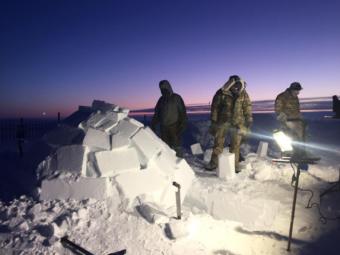
Trainees in an U.S. Air Force barren lands survival course stand next to an igloo shelter that was built as part of the training. Jan. 30, 2019. (Photo by Ravenna Koenig/Alaska’s Energy Desk)
On any given day, pilots in the U.S. Air Force might be flying in the airspace above any environment on Earth. Desert, open ocean, the tropics… or the Arctic.
So they have to be prepared to survive in any one of those places in case they get stuck there for some reason — and in the Arctic especially, that requires some unique training, like one that recently took place in Utqiaġvik.
Mid-morning, a handful of men stood around a domed igloo under a still-dark sky, watching an instructor add the last snow bricks to the structure.
“It’s kind of like a puzzle,” Sgt. Garrett Wright, another instructor, explained to me as we listened to the snow bricks creak and screech like Styrofoam. “You have to have the proper pieces to fit in the spaces, or it’s all going to collapse.”
The trainees had been out there the past two days and nights in temperatures that dipped to 15 below zero and winds that gusted up to 30-plus miles an hour.
Students in the course learn how to signal for help with flares. Jan. 30, 2019. (Photo by Ravenna Koenig/Alaska’s Energy Desk)
“They don’t go back inside after they come out here and begin the training,” said Wright.
The men were learning how to build shelters, flag down help and just generally survive in an incredibly forbidding environment.
Wright, who works out of Eielson Air Force Base close to Fairbanks, said that there are U.S. aircrew flying throughout region, and if anything goes wrong they need to be prepared to hunker down and survive until help can get to them.
This training had six students. Even though the course is typically geared at the Air Force, most of the trainees were Army survival instructors from the Fairbanks area.
Of everything they got training on, the igloo-building was probably the most sophisticated.
They also learned basic things, like how to recognize and prevent frostbite and how to think through the logistical challenges of the Arctic that complicate normally simple tasks. For example: pulling down a plastic tab on a flare.
“What do you think you have to be careful of?” Wright asked during a flare demonstration.
“Brittle,” a couple of the guys said.
“Super brittle in the cold temperatures,” Wright agreed.
But they managed to set off the flares successfully, the tundra echoing with cracks and the air filling with red smoke.
Sgt. Jess Evans is the lead instructor for this course. He’s been a survival specialist with the Air Force for about 14 years.
“I fell in love with the cold environment,” he told me. “I fell in love with Alaska as a whole.”
He teaches cold-environment survival in the Fairbanks area, and periodically “barren lands” courses like this one — basically anywhere above the treeline where you don’t have access to fire-building.
And while Evans sees living outside in these conditions as a serious challenge, he also thinks it can be kind of fun. He loves working with snow, for example.
“It seems funny, but if your imagination can picture it in your head, you can figure out how you can shape the different angles and make pretty much anything out here,” Evans said.
He recounted that, with a different group a few weeks ago, they actually used building snow sculptures as a way to deal with the psychological stress of a potential crash and the boredom of waiting a long time for help.
“They got pretty elaborate with it: polar bears, penguins, you name it,” he said.
After the course in Utqiaġvik, trainees will hopefully know how to stay alive in one of the harshest environments in the world. And maybe also build a polar bear out of snow.
The "fighter trench" is one of the easier shelters that students learn how to build in the course. Jan. 30, 2019. (Photo by Ravenna Koenig/Alaska's Energy Desk)
Sgt. Jess Evans — the course's lead instructor — in a "fighter trench" shelter built from snow. Jan. 30, 2019. (Photo by Ravenna Koenig/Alaska's Energy Desk)
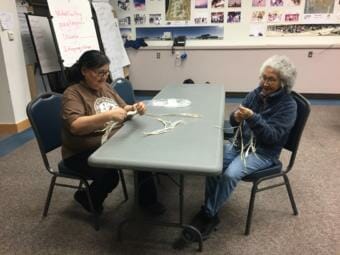
Diana Martin (left) and Nancy Leavitt (right) at the start of an ivalu workshop, where people can come learn how to make thread from caribou sinew. Feb. 2, 2019. (Photo by Ravenna Koenig/Alaska’s Energy Desk)
In Utqiaġvik, spring whaling is still about two months away, but preparations are already in high gear.
That includes making a traditional thread called “ivalu” from caribou tendons, which are used to sew together the sealskin boats that whalers take out on the ice.
Diana Martin was the first to arrive at the Iñupiat Heritage Center for an ivalu workshop that would go on for most of the day. She’s a curator at IHC and led the way back to the artifact storage area, where she keeps the sinews she’s working on.
Diana Martin splits caribou tendons. Eventually the split strands will be made into a braided thread used to sew together the sealskin boats that whalers take out to hunt the bowhead whale. Feb. 2, 2019. (Ravenna Koenig/ Alaska’s Energy Desk)
“I have my sinews on the floor because they need to stay cool,” she said, taking several caribou tendons out of a plastic bag.
The work actually started months ago — collecting tendons from family members who brought home caribou.
Then they had to be dried outside in the cold for several weeks. Now they almost look like stalks of a plant: beige and kind of stringy. They crunch when you split them apart.
After they’re split, the strands will be braided into thread.
This whole process takes a ton of time and energy. One skin boat can require over 50 tendons. And some years there are a lot of boats to make thread for.
“At one time there was 17 … that were sewn in one spring,” remembered Martin.
Five of Martin’s 12 siblings are whaling captains, so for the past two decades she’s had her hands full almost every year making sinew thread for their skin boats. She also lends a hand to other captains when they ask her.
She was one of the teachers at the workshop. The other was Nancy Leavitt, an elder and a whaling captain’s wife.
Flora Patkotak, who attended the workshop led by Diana Martin and Nancy Leavitt, holds a braided thread made from caribou sinew. Feb. 2, 2019. (Ravenna Koenig/ Alaska’s Energy Desk)
Workshops like this one have been held for the past few years to teach those who are interested in how to make the thread.
“We learn how to split the sinew, we learn how to clean it, for the ladies who would like to learn,” said Leavitt.
Leavitt said the splitting stage is especially difficult because the tendons are tough. Sometimes it takes two people to pull them apart.
“It builds up your muscles,” said Leavitt. “It’s like you go to the gym, except your arms work a lot and your feet work a lot.”
That raised the question: How do your feet work?
“Like this,” said Leavitt, stepping on one part of the tendon and using her arms to work on splitting a part of it away.
She actually enjoys the work, in part because it’s so all-consuming.
“Everything just falls into place,” she said. “The problems, the stress, the thoughts you have. Most of them just disappear.”
And all the effort pays off when whaling crews get home safely with a new season of whale to feed the community.
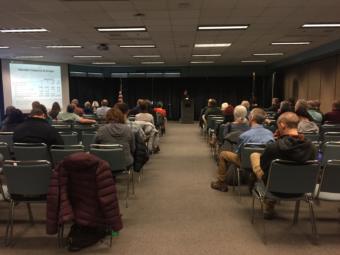
The early part of a public meeting held in Fairbanks yesterday on the Bureau of Land Management’s draft environmental review for leasing in the Arctic National Wildlife Refuge. (Ravenna Koenig/ Alaska’s Energy Desk).
On Monday in Fairbanks, the Bureau of Land Management kicked off its latest round of public meetings on the planned oil and gas program in the Arctic National Wildlife Refuge.
The meeting focused on the draft environmental review released by BLM in December. The final version will include the details of where and how leasing will happen.
Sydney Deering, a student at the University of Alaska Fairbanks studying petroleum engineering, came to put forward a positive voice for exploration and development.
“This is a very important event in Alaska’s history,” Deering said. “We’ve been trying to get this area open for a very long time.”
Others expressed concern about the process. Lisa Baraff with the Northern Alaska Environmental Center said that the timeline BLM has been using for their environmental review is too short.
“It’s hard to imagine that this is sufficient time to really do the in-depth analyses that are necessary,” she said.
Joe Balash, a high level official with the Department of Interior who is overseeing the environmental review process, disagrees.
“The contention by some of the critics that we’re rushing this I think is misunderstood,” Balash said. “In fact, we’re prioritizing this. It is a big deal to this administration to get this done and to get it done sooner rather than later.”
He says the speed can be attributed to the fact that Department of Interior has a core team whose only job is to work on this.
There were also people at the meeting who are opposed to the idea of drilling in the refuge altogether. Sarah James, a Gwich’in elder and leader from Arctic Village, says she’s concerned that drilling in the refuge would negatively affect the Porcupine Caribou Herd.
“We’re a caribou people, we use every part of the caribou from time beginning,” said James. “And we’re proud to be caribou people. And we don’t want to change that.”
Balash says the initial legislation passed by Congress in late 2017 requires that an oil and gas lease sale be held in ANWR, so not holding a lease sale is not an option. But he encourages those who are opposed to drilling to provide detailed comments with their concerns.
“The commitment I made to the Gwich’in people when I’ve met with them previously is: I can’t change what Congress said to do, but I can listen,” he said. “And the more they tell me, the more feedback we get from them, the better we can execute this law and this program and the more we can protect the things that matter most.”
Additional meetings are planned over the next two weeks in several Interior and North Slope villages, as well as Anchorage and Washington D.C.
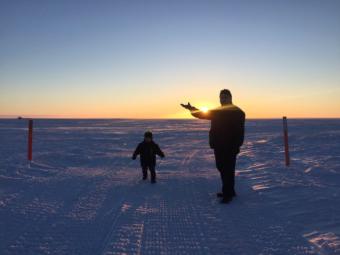
Robin Mongoyak and his young son enjoying the sun in Utqiaġvik. Jan. 30, 2019. (Photo by Ravenna Koenig/Alaska’s Energy Desk)
The sun came back in Utqiaġvik last week after spending the last two months hidden below the horizon.
That first sunrise of the new year is the pivot-point on which winter turns and begins to move toward spring, delivering people in Alaska’s northernmost town from the long spell of darkness.
If you’re not from here, Utqiaġvik has an other-worldly look at any time of year. It’s almost totally flat. There are no trees, no mountains. But it’s especially striking now, when the cluster of homes and buildings on the cusp of the Arctic Ocean are surrounded on all sides by white: the flat expanse of the snow-covered tundra to the south, and the frozen tumble of sea ice to the north.
So when the sun comes up, it makes a dramatic entrance: a thumbnail of neon pink inching above the horizon.
And people in Utqiaġvik are so, so glad to see it.
“When we get the sun back it’s a completely different atmosphere,” said Utqiaġvik resident Malcolm Noble. “You see people’s faces light up. You just want to step outside.”
Robin Mongoyak drives out to the edge of town where there’s an unimpeded view of the afternoon sun hovering just above a never-ending expanse of snow.
“Man, the sun, I’ve been waiting for it,” he said. “I tell you what, I’ve lived here for 49 years, I felt like I had S.A.D. this past year…. seasonal affective disorder.”
Mongoyak says this was the first time in his life that the winter darkness sat heavy on him like that. But when the sun came back last week, it reminded him that February and March — what he calls “the best days of sunshine” — are right around the corner.
He describes those days with clear enthusiasm: “The whitest snow, the bluest skies, and the orangest circle right there just getting higher and higher, from more orange to more golden, you know, it’s amazing.”
He repeats a phrase in Iñupiaq that he associates with this time of year: quvianaqsiniaqtuq.
“That’s what my mom and my dad used to say when we were growing up as kids,” he said, “‘Quvianaqsiniaqtuq!’ – ‘It’s going to get wonderful!’“
“Life is going to spring back to us,” he explained. “Spring is coming, summer is around the corner. Birds when they come in big flocks, it’s like thousands of people coming to greet us.”
Mongoyak gets out of the car with his toddler son, and they gaze across the tundra.
The sun rose above the horizon in Utqiaġvik on Jan. 23 for the first time in about two months. Jan. 30, 2019. (Photo by Ravenna Koenig/Alaska’s Energy Desk)
Mongoyak says that seeing the sun reminds him of all the spring and summer activities that are waiting for Utqiaġvik just around the corner: whaling, goose and duck hunting, fishing on the ocean, caribou hunting on the tundra. And just being outside.
He’s got a big smile on his face as he talks about it in the orange afternoon light.
Right now, Utqiaġvik is gaining minutes of sunlight by the day. By May, the town will be living in the other extreme: 24 hours of daylight, every day until August.
Close
Update notification options
Subscribe to notifications
Subscribe
Get notifications about news related to the topics you care about. You can unsubscribe anytime.