Ravenna Koenig, Alaska's Energy Desk

Arctic Report Card: 2018 was the Arctic’s second-warmest year on record

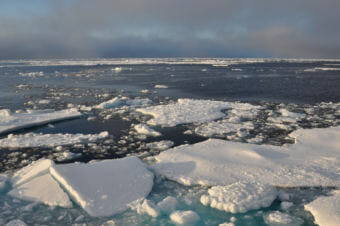
Sea ice on the Arctic Ocean. In 2018, the summer ice extent was the sixth-lowest, and the winter extent was the second-lowest in the satellite record (1979-2018). (Public domain photo by Patrick Kelley/U.S. Coast Guard)

The National Oceanic and Atmospheric Administration released its annual report card on the Arctic this week.

It’s the 13th such report, and provides yet another stark snapshot of a rapidly warming region.

“This was the second-warmest year on record in the Arctic. … That record started in the year 1900,” said Emily Osborne, a climate scientist with NOAA.

“And to add to that, (the) last five years have been the warmest on record, again since the year 1900,” she said.

The document looks at seven big categories — the Arctic’s so-called “vital signs.” Those include things like snow cover, the condition of the Greenland ice sheet, and sea ice conditions.

Osborne said sea ice is another category that registered at notable levels this year. The summer sea ice extent on the Arctic Ocean tied for sixth-lowest this year, while the winter sea ice extent came in at second-lowest.

There were also striking changes in the ice conditions on the Bering Sea, where last winter saw record low ice extent.

“There are scientists here at the American Geophysical Union meeting where the report card was released this week talking about how they’ve been working in the Bering Sea for their entire careers — 30, 40 years — and they were never anticipating seeing conditions that they saw in 2018 in the Bering Sea in terms of temperature and ice extent,” said Osborne.

The report also included discussion of several brand new topics, like the rise of microplastic pollution in Arctic waters and harmful algal blooms, which are pushing further north as ocean waters warm.

Osborne said that the takeaway of the report card is clear: The persistent effects of warming in the Arctic are continuing to mount, driving big changes throughout the entire Arctic system.

Reactions from Utqiaġvik on a whaling quota rule change: ‘We don’t have to beg anymore’

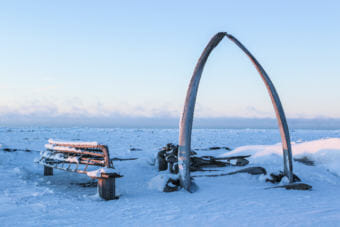
The bone arch in Utqiaġvik, made from bones of the bowhead whale. This year, Alaska whalers succeeded in getting the rules changed for how their whaling quota is renewed. (Photo courtesy of Arctic Council Secretariat / Kseniia Iartceva)

Back in September, a group of whaling captains made the long trip from Alaska to Florianópolis, Brazil.

They went to do something they’ve done dozens of times since the late 1970s: Ask an international commission to let them keep whaling.

But this time they had a new request, and it was a big one. They wanted to change the rules of the commission so they wouldn’t have to keep asking for that permission every few years. And they succeeded.

For context: Back in 1977, whaling communities in northern Alaska got some devastating news. The International Whaling Commission was concerned that the bowhead whale population was too low to support a subsistence hunt, and they put a moratorium on hunting bowheads.

“At the beginning of the battle in ‘77, through those early years, it was a real struggle to get the world to understand what our world was like up here,” said Marie Adams Carroll, who was the executive director of the Alaska Eskimo Whaling Commission in its early years. The group formed in response to the IWC moratorium to advocate for the right of Iñupiat and Yup’ik hunters to whale.

The IWC moratorium was only in place for a few months. After that, the whalers managed to get a small quota. But it was only half of what they said they needed.

Through a lot of hard work in the years that followed, the Alaska Eskimo Whaling Commission became a co-manager of the hunt. Whalers brought in scientists who used traditional knowledge to improve the technique for counting whales. The population estimates increased, and the quota grew.

But every few years, whalers had to show up to a meeting of IWC member countries and get 75 percent of them to say, yes, you can keep whaling.

If they didn’t succeed, their quota would expire.

“Seems like we had to go back and beg,” said Eugene Brower, former president of the Barrow Whaling Captains Association. Brower said he attended more IWC meetings than he cares to remember, and that feeling of having to beg — that’s not a good feeling. But additionally, there was always concern about the outcome of the vote.

“It wasn’t easy trying to get that quota,” said Brower. “Sometimes (the) United States failed to get that three-quarter vote needed to keep our way of life going.”

That happened in 2002. Eventually another vote was held at a special meeting, and the whalers got their quota.

But for several months before that, whaling communities in Alaska were in limbo, thinking they might not be able to hunt the bowhead whale without breaking the law.

So this year, the Alaska Eskimo Whaling Commission and the U.S. government put forward a new proposal that would change how the IWC renews the quota. Something called a “limited automatic renewal.”

The idea is that as long as certain conditions are met, including that the science says the bowhead whale population is doing well, every six years the quota will automatically renew. The limited automatic renewal won’t just apply to the bowhead quota, but to all aboriginal subsistence whale hunts conducted by IWC member countries.

The proposal also included an increase in the number of unused “strikes” that whalers could carry over from previous years. (“Strikes” are counted whenever a whale is hit, even if it’s subsequently lost.) With the new proposed carryover, the annual quota going forward would be 93 strikes per year for Alaska hunters. AEWC says that Alaska whalers usually take an average of 40 whales a year.

And the proposal passed.

“To me, that was a miracle,” said Crawford Patkotak, vice chair of the Alaska Eskimo Whaling Commission and one of the whaling captains who traveled to Brazil as part of the U.S. delegation. He described the rule change as both a surprise and a victory for Alaska whalers.

“It changes the way you think, the way you hunt, and it is a real pressure relief as far as not having to go back and questioning whether (the quota’s) going to be approved or not,” he said.

Patkotak said when they got back to Utqiaġvik, the atmosphere was pure excitement.

For people like Marie Adams Carroll and Eugene Brower, it felt like after years of struggle, a weight had been lifted from their shoulders.

“I had hoped to see that happen during my lifeterm,” said Brower. “Because my father, my uncles said, ‘Go out and educate. Fight for our people.’ It’s finally here … I’m happy that we don’t have to beg anymore.”
The automatic quota renewal could be revoked. But just as it took a large percentage of the IWC to make this new rule, it would take that same percentage to change it again. People familiar with the workings of the IWC say that’s unlikely.

Anchorage area hospitals report initial wave of earthquake injuries: Two life threatening, but mostly minor

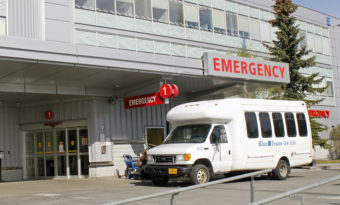
Entrance to Anchorage’s Providence Hospital emergency room. (Photo by Josh Edge/APRN)

Mat-Su Regional Medical Center in Palmer says in the first nine hours after the earthquake, they saw 99 disaster related injuries. Two were were life threatening and 51 were minor.
The three major hospitals in Anchorage are reporting that they’ve seen no serious injuries related to yesterday’s earthquake.

Providence and Alaska Regional have canceled elective surgeries through the weekend, and Alaska Native Medical Center (ANMC) has rescheduled the surgeries that were cancelled yesterday due to the quake. All three say that their emergency departments are open.

Among the minor injuries that hospitals have reported seeing are broken bones, bruises and lacerations.

The main damage to hospital buildings being reported so far are things like water leaks and cosmetic damage. Both ANMC and Providence have done structural assessments, and say that their buildings are sound. Regional is in the process of verifying their structural evaluation which also showed their structure was fine. Mat-Su Regional Medical Center says they didn’t sustain any structural damage. 

All four hospitals are reporting that the damage is not impacting their ability to provide emergency medical care this weekend.

Science and traditional knowledge converge in North Slope Borough’s bowhead whale program

Craig George, a wildlife biologist for the North Slope Borough’s Wildlife Department, weighs, measures, and catalogs samples from a recently-landed bowhead whale on Oct. 24, 2018. (Photo by Ravenna Koenig/Alaska’s Energy Desk).

When hunters in Utqiaġvik haul whales to shore in the fall, many members of the community flock to the beach to help butcher them.

Among them are North Slope Borough scientists, who for almost 40 years now have been collecting samples of those whales as part of a singular whale study program that has been built in concert with whalers.

On the snowy beach north of town during the last week of October, portable floodlights illuminate the work of over a dozen whalers as they cut the blubber and meat from a recently-landed whale. There’s heavy machinery out there helping, since this whale is particularly large, but it’s still hard work and they’ve been doing it for hours. When a whale is brought ashore, it’s something of a race to harvest it before the meat spoils.

That time crunch also applies to Craig George, a biologist with the North Slope Borough’s Department of Wildlife Management who’s lived in Utqiaġvik since the 1970s and has been with the bowhead program since its early days. He’s been awake until the early hours of the morning several days this week to take samples of whales.

George and his colleagues, with the permission of whaling captains, collect muscle, eyes, kidney, spleen — their collection checklist is a page long. Before butchering starts they also examine the whale for any outward harm like signs of net entanglement, orca attacks or ship strikes.

Their work then continues about a mile away in a small lab that’s part of the old Navy research complex on the outskirts of town.

George and his colleague, Raphaela Stimmelmayr, a wildlife veterinarian and research biologist for the department, work around each other in the narrow field lab to weigh, measure, and catalog the whale parts.

The purpose of this program is to look at the health and numbers of the bowhead whale population, in part for setting an appropriate hunting quota.

It was started back in the ‘80s because the International Whaling Commission had concerns that the bowhead whale population was too depleted to support a hunt the size of which Alaska whaling communities had traditionally practiced.

But through years of study, including a whale census that’s done periodically in the spring, North Slope Borough scientists were able to show that the population was doing well, which backed up what whalers had been saying.

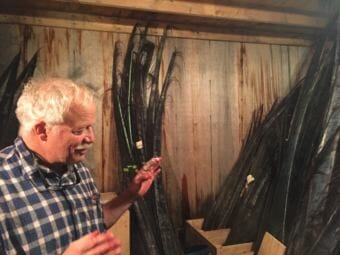
Craig George gestures to a collection of baleen plates that have been archived by the North Slope Borough’s Department of Wildlife Management. Those plates can provide a wealth of information about the bowhead whale, including reproductive history and information about feeding. Oct. 24, 2018. (Photo by Ravenna Koenig/Alaska’s Energy Desk).

The research also provides an important check that there’s nothing in the whales that could be harmful to the people who eat them, like parasites or contaminants.

Stimmelmayr said that new questions are coming up about how bowhead health — and consequently, human health — may be affected by rapidly warming oceans.

“Emerging diseases can occur. You know, we’re dealing with harmful algae (sic) blooms,” said Stimmelmayr. “So there are things now that are kind of coming towards the Arctic that maybe weren’t an issue 20 years ago.”

Borough scientists don’t have any evidence that the whales are being affected by harmful algal blooms at this point. In fact, they see evidence that the bowheads are actually benefiting from warmer waters because their food source is growing.

But no one knows what the future holds. So they’re watching closely.

While all this science has been done for a practical end, it’s also contributed a huge amount to what the scientific community understands about bowheads, and whales in general. Hundreds of peer-reviewed papers have come out of the borough’s Department of Wildlife Management over the years.

George said they cover all aspects of cetacean biology, from population work to genetics.

The involvement of whalers has been critical to that. It’s only with the permission of whaling captains that these scientists get access to fresh samples, which they can’t get any other way since it’s against federal law to intentionally kill whales except for traditional subsistence use.

But equally important is the expert knowledge of whale behavior and attributes that hunters have shared over the years.

“Migratory behavior, ice-breaking behavior, when they calve, where they calve, their feeding habits,” said George. “Just endless. And slowly… we were pretty clueless, but we listened.”

The way North Slope Borough scientists put it, the science has spent the past few decades catching up to traditional knowledge — documenting scientifically what hunters already knew. Like the fact that the whales can smell, and that they can travel under the sea ice.

George said that as scientists continue to learn about the bowhead, getting information from hunters who closely observe the species is invaluable.

“When you have 500 or more whale hunters from St. Lawrence Island to Kaktovik sharing observations, we learn a lot about things that we could never possibly capture in a study,” said George.

The samples that were collected this year will be sent out to institutions around the world and will form the basis of dozens of new studies, adding to the data that scientists on the North Slope — and worldwide — now have about the bowhead whale.

New study says Chukchi polar bears are healthy despite sea ice loss — for now

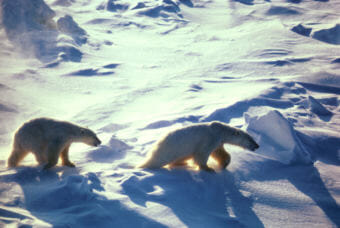
Polar bears traverse a frozen landscape. (Photo: U.S. Fish and Wildlife)

The very first tally of the Chukchi Sea polar bears has just been published, and here’s the big takeaway: Despite a decline in their sea ice habitat, for now the bears are doing well.

In a study published last week, researchers found that the Chukchi bears are healthy, and they estimate there are about 3,000 of them — which is relatively abundant.

That’s despite the fact that the bears’ window to hunt on the ice has been reduced by about a month over the last few decades.

Eric Regehr is a polar bear researcher at the University of Washington and led the study, which collected data on bears between 2008 and 2016.

His team thinks a possible explanation for the population’s health is that the Chukchi Sea is especially rich in the bears’ food source: ringed and bearded seals.

“Our hypothesis is that even though the bears in the Chukchi Sea have less time on the sea ice, during those months on ice in good hunting habitat that they do have, there are so many seals they’re able to fulfill their annual nutritional requirements,” said Regehr.

That could be a factor in why polar bears in the Chukchi Sea are still thriving, while Alaska’s other population of polar bears on the Beaufort Sea are getting thinner and seeing a population decline.

Regehr said the Beaufort Sea likely has fewer seals than the Chukchi Sea, so the Beaufort bears may not be getting the food they need as sea ice declines.

He stresses that just because the Chukchi bears are doing well now, it doesn’t mean that they will continue to do so.

“Unless the underlying problem of climate change is addressed, the sea ice is expected to continue to diminish,” said Regehr. “And at some point that will likely have a negative effect on the bears in this Chukchi area.”
Variability in the Arctic means that, in the short term, there may be differences in the health of the 19 groups of polar bears worldwide. But in the long-term, continued ice loss will likely cause negative effects for polar bears across the board.

In a warming Arctic, October in Utqiaġvik presents an especially striking picture

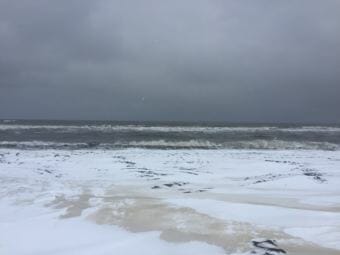
The view of the Chukchi Sea from the Utqiaġvik coastline, October 26th, 2018. Hunter Billy Adams says that when he was growing up, there was almost always ice attached to shore by late October. (Ravenna Koenig/ Alaska’s Energy Desk).

If you want to see some of the most dramatic changes in the part of the world that’s changing most dramatically, Utqiaġvik in the fall is a good contender. Over the course of the past 50 years, temperatures in Utqiaġvik have increased in October more than any other month and the sea ice pattern has changed drastically.

The sky is close and gray as Billy Adams stands on the shore in Utqiaġvik at the end of October, looking out at the Chukchi Sea. There’s semi-frozen rain falling from the sky, waves crashing on shore and open water as far as the eye can see.

Adams is a hunter who’s lived in Utqiaġvik all his life. He’s in his 50s. And he says that when he was growing up, there was almost always ice attached to the shore by now.

“We could have been walking out there and hunting ringed seals,” Adams said. “But we’re on land right now.”

According to Rick Thoman, Alaska climate specialist at the Alaska Center for Climate Assessment and Policy at the University of Alaska Fairbanks, that lack of ice is both the effect of warming in the Arctic, broadly, and a primary driver of local October warming in Utqiaġvik.

“When you’ve got that water right off shore that’s staying at 28 [degrees Fahrenheit] or warmer, that greatly limits how cool the air can get,” Thoman said. “Even a thin layer of ice with a little bit of snow on it, the air right above that can cool much more.”

What used to happen usually in October is that the pack ice that was able to remain frozen on the Arctic Ocean throughout the summer would start getting blown to shore. It would cool the land, and the water around it, which helped to form even more ice along the coastline.

But the edge of that pack ice has been steadily retreating further north. Where even two decades ago it was rare for the ice to be more than 50 miles from the coast in October, now it’s often hundreds of miles offshore. Which means that these days in October, it’s beyond the range where normal wind patterns can blow it in.

“So we’ve moved into a situation now where we have to ‘make our own ice’ so to speak,” said Thoman, meaning that the ice has to form in place along the coast, without the help of pack ice. And that takes more time.

Back on the shore of Utqiaġvik, Billy Adams tells me that the ice now tends to form in late November or December, instead of October like it used to.

Besides shortening the hunting season on the ice, the new ice pattern has also contributed to increased coastal erosion along the unprotected shore, with potentially serious consequences for Utqiaġvik’s infrastructure.

For Adams himself however, the biggest consequence of no October ice is simply that he misses it. For him, it’s hallowed ground.

“You find your own place out there, and pray and ask for comfort…  A lot of the time I go out there and heal out there from all the things that go on in the world,” said Adams. “I just like to be alone with the creator and enjoying his world.”

I ask Adams if he’s concerned that future generations won’t get that.

“You know I’m not going to worry about it right now,” Adams said. “That’s not in my thoughts right now. I’m not going to worry. They’re going to do fine. We have to be positive.”

Ice on the Chukchi Sea is only now forming, and freeze up is still weeks away.

Site notifications
Update notification options
Subscribe to notifications