Ravenna Koenig, Alaska's Energy Desk

Arctic sea ice minimum continues downward trend, with implications beyond the Arctic


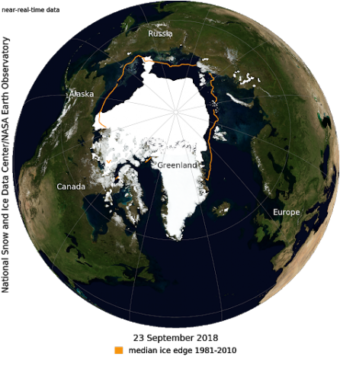
This NASA Blue Marble image shows Arctic sea ice on September 23, 2018, when sea ice reached its minimum extent for the year. Sea ice extent for September 23, as well as on September 19, averaged 4.59 million square kilometers (1.77 million square miles)—the sixth lowest in the satellite record, tied with 2008 and 2010. (National Snow and Ice Data Center/ NASA Earth Observatory).

Arctic sea ice has reached its minimum extent for 2018, according to scientists at the National Snow and Ice Data Center.

At 4.59 million square kilometers (1.77 million square miles), it ties with 2008 and 2010 for the sixth lowest minimum in the nearly 40-year satellite record.

“It’s a fair amount above our record low, which was a really extreme year in 2012, but it’s much lower than what used to be normal conditions in the ’80s and ’90s,” said Walt Meier who analyzes sea ice for the National Snow and Ice Data Center in Colorado.

The Arctic used to be cold enough that huge portions of the ice on the Arctic Ocean would remain throughout summer, creating what’s called “multi-year ice.”

“We’re taking an area that was basically the size of the lower 48 United States that was continuously ice-covered even through the summer,” said Meier. “Now we’ve lost basically about half of that ice cover… half that’s open ocean at the end of summer.”

That’s a striking image: an ice country on the scale of the lower 48 that’s been cut nearly in half as the Arctic has warmed. The borders of that country are essentially what the “ice minimum” is a measure of.

Meier says the Arctic has been losing upwards of 13% of that area each decade.

Ice reflects most of the energy that reaches it from the sun, while water traps and holds it. So the more ice is replaced by open water, the more heat is added to the Arctic. And what happens in the Arctic, doesn’t stay in the Arctic says Meier.

“The Arctic’s like an air conditioner or refrigerator for the global climate,” said Meier. “And as the Arctic warms, partly because the sea ice is going away, it’s like you’re opening that refrigerator door… we’re losing that cooling ability.”

Meier says that some scientists also see indications that a warming Arctic is affecting the polar jet stream, a current of wind above the earth that can affect seasonal weather patterns. He says it could be part of what explains increasing frequency and severity of certain weather events like droughts, heat waves and heavy rains.

When NSIDC does its final analysis in a few months, the sea ice minimum could change slightly. Meier says that they generally see the number in the final analysis change by less than 0.05 million square kilometers, but since the 2018 number was so close to 2008 and 2010, it’s possible it could change the ranking.

In Fairbanks, building a home on permafrost with an uncertain future

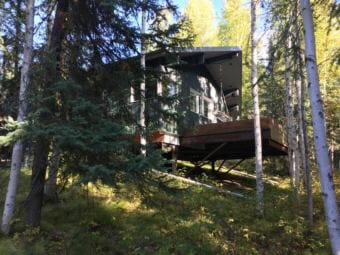
One of the two cabins that Ilya Benesch is building on a property underlain with permafrost. September 7th, 2018. (Ravenna Koenig/ Alaska’s Energy Desk).

A lot of houses in Fairbanks are built on permafrost, and there are techniques for building on that kind of ground that have been used for decades. But depending on the type of permafrost, there are unknowns about what will happen — even to those houses that have been built using best practices — as the permafrost thaws due to climate change. For one homeowner, that concern is front and center as he builds a house on what he calls some of the worst ground in Fairbanks.

Ilya Benesch is a do-it-yourself kind of guy. He’s worked in construction for close to 30 years. And for the past 10, he’s been working on two large cabins — one to live in, one to rent — at the edge of a gully dotted with birch and black spruce trees.

When Benesch bought this property back in 1999, he was pretty sure it had permafrost under it, though he didn’t know for certain. But he wasn’t intimidated by the idea of building on permafrost; as a carpenter he’d already had some experience with it. And the reasons to buy the land were compelling: it was spacious, relatively cheap, and only a few minutes from his parents’ house.
“As I saw my parents aging, I saw a lot of value to being close by, and what was affordable in 1999 was north side of the hill property,” said Benesch.

A commonly-cited rule of thumb in Fairbanks is that if a property is on a north-facing slope, it’s more likely to have permafrost under it. The permafrost in the Interior is what’s called “discontinuous”: it can stretch hundreds of feet below the surface in some places and be totally nonexistent in others. There are a number of factors that determine whether there’s permafrost below: soil type, vegetation cover, elevation and sun exposure to name a few.

Benesch started building in 2008. And a few years in he decided to get the soil drilled to get a sense of exactly what the permafrost looked like under the surface. The news he got was bad.

“This shallow, warm, ice-rich permafrost with massive ice formations is one of the most difficult environments on which to construct a stable foundation,” said Benesch, reading from the drill report he got back.

Basically, Benesch’s house is built on permafrost that’s relatively close to the thawing point — which is common for Fairbanks — and is full of ice that will turn to water when it thaws. That could dramatically transform the land under his house, though he’s still not sure exactly what that would look like, especially since he’s on a hill.

“There’s not a lot of resistance to this hillside starting to slide… if things thaw deep enough,” Benesch said.  “I can’t get a clear answer from anyone as to whether that will happen or the ground will just drop straight down. I don’t think anybody can say.”

But Benesch is perhaps one of the best people in Fairbanks to be in this position. For the past decade, he’s worked as a building educator at the Cold Climate Housing Research Center. That’s a Fairbanks-based nonprofit that researches building strategies for Arctic environments and provides public education.

Ilya Benesch standing in the doorway of the shop on his property. September 7th, 2018. (Ravenna Koenig/ Alaska’s Energy Desk).

Benesch talks to homeowners and contractors about exactly this kind of stuff: how do you build the best house you can on permafrost that’s expected to thaw?

Benesch walks under the porch of the first cabin, and points to the foundation — one of the important design choices for building on permafrost. His consists of pilings made of steel pipe, 6 inches in diameter.

Building on pilings is a common approach for constructing on permafrost; they anchor the house and loft it up so it doesn’t warm the ground underneath. When Benesch started building, he knew that 40 feet was the typical depth for pilings, so he went with that.

“What I know now is that I probably should have driven to 60 feet,” he said.

That’s really deep. He’s since retrofitted two additional 60-foot pilings that will be able to support the house if the others fail.

Aside from the foundation, Benesch has given a lot of thought to how to protect the ground and keep the permafrost cold. He’ll have a large wraparound porch to keep the foundation shaded, and a continuous gutter around the roof that empties 25 feet into the gully to prevent any erosion or water from getting in the pilings.

He’s also doing his best to not disturb the moss and trees around the house, which provide shade and insulation for the ground. He’s even adding to them.

“I’ve actually planted Siberian larches; there’s about 22 of them right now,” he said, pointing at the seedlings scattered around the house.

All these measures are standard for people who are building on permafrost and want to make sure the house itself doesn’t cause the permafrost to thaw.

But they’re also just the simplest and most affordable tools in the toolbox when it comes to stalling thaw due to rising temperatures.

Benesch knows that they won’t stop it in the long run. But he hopes they’ll be enough, at least for his lifetime… and even beyond it. He’s 49 now.

“I’m not afraid of a challenge, but the not knowing what this area’s going to do in 10, 20, 30, 40 years, it makes me uneasy,” he said.

If Benesch had the chance to go back to 1999 and buy a different piece of property would he? Yeah, he says, he would. It would save him a lot of time and some sleepless nights.

But he says that for anyone determined to build on permafrost themselves he has a few suggestions: build small, get educated on best practices, and make sure to get the drill testing done before you start.

For methane researcher, golf course bubbles are a first

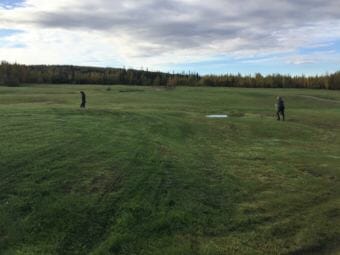
Carbon scientist Katey Walter Anthony and her assistant Hannah Mevenkamp look for methane bubbles at the North Star Golf Club. Sept. 13th, 2018. (Ravenna Koenig/ Alaska’s Energy Desk).

For golfers at the North Star Golf Club in Fairbanks, there’s an extra perk: if you come at the right time of year, you can find methane bubbles on the course. It’s been happening for the past two decades, says Roger Evans, the owner. People regularly poke them with tees and light them on fire.

In many respects, the North Star Golf Club looks like any other golf course: emerald grass dotted with ponds, idyllic forest on all sides, a flock of bothersome geese. But it’s full of dips and swells, like a pond frozen mid-ripple.

That’s not by design, according to Roger Evans.

“Twenty five years ago, this was all a disked field that was all smooth,” said Evans. “So this is all permafrost action.”

Evans is out on his golf course in big boots, squelching through the waterlogged grass to help scientist Katey Walter Anthony and her two assistants find some methane bubbles. Walter Anthony is a research professor at the University of Alaska Fairbanks. She’s been studying methane bubbles in Alaska and Russia for almost 20 years.

She says that the reason methane is being produced beneath this turf likely has to do with the permafrost thaw Evans described. That thaw triggers the breakdown of organic matter that has accumulated beneath the soil over thousands of years.

“It’s like opening the freezer door, making it accessible to microbes that decompose it and turn it from organic carbon in the soil…back into greenhouse gases,” Walter Anthony said.

Often the greenhouse gas released is carbon dioxide. But when the decomposition happens in an environment without a lot of oxygen, it can produce methane too.

The most obvious place for scientists to look for that kind of methane is in lakes and wetlands, because standing water makes it hard for oxygen to get into the soil. That’s where Walter Anthony usually does her research.

“To see and to hear about methane bubbles under grass in a golf course lawn is very different than the type of environment we’re normally sampling methane in,” she said.

This golf course is not exactly a wetland, but after four inches of rain in August, it is pretty soggy. And Evans says that the methane bubbles usually appear during the wet seasons: spring and fall.

Walter Anthony thinks rainwater may be pooling above a layer of impermeable permafrost, creating the conditions for methane production.

After about 20 minutes of searching, we finally find what we’re looking for.  Evans points it out.

The bubble is sort of flat, not like the bigger ones that Evans has described as beach balls that bulge up out of the ground. But when you tap the ground with your foot, you can definitely tell that it’s not normal grass. It wobbles like Jell-O. “It’s kind of like an air mattress,” Walter Anthony’s colleague Philip Hanke said. “Or a water bed,” added Evans.

Using a syringe, a sawed off plastic bottle and a few other tools they rig on the spot, Walter Anthony and her team collect several vials of methane gas.

Katey Walter Anthony, Hannah Mevenkamp and and Philip Hanke, collecting methane from one of the bubbles at the North Star Golf Club. September 13th, 2018. (Ravenna Koenig/ Alaska’s Energy Desk).

She’ll use those samples to confirm that the methane really does come from thawed organic matter in the permafrost. She’s pretty sure it does, based on the obvious permafrost thaw all around us.

But why is the methane forming bubbles?

Walter Anthony cuts up a square of the soil to take a look at what’s underneath. “It’s probably that little silt layer right there,” she says, pointing.

She hypothesizes that the density and fineness of the silt combined with the layer of grass could make it hard for the methane to escape. All the traffic the golf course gets could be part of it too, compressing the top layer to make it even denser.

That’s all interesting to Walter Anthony, but what she’s really curious about is if this phenomenon is happening elsewhere on land.

“It’s an area that I and some other colleagues have started thinking about: can you get methane forming in terrestrial environments? But it’s a very new area of science,” she said.

It’s a new area of science because grasslands and boreal forests are thought of as places where greenhouse gases are absorbed, not released. But as permafrost thaw increases in the Interior — releasing more trapped carbon — Walter Anthony wonders if that’s changing. That would be really important for scientists to document and build into climate models, since potential emissions from the ground could contribute to global warming.

Walter Anthony says that none of this is definitive yet, but that’s why it merits further study.

Her next step? “I’m probably going to go hiking through the woods… and look for some gas bubbles,” she says.

International Whaling Commission votes to change subsistence quota renewal process

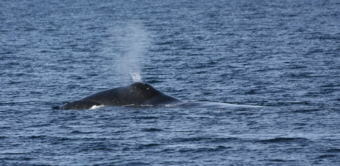
Subsistence hunt quotas for bowhead whales are set by the International Whaling Commission, which has just voted to change the way it renews those quotas. (Anne-Line Brink). 

At a meeting of the International Whaling Commission (IWC) in Brazil on Wednesday, Sept. 12, Alaska bowhead whale hunters celebrated a big victory.

The organization — which manages international whaling, including for indigenous hunters — voted to change the way that subsistence hunt quotas are set.
Instead of quotas that expire and have to be renewed by the full IWC every six years, the quotas will now be renewed automatically, provided they have approval from the scientific committee that reviews the health of different whale populations.

It will also enable hunters to carry over more of their unused allowance from past years to another year.

Members of the Alaska Eskimo Whaling Commission are attending the meeting in Brazil as part of the U.S. delegation. The meeting ends Friday, Sept. 14.

The IWC began setting quotas for the Alaska bowhead whale subsistence hunt back in 1977.

Fuel for North Slope oil production arrives by barge for the first time in decades

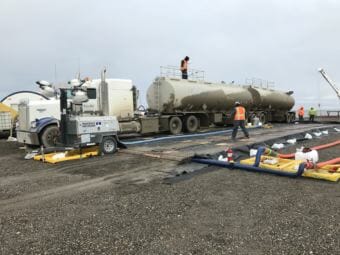
Diesel fuel is offloaded from a barge to a tanker for delivery to Colville’s fuel storage facility at Deadhorse, Alaska. August 30th, 2018. (Photo courtesy of Colville).

Fuel for oil field operations arrived on the North Slope by barge instead of by truck last week, Aug. 30,  for the first time in decades.

Colville, the company that contracted the barge, supplies about 90% of the refined fuel for oil field operations on the North Slope.

“The industry demand has increased and is anticipated to increase and so a fuel barge is a way to augment our trucking operation and the ability to transport fuel up to our customer,” said Colville CEO and President Dave Pfeifer.

There’s an increasing number of big oil projects being planned and developed on the North Slope right now, especially west of Prudhoe Bay. That’s where companies like Conoco have made large oil discoveries recently.

Pfeifer says that bringing fuel up by barge is now easier due to declining sea ice.
“The Beaufort Sea has been in the last few years particularly accommodating with a lesser ice floe, which has allowed the ability for barges to come in that hadn’t been in years past,” he said.

He expects barging to become a regular part of the company’s fuel delivery system, and perhaps even increase in the coming years.

Colville typically delivers 20 million gallons of fuel to the North Slope a year, which requires about 2,000 truck deliveries. One barge delivery is equivalent to that of 200 trucks.

Pfeifer says that Colville’s interest in barging stems in part from a 2015 event where ice and water flooded the Dalton Highway from a nearby river and held up transport.

“No truck was able to get past it for about 18 days,” Pfeifer said. “So the supplies ran out and it was only critical services… that the oil companies allowed to burn fuel.”

Pfeifer says that barging will provide the company another way to get fuel to the North Slope should something like that happen again.

Editor’s note: A previous version of this story stated that Colville’s delivery of fuel for oil field operations by barge was the first. It’s the first in several decades. The story has been corrected.

August storms prompt North Slope Borough to file disaster declaration

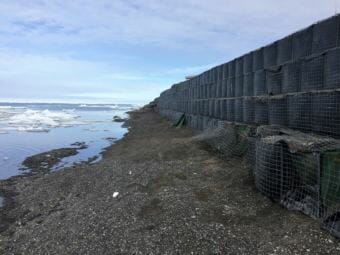
Utqiaġvik’s gabion basket wall, pictured here in July 2018 with visible damage from a September 2017 storm. The wall was much more severely compromised by the three storms that took place in August 2018. (Ravenna Koenig/ Alaska’s Energy Desk).

It’s the start of storm season on the North Slope, and already, several August storms in Utqiaġvik have prompted the North Slope Borough to file a disaster emergency declaration.

Three weather events damaged a number of community protections, most significantly a 200-foot seawall that had already been compromised by a storm last September.

“The outer surface of the wall is gone, the back-fill that it held behind it has slumped and fallen into the water,” said Bob Shears of the Borough’s Capital Improvement department. “What’s really noticeable is that the beach in front of the wall is gone this year; it existed last year.”

The Borough had already been working with the state and federal governments to repair the wall after the 2017 storm, for which they received a Federal Disaster Declaration. The repairs had not yet been made when the August storms hit.

Shears says they’re hoping that the new damage to the wall will be covered under that previous declaration.

Last Friday’s declaration gives the Borough access to 22,000 sandbags from the U.S. Army Corps of Engineers to temporarily protect the area behind the seawall.

Emergency Manager Heather Seeman says she’s concerned about the storm season ahead.

“I am worried very much about the upcoming months given the amount of sea ice that is present at this time, given the location of the sea ice and the lack of protection that our coastline has,” Seeman said.

Declining sea ice has made the Utqiaġvik coastline more vulnerable to erosion due to storm damage.

Site notifications
Update notification options
Subscribe to notifications