Ravenna Koenig, Alaska's Energy Desk

Utqiaġvik barbecue connects people to scientific research next door


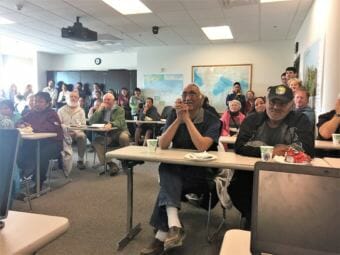
Residents attended a recent science-centered barbecue at the Barrow Arctic Research Center to hear about some of the research being done in Utqiaġvik. (Ravenna Koenig/ Alaska’s Energy Desk).

There’s a lot of science that happens on the North Slope. Some of it’s homegrown, like the wildlife research done by the North Slope Borough. But a lot of it is done by scientists who spend weeks or months doing field work here before heading home.

So how does the community stay in the loop on the research being done in their own backyard?

Out on the edge of Utqiaġvik, people filter into the building that serves as the town’s science hub. Kids play on the floor, while adults chat over hamburgers and hot dogs. By the time the presentations get started, every seat is taken.

“Thank you all for coming to our first BARC-becue,” said Kaare Erickson, the community science liaison for Ukpeaġvik Iñupiat Corporation (UIC) Science, the arm of the village corporation that works on science logistics. “We call this building the BARC — it’s the Barrow Arctic Research Center… we’re just starting the BARC-becue series.”

Erickson grew up mostly in Unalakleet but his mom is from Utqiaġvik. Basically his job is to represent North Slope residents to the scientists who work up here, and vice versa.

In addition to food, there are also presentations from scientists who are trying to better understand some of the natural processes that affect climate by studying things like clouds and vegetation.

Fifty or so people showed up to the event, including Emma Kignak, who goes by Susie.

“I wanted to hear what was going on with the global warming,” she said.

Kignak says that she’s seeing the effects of that warming with her own eyes, like changes in the sea ice. She came to this talk because she wants to understand why those changes are happening, and what might happen in the future. For example, she’s concerned about the warming of the permafrost that her town is built on.

“I always wonder… where are we going to go if all of a sudden the ice melt[s] and we all sink in?”

Leanna Mack is another resident who turned out for the event. She says she likes to keep tabs on the science being done in her hometown; it’s something she’s naturally curious about.

“I’ve been interested in science myself,” Mack said.  “And growing up, my grandmother — she translated for National Science Foundation.”

Mack says she was a little surprised that so many people came to the talk because it is a drive, albeit a short one, from the main town. But she also said it makes sense, given this community’s long history with research.

“A lot of people in the community have been engaged in all the science that’s been going on up here for like 30, 40 years already,” Mack said. “And so I think that’s why there are so many people who do come out here, especially older people, because they were involved in it when they were little as well.”

Throughout the summer, Kaare Erickson will be organizing several other science outreach events.

Though he’s an employee of UIC Science, about half of his work is funded by the National Science Foundation, which sponsors a lot of North Slope research.

Erickson says that some researchers are more invested in outreach than others, and he’s glad when he encounters people who want to engage with the public. Presentations like those at the BARC-becue do help the community stay informed about the science that’s happening in their home.

But he also wants researchers to take a second look at when in the research process that outreach happens.

“Does it come at the very end when you’re all done with the research when you come back and share the knowledge?” Erickson said. “Or does it come in the middle where you’re doing the research so that some of that traditional knowledge might be incorporated into your results? Or does it come in the very beginning when you’re planting the seeds and creating the research questions?”

In the future, he hopes that things will shift more toward the last.

Inuit Circumpolar Council signs Utqiaġvik Declaration: a guide for Arctic action for the next four years

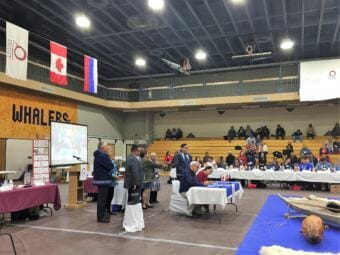
The Utqiaġvik Declaration being signed by members of the Inuit Circumpolar Council’s Executive Council. The declaration provides guidance for ICC action and advocacy for the next four years. (Ravenna Koenig/ Alaska’s Energy Desk)

The Inuit Circumpolar Council wrapped up its 2018 General Assembly Thursday in Utqiaġvik.

Iñupiat, Yupik and Cup’ik from Alaska and Inuit from Canada, Greenland and Russia got together to discuss a range of common issues and interests across the Circumpolar North. The meeting concluded with the signing of the Utqiaġvik Declaration, which will guide the ICC’s work for the next four years.
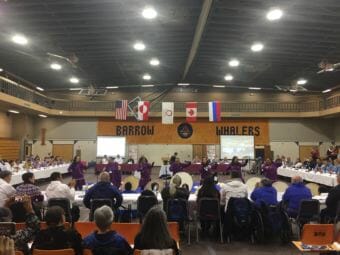
In the Utiaġvik high school gym, translators were kept busy for four days, working to translate content live into the languages of the listening audience:  Iñupiaq, Yupik, Inuktitut, Russian, English, and Kalaallisut, the main dialect of Greenlandic.

This meeting happens every four years, when the Inuit Circumpolar Council gets together to set priorities for the next term and elect new leadership.

On Thursday, Alaska’s own Dalee Sambo Dorough was elected Chair of the ICC, a position she will hold until 2022. Sambo Dorough has been to every ICC General Assembly since the first one was held in Utqiaġvik in 1977. This is her first time elected Chair.

“I am deeply humbled by the recognition, and the support, and the confidence that people expressed in me,” Sambo Dorough said.

Sambo Dorough is Iñupiaq with family roots in Unalakleet. She’s also a professor of political science at the University of Alaska Anchorage, specializing in international law and Indigenous human rights.

In her closing address, she underscored the importance of Inuit engagement in global decision-making, as more and more countries show interest in the Arctic.

“We can’t underestimate it. We’ve already seen the growing compounded interest and pressure,” she said. “Therefore, we must become more assertive about our status and rights to effectively safeguard what is indeed ours: the lands, territories and resources of the Arctic.”

On the last day of the meeting, the ICC passed the Utqiaġvik Declaration, a document that outlines some of the ways forward on issues ranging from education and economic development, to wildlife management and food security.

It includes a provision advocating for the phase out of heavy fuel oil, a type of fuel used in shipping that can present unique clean-up challenges, especially in the Arctic. The UN group that regulates international shipping is currently considering banning its use.

James Stotts, the President of ICC Alaska and member of the ICC executive council says the declaration also deals with a range of social and cultural issues. One thing that stood out to him from this year’s meeting was the frank discussion of suicide, especially suicide among young people.

“It’s an issue that’s been more or less hidden or silent for a long time and I heard a very strong desire to bring it out into the open,” Stotts said.

The declaration directs ICC to hold a summit sometime in the next four years on health and well-being that will look at suicide, addiction, and general mental health.

The next General Assembly meeting will be held in Greenland in 2022.

Arctic without borders: Inuit Circumpolar Council meets in Utqiaġvik

The King Island dance group performing for the welcoming ceremony for the start of the Inuit Circumpolar Council (ICC) on Monday, July 16th. ICC’s 2018 General Assembly is meeting the week of July 16th in Utqiaġvik. (Photo by Ravenna Koenig / Alaska’s Energy Desk)

This week, Indigenous people from four Arctic countries are gathered in Utqiaġvik for the Inuit Circumpolar Council (ICC)’s 2018 General Assembly. ICC advocates for the rights of the Inuit at the local, regional and international levels.

At the high school gym in Utqiagvik there’s a sign for the high school’s “Barrow Whalers” — and several flags strung in front of it, representing the United States, Canada, Greenland and Russia.

Over 800 people are at this event — some are from here in Utqiaġvik, but others have flown in from Nome, Kotzebue and St. Lawrence Island, as well as the countries represented by those international flags. You see a lot of people embracing friends that they haven’t seen in awhile, and the feeling is definitely one of reunion.

This group was founded back in the 1970s, on the idea that even though borders had been drawn throughout the Arctic, the common history, culture and language of the people who live here unites them, and that they should have a vehicle to promote their common interests. The founder, Eben Hopson, Sr. said, “Although not a nation-state, as a people, we do constitute a nation.”

“For us as Inuit people, we have more in common with those east and west of us than north and south,”said Cordelia Kellie. “We really are one people with one shared homeland and one language and one culture.”

Kellie splits her time between Anchorage and Utqiaġvik but made sure to be in town for the event.

The ICC helps to shape Arctic policy on the international stage, like at the United Nations and the Arctic Council.

And at this week’s meeting, the ICC is talking about a whole range of issues, including food security, climate change, economic development and language loss. They’ll elect new leadership, and come up with a document that will guide their priorities until the next General Assembly four years down the road.

Interior utility breaks ground on test solar farm


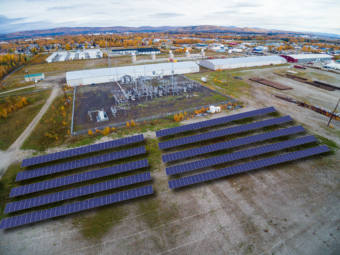
An artist’s rendition of what Golden Valley Electric Association’s new solar farm will look like. (Courtesy of Golden Valley Electric Association).

In June, Golden Valley Electric Association, the cooperative that provides electricity to the Interior, broke ground on a new photovoltaic solar demonstration project in Fairbanks.

The solar array is a small-scale test and will be completed at the end of October. It’s expected to add more than 500 kilowatts to the grid, enough to power around 70 homes.
Nathan Minnema  is the project manager. He says the solar array fits into the utility’s goal to reduce their carbon emissions, while being mindful not to raise energy costs.

“We’ll get a good feel on what our average cost of power will be from this project,” said Minnema. “And then that is information that we can present to our CEO and board and let them be able to decide on what or how much they want to expand.”

This project is too small to have a significant impact on emissions, but if the dollars pencil out, could lead to a larger-scale solar installation further down the road.

Golden Valley currently gets 10% of its electricity from renewables — mostly wind and hydro power and a small percentage individual-owned solar. The rest comes from oil, natural gas, and coal.

Beavers are moving into the Arctic — you can see it from space

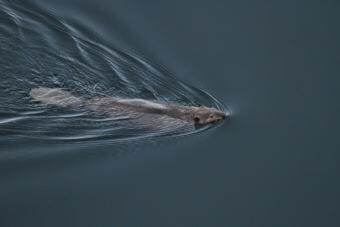
A beaver swims in a creek. A new paper uses satellite data to show how beaver have expanded their range into the Arctic tundra. (Creative Commons photo courtesy Larry Smith)

The Arctic tundra in Northwest Alaska is being colonized by a new species: beavers.

Historical records and previous studies indicated that Alaska’s boreal forests were the northern edge of the species. But a new analysis of satellite data shows the animals expanding past the treeline and into the Arctic.

Beavers are like little engineers: they alter the shape of streams, rivers and ponds by building dams. Which is a lucky break if you’re a scientist with satellite images.

“We can actually see the mark of this animal from space,” said Ken Tape, professor at the University of Alaska Fairbanks and the lead author of the new paper playfully titled “Tundra be dammed: Beaver colonization of the Arctic.”

Tape and his colleagues used satellite data to map the formation and disappearance of beaver ponds in an 18,293 kmarea of the northwest Arctic over a 15 year period ending in 2014.

“We didn’t really know what we were going to find,” said Tape. “If they were moving out of the Arctic, then you’d see a lot of ponds draining…  But that’s not what we saw, we saw a lot of new ponds forming.”
So, what could be causing this push into new territory?

Tape says they think that climate change is definitely playing a role. As the Arctic warms, there’s more unfrozen water in winter, which is prime habitat for beavers to build their shelters. There’s also more shrub growth, which means more food, and more building material.

Satellite image showing the establishment and growth of a beaver pond in the Northwest Arctic. A new paper uses satellite data to show how beaver have expanded their range into the Arctic tundra by mapping the formation and disappearance of beaver ponds between 1999 and 2014. (Photo courtesy of Ben Jones, Digital Globe Inc.)

But the researchers aren’t ruling out the idea that beavers may be returning to an area they inhabited in the past. Tape says it’s possible they were wiped out by trapping in the 19th and 20th centuries.

“So we could be seeing a population rebound where they’re reoccupying their former range,” he said.

Both of these things could explain their expansion north.

So, given that beavers change whatever land they get their paws on, what does that mean for the Arctic ecosystem?

“We don’t really have a clear answer to that,” said Tape. “But what we see is that when you change the hydrology, when you pool water on the tundra landscape, you immediately induce permafrost thaw.”

That thaw — under the beaver pond and around it — along with the warmth of the beaver pond itself might create what Tape calls a sort of “oasis” where plants and critters typically found further south might flourish. In other words, the beavers could be accelerating changes already happening in the Arctic due to a warming climate.

The obstructions that beavers make in the waterways could also impact existing fish populations, in ways that could be positive in some cases and negative in others.

Tape says he hopes to do more research to try to answer some of those questions.

Study examines risk to marine mammals from increased Arctic traffic

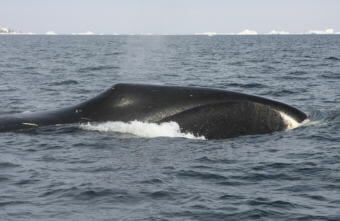
A bowhead whale in Disko Bay, West Greenland. Ships following the Northwest Passage would travel through Baffin Bay off Greenland’s west coast. (Photo courtesy Kristin Laidre/University of Washington)

study released this week sheds new light how vulnerable marine mammals are to increased traffic in the Arctic.

As sea ice cover has decreased in recent decades, the number of vessels that pass through Arctic waters has increased. With more ice loss predicted in the years ahead, there’s potential for even more ship traffic.

Researchers with the University of Washington looked at 80 subpopulations of 7 different marine mammal species throughout the Arctic. They focused on the month of September, when sea ice extent is at its lowest.

In Alaska specifically, bowhead whales got the highest vulnerability rating, partly due to the fact that their fall migration crosses the two main Arctic shipping routes in the Chukchi Sea.

Donna Hauser is the lead author of the study. She said certain aspects of bowhead whale behavior make them especially vulnerable to ship traffic.

“Things like slow speeds; they spend a lot of time at the surface, particularly when they’re foraging, and so are more likely to potentially actually get hit by a vessel,” said Hauser, who is now with the University of Alaska Fairbanks.

Hauser said she hopes the study can be useful in creating guidelines for vessel traffic in the future.

“We could aim to develop some mitigation strategies that would help ships avoid key habitats, adjust their timing, take into account certain migration routes and times…as well as make some efforts to minimize sound disturbance by changing vessel speeds,” Hauser said.

In May, the International Maritime Organization established the first international guidelines for vessel traffic in the Bering Strait. Those guidelines take marine mammal safety into account as well as other natural hazards related to climate change. Hauser said the new study provides an opportunity to build on those efforts.

Site notifications
Update notification options
Subscribe to notifications