Ravenna Koenig, Alaska's Energy Desk

Girls on Ice: an all-female science immersion course on top of a glacier

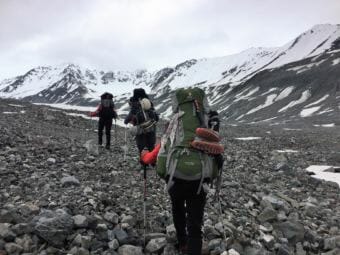
Part of the “Girls on Ice” team starts their climb up Gulkana Glacier in Alaska. The program is a science and wilderness course, taught by female scientists and mountaineers for high school girls. (Photo by Ravenna Koenig/Alaska’s Energy Desk).

It’s not news that science has a gender problem. For years, there’s been a persistent gap, with significantly more men going into science and engineering careers than women.

One program called “Girls on Ice” connects high school girls with both science and mountaineering — another space that’s historically been dominated by men — by taking them out for a week to explore a glacier with an all-female team of scientists and mountaineers.

One of the “Girls on Ice” trips takes place in Alaska, on Gulkana Glacier in the eastern Alaska Range.

Mia Tucholke is a mountain guide and one of the leaders of the Gulkana trip. And on the day of the girls’ hike to base camp, she stands at the start of the Gulkana Glacier trail, surveying the group of 16 and 17 year old girls as they struggle to pull on mountaineering boots and gaiters.

As they do, she reminds them that in a few hours they’ll be taking all the gear off to cross what she jokingly calls a “lovely warm river.” The girls groan, and one of them wonders how they’ll dry their feet without towels.

“We’re going to air dry them!” Tucholke says cheerfully to the long faces around her.

Some of the girls are already pretty familiar with the outdoors, but others have never hiked up a glacier, spent a night camping in the wilderness or crossed a freezing river with a pack on their back.

Now, they’re about to spend a week on Gulkana Glacier with Tucholke.

“I like to suffer a little bit,” Tucholke said, “And I like to show that suffering can be ok.”

Tucholke and a group of scientists will spend the week teaching the girls wilderness skills, glacier science 101, how to do field research and all the different ways you can make observations about the natural world — whether that’s as a mountaineer, a scientist or an artist.

“Something we’re going to continue talking about for the rest of the week is: what is the line between art and science?” said Aurora Roth,  one of the instructors. “When is that blurred? Should they be these separate things? Are they the same?”

Roth is a glaciologist from Fairbanks. “I absolutely love ice,” she said, “I’m an ice nerd.”

Some of the girls participating in this program already know they want to go into science: everything from zoology to astrophysics to nursing.

Instructor Brita Irving (right) teaches Trinity Joshua about topographic maps, using her knuckles and a pen to illustrate. The program teaches the girls mountaineering techniques, wilderness skills, art and glacier science. (Ravenna Koenig/ Alaska’s Energy Desk).

Lauren Smith is a high school senior from Portland, Oregon. She’s not sure exactly what she wants to do with science, but she does have one idea.

“My absolute dream would be to write about science in a way where it would be accessible for everyone,” she said.

Even though there are more women in science than there used to be, instructor Emilie Sinkler says that the relatively low number of women in science and mountaineering makes it harder for some girls to see themselves getting involved.

“There aren’t as many role models to look up to these days just because of the history of those fields being mostly male-dominated,” Sinkler said.

Under 30% of the science and engineering workforce is female. And while it’s hard to quantify how many women spend time mountaineering versus men, as of 2016 only 8% of guides in the American Mountain Guides Association (AMGA) were women. AMGA says that number is rising, but they don’t have more recent figures available.

So part of the goal of “Girls on Ice” is to just give girls exposure to women who scale mountains and do science and show that it’s an option.

“We want to give them extra confidence and experience in the outdoors and in science to see if those are the directions they might want to go, potentially,” Sinkler said.

Beyond that, instructors hope that spending a week braving the Alaskan wilderness with an all-female group will inspire the girls to take on whatever challenges they encounter in their lives.

“I think it’s just so empowering, just that as women, alone, we can do this,” said Jessica Mejia, a glaciologist and one of the organizers of the trip. “We can do great science, we could be on a glacier by ourselves, we could do anything.”

Anything: even, as so many of the girls were worried about, side-step with a heavy pack on your back through a tumbling glacial river so cold it gives you brain freeze.

Two Alaska projects selected for federal marine energy innovation grant funds


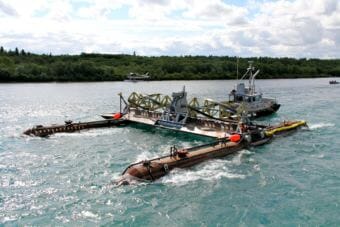
A turbine device being tested in the Kvichak River close to the village of Igiugig in 2015. Grant money from the Department of Energy will be used to update this model, with the goal to transition the village from primarily diesel to primarily water power. (Photo Courtesy of the Ocean Renewable Power Company).

Two energy projects that could help rural Alaskan villages lower their energy costs just got a financial boost from the federal government.

The grant money comes from the Department of Energy and is part of a larger award to support innovation in marine energy generation.
$2.3 million will go to the Igiugig Village Council in rural southwest Alaska, and its partner the Ocean Renewable Power Company. Since 2014, they’ve been testing a device that uses turbines to generate power from the Kvichak River. The grant money will help them update that design, with the ultimate goal of transitioning the village’s main power source from diesel to water.

Another $1.3 million will go to the Alaska Center for Energy and Power at the University of Alaska Fairbanks, and its partner Renergé Inc.

That grant will help develop what the company is calling a “water horse.” It’s designed to harvest energy from small rivers where the water is not deep enough for large turbines.

At the top of the world, an international field school for research students


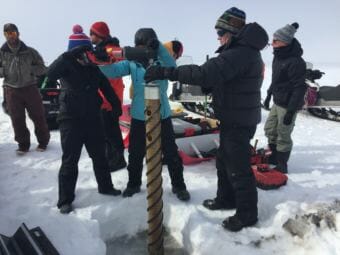
Students at an Arctic field school in Utqiaġvik learn how to use an ice corer, June 2nd, 2018. The program is a collaboration between the University of Alaska Fairbanks, the University of Calgary and the University of Tromsø in Norway. (Ravenna Koenig/ Alaska’s Energy Desk).

Earlier this month, the University of Alaska Fairbanks (UAF) participated in an international field school in Utqiaġvik.

The school gave early-career researchers a broad view of the Arctic coastal system and how it’s changing, along with some different methods for studying it.
It’s the second year of a collaboration between UAF, the University of Calgary in Canada and the University of Tromsø in Norway.

Brian Moorman from the University of Calgary is one of the instructors. He studies permafrost and glacier hydrology. But the professors teaching the field school come from a range of backgrounds.

“We have people that are atmospheric scientists, and we have people that are remote sensors that use satellites to view the world,” said Moorman. “And there’s people that get right down and dirty in the mud and sea ice.”

Those instructors taught students how to collect physical data in the Arctic, as well as how to use satellite and drone tools.

Cornelius Quigley is a student from the University of Tromsø and works primarily with satellites. He said that being out in the field with a diverse group of scientists was a departure from his usual work.

“In my area of research, you really do only speak to people who do what you do,” Quigley said. “But now at field school I’m working with people who are geologists, or people who have never seen satellite data, but still, they would have a different perspective on the entire thing.”

The first year of the field school was held on an icebreaker off the coast of Norway. Next year, it will be held in the Yukon Territory in Canada.

Alaska’s northernmost town still in transition 1 1/2 years after official name change

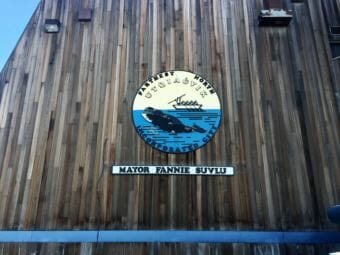
The new logo for the City of Utqiaġvik, photographed June 5. In October 2016, residents of the town formerly known as Barrow voted to officially change the name of their city to the traditional Iñupiaq name Utqiaġvik. (Photo by Ravenna Koenig/ Alaska’s Energy Desk.)

The town most of the world knew as Barrow voted in 2016 to officially start going by the traditional Iñupiaq name of Utqiaġvik.

The vote passed by a slim margin of 6 votes.

Some residents pushed back in the ensuing months, wanting to keep the name Barrow. Others said the town historically had a different traditional name, which was the view of the local Native corporation that filed a lawsuit to try to stop the change.

Over year and a half later, Utqiaġvik is still what the town is officially called.

But when you arrive by plane, the first thing you see is the word “Barrow” printed over the airport on the side facing the tarmac. 

“Barrow” is everywhere while walking around town: on the fire trucks, in the name of the high school, the local utility company, on the North Slope Borough’s official logo. It’s even scrawled on some of the brightly painted dumpsters.

City Hall has “Utqiaġvik” on the front of the building. And on bulletin boards around town where people post notices to the community, “Utqiaġvik” is starting to appear in some municipal department letterhead.

When you ask people what they call it, you get a real mix:

“I call it Utqiaġvik now,” James Koonaloak said.

“I still call it Barrow,” Murphy Nuglene said.

“I will use both at this point,” Muriel Brower said.

“I still call it Barrow out of habit,” Mary Patkotak said.

“Utqiaġvik,” Richard Okpeaha said.

“I was born in Barrow and I still live in Barrow,” Isaac Kalayauk said.

“Utqiaġvik,” Edith Nageak said. “I’m very happy they changed it to the original name.”

A lot of feathers got ruffled here when the name change went through.

Less than 20 percent of the town voted.

Some said they didn’t have enough time between the proposed change and ballot voting to really become aware of what was going to be decided at the polls.

There are people who still feel the official name should have remained Barrow.

Charles Brower, interim executive director at the Native Village of Barrow — the local tribal government — is one of them.

“I wasn’t interested in changing the name to Utqiaġvik,” he said. “It’s always been Barrow.”

He adds that the tribal council has no plans to change its name.

Then there are those who were really supportive of the change.

Fannie Akpik, the coordinator for Iñupiaq Education for the North Slope Borough school district, says hearing people calling the name of her hometown Utqiaġvik “warms my spirit.”

Akpik is in her 60s and says she doesn’t remember hearing the name Barrow until she showed up for her first day of school and saw it written on the building.

For her, the reversion to the traditional name is a way of affirming the Iñupiaq identity of this place.

“Someday I hope everybody will walk around and be proud to live in Utqiaġvik like I do,” Akpik said.

Tennessee Judkins teaches Iñupiaq education for the school district.

She voted to change the name, but also said that she’s OK if certain things in town continue to be called “Barrow” such as the high school where she played volleyball and rooted for the basketball teams.

“I wouldn’t be sad if it never changed,” Judkins said of her alma mater. “That’s one thing I’m like, cool, you can keep it Barrow High School, ’cause we are Barrow Whalers.”

Some of the initial hubbub about the name change has quieted at this point.

But Utqiaġvik is still in transition.

There’s a mountain of logistics that go into changing a place’s name. And some of that costs money, which was one of the initial concerns brought up by people who were against the change.

It’s unclear how long it will be before all the signage, textbooks, maps and the airport code fully reflect the name Utqiaġvik.

A T-shirt for sale at the Iñupiat Heritage Center in Utqiaġvik. In the gift shop you can buy items that say both ‘Barrow,’ and ‘Utqiaġvik.’ (Photo by Ravenna Koenig/Alaska’s Energy Desk)

For now at least, what people call this place seems to be a choice they’re making day by day, conversation by conversation, document by document.

At the DMV, for example, residents can choose what name they want printed on their driver’s license.

Dawndee Ipalook, who works at the DMV, issues those IDs. When asked for an estimate of the percentage of people who are choosing Barrow versus Utqiaġvik, Ipalook said, “I would say about probably 80-20.”

That’s 80 percent Barrow, 20 percent Utqiaġvik.

A lot of people choose Barrow because it’s easier to spell, Ipalook said.

Others have come in to add Utqiaġvik to their ID even though it hasn’t expired yet, just because they’re proud of the name.

Robert Nageak, who grew up here, says he respects the change, and uses Utqiaġvik sometimes himself, but he’s not a stickler for what people call this place.

“I just don’t have a problem with either/or,” he said. “Utqiaġvik; Barrow; still the same place. The most northern city in the United States of America.”

In other words, home.

As the Arctic warms, a changing landscape on the Chukchi Sea


Ice researcher Andy Mahoney, joining polar bear guard Robert Nageak at the top of a pressure ridge on the Chukchi Sea off Utqiaġvik. In decades past, this landscape would have been full of much taller pressure ridges and more of them, partly due to the presence of thicker ice that survived more than one summer. That type of ice is disappearing as the Arctic warms.  (Photo courtesy of Rowan Romeyn).

It’s well established that Arctic ice is changing in dramatic ways. As the climate warms, ice coverage is decreasing, the amount of multiyear ice has gone down significantly and in Alaska, many communities are seeing the ice come in later, and leave sooner. So, what do those changes look like up close?

On a late-May evening, about a dozen graduate and post-doctoral students gather at the north edge of Utqiaġvik, by the Barrow Arctic Research Center. They’ve come to Alaska for an Arctic field school and are about to go out onto the sea ice, led by two men who have logged a lot of time out there.

One is Craig George, a wildlife biologist with the North Slope Borough since the early 1980s. He’s spent months of his life on the ice in this part of Alaska, often camped out for days or weeks at a time doing bowhead whale counts, and helping to measure and sample whales during spring whaling.

The other is Andy Mahoney, an ice researcher at the University of Alaska Fairbanks who has been coming up to Utqiaġvik for the past 18 years to study sea ice.

“Craig was there at the very beginning of my sea ice career,” Mahoney says by way of introducing George to the group.

“During the Pleistocene,” George quips.

“During the Pleistocene, yeah,” says Mahoney, “back when ice used to be ice. Before this ‘new ice’ that we’ve got now.”

The group piles onto snowmachines, and charts a path toward the Chukchi Sea, whipping over snow-covered lagoons, down the slope leading to the ocean, and over several miles of relatively flat ice close to shore.

Then, the surface gets rougher. Big piles of broken ice start appearing — pressure ridges; they’re created when big chunks of floating ice bump up against the shore-fast ice the group is snowmachining on, forcing it to crumble and push both up above the surface, which you can see, and down below it, which you can’t.

The group stops to get off the machines and look around. As Craig George surveys the landscape, he says he sees a lot of differences from when he started coming out here decades ago.

“The ice tells you what it’s made out of, when it formed,” he says. “The ridges… see the thickness? So that’s relatively thin first-year. I haven’t seen any multiyear.”

Multiyear ice is ice that’s survived at least one summer. It’s usually several feet thicker than the ice that forms and melts away in a single year. Back in the ’80s, George says he used to see a lot of it out here.

“First/second year ice looks like the Rockies, the Rocky Mountains,” George said. “And the old multiyear ice looks like the Appalachians, sort of rounded.”

A few decades ago, sixty-one percent of the ice on the Arctic Ocean was multi-year ice. Now it’s about half that.

One reason that multiyear ice matters is that it’s one of the ways the Arctic stays cold. Ice reflects heat from the sun, while water traps it. So if a ton of ice stops being ice during the summer, and instead becomes water… the Arctic is going to get warmer. Which means it won’t be able to help keep the rest of the earth cool.

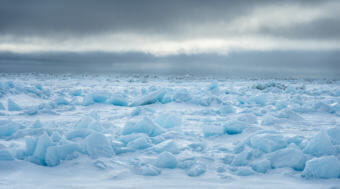
The students clamber up onto a 20-foot pressure ridge. Out to the north is a seemingly endless field of ice rubble — sharp blue shards jutting up in every direction. No rounded Appalachians here.

A field of ice rubble, pictured from the top of a pressure ridge. All of this ice is “first-year” ice, which means it was formed sometime in the last year. (Photo courtesy of Rowan Romeyn).

The lack of multiyear ice doesn’t just mean that certain shapes are jagged when they used to be round. Andy Mahoney says it helps explain why the landscape looks different in other ways.

“These ridges that we’re standing on, there would have been more of them, and they would have been bigger,” Mahoney says. “So it really has changed. I mean you look back at some pictures of that era, and the features that we now see, they’re something of a shadow from the past.”
There are other changes too. The ice here is forming later, and in some places this year was record thin.

But that doesn’t necessarily translate to a bad ice year for people who depend on the ice, like hunters here in Utqiaġvik. Yes, it means the window of time to hunt certain animals on the ice is shorter. But when it comes to the ice conditions that make for a good whaling year, wind, currents and weather play a huge role too.

“Weather, it plays a big factor in our hunt and this year the weather was pretty windy,” said Joseph Leavitt, an Utqiaġvik whaling captain. “Pretty windy but… our ice stayed solid… there was hardly any current on the ocean, and so it turned out to be a good year. At least, we got eight whales.”

Billy Adams is another whaler who works for the North Slope Borough Wildlife Department. He said that yes, ice is freezing later, and yes, parts are thinner, but even as they see changes in the ice, whalers are adapting.

“We just make changes to how we’re going to hunt, and when we’re going to hunt. That’s the biggest thing,” Adams said.

So even as the ice continues to change, whalers say they will keep finding ways to bring whales home to the community.

Utqiaġvik weighs in on the proposed gas and oil lease plan for ANWR

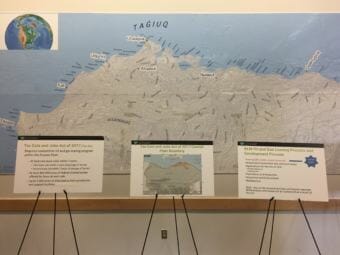
Slides from the BLM at the Utqiaġvik scoping meeting on drilling in the Arctic National Wildlife Refuge, May 31st, 2018. Public meetings are being held around Alaska to solicit comments on an oil and gas lease program in the 1002 area of the Refuge. (Ravenna Koenig/ Alaska’s Energy Desk.)

The U.S. Interior Department is taking comments about its plan to open the Arctic National Wildlife Refuge to oil and gas activity.

At public meetings in Fairbanks and Anchorage earlier this week, hundreds of people turned out, including organized protesters.

A much smaller group gathered Thursday night, May 31st, at the meeting in Utqiaġvik. In a departure from the other meetings, the primary focus was on the details that should be considered as development moves forward, rather than whether or not it should happen.

Sixty-some people showed up at the Iñupiat Heritage Center in Utqiaġvik to weigh in on the Trump administration’s plan to develop an oil and gas lease program in ANWR’s coastal plain.

Some community members expressed enthusiasm about employment opportunities and additional revenue for the North Slope.

Gordon Brower is with the planning department of the North Slope Borough.

“I think the village corporation and the regional corporation in these areas may be the only ones that have been disenfranchised from their lands and the ability to use their lands since native land claims,” Brower said. “And I think it’s exciting to see the ability of landowners to be able to look forward to what they had envisioned in how to use these resources.”

Many commenters — including those who expressed support — also brought up concerns about how to protect subsistence resources.

One suggestion came from elder and whaling captain Arnold Brower Jr, who said that a percentage of the revenue from the lease sales should go to monitoring and protecting wildlife.

“I think that should be mandatory,” Arnold Brower Jr. said. “I don’t think that the government or North Slope Borough should try to find money to protect these renewable resources. It should be the primary thing funded right off the lease sale.”

Joe Balash, with the Department of Interior, says where the funds go is up to Congress.

“So we’re certainly going to take a look at that and see how far we can go and not run afoul of congress’ authority,” Balash said.

Another suggestion from Arnold Brower Jr, was to implement an agreement like the kind whalers negotiate with oil companies who drill offshore. It’s called the Conflict Avoidance Agreement, and it’s intended to minimize the impacts of development activity on whaling. Balash said he was interested in figuring out how to adapt that process for onshore purposes.

About a dozen people spoke at the meeting. A common theme throughout was the importance of local input as the process moves forward. The meeting concluded a half hour or so early due to the relatively small number of commenters.

The meeting in Utqiaġvik is one of two planned on the North Slope. The other is scheduled to take place in Kaktovik on June 12th.

Site notifications
Update notification options
Subscribe to notifications