Ravenna Koenig, Alaska's Energy Desk

Alaska State Legislature urges Congress to address state ivory bans

Walrus ivory carvings and masks, like these on display at Maruskiya’s in Nome, may be threatened by other states’ bans on the sale, purchase, and trade of various types of ivory. (Photo by Emily Russell/KNOM)
Walrus ivory carvings and masks on display at Maruskiya’s in Nome, in July, 2016. Alaska Native artists who use legal walrus, mammoth and mastodon say that broad ivory bans passed by other states make it more difficult to sell their work. (Photo by Emily Russell/KNOM)

The Alaska State Legislature passed a resolution today urging Congress to take action to protect the ability of Alaska Native artists to sell work made from legal ivory. The resolution asks Congress to pass federal legislation that would explicitly allow possession and trade of products made with legal walrus, mammoth and mastodon.

The resolution takes aim at state laws like those in New York, California, Hawaii and Washington. Those states have passed broad anti-ivory laws in an attempt to combat the poaching of African elephants.

The laws have had unintended consequences for Alaska Native artists, who say the bans make it difficult to sell art made from legal Alaska ivory.

Copies of the resolution will be sent to President Trump, Vice President Pence and Congressional leaders.

U.S. Senator Dan Sullivan introduced a bill back in October that would limit state powers to ban walrus and mammoth ivory.

Many details still to come, as task force meets to discuss first draft of state climate change policy

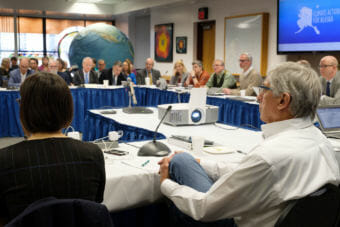
Meeting of Governor Walker’s Climate Action Leadership team, chaired by Lieutenant Governor Byron Mallott, on the University of Alaska Fairbanks Campus, in Fairbanks, Alaska, April 12, 2018.
(David Lienemann/Office of Governor Bill Walker)

Be bold. That was the message in Fairbanks on Thursday, as Governor Bill Walker’s climate change task force met to begin hammering out specific recommendations for how the state should react to a warming world.

It was the second time that the full group met in person since they were formed last fall.

The meeting came a day after their first public listening session, which was also held in Fairbanks. Luke Hopkins, former Mayor of the Fairbanks North Star Borough, led that session, and he said there was one clear takeaway.

“Alaskans want to see us be bold in our statement,” Hopkins said.

He said the public comments offered a wide range of suggestions for what boldness might look like, from greenhouse gas reduction to carbon pricing to an aggressive push for adaptation.

Task force members clearly took that sentiment to heart. The word “bold” came up repeatedly at the meeting. Many members said it was something they wanted to see reflected in the policy recommendations they make to the governor in September.

But President Jim Johnsen of the University of Alaska said that while he believes in the urgency of the issues at hand, it’s not the language he would choose.

“I just finished reading a book… about the French Revolution, and there was a great deal of passion and boldness there,” he said. “And about 40,000 people died in that process. So I think we need to keep that in context with what is actually practical, what is actually achievable, and what is actually cost effective.”

Most of the meeting focused on the draft climate change policy the team released on April 12th. It includes recommendations to reduce carbon emissions in Alaska by 2030, diversify the state economy beyond fossil fuels and mobilize funding from government and the private sector for climate change adaptation.
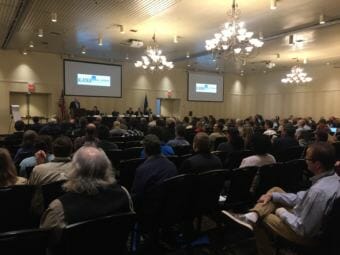
There was broad recognition that the draft is not final, and a lot of refining lies ahead. Some members said they hoped that the final product will have more decisive language and specificity — like the rate by which emissions should be reduced by 2030. 

“We’re seeing a transformation of a relatively general statement into a more specific statement that includes actions and objectives that can be met in the near term, but also a vision for where we need to be going in the future,” said Chris Rose, Executive Director of the Renewable Energy Alaska Project (REAP). 

I don’t see all of that reflected in the draft,” he said. “But I can hear in the conversation that people are moving toward that shared vision.”

Sam Schimmel is a high school senior from the Kenai Peninsula and St. Lawrence Island. He said he’d like to add more recognition that even though climate change is a “slow-moving disaster,” it’s affecting people in Alaska today. He said his uncles, who are whalers, are just one example.

“They need bigger boats,” he said. “Because the seas are too unpredictable and an 18-ft Lund is not a safe vehicle to be traveling around the Bering Sea in when there’s no ice to protect you from high surf.”

Linda Behnken, Executive Director of the Alaska Longline Fishermen’s Association, says she’d like the group to consider adding a carbon offset or sequestration recommendation to the policy. That system allows big polluters in places where there are limits on carbon emissions to go over that limit by purchasing carbon credits from other places — essentially, paying them to keep their carbon in the ground — whether it’s in the form of timber, coal or other resources.

“It’s not just what we do, it’s what we don’t do,” she said, “And what that does in terms of sequestering or releasing carbon.”

Janet Weiss, President of BP Alaska, is the sole representative of the oil industry on the task force. She said the industry has its part to do in bringing down carbon emissions by making their operations as efficient as possible.

“I think we’re all involved in this kind of debate,” she said, “and we all need to be pulling together.”

She also said that the task force should be mindful of the impact that some of their recommendations could have on the economy.

“I think we need to think about the effects of additional fees and what would that mean to Alaska’s economic engine. You gotta look at — what’s the result of something you impose?”

Between now and September, the team will be working toward nailing down more specifics.

Nils Andreassen is executive director of Institute of the North and coordinator for the task force. He says the policy draft discussed at the meeting is meant to be a guiding document. It will be complemented by a more granular action plan, a draft of which will likely be released this summer.

“That’ll be describing potential costs to the state, which agencies are leads, a timeline, partners that would be involved,” Andreassen said. “So that would be, by necessity, a more extensive document.”

Going forward, the group will be bringing on a science advisory panel and an oil and gas technical committee to help give them the information they’d need to get more detailed in their recommendations — like setting carbon emission reduction targets.

Andreassen says that the task force plans to hold more public hearings around the state as they draft these documents. The public can also submit comments online. 

How do you keep developing rural energy projects in a fiscal drought? More loans.

Governor Bill Walker delivering the Keynote Address at the Alaska Rural Energy Conference in Fairbanks, April, 2018. One of topics of discussion was paying for energy projects with loans. (Ravenna Koenig/ Alaska’s Energy Desk).

It’s a fact of life in rural Alaska that energy is expensive.

In the past, one way the state helped with high costs was through grants — for things like renewable energy projects, efficiency projects, or diesel system upgrades.

But as the fiscal picture has changed, there are fewer grants available and more loans are cropping up in their place.

At the Alaska Rural Energy Conference in Fairbanks this week, one of the big questions on everyone’s mind is: how do you pay for energy projects now that there’s just less grant money than there used to be?

Cady Lister is the chief economist for the Alaska Energy Authority. She says that communities and rural utilities need to rely less on grants and look more to loans.
Lister oversees a loan program for the Alaska Energy Authority that has gotten a significant increase in applications since 2014. It’s called the Project Power Loan Fund.

“That’s a very flexible loan program,” Lister said. “It certainly is useful for communities who don’t have the ability to access capital through other means.”

That flexibility is important because small rural utilities often have trouble getting loans from banks. Sometimes the amount they’re asking for is too small for the bank to make a profit from. Or they don’t have the kind of assets that a bank wants to see to make sure the loan gets paid back.

State and federal loan programs can help get around those problems.

Jessie Huff works to connect communities with loan programs at the US Department of Agriculture.

She says that even though government loans can help rural communities access funding, there’s still risk involved that there isn’t with grants, and that makes some communities wary. But she thinks it’s important for them to consider how expensive it can sometimes be to do nothing.

“It really does come down to: if there are no grants available, and you can reduce your energy cost by 30%… if you don’t do the project, you’re wasting money,” Huff said.

For example, the City of Aleknagik close to Dillingham wants to retrofit six buildings to make them more energy efficient. City Administrator Joseph Coolidge says they currently spend $24,000 a year on electricity for those buildings. And while the city council has been hesitant to apply for a loan because they’ve been used to grants in the past, Coolidge is going to push them to reconsider:

“We need to spend money to save money, and it will save money years down the road when everything’s all paid for,” Coolidge said.

Cady Lister at the Alaska Energy Authority says the hope is that in the coming years a lack of grants won’t keep communities from getting the resources they need to move forward on energy projects.

New map shows the potential future of permafrost on the North Slope


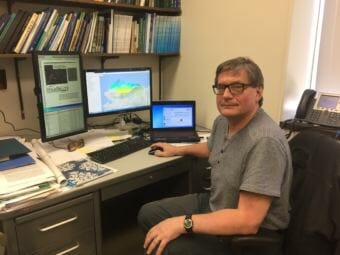
Permafrost researcher Vladimir Romanovsky, pictured in his office at the University of Alaska Fairbanks in April, 2018. On his computer screen is a new map he helped develop showing permafrost scenarios out to 2090. (Ravenna Koenig/ Alaska’s Energy Desk).

All infrastructure in the Alaska Arctic — from roads to homes to the trans-Alaska pipeline — rely on stable permafrost to be functional. And it’s no secret that as the Arctic warms, that stability is being threatened.

Now, researchers have put together a tool that’s designed to help visualize how thawing might play out in specific places, so they can better prepare for the future.

Vladimir Romanovsky is a permafrost researcher at the Geophysical Institute and a professor at the University of Alaska Fairbanks. He’s sitting in his office looking at a map on his computer.

“If you’re interested in Barrow, you can make this map kind of blow up a little bit and then see what is the situation in Barrow,” he says, zooming in.

The map is almost identical to what you’d see if you looked up the North Slope on Google maps. But instead of the normal grays and greens, the whole region is lit up in vibrant colors representing ground temperatures.

The map allows you to see what might happen to those temperatures if, say, greenhouse gas emissions come down a bit from what they are now. In that scenario — 70 years from now — the permafrost remains frozen, at least in Utqiaġvik (formerly known as Barrow). In another scenario, emissions stay the same and as a result:

“We see it completely change in the colors… and now we see the temperatures are all somewhere above 0ºC, above this threshold, around +1,” Romanovsky says.

No surprise — right around that freezing point is where permafrost starts to thaw. And that’s not great for the structures that rest on top of it.

A few things make this map possible. One is that scientists have already mapped the ecology and geology of the North Slope in a pretty detailed way. And based on that, along with temperature data they’ve collected from 35 sites around the region, they can project how specific parts of the landscape might react to warming temperatures.

“Say if you have two different conditions next to each other, we can say that in this 100 x 100 feet permafrost will behave this way, and next to it, it could behave differently,” Romanovsky said.

In addition to the two different climate scenarios, you can also see how adding gravel, say for a road, or seeing an increase in vegetation might change the temperature of the ground.

Romanovsky emphasizes that the map is not a prediction. Instead, it’s simply a projection of how a few scenarios might play out, based on different assumptions.

“We hope that this tool will be useful for engineers who [are] doing some projects in this area, for government thinking about what they should expect, and also for any people who live in Alaska,” Romanovsky said.

He says that the North Slope is just the first region they’ve made a map for. Eventually, they’d like to make others for permafrost throughout the state.

The project was paid for by the Alaska Climate Science Center at the U.S. Geological Survey. It will be available to the public in a few weeks.

Meet the Fairbanks teen who’s suing the U.S. government over climate change

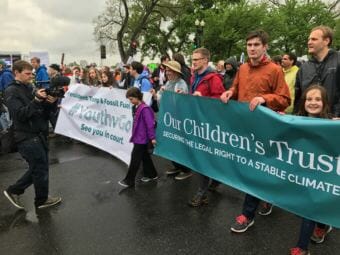
Nathan Baring, third from right, at the March for Science in Washington D.C. in April of 2017. He’s one of 21 youth plaintiffs suing the federal government over climate change. (Robin Loznak/ Our Children’s Trust)

Should the courts be the place where climate change battles are fought? That’s a question that’s gained traction in recent years, as individuals and municipalities have brought suits against fossil fuel companies and governments trying to prompt action on climate change.

In March, a request from the Trump administration to dismiss one of the more high-profile cases was denied by a federal appeals court. It will now move forward in the district court in Oregon. Its plaintiffs are 21 young people who want to see the federal government take steps to reduce greenhouse gas emissions.

One of them is a high school senior from Fairbanks.

Nathan Baring is 18, and in some ways his life tracks pretty closely with those of other kids his age. He likes to play soccer, ski on the weekends, and hang out at Carl’s Jr. playing Clash Royale on his phone with his friends.

But… he’s also suing the United States Federal Government.

“I started actual activism when I was 13,” Baring said. “I can trace my first letter to the editor to February 2013.”

That first letter was about the air quality problem in the Fairbanks area. But since then, Baring’s activism has expanded. Climate change isn’t the only issue he cares about today. But it’s a core one.

“Since the whole world has problems, I try to focus on what I can really take a bite out of,” he said. “And I quickly realized that climate change is the pressing local problem in Alaska.”

Baring’s engagement started with lobbying and letter writing — but he didn’t think it was effective enough. He also began to feel like the voices of young people weren’t taken seriously in the political sphere. So when a nonprofit legal organization called Our Children’s Trust came looking for young Alaskans to join a suit trying to get the government to change its energy policies, he went for it.

“I saw the lawsuit as kind of a last-ditch effort to give my generation a seat at the table,” he said.

The case is called Juliana vs. United States. And basically the argument that Baring’s lawyers are making is that the government has known about climate change for decades and has made the problem worse by supporting an oil and gas-based energy system.

Phil Gregory is one of the lawyers. “[The federal government] created a danger that has, and is causing and certainly will cause harm to these young plaintiffs, to the youth of America and to future generations,” Gregory said. “This is a constitutional violation of these young plaintiffs’ rights.”

In particular, the case argues that the government has violated the plaintiffs’ 14th Amendment rights to life, liberty, and property, and also that it hasn’t held up its duty to protect essential public resources under what’s called the “public trust doctrine.”

Ultimately, Baring and his co-plaintiffs are hoping for a decision from the court that would require the federal government to lower the emissions that contribute to climate change.

Right now the case is gearing up to go to trial — Gregory expects by the end of the year.

One thing that Baring goes out of his way to acknowledge is how complicated this issue is for Alaskans. His mom is a public school nurse and his dad is a public school teacher. Both their salaries are paid for by revenue from the oil industry. And many members of his community are even more directly tied to it — like his neighbors, who work for the pipeline.

He worries that the mainstream environmental movement isn’t sufficiently addressing this issue. What would happen to these people’s jobs if the oil industry went away?

“I try to remind the people that I’m working with that we’re dealing with people’s livelihoods, and any solution has to bring the workers with it,” Baring said. “We can’t just put caps on emissions and hope that the problem will go away. This is a multifaceted solution that we’re looking for.”

This fall, Baring will be leaving Alaska to go to college. He eventually wants to become an international lawyer — and his big dream is to work as a liaison on climate action on the world stage.

The Cost of Cold: Staying warm near Fairbanks

The home of Jeremy Eberhardt and Ember Kalama, located in Fox, just outside Fairbanks. Eberhardt says that for him, using wood for fuel is about more than just saving money; it’s part of his Alaskan upbringing. (Courtesy of Jeremy Eberhardt).

Interior Alaska is known for extreme cold in the winter. But because Fairbanks doesn’t have easy access to natural gas, most people use pricey fuel oil to heat their homes. And as a result, many families turn to a cheaper local resource to bring down their heating bills: wood. But wood contributes to an air quality problem that has Fairbanks in trouble with federal regulators.

Even with the downsides, one family says that wood is still their best option.

Jeremy Eberhardt and Ember Kalama live about 10 miles outside of Fairbanks with their four kids.

Kalama moved here from Hawaii when she was in her teens, but Eberhardt was born and raised here. He calls 20 below “T-shirt weather.” And he says burning wood for fuel is about more than just saving money; the whole process of chopping, drying, and hauling it is part of his Alaskan upbringing and something he’s teaching his kids.

“I don’t know what the kids think, but I think it’s a pretty good activity,” Eberhardt said. “It’s something that you kind of hand down… I did it with my parents and… my grandfather. And… I guess I’m passing the torch as you would say to them.”

But money is definitely part of it too. Kalama works in the plumbing industry, and Eberhardt is a mechanic. They say their income varies year to year, and it would take a real bite out of their budget if they were paying for heating fuel.

They did heat their home that way several years ago and Eberhardt says it cost them at least $700 a month.

The price of oil has gone down a bit since then, but Eberhardt says wood is still a lot cheaper. The only money they spend is on chainsaw and truck fuel and minor maintenance costs — less than $1,000 a year. They get the trees from their property or a nearby homestead that belonged to Eberhardt’s grandfather.

“I do all the chainsaw work,” Eberhardt said. “So I’m always cutting it or stacking with the Bobcat, moving it around. And the kids and Ember helped me haul it.”

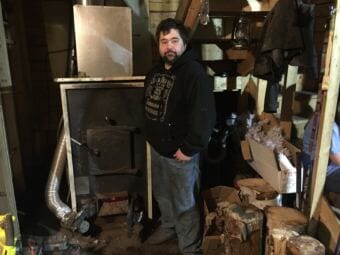
Jeremy Eberhardt standing next to his family’s forced air furnace – it burns wood and distributes the warm air throughout the house. (Ravenna Koenig/ Alaska’s Energy Desk).

The part of the Fairbanks area where Eberhardt and Kalama live is a bit north of town — it’s not where the air quality issue is the worst. Even so, Eberhardt acknowledges that it’s a problem.

But he also says that part of what makes the situation so bad is that people are burning wet wood. “We have a lot of people that sell wood in the Interior that… aren’t taking care of it, and aren’t seasoning it properly,” Eberhardt said.

“And in the midst of the winter when it gets cold and there’s a lot of people begging for firewood, these people are popping up going ‘oh, I got all this dry wood’ you know and it really isn’t,” he said.

He wishes more wood sellers and users would take the time to properly dry the wood.

Eberhardt and Kalama don’t use an average wood stove to heat their home. On the bottom floor of their house they have a forced air furnace —  a big hulking thing about the size of Eberhardt himself — connected to a duct, which distributes the warm air throughout the house.

On a typical day, Eberhardt says he adds wood to the furnace about three times. He says on the days when the temperature dips well under zero, he gets a feeling of satisfaction, knowing how hard he worked to keep the house warm.

Site notifications
Update notification options
Subscribe to notifications