Ravenna Koenig, Alaska's Energy Desk

International “range states” meet to discuss polar bear conservation

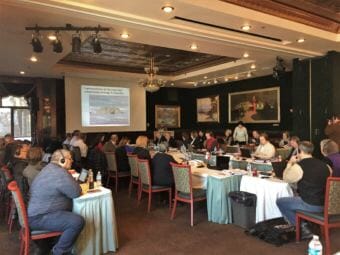
A presentation being given at the 2018 Polar Bear Range States Meeting in Fairbanks, AK. (Alaska’s Energy Desk/ Ravenna Koenig)

Representatives from Norway, Canada, Greenland, Russia and the United States met in Fairbanks Feb. 2 – 4, 2018, to talk about polar bears. Those countries are all part of a treaty signed in 1973 to coordinate protection of the species. And for about a decade now, those same countries have been holding meetings every two years to address the threats that polar bears are facing, especially from climate change.

At Pike’s Waterfront Lodge on the Chena River in Fairbanks, dozens of people mill about a cavernous meeting room, different languages echoing off the walls. A weekend-long meeting of what’s referred to as “the range states” — or the five nations where polar bears live — has just ended.

When the Agreement on the Conservation of Polar Bears was signed by these countries in 1973, the main issue they were trying to deal with was the dwindling numbers of polar bears in many areas, largely due to sport hunting. Not anymore.

“The number one challenge is loss of polar bear habitat, meaning sea ice,” said James Wilder, the polar bear program leader for the U.S. Fish and Wildlife Service. He’s one of several people representing the United States here.

A few years ago the range states finalized an initiative called the Circumpolar Action Plan, essentially a way for the different countries to coordinate their efforts to address things like human-bear conflicts, climate change and bear management with oil and gas development.

This meeting is, in part, a way for the group to catch up on the work they’ve done under that plan since they last met in 2015. One example: an update on an ongoing study on the effectiveness of bear spray on polar bears in Arctic temperatures. As sea ice disappears, polar bears are spending more time on land, leading to more conflicts with humans.

“It can range from polar bears raiding fishing camps on the coast, to getting into landfills in coastal villages, to traveling through and inhabiting oil and gas fields,” Wilder said. “It can also go to the other extreme of attacking people.”

The delegates for the U.S. include the State of Alaska, the North Slope Borough, the U.S. State Department and USGS, among others.

Nicole Kanayurak spoke for the North Slope Borough at the end of the meeting. She thanked the range states for recognizing that indigenous knowledge is an important part of managing and researching polar bears. But she also urged them to include native communities to a greater extent in that work.

“What we have drawn from the last two days is that there may be missing variables and a void that the intricacies of our indigenous knowledge on the ground may inform,” Kanayurak said.  “It is important for our people that we are equitably involved in polar bear affairs.”

Other groups representing indigenous perspectives at the meeting echoed this push for more inclusion.

James Wilder says that this has been and will continue to be a point of focus for the range states.

“What we heard repeatedly during this meeting — and the range states are committed to doing a better job with — is working more closely with the native people,” Wilder said, “incorporating traditional ecological knowledge and subsistence users concerns and knowledge into the management and scientific processes that govern what we do.”

Wilder says that one example of how the U.S. is working towards more inclusion is a scientific working group they have with Russia. The group is designing studies on polar bears in the Chukchi Sea, and includes native hunters from both countries.

The range states will next convene in Norway in 2020.


Alaska’s only tribal college now offering bachelor’s degree in business


Iḷisaġvik College’s main campus on the northern side of Utqiaġvik. The college launched its first bachelor’s program last fall. (Alaska’s Energy Desk/ Ravenna Koenig)

There’s now another way for North Slope residents to get a college degree without leaving home. Iḷisaġvik College, Alaska’s only tribal college, launched its inaugural bachelor’s of business administration this past fall.

The main campus for Iḷisaġvik College is located in what’s known as the NARL complex in Utqiaġvik; it’s the spot where the Naval Arctic Research Laboratory used to operate until it was shuttered about 40 years ago. A short drive north of town, it’s a collection of scattered Quonset huts and a boxy blue building lofted up on stilts.

The President of the college, Dr. Pearl Brower, says that the vision for higher education on the North Slope began back in the 1970s with the Borough’s first mayor, Eben Hopson Sr.

Hopson felt strongly that local education was the key to self-governance, and he made it one of his top priorities.

“He recognized that that was going to be one of the most important things for the future of the North Slope given the fact that we were playing such a major role in oil and gas development, and the fact that we were on the edge of the Arctic in regards to science and climate change,” Brower said.

Shirts and hats for sale in the Iḷisaġvik College Bookstore. Iḷisaġvik is currently Alaska’s only federally recognized tribal college. (Alaska’s Energy Desk/ Ravenna Koenig)

Over the years, higher education here has gone through several different iterations. But in the 1990s Iḷisaġvik College was established in its current form, offering vocational certificates, associate degrees, and short-term workforce development training. And now, exactly one bachelor’s degree as well.

At 5:30 pm in one of Iḷisaġvik’s classrooms, professor David Rice is teaching a managerial accounting course to a classroom of five students. The main topic is budgets. How you set them, who within an organization should get a say in how they’re set, and the advantages and disadvantages of different budgeting tactics.

Iḷisaġvik professor David Rice, teaching a class in January on managerial accounting. One of the students in this class is in the new bachelor’s degree program. (Alaska’s Energy Desk/ Ravenna Koenig)

Not all of the students in this class are part of the bachelor’s program. But one of them — Roxanna N. Evikana just started the program this semester.

Evikana grew up here on the North Slope. She attended some college in Anchorage and Washington State, but now that she’s back on the Slope, she’s excited that she can work towards her degree without leaving behind the things that are important to her.

“Me and my family try to live a subsistence lifestyle,” Evikana said. “I believe that’s what’s best for my children growing up… and being home, being able to go to college at the same time is just… that is the best.”

Evikana currently works as an accounting manager for Utqiaġvik’s village corporation. She says she joined the bachelor’s program mostly because it was a personal goal of hers. But also because she thinks she may want to open her own business one day.

She says there isn’t a ton of entertainment in town, so she’s leaning toward that. “Bowling, movies, you know, something fun,” she said.

Roxanna N. Evikana is currently a student in Iḷisaġvik’s new bachelor’s of business administration program. It’s been a longtime goal of hers to get her bachelor’s degree. (Alaska’s Energy Desk/ Ravenna Koenig)

Her professor David Rice says that most of the students in the Bachelor’s program are like Evikana — they’re not taking the course because they don’t have jobs. They’re taking it to open up more opportunities down the road.

“They’re just making sure that they’re getting the training so they can move up to upper management,” Rice said. “That keeps the jobs here in the local population. That keeps the money here in the local population. We don’t have to bring anybody up from the lower 48 or even from Anchorage.”

President Brower echoes this idea. She hopes the bachelor’s program will give local students the qualifications they need to fill positions that might otherwise go to applicants from elsewhere.
“We see this influx of an outside workforce in our state,” she says. “We have every ability to… have local control of that. But that takes education. In today’s world — it’s not the world of our ancestors — in today’s world we need that education to go along with our indigenous experiences.”

While the bachelor’s in business administration is Iḷisaġvik’s first, Brower says the college hopes to soon have another. They recently started offering courses in elementary education with an indigenous focus, and they hope to grow it to a bachelor’s program in the coming years.

In December, Iḷisaġvik College announced that starting this semester, the college will waive tuition for all Alaska Native students, including for the bachelor’s in business administration.

Editor’s note: The first line of this story has been changed to reflect that Ilisagvik is not the only place to get a bachelor’s degree on the North Slope. There are distance education programs available for enrollment.

Borough mayor on new potential development coming to the North Slope

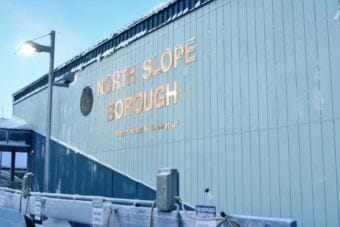
The North Slope Borough’s main building in Utqiaġvik. (Ravenna Koenig/ Alaska’s Energy Desk)

The Trump administration’s vision for American “energy dominance” has big implications for Alaska, and this winter, some of them became more concrete. In December, the Arctic National Wildlife Refuge (ANWR) was opened to drilling. And in January the Interior Department released a new draft plan to open most of Alaska’s coastal waters to oil development.

One of the places that stands to be significantly impacted by those decisions is the North Slope.

Harry K. Brower Jr., is the mayor of the North Slope Borough. He works out of big mint-green building smack dab in center of Utqiaġvik — with his name and title printed on the front.

On the second floor of the building, Brower sits at a conference table in his office and talks about some of the changes that may be coming to the region.

The North Slope Borough has the ability to tax oil and gas infrastructure within its borders, and that money is what allows them to build roads, keep the schools open and pay for the fire department.

But as the prospect of offshore drilling in the Arctic takes shape, the borough is also registering its concerns for how to protect the bowhead whale and other marine life people here depend on for food.

“Offshore activity is one that’s most important to us because it’s been providing our sustenance for thousands of years,” Brower said.  “And here’s a new administration wanting to go full bore: let’s go and explore and develop whatever we can.”

Already, the borough has been in touch with the Interior Department, requesting that certain federal waters stay off-limits for drilling.

When it comes to ANWR, the borough supports opening the area known as the coastal plain — or 1002 area — to oil and gas development. But even so, Brower says that there’s still information his office doesn’t have about how the area will be developed, and how that will impact local residents.

“It’s a very large area of land,” Brower said. “But then there’s no infrastructure. So where’s the interest going to be? Is it going to be close to the current infrastructure, is it going to be further away so they can develop all this infrastructure that’s needed to extract the resource? I don’t know.”

On ANWR and the new offshore plan, the mayor says that communication with the federal government will be key. His office later confirmed by text that the Interior Department is planning site visits to the North Slope and community briefings for later this year.
Support and concern as Ambler Road comment period draws to a close

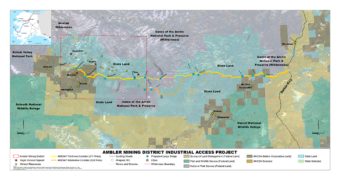
Ambler Mining District Industrial Access Project (Graphic courtesy Alaska Industrial Development and Export Authority)

The window for public comment on a controversial road comes to a close this week. The Ambler Mining District Industrial Access Project — or Ambler Road — would start at the Dalton highway and stretch over 200 miles west.

That’s a big road in a state with not that many of them. Proponents say it will enable growth of the mining industry, and create jobs. Detractors worry about impacts to subsistence and the environment.

The road itself is an idea that’s been kicking around for decades. But it picked up steam back in 2011. At that time, the price of oil was high, the state had cash, and then-Governor Sean Parnell wanted to put some of that money toward encouraging natural resource development in parts of the state that were off the road system.

Ambler Road was part of that push. It’s an area that has been explored for its rich mineral potential since the 1950s, but hasn’t been developed because of its remoteness.

“You can’t develop the Ambler Mining District without a road,” said Rick Van Nieuwenhuyse, President and CEO of Trilogy Metals.

His company is currently exploring two copper deposits tucked into the southern part of the Brooks Range. Van Nieuwenhuyse says that without a road, there just isn’t an economical way to get the minerals to market if they do decide to start mining there.

“We’ve looked at this very seriously. Looking at using aircraft and even airships that aren’t in commercial use, but are in planning stages. We’ve dialogued with Lockheed… and the math just doesn’t work,” said Van Nieuwenhuyse.

The state’s proposed solution to this access problem is a private industrial road, 211 miles long, running from east to west along the south side of the Brooks Range. Picture a road that starts in the heart of Alaska’s interior and makes a beeline for the Chukchi Sea and Kotzebue, stopping near a group of Kobuk River villages.

Wilmer Beetus is First Chief of Hughes, one of the villages close to the east end of the proposed road. He says that residents in Hughes support the project, because they believe it will translate to construction and mining jobs.

“Right now we’re in a deficit we’ve been in the last couple years and it really hurts the economy around here. It’s not an easy life living out there, especially when there are no jobs,” Beetus said.

But other residents in the area are opposed. Vanessa Edwards is Acting Tribal Administrator of Alatna, another community close to the proposed route. She says the benefits that might come from a road don’t compare to the potential damage the project could do to important subsistence resources.

“That ambler mining road would cross two rivers that would directly affect us, that’s the Koyukuk and the Alatna rivers. That’s where sheefish and whitefish go to spawn,” Edwards said.

There are also concerns about how the road might affect the caribou population. Cyrus Harris lives in Kotzebue and is the Vice-Chair of the Western Arctic Caribou Herd Working Group. At a meeting of that group earlier this winter, he expressed worry over how the project might affect a critical resource for his community.

“Caribou is our main source of meat back home. Unlike beef and so forth that urban folks depend on, well, we depend on the land, the land being our garden. And that’s how we’re raised from time immemorial,” Harris said.

All of these sentiments are currently being collected by the Bureau of Land Management. The agency will use those public comments in its assessment of the impacts of the project, including economic, environmental and subsistence impacts.

Tim La Marr is overseeing the process for BLM. He says that analysis will be done by a team of professionals including wildlife biologists, engineers, hydrologists, fisheries biologists, as well as a sociologist and economist.

Ultimately the agency will have to decide whether or not to grant a permit to build the road through federal land, and if so, what the requirements will be to mitigate the environmental impact.

BLM could deny that permit, but La Marr says in his experience, that’s pretty rare.

The National Park Service is also conducting a separate but parallel analysis of the section of the road that crosses Gates of the Arctic National Preserve. The Alaska National Interest Lands Conservation Act, which established the Preserve, included a provision that if there was ever a transportation system built to the Ambler Mining District, NPS would have to accommodate it.

“The Park Service I suppose you could say wasn’t given the opportunity to say no,” said Greg Dudgeon, Superintendent of Gates of the Arctic National Park and Preserve. “Rather it was where the road would go such that it would be least impactive to park purposes, and the terms and conditions for how the road would be used.”

The state agency leading the Ambler Road project — the Alaska Industrial Development and Export Authority, or AIDEA — estimates that it could cost up to $380 million dollars to build. The agency expects to finance that price tag through a mix of private capital, bonding and tolls.

It’s not yet a done deal that the environmental review process will be completed — so far AIDEA has only paid for the scoping and some of the analysis that happens directly afterward. An AIDEA spokesperson said that once the scoping is complete, the AIDEA board will decide the next step.

The public comment period is open through Wednesday, January 31st.

Porcupine caribou herd numbers highest in monitoring history

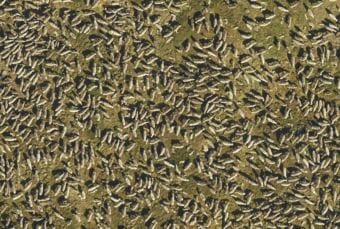
Caribou are captured in a photograph taken last summer by a digital camera mounted in a small aircraft. (Photo courtesy ©Alaska Department of Fish and Game)

The Porcupine caribou herd, whose range includes the Arctic National Wildlife Refuge, has grown to the highest number seen since monitoring started back in the 1970s. That’s according to the Alaska Department of Fish and Game, which just released the results of a photocensus they did this summer.

That census is done by mounting cameras to small aircraft, and taking aerial pictures of the herd during the short window they aggregate during the summer.

The new count puts the herd at an estimated 218,000 animals. For comparison, the low point was 123,000 – back in 2001.

The growth is part of an upward trend for the Porcupine herd; the surveys taken in 2010, 2013, and 2017 all show an increase.

“We’ve definitely had an improvement in calf production and adult female survival,” said Jason Caikoski, a wildlife biologist with the Alaska Department of Fish and Game. But he says that while they can identify things that explain how this caribou population is growing, they still don’t know the underlying causes that explain why.
“Predation, changes in weather, changes in habitat… all those types of things affect all those demographics,” Caikoski said. “And currently we don’t have any studies specifically looking at what factors are affecting those demographics.”

Photocensus counts are used by state and federal wildlife managers to help set hunting limits and seasons. Sometimes a finding will prompt a change in regulation, but in the case of the Porcupine caribou herd, which has a moderate population and low hunting pressure, no changes are anticipated.


New analysis out on renewable energy costs in rural Alaska


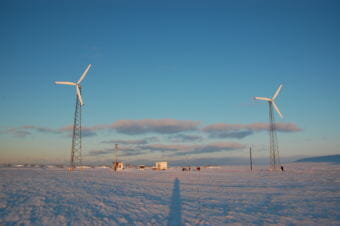
Wind systems like the one pictured here in Wales, Alaska, were the subject of analysis published in December by researchers at the Alaska Center for Energy and Power (Photo courtesy of Alaska Center for Energy and Power).

Many rural communities in Alaska have been experimenting with renewable energy systems in recent years, trying to reduce the amount of costly fuel they have to ship in. In late December, researchers at the Alaska Center for Energy and Power published a series of articles looking at how those technologies are doing, and what challenges remain in making them more cost effective.

The analysis includes data from wind, solar electric, biomass, and several other energy technologies that are currently in use in over 100 rural communities around the state.

Erin Whitney is one of the lead researchers. She says that renewable energies are helping to bring costs down in many rural areas, but there are still improvements to be made. One of the big takeaways from her team’s analysis is that the cost of maintaining renewable energy systems — not just installing them — can put a real burden on communities. She says that finding ways to streamline the maintenance process, or coming up with other ways to bring the cost of down is key to making renewable energy solutions sustainable in rural Alaska.

The research was made possible by a grant from the Alaska Energy Authority back in 2015. It was part of their effort to come up with recommendations for making energy more affordable in parts of the state that won’t have access to the proposed natural gas pipeline.

But Whitney hopes that this information will also be useful outside Alaska. There are many communities around the world with similar energy access issues that are looking for solutions.

“It shouldn’t be used as a manual but it is a good place to start,” said Whitney.

And because the rural systems featured in the analysis consist of small independent power stations – also known as micro-grids – the analysis may also be of interest to organizations wanting to experiment with those sorts of autonomous systems for security or resiliency reasons.

Whitney says that many of the villages included in the analysis are cited by name, which means that anyone interested in finding out more about how a particular technology was used can follow up with the village themselves.

Site notifications
Update notification options
Subscribe to notifications