Ravenna Koenig, Alaska's Energy Desk

Work starts on oil exploration project in Arctic federal waters

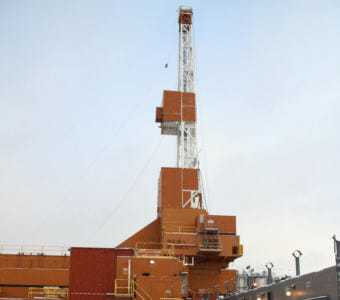
The drilling rig on Spy Island. Eni started exploration this week. (Photo courtesy Bureau of Safety and Environmental Enforcement)

This week, the Italian company Eni began the initial drilling of an exploratory oil well in the Beaufort Sea, west of Prudhoe Bay.

It’s the first oil exploration project to take place in Arctic federal waters since Shell discontinued their efforts in 2015.

The movement on the project comes after Eni passed a pre-drill inspection earlier this month, conducted by the federal Bureau of Safety and Environmental Enforcement.

Two of the Bureau’s personnel were present for the initial drilling to ensure compliance with permits and regulations. Inspectors from the agency will continue to make visits to the site throughout the drilling phase, which they anticipate to last most of the winter.

There’s currently a second drilling project proposed in the Beaufort Sea, by the Texas-based company Hilcorp. Known as the Liberty Project, it’s a drilling and production facility that Hilcorp says could increase the amount of oil going through the Trans-Alaska Pipeline by 70,000 barrels a day. The federal government has begun preparing the final environmental impact statement for that project.

Disaster declared for North Slope Borough damage from fall storm


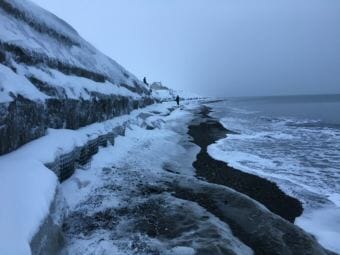
A section of seawall in Utqiaġvik, AK that was damaged during a September storm that was recently declared a Federal Disaster. (Photo courtesy of Alaska Division of Homeland Security & Emergency Management).

In late September, Utqiaġvik was hit by an Arctic storm that lasted several days and caused over $6 million in damages to public structures.

On Thursday, President Trump approved Governor Walker’s request for a disaster declaration for that storm. It’s the second time in three years that the North Slope Borough has received a disaster declaration for such an event; the last time was in 2015.

The recent disaster declaration means that funding is now available from the Federal Emergency Management Agency, or FEMA, to rebuild those public structures that were damaged.

“There was high wind gusts up to 47 miles per hour, a storm surge two feet above normal high tide,” said Thomas Dargan, the Federal Coordinating Officer for federal recovery operations on the North Slope.

A storm of that magnitude isn’t especially severe for Utqiaġvik, but Rick Thoman, a climatologist with the National Weather Service Alaska Region, says what’s changed in recent years is the lack of sea ice — both nearshore, and out on the Arctic Ocean.

“The wind basically acts as a plow pushing the water ahead of it and it piles into the land,” Thoman said. 

The result is often water damage to berms, roads, and buildings. Thomas Dargan says that one of the structures that needs repair in Utqiaġvik is a shoreline berm meant to protect the city from storm surges. The same berm was damaged and rebuilt back in 2015.

In addition to receiving money to fix damaged structures, the relief comes with funds for mitigation — or protective measures — for the future.

But building better storm protection isn’t easy. Dargan worked on the federal storm recovery effort in 2015 and says that when it comes to rebuilding structures like the shoreline berm, there are complicated engineering problems. And it’s not clear that they have a better option than to just keep rebuilding it.

“We’re not quite sure what that long term solution might be,” Dargan said.

The federal relief comes almost a year after the town of Newtok was denied a Disaster Declaration. FEMA currently doesn’t have a way to fund slow-moving disasters, like the large-scale coastal erosion that’s taking place in Newtok. In contrast, the damage to Utqiaġvik was triggered by a single, distinct event.

Alaska’s only tribal college will waive tuition for Alaska Native students

A 2005 advertisement for Iḷisaġvik College in Utqiaġvik, Alaska (Courtesy of ulalume)

Earlier month, Iḷisaġvik College in Utqiaġvik — the only federally recognized tribal college in Alaska — announced that it will waive tuition for all Alaska Native students, starting next semester. The college offers associate degrees, vocational certificates, and short-term workforce development courses, plus a bachelor’s degree in business administration that just launched this fall.

Of the 700 or so students enrolled in the college each semester, a large proportion are non-native. In fact, among tribal colleges and universities, Iḷisaġvik has one of the highest non-native enrollments.

“We hover between about 55-60% Alaska Native students currently,” said Pearl Brower, President of Iḷisaġvik College, “and we certainly hope that those numbers are going to grow with this waiver of tuition.”

Brower said that students have expressed concern with the price of tuition, which for a full course load runs over $3,000. This is especially hard for distance-education students who take classes online from rural areas where there aren’t a lot of high paying jobs.

“More and more we were hearing that funding was a barrier. They were trying to figure out how to go to college when this looming monetary amount was in front of them,” Brower said.

The school is planning to cover the cost of the waiver internally, although the price will be defrayed by the Bureau of Indian Education, which gives Iḷisaġvik money for each full course load being taken by Alaska Native or American Indian students.

Brower said that the ultimate goal of the waiver program is to encourage more Alaska Native students to finish their associate degrees and go on to get their bachelor’s. She hopes that will translate to more hiring of Alaska Natives in positions that require those degrees, especially in rural schools and businesses across the state.
High temperatures in Utqiaġvik confuse NOAA algorithm

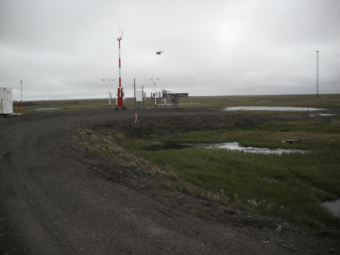
The Automated Weather Observing System (ASOS) at the Utqiaġvik (Barrow) Airport, photographed in summer 2017. This system has been recording temperature data so high, it was flagged by NOAA as a possible mistake (Photo courtesy of NOAA/National Weather Service)

“North Slope climate change just outran one of our tools to measure it.” That was the message from the National Oceanic and Atmospheric Administration (NOAA) earlier this month, when an algorithm they use for quality control balked at the data coming out of Utqiaġvik.

NOAA manages thousands of weather stations across the United States that measure temperature and other variables. That data helps weather forecasters, but it’s also closely monitored by climate trackers.

“What’s been happening in Utqiaġvik is that temperatures are warming so fast that quality control algorithms finally had enough and said ‘Oh, the station must have moved because temperatures can’t be warming this fast naturally!’ said Rick Thoman, NOAA’s Weather Service climatologist for Alaska.

The algorithm is designed to flag data that looks wrong. And when scientists see a flag like that, they investigate. Sometimes they find that the weather station has moved, say, closer to or further from the coast, which would explain why it’s recording such different temperatures.

But that’s not what happened in Utqiaġvik. Temperatures there really are just that much warmer. This November was the hottest on record, averaging 17.2°F.

Bryan Thomas works in the NOAA Observatory in Utqiaġvik, and said he can see obvious signs of warming.

“When we look out on the ocean right now we see a few icebergs,” he said. “Normally we would see white to the horizon in the past, and in this case we’re seeing dark water to the horizon.”

NOAA is working to tweak the algorithm to make it more forgiving in the Arctic, a place where climate change is happening twice as fast as anywhere else on the globe. They hope to have the adjustments in place in a month or two.

Site notifications
Update notification options
Subscribe to notifications