Ravenna Koenig, Alaska's Energy Desk

New analysis adds to picture of how belugas are impacted by sea ice loss

Beluga coming to the surface to breathe.
Beluga coming to the surface to breathe. (Creative Commons photo by Eva Hejda)

Warming temperatures are resulting in less sea ice out on the Arctic Ocean. But when it comes to if and how that change is affecting marine life — there are a lot of unanswered questions.

Researchers have published a new paper that adds a little more to what we know about how beluga whales are navigating their changing habitat. It’s based on data scientists got from tracking two groups of belugas in the Chukchi and Beaufort seas during the summer and fall between 1993 and 2012. They learned where the belugas went and how deep they dove for food.

One of the things that changed in those 20 years is sea ice: in the earlier part of that period there was more, and in the later part there was less. 

Robert Suydam is one of the co-authors of the study, and a senior wildlife biologist for the North Slope Borough’s Department of Wildlife Management.

“The big results are that beluga whales like to use the same areas over, and over, and over again regardless of what the ice conditions are like,” Suydam said.

He says the researchers think what that means is — so far at least — changing ice conditions aren’t changing belugas’ ability to get the food they need.

“Which is kind of a good perspective. You know if belugas aren’t negatively impacted at least at this point… the changes in the ice maybe aren’t going to negatively impact them as much as maybe some of us… thought they might,” Suydam said.

Another big observation scientists made was that the Chukchi group of whales did start diving deeper for food in later years when there was less ice. That could mean that whales are seeing more opportunities to feed, which is keeping them underwater longer. Or that their food is deeper than it used to be.

“We don’t know what that means; we don’t know if it’s a shift in their prey,” said Suydam. “We don’t know if there’s something else that’s going on that has caused them to do this.”

Either way, it’s not necessarily a bad thing.

Suydam says that even though this data suggests that belugas aren’t being negatively impacted by the loss of sea ice now, we really don’t know what things will look like in 10, 20 or 30 years. He says scientists will need to keep a close watch so they can help inform policies on everything from development, to shipping routes, to subsistence hunting in a changing arctic.

Iñupiat leadership organizations contemplate a “unified voice”

The Voice of the Arctic Iñupiat annual board meeting at the Arctic Slope Regional Corporation headquarters in Anchorage, Alaska in March 2018. Governor Walker and Lt. Governor Mallott were also in attendance. The organization consists of many of the Iñupiat leadership organizations of the North Slope, and the Governor has been invited to fill an advisory role on the board. (Credit: Brice Habeger, Office of the Governor)

In a place like the Alaskan Arctic, local issues often unfold on a national, or even international scale. Oil companies, the state, the federal government, environmental groups — they all have something that they want to see happen there.

So, how do the wants of local people get heard? And who gets to speak for them?

There’s a new organization that says the Iñupiat of the North Slope will be stronger if they speak as one.

The group is called Voice of the Arctic Iñupiat, or VOICE. It’s a nonprofit, and gets its funding from the North Slope Borough and the Arctic Slope Regional Corporation, as well as donations from its other member entities, and public contributions through its website. Their goal is to bring together the leaders of the region to weigh in on policies that affect their communities.

“Whether it’s development, whether it’s subsistence rights, we want to be heard in our fashion, in our manner,” says John Hopson, Jr., the mayor of the village of Wainwright and vice chairman of VOICE in a promotional video on their website. “Not someone who lives in Washington D.C. telling us what’s right and what’s wrong for us.”

Leaders like Hopson from the local governments, tribal councils and native corporations say they kept hearing outsiders — like politicians in Washington, D.C., and environmental groups — talking on a national stage about their local issues. And some of those leaders felt that their groups would be better heard on that national stage if they unified.

Speaking at a Resource Development Council conference last November, VOICE Chairman Rex A. Rock Sr. described the idea for the group this way: “To allow us, as many different individual organizations with unique purposes and goals to come together, to finally speak with one voice.” Rock is also the President and CEO of the Arctic Slope Regional Corporation.

Since VOICE was launched in 2015, it’s invited 28 leadership organizations across the North Slope to be members. Twenty have accepted.

The city of Utqiaġvik is a member, and the mayor, Fannie Suvlu, represents the city at VOICE meetings. She says that hard conversations sometimes happen around the table. Some policies affect certain parts of the North Slope differently than others, and not everyone agrees. She likes that part of it — hearing what other leaders are thinking.

“I know what’s happening with [the Arctic National Wildlife Refuge], but I don’t know how it’s affecting the people at home in ANWR,” Suvlu said. “Or…I know that that we have development in Alpine real close to Nuiqsut, but I don’t see the everyday effects of that.”

But Mayor Suvlu also says that in this regard the organization hasn’t yet reached its full potential.

That’s because despite the emphasis on unity, there are some big gaps in the membership. For example, there’s currently no representation from the village of Nuiqsut, which is one of the places on the North Slope most directly impacted by development.

Also missing is the regional tribal government, the Iñupiat Community of the Arctic Slope, or ICAS. That’s the group that the federal government has to consult with before taking any action in the region.

George Edwardson is the President of ICAS.

“We don’t want to weaken our ability to speak and stand, and to join the VOICE we would have to,” Edwardson said.

To be clear, Edwardson doesn’t have a problem with the fact that these other leadership groups have teamed up as VOICE. He just thinks that remaining separate from the organization will give his group the independence it needs to counterbalance some of the others in the region, like the local corporations.

“They’re doing what they were designed to do: make money. And as a regional tribal government, my job is to protect the ecosystem, and the people and the culture.”

One of Edwardson’s group’s big issues is offshore drilling. He says they’re completely opposed. But VOICE has decided not to take a position on offshore development, though they have said they want several critical subsistence areas to be off-limits.

And this gets at the real question facing leaders on the North Slope. Do they join together, hash out their differences, and try speak to issues with one voice, like Mayor Suvlu and the members of Voice of the Arctic Iñupiat are suggesting?

“I definitely think it’s possible to have a unified voice but it’s never going to be truly unified unless all entities that were invited to the table take advantage of it,” Mayor Suvlu said.

Or, are their constituents better served by a chorus of distinct ones, like George Edwardson and his group?

“So when the community has issues, we’ll stand up with them,” said Edwardson. “Sometimes the issues might be against one of the organizations in Voice of the Arctic… Sometimes we internally fight each other; that’s no problem…that’s how democracy works. Everybody has its voice.”

Voice of the Arctic Iñupiat says it respects the regional tribal government’s decision not to become a member, and that the door is always open for the groups that have been invited to join.

Editor’s Note: The original version of this story listed the North Slope Borough and Arctic Slope Regional Corporation as the funding sources for VOICE. It has been corrected to reflect additional sources of funding.

Interior Department officials visit North Slope to talk ANWR

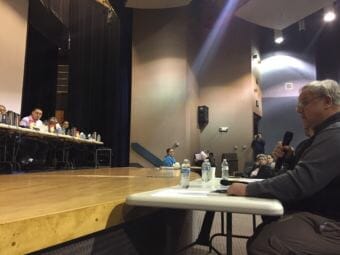
Interior Department Deputy Secretary David Bernhardt addresses the North Slope Borough Assembly in Utqiagvik March 6, 2018. (Photo by Ravenna Koenig/Alaska’s Energy Desk)

A high-profile guest was in attendance at the North Slope Borough Assembly meeting in Utqiaġvik Tuesday. The Interior Department’s second-in-command, Deputy Secretary David Bernhardt addressed the mayor and the assembly members at the Barrow High School Auditorium.

“We’re here today to begin a conversation with you because we want to have you collaboratively and collectively involved with us as we go forward with our new job,” he said.

That new job is managing the oil and gas leasing program in the Arctic National Wildlife Refuge, which is within the North Slope Borough boundaries.

“We want to hear your voice, we want to understand your issues, we have an opportunity to try to accommodate those issues that are of concern to you within our authority,” Bernhardt said.

Assembly members had the chance to comment and ask questions. North Slope Borough Mayor Harry K. Brower Jr. thanked the Deputy Secretary for coming. He then went on to say that oral communication is one thing, but he wants to start seeing plans in writing.

“You know, the first thing I wrote down was, when do we start reading the information in black and white. In written materials. That’s something of importance,” Brower said.

Bernhardt responded that once the scoping process begins, more of those materials will become available. He also said he expects that process to kick off in the next few weeks.

After the meeting, Bernhardt was also asked why three critical whaling areas were included in the initial draft of the Trump Administration’s plan for offshore leasing. Local stakeholders have identified those areas for exclusion in years past.

“We started with what I would consider a zero baseline,” he said. “Let’s presume we’re starting the dialogue fresh. The process will take the same amount of time either way, and we’ll get comments and decide whether it was right-sized nation-wide or not. So that’s where we’re at.”

The Deputy Secretary said he will also be visiting Fairbanks and Nome on this trip.

Archaeology in northern Alaska: a race against the clock


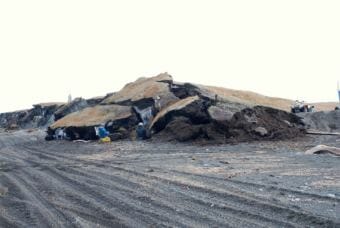
A photograph of the Walakpa archaeological site south of Utqiaġvik following a storm in 2014. The storm caused over 30 feet of coastline to collapse and wash away in certain places, along with archaeological artifacts it contained. (Photo Courtesy of Walakpa Archaeological Salvage Project).

Until recently, northern Alaska was one of the places that archaeologists weren’t exactly in a hurry to dig. That’s because the permafrost functioned kind of like a big freezer where artifacts could stay well-preserved until researchers got around to excavating them.

Of course, that’s changing. Permafrost thaw and coastal erosion mean that more sites are at risk of being lost, or are already gone. And Alaskan archaeologists are joining a national conversation about how to confront these sorts of changes

Anne Jensen is one of them. She’s an anthropological archaeologist who’s lived in Utqiaġvik for over 2 decades.

During that time, she’s excavated many different sites across the North Slope. And increasingly, that work has become a race against the clock.

“I mean it’s like burning down a library basically,” she said. “If you see a library burning, you should at least try and get the rare books out.”

In the Alaskan Arctic, several things are happening at once. One is that the ground is getting warmer, which means that eventually, frozen artifacts will start to rot. Another is that as sea ice disappears from the Arctic Ocean, the coastline of the North Slope is more vulnerable to storm damage. And that means that all kinds of archaeological material is disappearing into the ocean in big chunks.

In her lab at the Barrow Arctic Research Center, Jensen goes to a cabinet and takes out several artifacts, carefully labeled and sealed in plastic bags. One is a fishhook, recovered from a nearby archaeological site in 2013.

“Had we not excavated this in 2013, there was a storm in 2014 that took out not only where this was but about 33-34 feet directly in from the bluff was undercut and slumped and fell apart,” Jensen said. “So this would have all been gone.”

Anne Jensen at her lab in Utqiaġvik, looking through artifacts recovered from the Walakpa archaeological site in 2013. She says that, had they not been excavated the year before, they would have been washed away in the 2014 storm. (Alaska’s Energy Desk/ Ravenna Koenig)

It’s lucky that Jensen got to these artifacts in time. Because in a state as big as Alaska, she says there are probably thousands of sites that archaeologists haven’t excavated… or might not even know about.

So what do researchers do?

One idea is to change the way that research is actually done in places like Alaska. Jensen is part of a committee of anthropologists that are currently urging institutions like the National Science Foundation to fund a surge of documentation of what’s in the field now, and analyze it later.

“Rather than doing the normal science process where you write the proposal, you do the work, you do the analysis, you write it all up, and then you start the cycle over again… having a cycle that’s just getting the data, and getting it stabilized enough that it doesn’t rot in the bags; it goes off to a museum and is taken care of, and then gets analyzed a little further down the road — you’ll wind up with more data 50 years from now than you would if you just do normal science,” Jensen said.

Another thing they’re talking about is coming up with what they call a “threat matrix” — basically a way to help assess which sites are most vulnerable to climate change — which could factor into funding decisions.

Jensen acknowledges that there’s usually not much money available for social sciences like archaeology. But she hopes that the time pressures archaeologists are now under — not just in the Arctic, but in other places around the world where coastal erosion and sea level rise are a problem — will spur more attention to the field.

Meet Utqiaġvik’s Arctic Youth Ambassador, Eben Hopson

Eben Hopson, standing in the Iñupiat Heritage Center in Utqiaġvik, Alaska in January, 2018. The photo behind him is of Nalukataq, the spring whaling festival. (Ravenna Koenig/Alaska’s Energy Desk).

A new cohort of Alaskan teens started as Arctic Youth Ambassadors this past fall. Among other things, the program provides an opportunity for young people across the state to represent the concerns of their communities on an international level.

One of those ambassadors is Eben Hopson, a 17 year old in Utqiaġvik who’s worried about how changes in the environment are already transforming his hometown.

It’s five o’clock on a school night and Eben Hopson is standing in the lobby of the Iñupiat Heritage Center pointing to a huge photo in the middle of the room.

“Here’s a 360 degree wide shot of the spring whaling festival called Nalukataq,” Hopson said. “What they do is they distribute every part of the whale. Here’s my sister Jessica right there, my brother Jonathan, and me.”

This is not the only piece in the museum that Hopson has a personal connection to. An intricate baleen ship that his father made sits in a glass case just behind us. And a few steps further into the lobby is the expansive wooden desk that belonged to his grandfather — Eben Hopson Sr., the hugely influential first Mayor of the North Slope Borough.

An exhibit in the Iñupiat Heritage Center dedicated to the first mayor of the North Slope Borough, Eben Hopson Sr. (Ravenna Koenig/Alaska’s Energy Desk)

“I feel like me carrying his name is a big deal for me because he did things for our people during his time. And I feel I need to do something for our people during this time,” Hopson said.

When Hopson thinks about the future of the North Slope, the thing that weighs most heavily on his mind is climate change. Like many places in Alaska, Utqiaġvik is experiencing coastal erosion, and Hopson says he worries that by the time he’s 50, they might have to move the town.

Last year he actually made a short movie about climate change that he shared online — featuring interviews that he did with town residents, including the city mayor.

He loves photography and video; part of his current after-school job is filming the high school basketball games for the coaches and the community.

Eben Hopson, livestreaming one of the high school basketball games in Utqiaġvik in January, 2018.(Ravenna Koenig/Alaska’s Energy Desk)

He says that in the future he’d also like to make movies about whaling from an insider’s perspective. He thinks that what most of the media represent about this place to the outside world doesn’t show the whole picture.

“What they see up here, and what they do with their cameras…. Like during whaling season, they only focus on the blood; they only focus on what they see as bad,” said Hopson. “And me being a native kid in this community, I feel like I’ll bring out what I see, traditionally.”

Hopson says that after high school, he hopes to get his bachelor’s degree in either film or journalism so he can be part of shaping the stories that are told about the place he calls home.

Two lives that came together at the top of the world


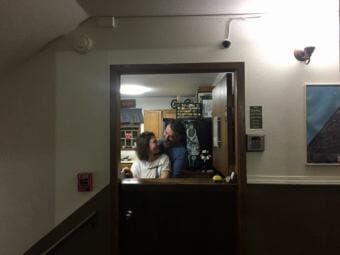
Nancy and Andrew Grant, pictured behind the front desk of their hotel in Utqiaġvik in January 2018. (Alaska’s Energy Desk/ Ravenna Koenig)

“He does not remember meeting me,” Nancy Grant says of her first encounter with her now-husband, Andrew Grant. “I do, too!” he insists.

They can both agree, however, that they met while working for the North Slope Borough School District back in 2002. Today, they own and run the Airport Inn in Utqiaġvik — which, as you might guess, is just a few blocks from the town’s runway.

Neither Nancy nor Andrew grew up on the North Slope. Andrew is a self-described Army brat; his family moved around a lot. And while Nancy’s father is from the North Slope village of Wainwright, she grew up in California. She came to Utqiaġvik for the first time as an adult, to attend her grandmother’s funeral.

“At that point in my life, I had just completed college and I had a dead-end job,” she said, “I was providing for me and my son, and I was a single mom.”

After changing her mind a few times about whether it made sense, she decided to stay.

Her husband Andrew attributes his own decision to move up here to a manager he had at a job in Arizona. The manager had worked at Prudhoe Bay, and had met his own wife there. And for months he pestered Andrew to apply for jobs on the North Slope.

“He said, ‘you’re a young man, you need to go to the Slope!” Andrew remembers, “You need to get a job up there; meet your wife.”

Andrew eventually did apply for a job in Utqiaġvik, and got it. Just like that, he found himself moving to the northernmost town in America.

Even though Nancy and Andrew first met at work, they started to get to know each other through a group of singles that attended the same church.

“I’m just not the real hostess type but these other ladies in the group were, so they would woo us with food — you can’t go wrong with food, especially up here — and games, and just fellowship,” Nancy said. “And that was during the winter and spring, and come summertime, they all left and Andrew and I were the only ones here,” she said.

While everyone else was on vacation that summer, Nancy and Andrew spent a lot of time hanging out one-on-one. Pretty soon, they fell in love. And by that winter, they were engaged.

Together, they bought the Airport Inn back in 2015.

It’s hard to capture the sheer number and diversity of the people passing through this small arctic town. But looking through Nancy and Andrew’s guest book is a pretty good way to do it. Under the heading “To See” people have written “polar bears,” “for work,” “a football game,” “family,” “climate change,” and “just to say we’re here.” Nancy and Andrew say that the flow of people includes tourists, arctic researchers, oil and gas industry people and journalists among many others.

The Grants say that one of their favorite things about working in the hospitality industry here is that this place often leaves a lasting mark on the people who visit. For instance, they still get calls from one man who came up from the Florida Keys years ago, and is now a fan of the high school’s football team.

“When we have a football game going on, sometimes he’ll call the hotel and say ‘hi this is so-and-so from down in the Keys. Who’s winning? What’s the score?'” said Andrew. “I just thought that was the neatest thing.”  

Valentines Day is Nancy and Andrew Grant’s 14th wedding anniversary.

Site notifications
Update notification options
Subscribe to notifications