Ravenna Koenig, Alaska's Energy Desk

Department of Energy scientists to attend first Alaska National Lab Day

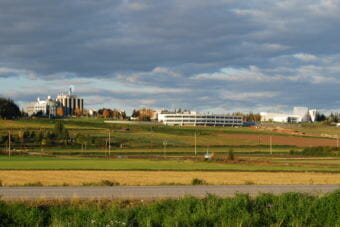
The University of Alaska Fairbanks, 2010. The University will be hosting representatives from the Department of Energy’s national labs this week. (Creative Commons photo by Frank Monaldo.)

On May 30 and 31 scientists from the U.S. Department of Energy will visit the University of Alaska Fairbanks for Alaska National Lab Day.

National Lab scientists along with Alaska researchers, officials and industry leaders will present their work and discuss opportunities for collaboration.

Senator Lisa Murkowski, who helped organize the event, is scheduled to speak.

Larry Hinzman, UAF’s Vice Chancellor for Research, says that the event will highlight research opportunities in Alaska for the Department Of Energy on a variety of issues including energy, climate change and security.

“We think we’ve got some great challenges right now for them and we hope they’ll pick some up,” Hinzman said.

Among those challenges are things like reducing rural energy costs, and designing infrastructure that can deal with climate change.

“And to do that, that requires a lot more understanding than we have now, a lot more engineering capabilities, and just a wiser designs and structural developments,” Hinzman said.

It’s one area of collaboration that Hinzman hopes the national labs will be interested in.

A lot of people get this pretty basic question about oil wrong


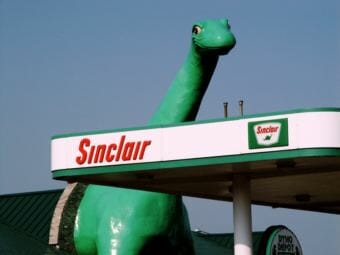
The Sinclair Oil Corporation’s logo is an Apatosaurus named “Dino.” Paleontologist Kenneth Lacovara says he thinks some of the association between dinosaurs and oil started with the company’s advertising. (Creative Commons photo by Jason Clor.)

There’s a pretty basic question about oil that a lot of people get wrong: Does it come from dinosaurs?

Doing a quick poll on the streets of Fairbanks, a lot of people thought it did.

Zach Lyons, a geologist with the oil and gas division at the Bureau of Land Management, Alaska, says that’s a persistent falsehood.

“Oil actually originates from plants and tiny marine organisms that sink down to the ocean floor and are buried over the course of millions of years,” he said.

The plants and critters Lyons is talking about are tiny; most are only visible through a microscope.

Little by little, over millions of years, these creatures died and piled up at the bottom of the sea, mixing with mud and sand to form layers that could be tens of thousands of feet thick. And through a particular formula of heat, pressure, lack of oxygen, and hundreds of millions of years… that marine sludge became oil.

So why do so many people have the impression that we’re loading up our gas tanks with giant ancient reptiles?

Kenneth Lacovara is a paleontologist and geologist, and Dean of the School of Earth & Environment at Rowan University in New Jersey.

“I have tried to trace the history of this” Lacovara said, “and I think it largely goes back to the Sinclair Oil Company.”

You probably know Sinclair Oil by their logo: a big green dinosaur. Sinclair never actually claimed that oil came from dinosaurs, but the creatures became central to their marketing starting back in the 1930s.

But can one company single-handedly create that kind of association?

“Dinosaurs I think, in the public imagination, stand in for the ancient,” Lacovara said. “And dinosaurs are of course known to us as fossils, and oil is called a fossil fuel, and so I think it’s easy for people to make that connection in their minds.”

Lacovara says that the connection runs deep.  It’s a misconception he’s still working to correct.

“I speak to school groups quite frequently,” Lacovara said. “And I have had to correct school teachers in the past who have been teaching their kids that oil comes from dinosaurs.”
So if oil doesn’t come from dinosaurs that died out millions of years ago, what does that mean for the future of oil? Could it be replenished hundreds of millions of years down the line? The answer is… maybe.

The conditions that made all that oil possible — a much warmer climate that encouraged explosive growth of those little marine critters — we just don’t see that now at the same scale.

“So while we are producing the raw material today that could later be turned into petroleum by geological processes, we’re probably not producing them as fast now as 100 million years ago,” Lacovara said.

In other words, we don’t see the conditions on Earth today that would lead to the replication of the oil we’ve used up. But geologic time is a lot longer than human time. You never know what might happen in several hundred million years…

‘How much, how fast?’ Alaska researchers ask of melting Antarctic glacier

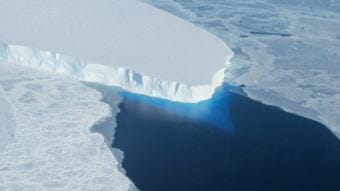
A NASA photo shows the Thwaites Glacier in West Antarctica. Two researchers at the University of Alaska Fairbanks are part of a 5-year research program that will try to determine how fast the glacier is disappearing. (Image courtesy of NASA)

There are glaciers melting all over the world, adding to global sea level rise. Some contribute more than others, and a glacier that’s seen as one of the most critical is the Thwaites Glacier in Antarctica.

Now, two researchers from the University of Alaska Fairbanks (UAF) are embarking on an international research project to study the melting taking place there. Martin Truffer, a physics professor at UAF is one of them. 

“There’s many indications that any sort of potential large-scale sea level rise in the next decades and centuries will come from that area,” said Truffer. “So there’s a large international push to go and understand that better.”

The main thing the researchers will be trying to figure out is the pace at which the glacier is disappearing.

“The report that triggered this proposal call originally had a title that I think was quite catching.  It asked ‘how much, how fast?’ ” Truffer said. “And that’s really the question here.”
He says that in the past few years scientists have come up with a model for the Thwaites Glacier’s collapse that’s faster than anything thought previously.

Truffer and his colleagues will try to establish if that model is correct. They hope their research will give coastal communities the information they need to plan for the future.

“When you start talking thousands of years, then maybe it’s not so important where I build my house, or where people put infrastructure today,” Truffer said. “But if you start talking decades, then you need to plan for that.”

The $25 million, 5-year project is a joint undertaking between researchers in the United States and the United Kingdom.

In October, Truffer’s team will start sending their research equipment to Antarctica. He and fellow University of Alaska Fairbanks professor Erin Pettit will make their first trip for the project there in 2019.

This man and his yellow truck signal the arrival of spring in Fairbanks


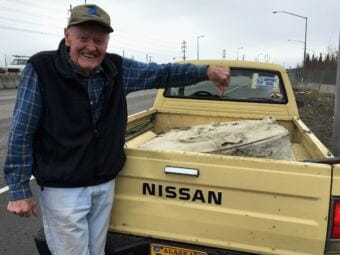
93-year-old Glenn Hackney, giving the thumbs down to a mattress he hauled off the side of the road in Fairbanks on April 30th, 2018. He starts picking up roadside trash as soon as the snow melts each year. (Ravenna Koenig/ Alaska’s Energy Desk)

Glenn Hackney of Fairbanks has been fighting the same battle for over 50 years. It starts every spring, and it’s won with plastic bags and a pickup truck.

“This is the most famous pickup in Fairbanks,” Hackney said. “This little yellow pickup has been hauling trash around town for 25 years.”

Hackney’s big battle is garbage. In Fairbanks his name is synonymous with the annual springtime clean-up day, but for 93-year-old Hackney, any day there’s not snow on the ground is an opportunity for tidying up.

Most of what Hackney picks up off the side of the road is pretty ho-hum: paper cups, plastic bottles, kids toys. But he’s also encountered some stranger stuff, like a bowling ball, and a gilded rose packed in a box.

“I figured it was a jilted lover who tossed it out the window,” Hackney said, laughing.

In late April, Hackney took me on a Fairbanks trash tour in his custard-colored pickup. He jokingly refers to the dents in it as “parking lot kisses.”

Hackney moved to Alaska back in 1948. He spent most of his career working in concrete and construction, and served eight years in the state legislature.

He started picking up trash his first spring in Fairbanks as one of the organizers of the community-wide clean-up day. And he’s been a booster for the cause ever since.

“It gets in your blood,” Hackney said. “I like to see a clean community. I’m frankly appalled at what visitors to Fairbanks would think about right now driving along this section of highway I’m going to show you in a few minutes.”

We got out along a stretch of road that Hackney says is one of the biggest eyesores in town. Cars whipped past us at 55 miles per hour. And yes, there was a lot of trash lying around. But Hackney was there for one item in particular. A soggy mattress that someone had lost, Hackney presumed off the back of their pickup.

Hackney hauled it into the back of his truck with just a little help.

He’s 93 years old, but he’s always had exceptional grit when it comes to improving the street view in Fairbanks.

Back in 1992 he actually got hit by a car while doing it. The car broke both his legs, and he had to have surgery. That might give the average person pause about continuing. Not Hackney.
“You know what they say,” Hackney said with a grin, “Camaros never strike twice in the same place!”

Hackney would like to be clear: his enthusiasm is for clean roads, not necessarily the activity of cleaning them. He says he’d prefer it if there was no trash to pick up in the first place.  

To that end, there are some change’s he’d like to see around town: more people covering the backs of their trucks so stuff doesn’t fly out. And people with mattresses in the back, driving just a bit slower.

“They simply drive too fast and the law of physics, which is immutable, takes over and they fly out the back of the pickup,” said Hackney.

Hackney’s parting words to the people of Alaska: “Always keep busy, never give up, and pick up your darn trash!”

Fears over caribou, access vs. mining’s economic promise — BLM releases public input on Ambler Road

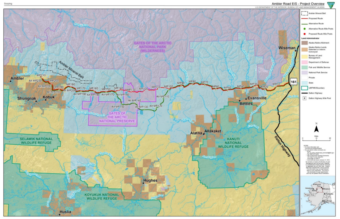
A map of the proposed Ambler Road project. The Bureau of Land Management has just released a summary of the public comments on that project. (Graphic Courtesy of HDR for the Bureau of Land Management.)

The Bureau of Land Management received thousands of public comments on the controversial proposed Ambler Road during the scoping period for the project, which ended in January. The BLM released a summary of those comments this week.

The road, which is proposed by the state, would begin at the Dalton Highway and run over 200 miles west, along the southern edge of the Brooks Range. Proponents say it’s needed to develop the Ambler mining district.

Tim La Marr with BLM said the agency received input from people on all sides of the issue.

“I was impressed with the range of comments that we got,” La Marr said. “Comments from the mining industry, comments from environmental groups, a lot of comments from the tribes… comments from people throughout Alaska and people in the Lower 48 as well.”

La Marr said that of the 7,000 or so written comments, most were form emails. But over 800 were unique messages, many with substantive suggestions for issues that BLM should consider as they assess the impacts of building the road.

Some of those comments argue the road will lead to job growth and economic benefits for the state. Others raise concerns that it would disrupt the Western Arctic Caribou Herd’s migration, or enable more drugs and alcohol to enter rural communities.

A topic that came up often in the comments was who would have access to the road. The state says the road will only be permitted for non-public, industrial use. But a number of people who commented questioned the state’s ability to keep the road closed to the public, especially over the long term.

“A lot of those comments stem from the concern that if it is opened up to public use, then that opens up a huge area in Alaska that sport hunters and fishermen can start to… use those resources at the expense of subsistence uses,” La Marr said.

The comments will help the agency develop an environmental impact statement for the project. That assessment will underpin BLM’s decision on whether to allow the road to be built on federal land.

The state is funding the federal environmental review process. The legislature appropriated funding for the project in the past, but Governor Walker has only allowed a portion of that to be spent so far.

BLM says the state has provided funding through the end of the scoping phase of the Environmental Impact Statement process. To complete the EIS, the state will need to provide BLM with additional funds.

U.N. committee moves toward banning heavy fuel oil in the Arctic

The Marine Environment Protection Committee of the U.N.’s International Maritime Organization, meeting in London in April 2018. At that meeting, the committee took steps to develop a ban on heavy fuel oil use in the Arctic. (Creative Commons photo by International Maritime Organization.)

The United Nations group that regulates international shipping recently decided to move toward banning the use of heavy fuel oil in the Arctic. The thick oil presents unique challenges for cleanup in the event of a spill, especially in cold temperatures.

Environmental groups are cheering the decision, but the ban is still a ways from becoming a reality.

Heavy fuel oil, also called HFO, is relatively cheap. Which is why it’s commonly used by big commercial ships around the world, and to a lesser but still significant degree in the Arctic.

Kevin Harun is the Arctic program director for Pacific Environment, an international conservation organization. He represented the group in early April in London, at the meeting of one of the committees of the International Maritime Organization.

“It is a big deal that the IMO has been looking at a ban,” said Harun. “It’s a very cautious body and it normally does not act without strong support from countries.”

The United States was one of several countries that submitted a paper recommending the move. 

Heavy fuel oil is especially viscous and could present some particular difficulties in a spill. It sinks in many cases when it’s cold, and it doesn’t disperse easily.  

Austin Ahmasuk from Nome also attended the meeting. He’s a marine advocate for the Bering Strait regional nonprofit corporation Kawerak and he supports HFO being taken out of use in the Arctic.

“We want our waters as pristine as possible,” Ahmasuk said. “And a heavy fuel oil spill, or burning of heavy fuel oil… is some of the dirtiest ship power generation that exists.”

One of Ahmasuk’s big concerns is how such a spill could affect marine subsistence resources in the Bering Strait region.

Even though the regulatory group made the decision to start developing a ban, there’s still a lot that will have to happen before it’s put in place. Jeff Lantz is with the U.S. Coast Guard and was the lead representative for the US at the meeting. He says the group will have to do an assessment on the impacts of a ban. 

“It would be looking at the environmental benefit but it would also be looking at the cost to shipping,” Lantz said.  “It could be looking at the cost to communities in the Arctic. Would it raise the cost for delivery of goods and services to these communities?”

Once the assessment is done, the terms of the ban will have to be negotiated, including things like when it would go into effect. A final decision may still be several years out.

Site notifications
Update notification options
Subscribe to notifications