Ravenna Koenig, Alaska's Energy Desk

Fall whaling in Utqiaġvik: joy, excitement and this year, mourning too

Friends and relatives including Rosanna Lemen, the captain’s mother-in-law, help to bag up portions of the whale to give to the community. October 25, 2018. (Ravenna Koenig/ Alaska’s Energy Desk).

Fall whaling concluded in Utqiaġvik in late October, and was characterized this year by events that brought additional excitement, but also sorrow to a usually celebratory time for the community.

In early evening a few days after the last whale has been brought onshore in Utqiaġvik, Ross and Justina Wilhelm’s house is crowded with about 20 friends and relatives. They’re setting out doughnuts and pineapple cake, arranging plates of whale meat and unaalik — which is boiled whale blubber and skin — and bagging up servings of whale for people to take home.

Ross Wilhelm is a whaling captain and his crew, with help from others, brought in the final whale of the season. His wife Justina is responsible for organizing tonight’s “crew’s serving,” an event where anyone in the community can come get a portion of the whale.

The group circles up to pray before the serving starts. As the captain’s wife, Justina Wilhelm, second from right, is responsible for organizing the event. October 25, 2018. (Ravenna Koenig/ Alaska’s Energy Desk).

When everything is ready, the group joins hands. Ross’ mother Lagoo Kunaknana says a prayer in Iñupiaq, expressing gratitude for the whale they’re about to serve.

The prayer is broadcast over VHF radio, along with the family’s house number and an announcement that they’re ready to serve. Soon there’s a steady stream of people revolving through the house, yelling congratulations and trading hugs in the Wilhelm’s living room.

Ross Wilhelm spends the evening shaking hands and greeting visitors.

“It’s just what puts us together is the whale, the bowhead whale. Just gets us all together,” he says, before breaking off to say hello to an approaching friend.  

Wilhelm says that the usual energy around fall whaling was boosted this year, coming off a big success at the meeting of the International Whaling Commission in September. At that meeting, the IWC made some key changes to the bowhead whale quota that Alaska subsistence hunters had been pushing for.

But on the other end of the emotional spectrum, the community just experienced a profound loss. About a month ago Captain Roxy Oyagak Jr. and crew member Ron Kanayurak were killed in a whaling accident off the coast of Utqiaġvik when their boat capsized while towing a whale to shore.

Ross Wilhelm says that the crew’s serving is a time of joy, and that seems to be the main emotion in the room during the event. But in conversations around town it’s clear there’s still a lot of pain related to the accident. It’s also an important reminder of something that whalers already know well: that whaling can be dangerous.

Wilhelm says that he was shaken by what happened.

“I’d make myself look bad if I said it doesn’t scare me,” he said. “I’d be stupid if I didn’t say that of course it does.”

Captain Ross Wilhelm, using the VHF radio to notify the community that they’re about to broadcast a prayer. His mother Lagoo Kunaknana, to his right, says the prayer in Iñupiaq. October 25, 2018. (Ravenna Koenig, Alaska’s Energy Desk).

Despite what happened this season, and a close call he himself had in the past, Wilhelm isn’t deterred from the hunt. He says sometimes things happen that are outside your control, but the only thing you can do is renew your vigilance when it comes to basic safety.

He’s not the only one thinking along these lines. The Barrow Whaling Captains Association is reviewing what happened, and will be discussing what safety lessons may be drawn from the accident at upcoming meetings. That’s according to Crawford Patkotak, a whaling captain and board member. He says that many in the community are still mourning the loss of the two men, but the overarching dedication to continuing the tradition of whaling remains strong.

“For the most part our people are able to rebound and continue our life, our culture,” said Patkotak. “And knowing that Roxy and Ron would have it no other way, they would want us to continue our culture.”

Fall whaling concluded in Utqiaġvik with hunters bringing in a total of 19 whales, the full number of whales permitted by their quota.

A warming Arctic means a change of plans for offshore drilling project

Liberty
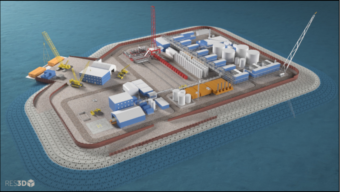
A 3-D rendering of Hilcorp’s proposed Liberty project represented in the Bureau of Ocean Energy Management’s environmental impact statement. (Image courtesy BOEM)

The Trump administration gave a key approval last week to a milestone oil development. Called the Liberty Project, it would be the first oil production facility in federal Arctic waters. It’s being developed by Hilcorp, a Texas-based oil company.

But as the Arctic warms, Hilcorp is already having to tweak its proposal to accommodate climate change. And future companies looking to drill offshore in the Arctic may have additional changes to plan for.
To get at the oil, Hilcorp is planning to build a gravel island about five miles from shore in the shallow waters of the Beaufort Sea and drill from there.

In order to build that gravel island, the company plans to use what’s called landfast sea ice, or ice that attaches to the coast each winter. They would drive on top of it and dump the gravel through holes in the ice. Shallow, near-shore operations have used sea ice in that way before.

“When it’s in place and when it’s stable, it makes actually a fairly convenient platform from which to operate,” said Andy Mahoney,  a sea ice researcher at the University of Alaska Fairbanks who provides information to oil companies and federal regulators on what they can expect of ice thickness, extent, and seasonal duration.

“You can build ice roads on it. You can operate drilling equipment from it. And it’s, I think, in many ways easier than trying to work off of a ship or a barge or something like that.”

Mahoney says that the primary concern he hears from oil companies who want to work on landfast ice is that the window they have to work is shrinking as the Arctic warms. Mahoney says the ice is forming later and breaking up earlier.

That means companies may have to stretch out work from one winter to two.

Apparently, that’s happening to Hilcorp, according to construction plans the company has provided to regulators.

According to plans Hilcorp shared with a federal agency in 2015, the company originally thought it could build the gravel island in one year. But in an email, the Bureau of Ocean Energy Management (BOEM) confirmed that due to “historically abnormal ice conditions in the Arctic,” Hilcorp amended its plans. Now, the company is telling the agency it could take two years to build the gravel island.

Hilcorp declined to comment.

There are also other ways that a warming Arctic may affect companies who pursue offshore drilling projects.

“With the projections of declining sea ice you would expect the waves to get bigger and bigger, and in fact that’s what is being seen in the Beaufort Sea,” said Jeremy Kasper, an oceanographer at the University of Alaska Fairbanks.

Kasper is currently leading a study for BOEM trying to better understand wave and sediment dynamics in the area around Hilcorp’s Liberty project.

A large part of their focus is the potential impacts of the Hilcorp development on the marine environment. But they’re also going to model how wave height, storm surge and coastal erosion may change along the whole Beaufort coast and some of the Chukchi coast decades into the future as the climate warms.

Kasper says those changes could mean that companies have to plan for increasing erosion around their pipelines or alter how they work in higher wave conditions — for example, in shallow areas of the Beaufort sea.

“If you increase the waves, you’re talking about bigger boats,” said Kasper. “Bigger boats, you have to start thinking about dredging because it’s pretty shallow up there.”

Earlier this year the Trump Administration proposed opening the majority of Alaska’s federal waters to drilling, including Arctic waters. The first federal offshore lease sale for the Beaufort Sea could happen as soon as late next year. However, a final plan has yet to be issued and lease sales have yet to be held.

But as warming temperatures change the Arctic landscape, it’s hard to imagine that any future drilling operation in Arctic waters could avoid calculating in the effects of climate change.

This article has been clarified to reflect that the Liberty Project would be the first oil production facility in federal Arctic waters, but not the first oil production from federal waters. Northstar Island, also operated by Hilcorp, produces oil from federal offshore leases in the Arctic, as well. 

Alaskans rally in support of youth climate lawsuit, currently in limbo


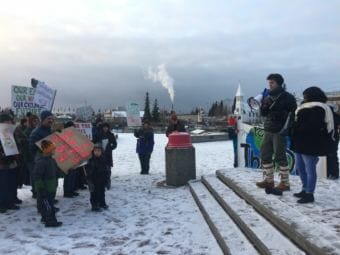
Tristan Glowa, 22, addresses a crowd that gathered in Fairbanks Monday to support Juliana vs. United States. (Ravenna Koenig/ Alaska’s Energy Desk).

Monday was supposed to mark the start of a trial in a landmark climate change lawsuit brought against the U.S. federal government by almost two-dozen young Americans.

The lawsuit — Juliana vs. United States — argues that the government has violated the constitutional rights of 21 youth plaintiffs by actively worsening climate change with its policies. They also argue that the government has failed its duty to safeguard important environmental resources under the “public trust doctrine.”

But the case has been placed temporarily in limbo by the Supreme Court. So, instead of a trial, the day was marked by rallies in support of the case.

At the rally in Fairbanks, over 50 people showed up to hear speeches from mostly young people.

“This is no longer a scientific issue, it’s not a scientific question. It’s a moral and spiritual issue,” said Tom Baring to cheers from the crowd. “And we are making it a legal issue as well.”

Baring is the father of one of the plaintiffs, 19-year-old Nathan Baring.

Rallies were also held in Anchorage and Sitka, and a youth engagement event in support of the lawsuit was held in Homer. According to a press release from Our Children’s Trust, the legal organization supporting the plaintiffs, there were more than 70 events planned across the U.S. for Sunday and Monday.

The Juliana case was put on hold over a week ago by Chief Justice John Roberts who granted a request from the Trump administration to delay the proceedings. The Trump Administration has already tried to get lower courts to dismiss the case, without success.

According to Michael Gerrard, a professor of environmental law at Columbia University, it’s not clear what the outcome will be.

“It’s conceivable that they could dismiss the whole thing, but that is unlikely,” Gerrard said.

He says the Supreme Court’s other options are to lift the stay and allow the case to proceed to trial, or to send it back to a lower court to rethink their decision to allow the case to move ahead.

U.S. Treasury Secretary Steven Mnuchin talks gasline, Alaska economy in Fairbanks


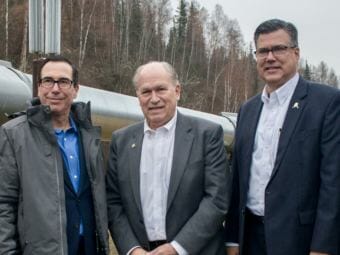
U.S. Treasury Secretary Steven Mnuchin, Alaska Governor Bill Walker, and AGDC President Keith Meyer at the Trans-Alaska Pipeline visitor center north of Fairbanks on October 13, 2018. (Alaska Gasline Development Corporation).

One of President Trump’s Cabinet officials made a stop in Fairbanks this past weekend.

Treasury Secretary Steven Mnuchin was on his way back to Washington D.C. from a meeting in Indonesia. On Saturday, October 13th, he attended several meetings to talk about Alaska’s economy with community and business leaders.

Gov. Bill Walker organized a number of those meetings, but he said the idea to come to Alaska was the Mnuchin’s idea. He said the primary reason for the visit was for the Secretary to get a better understanding of the Alaska LNG Project.
“Learning more about the mechanics of the project, how it would work,” said Governor Walker. “He’s obviously very involved on the trade issues as well.”

The Secretary also attended a discussion with several Alaska Native corporations including Ahtna Incorporated, Calista Corporation, CIRI, Doyon and NANA.

“I wanted him to hear from them as far as what they do in the way of resource development in Alaska,” Walker said. “It’s a very unique model. And how successful they have been, and the big impact that their … corporations have on Alaska employment and revenue to the state.”

Both Sen. Lisa Murkowski and Gov. Walker accompanied Secretary Mnuchin during his Fairbanks trip.


Two Utqiaġvik whaling crew members die in apparent whaling accident

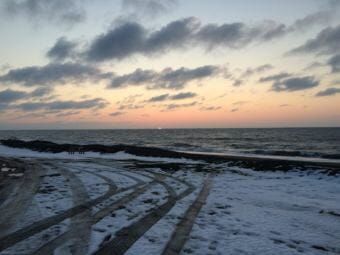
The coastline off of Utqiaġvik. September 25, 2014. (Andrew Petersen).

Two members of an Utqiaġvik whaling crew have died, reportedly after a boat capsized during fall whaling.

In a statement Monday, Oct. 8, North Slope Borough Mayor Harry K. Brower Jr. confirmed that two lives were lost and said that the Borough is not releasing details about the incident until all the facts are gathered and all family members have been notified.
On Facebook Monday, members of the Utqiaġvik community and others from around the state posted condolences, remembrances and prayers for the whalers and their families.

In Interior Alaska, reinvestment in coal power runs counter to national trend

The University of Alaska Fairbanks recently held an event to celebrate the completion of their new coal fired power plant, the only coal plant to be built in the U.S. since 2015. August 29th, 2018. (University of Alaska Fairbanks).

An oft-cited trend in the lower 48 is that coal plants are closing, in a large part due to the availability of cheaper natural gas.

But in the Interior of Alaska, that picture looks different. Last year, almost 40 percent of the Interior’s electrical generation came from coal, according to a 2018 report by the McDowell Group, and the area is home to the only coal power plant built in the United States since 2015. So why has coal has hung on in the Interior? And are there challenges to it on the horizon?

On a sunny day at the end of August, University of Alaska Fairbanks chancellor Dan White stood on a dais at the edge of campus. He addressed a crowd of people who had shown up to celebrate the completion of UAF’s coal-fired power plant, expected to come online in November.

“This is the university where the world class research for all of the Arctic is done,” White said. “And we can’t do that without a reliable supply of heat and power.”

Instead of a ribbon cutting, there was a switch to flip, prompting light bulbs that spelled out “U.A.F.” to jump to life.

This power plant is a big deal to UAF, considering its old one was in danger of failing. But it also has a more symbolic significance. In a decade when hundreds of coal plants have been retired across the United States, UAF’s reinvestment in coal shows just how different things are in Alaska’s Interior.

Why is it different here?

One of the big factors is that even after decades of talk about getting affordable natural gas to the Interior, Fairbanks as of yet has only a limited supply of natural gas. And unlike many other places in the country, it’s not price-competitive with coal.

“There’s an ad at the Fairbanks Economic Development Corp. from the News Miner: ‘Gas is coming!'” quotes Brian Rogers, former chancellor at the University of Alaska Fairbanks. “It’s from the 1958 News Miner.”

Rogers was part of the team that explored fuel options for the new plant. He says they looked at a slew of them, including trying to get natural gas.

“I didn’t particularly want to go with nuclear; we looked at it,” Rogers said. “I would have loved to have gone with natural gas, we don’t have it. Oil would have been super expensive… There’s not enough solar to heat a university campus in the middle of winter.”

He says that coal wasn’t their first choice, mostly due to its higher C02 emissions. But when they narrowed the field down to the types of energy that were available, feasible and affordable coal won, hands down.

UAF’s is one of 6 power plants that rely on coal in the Interior. One is at Fort Wainwright, another at Eielson Air Force Base and three more generate electricity for the local electric utility, Golden Valley Electric Association.

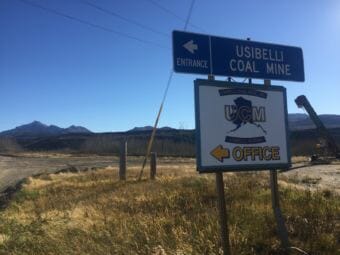
All of that energy comes from the Usibelli Coal Mine, which is two hours drive from Fairbanks and just 10 miles north of Denali National Park.

The Usibelli Coal Mine is located just outside Healy in Alaska’s Interior. It produces about a million tons of coal a year, and supplies 6 Interior power plants. October 1st, 2018. (Ravenna Koenig/ Alaska’s Energy Desk).

Usibelli is the only operating coal mine in the state of Alaska, and has been owned by the Healy-based Usibelli family for 75 years.

“Emil Usibelli came to Alaska in the ‘30s,” said Vice President of External Affairs Lorali Simon. “And he actually first started in the Matanuska coal fields and then he moved up here to the Interior, and in 1943 started Usibelli Coal Mine.”

Simon says Usibelli’s operation is pretty small when you compare it to most coal mines in the lower 48. The company employs about 100 people, and produces around a million tons of coal a year. In 2011 their production was over twice that, but it’s dropped since, mostly due to a declining export market.  They stopped exports altogether in 2016.

On the other hand, local demand recently went up. Just last month Golden Valley Electric Association (GVEA) brought a previously-built coal plant online, upping the percentage of their coal-generated electricity from about 30% to over 65%.

So, that’s the way things are. But what about the future?

When asked if he’s under pressure to move away from coal, Cory Borgeson, President and CEO of GVEA, answers in the affirmative.

“There is a drive to reduce CO2 emissions,” he said. “So how does that affect the future of coal in the Interior and at Golden Valley? I would say if you’re a futurist here and you’re looking at where things are going, you’re going to see a reduction in the production of power from coal.”

Borgeson thinks Golden Valley could move in that direction by expanding their renewables and battery technology, perhaps collaborating with other Railbelt utilities. He also thinks there’s a possibility that natural gas could become a more economical option as the Interior Gas Utility moves forward with their efforts to expand gas supply in Fairbanks.

Another thing that could play a role — at least in the future cost analysis for the Fairbanks-area power plants —  is the air quality issue. Coal and oil fired power plants aren’t the biggest contributors to the problem; the main source is wood smoke. Even so, if the issue isn’t fixed, the state and federal governments may have to place stringent requirements on those plants, which would likely make the energy produced by them more expensive than it is currently.

But, for the moment at least, the equation still doesn’t add up to an imminent challenge to coal.

Site notifications
Update notification options
Subscribe to notifications