Ravenna Koenig, Alaska's Energy Desk

After struggling for years to clean up its air, Fairbanks still faces contentious wood smoke problem

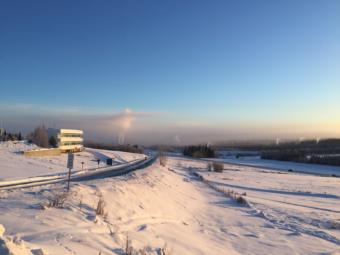
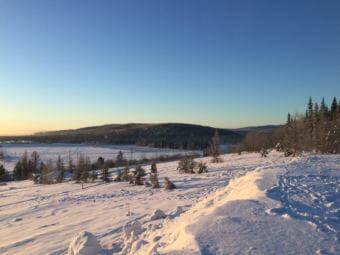
Part of what contributes to Fairbanks’ air quality problem is the fact that it gets strong temperature inversions where the air gets stuck and the pollution layers on itself. This photo was taken from the University of Alaska Fairbanks on Jan. 6, 2019, when there was an air quality alert in effect for the area. (Ravenna Koenig/ Alaska’s Energy Desk)

For years, Fairbanks and neighboring city North Pole have had some of the worst air quality in the United States. And a major contributor to that is people burning wood in their homes to stay warm.

The area has been failing to meet a federal air quality standard since 2009, and this year is the deadline for meeting that standard. But after almost a decade of struggle, trying to get people to cut back on wood burning is still as contentious as ever.

When you look at it technically, Fairbanks’ intractable problem is actually pretty simple, according to Nick Czarnecki, the air quality manager for the Fairbanks North Star Borough.

“We know what the main contributor to the pollution is,” said Czarnecki.

The federal standard that Fairbanks can’t seem to meet is for a tiny pollution particle known as PM 2.5. And Czarnecki said that studies have shown 60-to-80 percent of the pollution that’s putting them over that standard comes from wood-burning stoves in people’s homes. Smaller contributions come from home heating oil, industrial sources like power plants, and car emissions.

But the solution isn’t easy.

“It pits heating one’s home versus breathing clean air,” said Czarnecki.

According to the Environmental Protection Agency, PM 2.5 has been linked to numerous health issues, including premature death in people with heart or lung disease, aggravated asthma, and decreased lung function.

The high concentration of these particles in Fairbanks and North Pole is due in part to the fact that the area gets some of the most intense temperature inversions in the world. That means that periodically throughout the winter, there are events where the air just gets stuck close to the ground, and all the pollution layers on top of itself.

Over the years, the most controversial step the borough has taken to clean up the air is to ban wood burning on bad air quality days.

In 2015 the Borough Assembly voted to make those bans mandatory for the first time and back them with fines of up to $1,000 for repeat-violators.

Over the course of the next three winters, the borough issued several hundred warning letters, but only three citations.

But in the local election last October, voters passed a proposition that took away the borough’s power to regulate home heating devices like wood stoves and — among other things — their power to enforce burn bans. That job now falls to the state.

But the state — which had little time to budget or plan for their new responsibilities — has fewer resources for enforcement than the borough did. Plus, it doesn’t have the authority to issue fines.

Meanwhile, as the problem enters its 10th year, the emotions around it are as strong as ever.

Ice fog hangs over Fairbanks during a weather inversion on Jan. 21, 2003. This is facing South from the eighth floor of Bartlett Hall at the University of Alaska Fairbanks.
Ice fog hangs over Fairbanks during a weather inversion on Jan. 21, 2003. (Creative Commons photo by Kyle Cuzzort)

Patrice Lee is a retired math and science teacher who’s been one of the people most outspoken over the years in trying to get the borough, state and federal governments to do more to clean up the air.

“My youngest son, Alex, has Down syndrome and congenital heart defects. They’re very serious. He’s had five open heart surgeries; a pacemaker implant,” said Lee.

Her son’s vulnerability is what got her involved with the issue, but she said she’s concerned about the health of her community as a whole.

As we talked, Lee got a phone call from a woman she knows out in North Pole. The woman had a heart attack a number of years ago and is worried about the effects of smoke on her health. She sounded deeply frustrated as she told Lee that the smoke pollution at her property is “worse than ever.”

Lee gave her the phone number to lodge a complaint with the state, and they hung up. I asked Lee if people call her like that often.

“They do,” she said. “They don’t know what to do. They’re desperate.”

Lee and others concerned about the health effects of poor air quality feel like they’re watching a public health crisis play out in slow motion.

It’s been almost 10 years, they say, and even though the numbers have improved, the air quality in certain areas is still far worse than the federal standard.

Size comparisons for PM particles.
Size comparisons for PM particles. (Environmental Protection Agency graphic)

But one of the things that makes this issue tricky to solve is that for some, burning wood is its own health and safety issue.

“February last year when it got pretty cold … My fuel tank got the point where it was a matter of either, be compliant and not burn wood, or not feed the kids,” said Jesse Shadley.

Shadley came to Fairbanks with the Army and later worked for the pipeline, where he said he had great benefits and great pay. But that changed when he got divorced and became a single dad.

“Having three kids I’m raising all by myself, I just … I needed to be home more,” said Shadley.

So he left his job at the pipeline and started working as a jeweler in town.

Shadley lives on a quiet suburban street in North Pole where — on the day I visited — the temperature was 40-something below zero.

He told me that it could cost anywhere from about $250 to over $700 a month to heat his home with fuel oil if he’s not supplementing with wood.

He has a waiver for this winter that allows him to burn even during the worst air quality days. He got it because his home would suffer damage from the cold if he didn’t use the wood stove.

That waiver is also issued for homes that don’t have another adequate source of heat, or for individuals who can show financial hardship requires them to burn wood. This year, 49 people have those waivers. Another 244 people have waivers for appliances that meet borough standards for emissions, which lets them burn on days when the air quality is bad but not at its worst.

Shadley said he does his best to burn as little and as cleanly as possible, and the only way he sees this problem being fixed is if everyone does their part to cut back on burning wood.

“There’s going to have to be some compromises. And, you know, people are going to have to understand that there are going to be times where … we can’t just burn wood,” Shadley said.

“And there’s also some people that defiantly burn wood,” he continued, “or defiantly burn wet wood or burn improperly just as a matter of, you know, ‘You can’t tell me what to do.’”

According to the federal law that dictates the timeline for getting an area with poor air quality into attainment, Fairbanks and North Pole are supposed to have the air cleaned up by the end of this year. The average air quality for 2017, 2018, and 2019 together are supposed to meet the federal standard. But both the state and the borough say that’s not possible.

It’s not clear yet what will happen after that.

The area could be required to start reducing the pollution 5 percent each year until they get into attainment. Or the state could request an extension from the EPA, which would require them to use even more stringent measures to clean up the air.

Or eventually — if the area doesn’t show progress — the federal government could take over and come up with their own plan to get the area into attainment.

Either way, local officials say that the longer this problem drags on, the more it’s going to cost the community to fix — and the less control they’ll have.

State of Alaska issues two key permits for Donlin mine

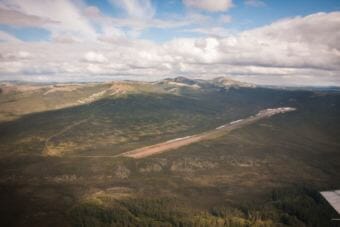
The proposed mine would be one of the biggest gold mines in the world if completed. (Photo by KYUK).

On Friday the state of Alaska issued two key permits for the proposed Donlin Gold mine in the Yukon-Kuskokwim Delta.

One is the reclamation plan approval, which outlines how Donlin Gold would clean up the mine site after the project is over. The other is a waste management permit, detailing how the company plans to deal with tailings, waste rock and wastewater related to the mine.

Along with the reclamation plan, the state also increased the amount of money Donlin Gold will be required to put down ahead of time for the mine’s cleanup.

That figure — which appeared in an earlier draft as $317 million — has been bumped up to $322 million. The state says the revision was made to cover the cost of maintenance for a permanent road that would be built to access to the mine.

Polar bear encounter reported in Arctic Village, many miles south of normal range

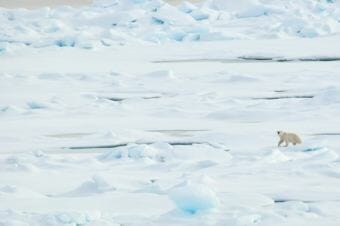
A polar bear on the Beaufort Sea ice in 2010. It’s rare but not unprecedented for polar bears to appear many miles south of the Beaufort Sea coastline. (Creative Commons photo by Dr. Pablo Clemente-Colon/NOAA National Ice Center)

A man in Arctic Village reports that in early January he encountered and shot a polar bear. That may be an unprecedented event in Arctic Village, which is over a hundred miles south of the Beaufort Sea coastline, far outside polar bears’ normal range.

Jim Hollandsworth has lived in Arctic Village for about 30 years. He said he has never seen a polar bear before now. Neither have any of the elders he’s spoken to.

“One of the elders had heard about polar bears before, maybe, but no one’s ever actually seen one,” Hollandsworth said.

He reported that he went to check a trapline about a week and a half ago and immediately saw evidence of the bear when he arrived at his camp, which is about 20 miles from town by trail.

“Tore up one of the snowmachines, flipped it completely over,” said Hollandsworth, describing the damage. “Destroyed everything all around it, um, kinda marking its spot.”

Jim Hollandsworth says that the day before he encountered the polar bear, he found it had done damage to his camp, including this snowmachine. (Photo courtesy of Jim Hollandsworth)

Hollandsworth didn’t see the bear itself until the next morning, when he stepped outside to put gas in the generator.

“My dog barked, and the bear was on my back, right behind me. And I jumped back inside, grabbed my rifle,” said Hollandsworth. “By time I got turned around, it was heading for the door, the open door. Wanted to come in. So they got shot point-blank right there at the doorstep,” he said.

Hollandsworth said it was still pretty dark out, and it was only after he’d shot the bear that he realized what it was. He said that the bear appeared to be a young female, probably about two years old.

When he reported the incident to the Alaska State Troopers, they put him in touch with the U.S. Fish and Wildlife Service, the agency responsible for managing polar bears.

Polar bears are federally protected, but there’s an exception when a bear is killed in self-defense.

U.S. Fish and Wildlife did not respond to requests for comment, presumably due to the government shutdown.

“It’s not common for polar bears to be way outside of the typical range, but it’s not unheard of,” said Eric Regehr, a polar bear researcher with the University of Washington who’s worked in Alaska.

He said that bears in Alaska usually stay within a few miles of the coast, with the exception of pregnant females who may go farther inland to build their dens. But even those bears generally don’t venture as far south as the Brooks Range.

The Alaska Department of Fish and Game provided two examples of polar bears appearing unusually far south in the past two decades: one in Fort Yukon in 2008, and the other on the haul road almost to Toolik Lake back in 2002.

Regehr said that in individual cases like this, it’s very difficult to attribute cause to why a bear wandered so far from its typical area.
“It seems to particularly happen with young bears,” he said. “And it’s not clear if they’re dispersing, looking for new habitat. It’s not clear if they got, you know, mixed up, if they’re just inexperienced and they went the wrong way.”

He said that generally, declining sea ice due to climate change may lead some bears to appear in unusual places, but at this time of year — when sea ice is present — it doesn’t seem to him to be a likely explanation.

Fairbanks’ famously severe cold snaps are getting less cold and more rare

Recent temperatures in Fairbanks have dipped into the negative 30s and 40s Fahrenheit, but won’t add up to the kind of severe, week-long cold snap that used to be more common in Fairbanks, according to climatologist Rick Thoman. Due to climate change and other factors, cold snaps in the area have declined in frequency and severity. (Photo by Ravenna Koenig/Alaska’s Energy Desk)

This week, some places in the Fairbanks area saw temperatures in the negative 30s and 40s Fahrenheit.

It only stayed like that for a few days — though more severe cold is predicted before the week is over.

Fairbanks’ cold snaps have historically been the stuff of legend. But due to climate change, and some other factors, they have become less frequent and less severe.

Mary and Dick Bishop arrived in Fairbanks in the fall of 1961. That December, Fairbanks experienced its most intense cold snap on record — averaging about -54 F for the last week of the month.

“Nothing’s bad after that,” said Mary Bishop, laughing. “We got quite an initiation.”

Over the past 50-plus years living in the Interior — most of it in Fairbanks — the Bishops have seen plenty of intense cold spells where it’s -40 F or colder for more than a week.

They said there’s a list of challenges that come along with that cold.

“Your tires are flat on one side,” said Dick Bishop, “and all the cars just didn’t start.”

“We had minimal insulation in (our) house,” said Mary Bishop, “and our young boys just lived in snowsuits.”

But the Bishops said those bottom-scraping temperature periods don’t happen nearly as often these days.

And they’re right, according to Rick Thoman, a climatologist at the University of Alaska Fairbanks.

He says that the definition of a cold snap is somewhat “in the eye of the beholder.” But when he mapped out the “great cold snaps” using the Fairbanks weather record, he defined it as a week where temperatures averaged -40 F or colder.

“Cold, like so many other environmental hazards in Alaska, is often cumulative,” said Thoman. “So one cold day, OK, you just get through it. But after several days of deep cold, as things start to really freeze up, the impacts grow,” said Thoman.  

What he found was that over the last 80-some years, there’s been a noticeable change: The more recent cold snaps haven’t been as cold, and they’re occurring less frequently than they used to.
Climatologist Rick Thoman graphed the frequency and severity of cold snaps in Fairbanks where the temperature averaged -40 F or colder for a week. (Graphic courtesy of Rick Thoman)

Thoman said a significant driver of that is climate change. But he said there are other factors too. One is related to urban growth, especially the increased number of cars on the road.

“Cars put out a lot of water just from burning gasoline, and that helps thicken up ice fog,” said Thoman. “And ice fog, believe it or not, is actually a pretty good blanket.”

That’s only a relatively small piece of it, according to Thoman, because when he looks at the data from other places in the Interior that have seen no population change, there’s a similar trend.

Another piece, he said, is natural variability — multi-decade cycles in the atmosphere and ocean that can be more conducive or less conducive to creating that super-cold weather.

But he added that even though those natural cycles have gone through at least one full rotation since the 1970s, “We have not see a return to the temperatures or the frequency of the cold snaps that we saw before that.”

The current forecast for the end of this week show lows in the -30 F to -50 F range in the Fairbanks area. Will it add up to a week cold enough to make it on Thoman’s graph of great cold snaps? Not this time, he said.

Japan whaling decision may have consequences for Alaska subsistence whalers

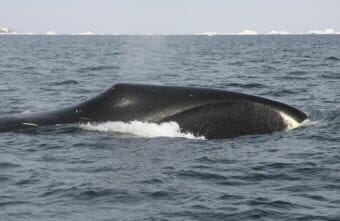
The International Whaling Commission recently voted to grant Alaska subsistence hunters a conditional automatic renewal for their bowhead whale quota. Japan’s departure from the IWC could make that automatic renewal less secure in the future. (Creative Commons photo by Kristin Laidre/University of Washington)

Last month Japan announced that it is leaving the international group that regulates whaling and will resume commercial whaling in its own coastal waters.

That move provoked some criticism. Commercial whaling has been banned by the International Whaling Commission since the 1980s.

But separate from that, Japan’s decision may have consequences for Alaska’s legal aboriginal subsistence whaling.

Japan’s departure means it will no longer conduct what it calls scientific whaling outside its waters — which was criticized by some as a loophole. Instead, it will hunt commercially in its own territorial waters and 200-mile exclusive economic zone.

The announcement comes on the heels of a proposal Japan made to resume commercial whaling at a recent meeting of the IWC — a proposal that failed.

Japan’s leaving the commission has potential consequences for Alaska whalers, whose quota for subsistence whaling is set by the IWC.

“It would be in our best interest to have Japan remain with the IWC,” said John Hopson Jr., chairman of the Alaska Eskimo Whaling Commission and a whaling captain in Wainwright. “They were a strong ally of ours in obtaining our quota.”

It’s too soon to know the ultimate impact of Japan’s decision. But the country does play an important role at the IWC, according to Jessica Lefevre, a lawyer for AEWC.

“Japan is a key member of the group within the body that refers to themselves as the ‘sustainable use group,'” said Lefevre. Others include Norway and Iceland, as well as some African, Caribbean and Pacific Island countries.

She said it’s possible that other countries in the sustainable use group could follow Japan’s example and leave the IWC as well — diminishing support for Alaska whalers.

That could make a critical rule change that passed last year less secure. The rule change made the renewal of aboriginal subsistence whaling quotas — including Alaska’s — automatic, provided certain conditions are met.

“The main vulnerability for us is that automatic renewal could be challenged at some point in the future if the … balance of power within the IWC, given Japan’s departure, shifts more in the direction of the anti-whaling coalition,” said Lefevre.

It would take a three-fourths majority vote of the IWC to change the current quota rule.

Hopson said AEWC will work with the United States and other IWC countries to try to find a path forward that preserves Japan’s membership.

He said his group will have a better sense of their next steps after AEWC’s next board meeting later this month.

Adding insulation to the outside of your home? Watch out for mold.

When people want to bring down their heating bill in Fairbanks — where winter temperatures often dip into the negative double digits — they’ll sometimes try to improve the energy efficiency of their homes by adding more insulation on the outside of their house.

But there’s a pitfall to watch out for: mold.

At the Cold Climate Housing Research Center in Fairbanks, there’s an experiment underway to try to find a cheaper way to make that kind of retrofit while still keeping risk of mold low.

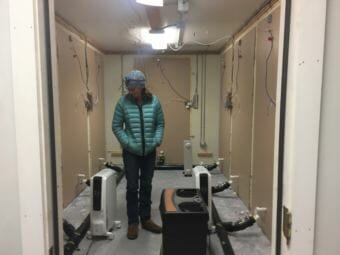
Research engineer Robbin Garber-Slaght leads the way behind the back of the main building to a shipping container in a stand of black spruce.

The mobile test lab at the Cold Climate Housing Research Center. (Ravenna Koenig/ Alaska’s Energy Desk).

Inside are heaters, pipes, a humidifier and a huge humming fan, which are mimicking the conditions you might find in a house with high humidity. The walls of the container have been divided into nine sections with different types and thicknesses of insulation behind them. Each wall also contains wires with sensors that pick up temperature, moisture content and other data.

“All those wires go back to our central station where we’re recording everything,” said Garber-Slaght.

The problem that the Cold Climate Housing Research Center is trying to solve here has to do with moisture — and money. Since foam can be expensive, people often opt for something like two inches when they’re doing a retrofit.

“Every summer driving through Fairbanks, I will see somebody adding this kind of retrofit to their home,” said Garber-Slaght.

Here’s the issue with that: Every home has moisture in the air. It’s created by breathing, cooking, showering. And that moisture can find its way into the walls through various leaks.

In a poorly-insulated house with no foam on the outside, that moisture can condense inside the walls, freeze, and then evaporate to the outside of the house when summer rolls around — at least in a dry climate like Fairbanks.

But with something like two inches of foam, the inside of the walls will likely be cold enough for the air moisture to condense into water, but not so cold that it freezes. And when summer comes, the foam can act like a barrier and prevent the water from evaporating out.

Those are ripe conditions for mold, according to Garber-Slaght. The test wall is evidence. She said after one winter, they opened the wall to look inside: “This wall that had two inches of (expanded polystyrene) bead board on the outside of it grew mold.”

Research engineer Robbin Garber-Slaght in the Cold Climate Housing Research Center’s mobile test lab. They’re doing an experiment that they hope will lead to cheaper insulation retrofits that have low risk of mold. (Ravenna Koenig/ Alaska’s Energy Desk).

Garber-Slaght added that in most houses in Fairbanks it could take longer for mold to become a problem. It may not become evident for years, but when it does, it can create all kinds of health issues.

The problem can be solved by adding enough insulation that the air in the walls stays close to the temperature of the air in the house. That standard will be different in different climate zones. But in a place as cold as Fairbanks, that standard can be about six inches of foam — which is really expensive.

Thus this experiment, which the Cold Climate Housing Research Center hopes will help them come up with a cheaper option.

In the meantime, Garber-Slaght said there are other things homeowners can try that don’t carry the same cost. Like getting a home energy audit to help identify leaks.

“Hot air moving through holes in the wall is really easy to block up, and it’s a huge energy saver,” said Garber-Slaght.

She also suggested insulating the attic, since a lot of heat can be lost through the top of the house.

As for adding insulation to the walls, Garber-Slaght said homeowners across the state should talk to a professional first to figure how much insulation is needed to keep risk of mold low.

Site notifications
Update notification options
Subscribe to notifications