Ravenna Koenig, Alaska's Energy Desk

State of Alaska petitions federal government to delist Arctic ringed seals under the Endangered Species Act

Ringed Seal
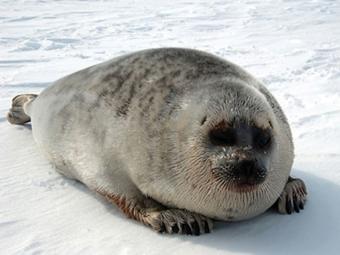
Ringed seal. (Public domain photo by NOAA Fisheries)

In the latest chapter of an ongoing debate over the status of Arctic ringed seals, the state of Alaska has petitioned the federal government to take the seals off the list of threatened species under the Endangered Species Act.

Ringed seals were added to the list back in 2012 because their sea ice habitat is expected to decline significantly in the coming years as the Arctic warms. A species can be designated “threatened” under the Endangered Species Act if it’s likely to become endangered in the foreseeable future through much of its range.

But in its petition, the state says that new research and re-analysis of prior data shows that ringed seals are doing well despite documented sea ice loss, and are likely to adapt to changing habitat conditions.

“They’re the most abundant marine mammal in the Arctic, there’s millions of them, and they’re a very resilient marine mammal as far as we can tell,” said Chris Krenz, the wildlife science coordinator for the Alaska Department of Fish and Game.

Krenz said that the “threatened” designation could create hindrances for oil and gas development, as well as for subsistence hunters.

Three North Slope entities are listed as partners in the state’s petition: the North Slope Borough, Arctic Slope Regional Corporation, and the Iñupiat Community of the Arctic Slope.

Subsistence hunting is generally exempt from restrictions under the Endangered Species Act, although the government can put regulations in place if they find that a hunt materially and negatively affects a species protected by the act. There are currently no such regulations for ringed seals, and federal government officials say there are no plans to put any in place.

The National Marine Fisheries Service — the agency responsible for threatened marine species — says that they have 90 days from when the state’s petition was filed to assess it and determine if they need to review the ringed seals’ listing.

Ringed seal
Ringed seal. (Public domain photo by NOAA Fisheries)

The petition comes shortly after an environmental group filed a notice of intent to sue the same agency for not doing enough to protect Arctic ringed seals. They’re pushing NMFS to designate critical habitat for the species in Alaska.

Miyoko Sakashita is with the Center for Biological Diversity, the group that filed the notice. She disagrees with the state’s scientific conclusions and said the evidence indicates that ringed seals stand to be negatively impacted by a continued loss of sea ice.

She added that even if ringed seals aren’t showing decline now, the Endangered Species Act should be used to protect animals before they’re at the brink of extinction.

“What it’s intended to do is protect an imperiled species early enough so that you can make sure that there’s still potential for recovery,” she said.

The state of Alaska, along with the Alaska Oil and Gas Association and other groups, have already challenged the ringed seal’s status in federal court, which ruled against them last year and kept the species protected.

State officials say that the new research and analysis outlined in their petition was not considered by the court in that prior decision.

For one petroleum engineering student, oil prices change but the dream stays the same

Sydney Deering, president of the Society of Petroleum Engineers, stands in the student organization’s shared office at the University of Alaska Fairbanks. The Lego drill rig next to her was made by another student last year. March 25, 2019. (Photo by Ravenna Koenig/Alaska’s Energy Desk)

College graduation is just around the corner, and many students will be heading out into the working world to try to figure out what they want to do with the hours they’ll no longer be putting into school.

For one petroleum engineering student at the University of Alaska Fairbanks, that answer has been obvious since she was a kid — and hasn’t changed, even as oil prices have.

Sydney Deering has known that she wanted to work in the oil industry since she was about 9 years old.

“Coming from Alaska, the people that I saw as most successful were either a part of the petroleum industry or the medical industry,” Deering said. “And I couldn’t do blood.”

As a kid growing up in Eagle River, she was good at math and science, so engineering felt like a natural choice.

As she got older, she fell in love with petroleum engineering specifically — the field where people figure out how to extract oil from the ground. Deering said it’s more creatively satisfying for her than other types of engineering.

“You can build two identical machines. You cannot find two identical reservoirs, and so every question is new,” she said. “And to me, that’s exciting.”

But when she was finishing up high school, the booming oil industry that she hoped to go into started to take a dive. In 2016, when she was a freshman at the University of Alaska Fairbanks, oil prices plummeted to under $30 a barrel.

She said she heard about people in the industry getting laid off or getting job offers revoked. And her sophomore year, her petroleum engineering-specific classes seemed to shrink by about half, at least in part due to students reconsidering what their job prospects might be after college.

“A huge amount of people actually moved over to mechanical engineering,” she said.

But Deering didn’t. Petroleum engineering is a narrower field, and it’s one that Deering knew might have fewer jobs available when oil prices were low. But it’s her passion, and she wanted to stick with it.

Sydney Deering stands next to a whiteboard with the words "Society of Petroleum Engineers" written on it.
Sydney Deering stands next to a whiteboard with the words “Society of Petroleum Engineers” written on it. She leads her school’s chapter of the organization. (Photo by Ravenna Koenig/Alaska’s Energy Desk)

“I saw it as: I’m in a cyclic industry,” she said. “I’m coming in in the trough. Hopefully it’s only up from here.”
Oil prices have gone up since Deering started the program, though they’re still not back to what they were before the downturn.

But Abhijit Dandekar — the chair of the petroleum engineering department at UAF and Deering’s advisor — said that right now actually isn’t such a bad time to be looking for work. He said there’s less competition for jobs right now, because there are fewer people trying to go into the field than there were when the price of oil was through the roof.

“If you look at the number of jobs and number of potential job seekers, that ratio has become much more favorable now,” he said.

Even still, Deering has spent the past four years doing everything she can to make herself a competitive candidate. She’s president of her school’s chapter of the Society of Petroleum Engineers, and she’s active in the community outside UAF as well. She participates in all kinds of STEM- and resource-related outreach events for young kids and high school students. When we spoke, she told me about an event on her calendar a few weeks out.

“I’m going out to North Pole High School and teaching a couple classes for their engineering department on petroleum engineering,” she said.

She’s also done three internships with oil companies — two of them with ConocoPhillips, which allowed her to build a relationship with the company while she was still a student.

She sees that as a big factor in why she has a job lined up for after she graduates. She’ll be working as a petroleum engineer for ConocoPhillips here in Alaska.

I asked Deering about what she sees as the future of the oil industry — beyond this year and further out on the horizon.

As Deering said, it’s always been a cyclic industry. But increasingly, there’s pressure to move away from oil and gas and toward renewable energy. Does that make her worry about her long-term job security?

Her short answer is no.

“While we are transitioning to renewables, we have to face the fact that it’s not going to transition as quickly as most people realize,” she said. “You can’t cut off cold turkey. There is going to be a time that we will continue to be dependent on oil.”

She also points to the many products that are petroleum-based — things like plastic, polyester shirts, rubber bands — that she doesn’t see disappearing anytime soon.

Deering’s graduation is just a month away. She showed me some plans for the graduation cap she’ll be wearing when she takes her diploma.

She paints in her free time, and she’s sketched out a painting she’s going to do on the square top of her cap. It’s the silhouette of an oil rig against a sunset.

Sydney Deering’s graduation cap, which she painted herself. (Photo courtesy Sydney Deering)

As Trump administration contemplates drilling in Arctic waters, North Slope organizations stress need to protect subsistence resources

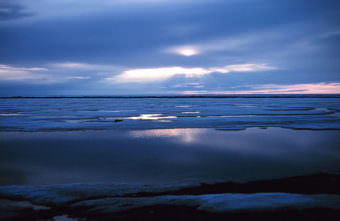
The Beaufort Sea, one of the areas included in the Trump administration’s draft plan for offshore Arctic oil development. (Photo courtesy NOAA)

The Interior Department is expected to release an updated plan soon on where the agency will hold offshore oil and gas lease sales in the Arctic over the next five years.

Many organizations on the North Slope offered comments on the draft proposal. Now they’ll be looking to see whether their feedback resulted in changes to the new plan.

In comments made available on a federal site, most North Slope institutions didn’t express outright opposition to the plan, but they did voice concern for subsistence resources and hunters’ continued access to them.
A point that was repeated by organizations like the Alaska Eskimo Whaling Commission, the North Slope Borough, and Arctic Slope Regional Corporation was the importance of exclusion zones. Those would take areas critical to whaling off the table for leasing — something that North Slope groups point out has been done for previous leasing programs.

AEWC, ASRC and the NSB proposed to exclude a 25-mile coastal buffer zone in the Chukchi Sea, and areas that whalers in Kaktovik and Utqiaġvik use for whaling.

The Bureau of Ocean Energy Management didn’t have exclusion zones in the proposed leasing plan, though some were included in a second option of the plan that BOEM wrote “may warrant further analysis.”

That drew criticism from Voice of the Arctic Iñupiat, an advocacy group composed of 20 Iñupiat leadership organizations on the North Slope. Their comment closely mirrored a letter they wrote last year to then-Interior Secretary Ryan Zinke expressing strongly-worded concerns about the fact that the plan did not set aside important subsistence areas.

The North Slope Borough also wrote that the proposal for six lease sales was “aggressive.” The borough said that such a program could be seen as a threat to the bowhead whale by the International Whaling Commission — the international group that sets the subsistence harvest quota.

“Similarly aggressive programs in the past have drawn the attention of IWC members who were concerned that increased oil and gas activity within the range of bowheads would subject the population to increased industrial noise and oil spill risks,” the borough comment reads. “Unable to directly address the industrial activity itself, the IWC may limit the bowhead quota as its means of ensuring continued protection for the species.”

The borough suggested two lease sales be held instead of six over the next five years.

Another suggestion brought up by several groups was the idea of requiring offshore oil and gas operators to work with local whaling captains to make sure industry vessels don’t disrupt whaling activities.

The Alaska Eskimo Whaling Commission developed the process, and oil and gas companies have committed to it on a voluntary basis. A key component of the agreement is deciding when oil and gas activity should be shut down in certain areas to allow bowhead whale migration to happen unimpeded, and to give hunters free movement on the water to hunt.

A few institutions also stated their support for putting some Arctic waters back on the table for leasing. ASRC was among them, writing that the Obama administration’s actions to limit Arctic leasing had been “extremely shortsighted and arbitrary,” and that offshore development could bring long-term economic stability to the North Slope and Alaska more broadly.

However, ASRC also emphasized their concern that the longstanding subsistence areas were not set aside from the get-go.

“We are encouraged that BOEM has included the Arctic OCS (Outer Continental Shelf) in the DPP,” they wrote, referring to the draft plan, “however we feel the importance of balance is overlooked in the DPP for the sake of energy dominance.”

They emphasized the importance of honoring the exclusion zones to balance energy needs with subsistence protections for the North Slope.

On the other end of the spectrum, the City of Kaktovik submitted a resolution that unequivocally opposed offshore development, as well as development in the Arctic National Wildlife Refuge.

“Our people are divided over the opening of ANWR for oil & gas drilling on land, but stand united in strong OPPOSITION to any offshore oil & gas activity and development,” the City of Kaktovik wrote in their comment, citing concerns for subsistence resources.

Another Kaktovik organization, Kaktovik Iñupiat Corporation, is a member of a corporation called Arctic Iñupiat Offshore, which contended in their comments that with proper protections offshore development can happen safely.

Cash-strapped state of Alaska takes aim at North Slope government’s oil money

Harball_DSC_0090
A flow line curves above the horizon on the western North Slope. (Elizabeth Harball/Alaska’s Energy Desk)

The North Slope Borough, which covers a huge swath of Alaska north of Fairbanks, runs on oil: The government pays for more than 90 percent of its annual budget with taxes on oil and gas infrastructure.

Which is why, when Alaska Gov. Mike Dunleavy’s administration unveiled a proposal last month to take away that taxing power and instead send that money to the state, borough officials were outraged. The plan — part of Dunleavy’s budget proposal — would add some $370 million to the state’s bottom line, while blowing a $370 million hole in the borough’s own $400 million budget.

“We use this revenue generated from our lands for schools, fire, police, infrastructure, erosion and subsistence protection, search and rescue, health care and transportation,” Harry K. Brower Jr., the borough mayor, wrote in a statement after the proposal was made public. “Frankly speaking, this isn’t fair and it’s not right.”

But Dunleavy administration officials said that the borough already benefits disproportionately from oil and gas revenues. And they justified their proposal, in part, by pointing to a second source of borough oil revenue that the state expects to sharply rise in the next decade.

That second source is the National Petroleum Reserve in Alaska, or NPR-A, where several significant projects are under development.

Dunleavy’s plan has gotten little traction in Juneau so far. But lawmakers and political observers said they see the proposal as an opening move in what’s like to grow into a broad debate about the division of the North Slope’s oil revenues — a debate driven by the anticipated sharp increase in those revenues, and by the state’s own budget crunch.

The discussion gets at a longstanding question: How much money from oil should stay in the North Slope, where it’s pumped from lands the Iñupiat have lived on for generations? And how much should be shared to pay for government services across the entire state?

NPR-A is an Indiana-sized swath of federal land in the western part of the North Slope. It was designated as a federal petroleum reserve in 1923, but it wasn’t until 2015 that oil was first produced there. It’s now a hot new area for oil development, with three new projects — Willow, and Greater Moose’s Tooth 1 and 2 — being pushed by ConocoPhillips.

Federal law directs half of the government’s royalty share of oil produced in the reserve to the state of Alaska. But there are limits on where that money can go: The law says that areas of Alaska “most directly or severely impacted” by development in the reserve get priority.

Right now that’s a handful of municipalities on the North Slope: The borough, as well as the cities of Nuiqsut, Wainwright, Utqiaġvik, Anaktuvuk Pass and Atqasuk. Alaska law allows those municipalities to apply for grants from the state’s NPR-A fund, and the state can keep money that remains after grants have been made to those communities.

Since it’s only recently that companies have been developing projects in the reserve, annual revenues over the past decade have topped out at $16 million. But with Conoco’s first project finished and a second under construction, the state is forecasting NPR-A revenues that could peak at $316 million a year in 2029. (That depends on oil prices of $80 a barrel; at $50 a barrel, peak annual revenue is projected to be $171 million.)

That could generate combined royalty and property tax revenues for the North Slope Borough, and its villages, of $700 million a year — or $70,000 for each of their 10,000 residents. Dunleavy administration officials, in a phone interview, said they think that’s too much.

“The question legislators need to ask themselves: Is that fair to the rest of the state?” said Jeremy Price, a deputy chief of staff to Dunleavy. “We would argue that is not fair.”

The state already collects substantial oil revenue in the form of production taxes and royalties — nearly $2.5 billion in the past fiscal year. But production tax revenue is volatile, and Alaska’s petroleum revenue is down substantially from years when oil production and prices were higher — in 2013, it was $7.5 billion.

That means the borough’s share of all the oil revenue collected in the state has grown, since it relies on property taxes, which are much more stable. Still, borough officials said they need the cash to sustain their own government programs.

“This would destroy the North Slope Borough. We’d be done,” said D.J. Fauske, the borough’s director of government and external affairs.

Fauske said the borough’s $400 million budget might seem like a lot for its small population. But, he added, it’s expensive to support people in eight Arctic villages, where most supplies have to be barged or flown in.

The borough uses its money to provide government services — police, public works, search and rescue — that the state handles in some other rural areas.

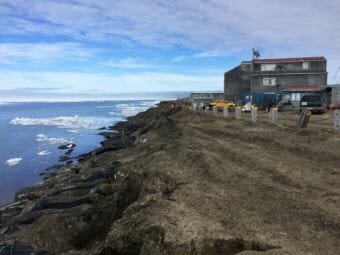
A piece of the Utqiaġvik coastline in a residential area near downtown. Much of this bluff collapsed during the September 2017 storm. Visible to the left are “supersacks,” part of the North Slope Borough’s current strategy for protecting the coastline from storm damage. (Photo by Ravenna Koenig/Alaska’s Energy Desk)

Fauske also noted that North Slope villages face expensive problems that road system communities don’t, like coastal erosion tied to climate change. One project to protect the coastline near the North Slope village of Utqiaġvik will cost $300 million, with $100 million needed from the borough, according to a federal estimate.

Then there’s the fact that the oil itself comes from the North Slope, and that local tax revenue gives residents a stake in the industry’s success. Fauske suggested that diverting more of that revenue to the state could turn the borough against new development, like in NPR-A or the Arctic National Wildlife Refuge.

“Our support of oil and gas development on the North Slope has always been and still is contingent upon such activities providing a benefit to our residents,” Fauske said.

Fauske also argued that it’s still uncertain how much cash will materialize from Conoco’s new projects, calling some of the numbers the state has cited “pie in the sky.” Until those numbers get more firm, borough officials said, it’s too early to have a conversation about how the NPR-A money should be divided.

In Juneau, Dunleavy’s proposal to redistribute property tax revenue appears to have stalled.

But borough officials said they’re concerned that the governor’s attempt to revoke the borough’s taxing authority is an opening salvo, and that ultimately, lawmakers outside the borough will seek a larger share of the NPR-A money, as well.

In a Feb. 5 letter to Alaska’s Congressional delegation in Washington, D.C., Brower, the mayor, said he heard that lawmakers in Juneau were pursuing changes to federal and state law to limit North Slope communities’ share of the NPR-A revenue.

The delegation, Brower said, should “summarily reject” that idea.

No concrete plan to reallocate NPR-A funding has emerged publicly. But a similar debate around the sharing of oil revenue from the reserve popped up at the Capitol in the mid-2000s, when the state was also facing tight budgets. And longtime observers of Alaska politics said that as revenues from NPR-A grow, the debate over where the money goes is likely to intensify, too.

“If the state’s finances are still tight, if the pain from budget cuts is still excruciating, you’re going to have a lot of people looking at this pot of money and saying, ‘Well, gee, I want some of that,’” said Larry Persily, a former deputy state revenue commissioner.

Sen. John Coghill, R-North Pole, said he’s interested in having a discussion about how the money is shared. But he wants it to be cooperative, he added.

“The governor has opened up the conversation, and it’s a proper conversation to have,” he said. “But the posture that I think you’ll see the Senate take is, ‘Okay, what’s fair? How do we all work with this as a state? How do we take care of the North Slope but make sure that the rest of Alaska isn’t left behind?’”

Prospect of commercial fishing in central Arctic Ocean poses big questions for science

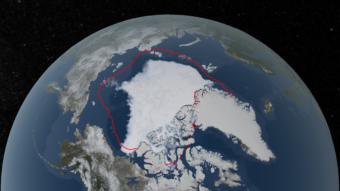
An image of 2018 Arctic sea ice minimum extent, with red line representing the 30-year average. Shrinking sea ice means new questions are being asked about the potential for commercial fishing in the central Arctic Ocean. (Image courtesy of NASA’s Scientific Visualization Studio)

This week, researchers and representatives from the United States and Japan met at the University of Alaska Fairbanks to talk broadly about Arctic science collaboration.

One of the topics was the prospect of working together on a somewhat new field of research: central Arctic Ocean fisheries.

There has never been commercial fishing in the central Arctic Ocean — the part that surrounds the North Pole and is beyond any country’s jurisdiction. But with ice-free conditions projected within this century, countries are already preparing for how to deal with that possibility in the future.

The first legally-binding agreement to prevent commercial fishing in the region was signed last October by a number of countries, including the United States and Japan.

Joji Morishita of Tokyo University of Marine Science and Technology was the head of the Japanese delegation for that agreement and gave a presentation at the UAF meeting on what Japan’s contribution to research on the topic might look like.

He said that while the Japanese fishing industry currently has no interest in fishing in the central Arctic Ocean, there are other reasons for Japanese researchers to be involved.

“There are many scientists and scientific institutions that are interested in the Arctic Ocean, which is going through very quick changes in terms of environment and biology,” Morishita said.

One of the key parts of the agreement is that the countries will collaborate on scientific research to bolster their knowledge of the central Arctic Ocean ecosystem. That research may underpin a fisheries management plan later on.

Candace Nachman is with the National Oceanic and Atmospheric Administration Fisheries office, which has been leading the U.S. delegation on the science part of the agreement. She said there are some big scientific questions that need to be answered before policymakers can decide if there could and should be commercial fishing in the central Arctic Ocean.

“What fish species are there? What fish species could move there as (there’s) change in ice cover and ocean temperatures?” she said. “And then how are the ecosystem linkages really going to play into any fisheries that may or may not occur in the region?”

There will be a scientific meeting next month in Russia for the countries who signed the agreement to discuss further plans for research.

Taking a ride with the last dog team left in Utqiaġvik

Geoff Carroll and his helper Asa Elavgak taking the dogs out of their pen to be hooked up to the sled, Jan. 31, 2019. Carroll has been mushing since 1986. (Photo by Ravenna Koenig/Alaska’s Energy Desk)

For hundreds of years, dog teams powered long-distance travel in northern Alaska.

Of course, now snowmachines, planes and cars have pretty much taken over the job of getting people around the North Slope.

But in Utqiaġvik, there’s still one dog team left, and their musher has been getting around the tundra by dogsled for more than 30 years.

It’s a beautiful afternoon with an orange sun blazing low in the blue sky, as Geoff Carroll and his 13-year-old helper Asa Elavgak wade into the dog yard to get the dogs hooked up to the sled. The dogs are yelping with excitement, and in its eagerness, one almost hauls Elavgak off his feet.

“So if you lift them up like this,” Carroll says, lifting one of the dogs by its harness so only its back feet are on the ground, “you get ‘em in two-wheel drive instead of four-wheel drive.”

This advice only gets Elavgak so far. By the time he gets the dog over to the sled, he’s winded.

“Asa needs to get a little bit bigger to handle these dogs,” Geoff jokes.

“Yup!” Elavgak agrees with a laugh.

After all the dogs are linked up to the line, Carroll stands on the back of the sled and shouts “KIITA!” (which means “let’s go” in Iñupiaq) and we’re off.

Suddenly, everything goes quiet — at least where the dogs are concerned. The only sounds are the squeaking of the snow, the creaking of the sled and the occasional thumps as we barrel over a mound or divot in the terrain.

We pass through the space between houses, across residential streets, and head out over the tundra and frozen lagoons north of town.

“Bouncing over the sastrugi,” Carroll narrates as we rattle over wind-sculpted grooves of snow, the afternoon sun throwing our shadow against the white.

“About as pretty as anything gets, as far as I’m concerned,” Carroll says, absorbing the scene. “The wide open country and sun shining on the horizon, and all those beautiful colors in the clouds.”

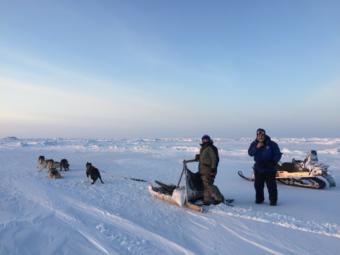
Asa Elavgak (standing on the sled) and Geoff Carroll (right) with Carroll’s dog team on the shorefast ice north of Utqiaġvik. Jan. 31, 2019. (Photo by Ravenna Koenig/Alaska’s Energy Desk)

Alaska is, of course, famous for its sled dog racing, but that’s never been where Carroll’s interest lies. He’s an expedition guy.

In fact, his introduction to mushing was on an expedition to the North Pole in 1986: Known as the Steger International Polar Expedition, it was a 56-day, 1,000 mile trek over sea ice by dogsled.

The trip was a tough one, says Carroll, with rough ice conditions that made for slow-going, and temperatures down to 70 below zero. But it left him with enormous respect for sled dogs. As he puts it, he got hooked. And within a year, Carroll had his own dog team.

Since then it’s been a passion of his, though never his day job. He moved up to Utqiaġvik the same year he was introduced to mushing, though he’d been working up there seasonally for about a decade already on bowhead whale surveys. He then spent 27 years as a biologist for the Alaska Department of Fish and Game, a job he retired from a few years ago.

Over his time living in Alaska’s far north, he’s done dozens of multi-day trips and visited almost all of the North Slope villages.

“You can head out the back door and mush 200 miles to Umiat and Anaktuvuk (Pass) or whatever,” he says.”Not a single road or power line or anything between here and there.”

I ask Carroll if he’s ever gotten lost.

“Gotten lost? Oh I used to be lost all the time before they invented GPS,” he says.

When Carroll says “lost,” what he means is that he only had a vague sense of where he was; he never got lost in a dangerous way. Nowadays he uses GPS to navigate, but back in the mid-1980s, when he was new on the North Slope, he didn’t have that option.

“When I first moved here, I figured out pretty quick that the only way you could really get out and see the country and do things was to find an elder that would take you along,” he recounts.

He says the elders he went out with knew the country so well, they could leave their houses and make a beeline straight for a hunting camp fifty miles from town without a compass.

“You could never figure out how in the world they could do that in this country without a lot of landmarks and things,” he says.

Geoff Carroll, who’s lived on the North Slope since the mid-1980s, is the only musher still running a dog team in Utqiaġvik. “Sad but true,” he says, “I’m the only team left now.” Jan. 31, 2019. (Photo by Ravenna Koenig/Alaska’s Energy Desk)

As we bump across the snow, Carroll describes some of the more memorable things he’s seen from this sled over the decades: the surprising sharpness of the dogs’ shadows in the moonlight, for example, and what a bunch of caribou looks like when you suddenly find yourself in the middle of it.

“Oh it’s just total chaos,” says Carroll. “The dogs don’t know what to do, the caribou don’t know what to do, and you’re all kind of moving along there in unison. Pretty cool.”

Carroll is the first to admit that dog mushing is not a very practical way to get around. You have to feed the dogs, take care of them, hook them up to the sled, put them back in their pen. With a snowmachine, on the other hand, you gas it up and you go. When I ask him why he’s the only one left in Utqiaġvik with a dog team, he says he’s not as pragmatic as most people.

Not that pragmatic, sure, but for Carroll, running dogs is about a lot more than getting somewhere. He loves the quiet of traveling by sled, and he loves the animals.

“I get to go out and run with … my six best friends,” he says. “Go out and run across the country, you know. They love it. I love it.”

He also says that it’s taught him some valuable life lessons.

“You learn a lot of patience,” he says. “You know, just kinda keep plugging away, plugging away and you get there eventually … Pretty good strategy for life, too. You just keep at it and, you know, if you really believe in what you’re doing, you make some progress towards it someday.”

Carroll says he would love to see dog sledding continue in Utqiaġvik after he retires from it. He’s given mushing lessons to both kids and adults over the years, but says he’s always looking for new people (who think they might enjoy a bit of non-pragmatic tundra travel) to share it with.

Site notifications
Update notification options
Subscribe to notifications