Seward’s Lydia Jacoby at the TYR Pro Meet in April 2021 in Mission Viejo, Calif. (Photo Courtesy of Lydia Jacoby)
Seward swimmer Lydia Jacoby is likely headed to the Tokyo Olympics after finishing second Tuesday evening in the 100 meter breaststroke at the U.S. Olympic Trials in Omaha, Nebraska.
17-year-old Jacoby set a national age-group record Monday to reach the finals. In the finals, she bettered her record by almost half a second, finishing in a time of 1:05.28.
Olympic gold medalist and world record holder Lilly King won the event with a time of 1:04.79.
At the 50 meter turn in the finals, Jacoby was in fifth place, but made up ground in the final stretch.
The second place finisher in the finals is almost always assured an Olympic spot.
Jacoby has been part of the Seward Tsunami Swim Club since she was 6 years old.
The Olympics are scheduled to begin July 23 in Tokyo, Japan.
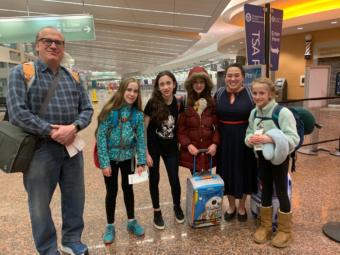
Inlet View Elementary sixth grader Ilsa Robinson, second from left, at the Anchorage airport for a trip to Washington, D.C., Feb. 28. Her mother, Julie Robinson, an Anchorage doctor, said she didn’t have anxiety about sending her daughter on the trip despite coronavirus concerns. (Photo courtesy of Dr. Julie Robinson)
When Dr. Julie Robinson of Anchorage dropped her 11-year-old daughter at the airport for a class trip to Washington, D.C., last week, she made sure the group boarded the plane with a few extra items.
“I met the group at the airport with a bag of wet wipes and bottles of hand sanitizer,” Robinson said.
Robinson felt good about letting her daughter travel across the country. For her, it wasn’t a tough call. But at Arete Family Medicine in Anchorage, where she’s a family practice physician, many of her patients are anxiously grappling with similar decisions.
“Especially with spring break next week, we’re just getting a lot of questions about travel,” Robinson said.
There are no confirmed cases of coronavirus in Alaska. The state is testing more patients every day and medical experts say the virus is likely to be discovered in the state soon. At local clinics and hospitals, doctors are fielding lots of questions. Many say they’re counseling patients to take COVID-19 seriously, but not to panic.
When addressing travel questions, Robinson tells each patient to think about their own health. Do they have chronic respiratory issues or another underlying health problem that could make them more susceptible to coronavirus, and more likely to contract severe symptoms if they do get the disease?
“And then also, do they have anxiety? A lot of patients who have underlying anxiety are really struggling with this decision about travel. And so if they’re otherwise a low-risk traveler, but they feel really anxious about it, that’s maybe a reason to stay home,” Robinson said.
For younger and healthy individuals, Robinson isn’t much more worried about coronavirus than she is about influenza, a more familiar virus that can be deadly for people in fragile health. She acknowledges there are a lot of unknowns. And she suspects Alaska cases will be confirmed soon, but tells her patients to be pragmatic.
Michelle Laufer, a pediatrician at Medical Park Pediatrics in Anchorage, gives similar advice.
“I don’t think we should walk around necessarily being worried,” she said. “For the most part we just need to be conscious about preventing illness and then caring for ourselves if we become ill.”
Laufer said the hardest part for most patients is that there’s still a lot of uncertainty surrounding the coronavirus. She said reliable data is limited.
“We know that it’s a virus, we know that it’s relatively transmissible and that it can cause severe illness and even death. But the numbers around that and risk of that — it’s just unclear at this point,” she said.
Laufer said she expects the virus is already in Alaska, but hasn’t yet been detected. Her biggest frustration is that the state doesn’t have more capacity to test. The state has capacity to conduct fewer than 200 tests and doesn’t know when the Centers for Disease Control and Prevention will ship more. Laufer expects private labs will be able to test for coronavirus soon, but said it’s unclear if insurance will cover the cost.
At Providence Hospital this week, the state approved testing for two intensive care patients who didn’t have a travel history, according to regional chief medical officer Michael Bernstein. He said both tests came back negative. Bernstein describes the level of worry in Anchorage over coronavirus as moderate, which he said is appropriate.
“My sense within our community, honestly, is that the sense of concern is probably about where it needs to be,” he said. “It’s enough to get us to do a lot of preparation.”
Bernstein said the Providence Health System has canceled all travel meetings for at least the next month to ensure there are enough workers to address coronavirus.
Bernstein asks people wash their hands, refrain from touching their face and to get a flu vaccine if they haven’t already.
Julie Robinson, the family practice doctor, adds that Alaskans should eat healthy and exercise. She said people also tend to underestimate the importance of getting a good night of sleep for warding off any illness.
Other than that, she said, it’s a waiting game.
“I think people need to take a big breath and try to relax and we’ll see what happens,” she said.
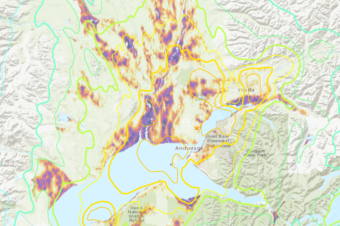
A new USGS tool modeled potential liquefaction sites after the Nov. 30 Anchorage earthquake (Courtesy of U.S. Geological Survey).
The 7.0 Anchorage earthquake last month caused several landslides and other dramatic ground movements. It was one of the first big tests of a new computer model aimed at quickly estimating how significant those ground failures will be following an earthquake.
The model is from the United States Geological Survey (USGS). After a big earthquake, it generates a map almost instantly indicating where major landslides and ground sinking or shifting are likely to take place. It also estimates how many people may be affected.
Kate Allstadt is a researcher with USGS in Colorado and helped develop the model. She says it’s intended to help first responders understand where the hardest hit areas may be in the minutes and hours after an earthquake.
“It can help decision makers figure out what areas should be a priority,” she said. “[And] if roads are blocked, which is often something that happens by landslides triggered by earthquakes, what areas might be cut off.”
Researchers have been testing the model for a few years and the public version was released in August. Allstadt says the Nov. 30 earthquake was the first chance for scientists to see for themselves on the ground how well the maps worked after a major event.
For the Anchorage earthquake, the model estimated significant landslides and other ground failures would affect about 4,400 people.
Allstadt was in Anchorage for a week of field research in early December to see if the model got it right.
“A lot of the work we did when we were in the field is taking the maps produced by these models and going to the places where they predicted higher probability of landslides and liquefaction and seeing what actually happened,” she said.
Allstadt says overall, the maps were pretty accurate. But she says they tended to overestimate where soil sinking and liquefaction might occur. And, she says, the maps are missing some important details: while they may accurately predict a large landslide that blocks a major road, they could miss a smaller slide that impacts just one house.
“Something that we’ve already been planning to do is to go to higher resolution to capture the areas that are maybe not going to produce dramatic rock avalanches, but they can be really impactful, because they’re often closer to where people live,” she said.
The model generates ground failure maps for any earthquake greater than magnitude 5.0 in the U.S and 6.0 around the world.
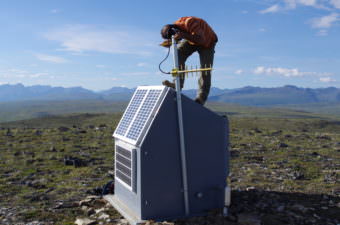
Field engineer Scott Dalton adjusts a radio communications link at a seismic station south of Cantwell. (Photo by Ian Dickson/Alaska Earthquake Center)
Congress passed a bill Tuesday to improve how the country prepares for earthquakes.
Michael West, who directs the Alaska Earthquake Center, said this legislation renews an existing law. But West said it’s more important and exciting than it sounds.
“This legislation reauthorizes programs that have existed for the better part of 40 years, but need tweaking and updates through time. But it hasn’t been authorized now for several years, and when programs aren’t authorized they begin to fall apart over time,” West said.
The prior version of the legislation expired nearly 10 years ago. West said that allowed some federal agencies to let earthquake preparedness creep down the priority list.
West said one important update involves calculating the financial risk from earthquakes. He said those studies are important for allocating funding for earthquake programs. But in the past, the studies ignored the potential damage from tsunamis, which has made Alaska’s financial risk look unrealistically low.
“Imagine considering a 1964-type earthquake but ignoring the tsunami component. That would be ridiculous,” West said.
West said the legislation, which now awaits the president’s signature, will also help Alaska implement the latest technology to monitor earthquakes. He said GPS instruments allow researchers to watch plate tectonics play out in real time. They are being widely used in other west coast states, but Alaska has lagged in installing the new technology. He said the new bill will make it easier for researchers to justify the expense of using GPS instruments in Alaska.
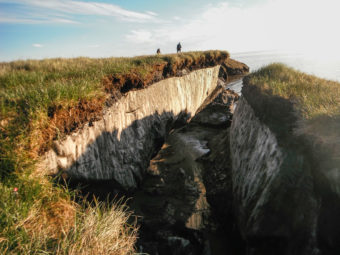
Coastal erosion reveals the extent of ice-rich permafrost underlying active layer in the Teshekpuk Lake special area of Alaska’s National Petroleum Reserve . (Photo by Brandt Meixell/USGS)
The latest National Climate Assessment was released today. The report devotes an entire chapter to Alaska and it describes the state as one of the fastest warming places on earth.
Fairbanks-based climatologist Rick Thoman helped write it.
He says one of the big takeaways for Alaska is that it’s going to be expensive to adapt to climate change and that will be felt in every household across the state.
Thoman says another key finding is that rural Alaskans will notice the impacts of climate change a lot more than Alaskans in cities.
“Some of that is socio-economic ability to respond to change,” he said. “Some of it is geography with many coastal rural communities very vulnerable to things like coastal flooding.”
The chapter on Alaska addresses things we’ve heard a lot about, like Arctic sea ice retreat and coastal erosion, but also less obvious threats, like the growing risk climate change poses to human health.
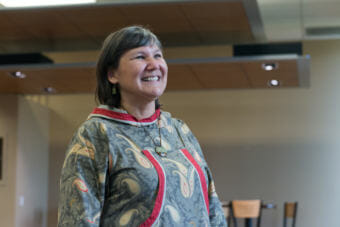
Thoman says the Alaska chapter was written by Alaskans, for Alaskans, and is much more specific than other big climate change reports. He says that means it can be used as a planning document for climate change.
“From the community level to the state government level, this can potentially serve as a resource to how do we move forward in the most economically viable, sustainable way,” he said.
A law requires a national climate assessment to be delivered to Congress and the president every four years. This is volume two of the most recent assessment. Volume one was released last year and was focused more on the science of climate change.
Valerie Davidson at the APU 2018 Indigenous Peoples Day celebration. Davidson was appointed as Lt. Gov. of Alaska following Byron Mallott’s resignation (Creative Commons photo courtesy of the office of Gov. Bill Walker)
The state’s new Lt. Gov. gave her first public speech today. Valerie Davidson is the first Alaska Native Woman to hold statewide office in Alaska. She spoke at the annual tribal conference, held today at the Egan Center to kick of the Alaska Federation of Natives Convention, which starts tomorrow.
Davidson began by acknowledging the troubling circumstances that led to her being sworn in as Lt. Gov. yesterday, when Byron Mallott abruptly resigned after admitting he made inappropriate comments.
This speech has been cut down and transcribed for length.
DAVIDSON: Quyana for allowing me to be here today and I just want to acknowledge that, while I’m really honored to step into the role of lieutenant governor, this is not really a situation that any of us could have predicted. And I’ll just be honest, yesterday was a really tough day for all of us.
But today is a new day, and today is our opportunity to move forward, to work together, to continue to heal the past so that we can move forward in strength and together and that’s what we do as Native people, and we will continue to do that today. I know actually a lot of you in the room today, but there are some of you who I don’t know.
So let me do a proper introduction. My Yup’ik names are Nurr’araaluk Amillamarnan. My English name is Valerie Davidson. If you forget my Yup’ik names, we Yup’iks have this wonderful word which basically means hey you. So do take care to practice it carefully though because if you say something else it’s something else entirely and we don’t want to go there.
I’m originally from Bethel. I grew up in Bethel and also upriver in Aniak. My mother’s family is Yup’ik from [a village that] literally means “Village With no River” because it’s located on the ocean. If you’re ever in Bethel and you head downriver, once you hit the ocean hang a right, and you will run into my mother’s home village. Her English name is Tilly Davidson. She’s a Mount Edgecumbe graduate.
My father’s family is kass’aq, which basically means “not Yup’ik” and they’re from Port Orchard, Washington. And in the fine Yup’ik tradition, my mother made my dad move completely from his home community and move to the Bethel area.
I was also recently adopted by the Jackson family in Kake and they are both Tlingit and Haida and I was given the Haida [a] Haida name which I’m told means “noisy lady.” And I was named after my late aunt, and I like to think that I was given that name because I have a really loud authentic Native laugh.
So the other things that you should know about me; probably the most important thing, I’m a mother of four children. I also have a godson. They are my greatest accomplishments in my entire life. They make me better than I really am and I love them dearly.
You should also know that I’m a village girl. And I’m proud to be a village girl because when you grow up in a village you learn from a really early age, it doesn’t matter whether it’s 40 above or 40 below. If it’s tough weather outside, it doesn’t matter. We get up, we put on our clothes, we pack water, we chop wood and we do what needs to get done to face the day and that’s where we are today.
Lt. Gov. Valerie Davidson, speaking at the annual tribal conference organized by Alaska Federation of Natives and the National Congress of American Indians. The speech was recorded in a Facebook Live video from the Anchorage Daily News.
Close
Update notification options
Subscribe to notifications
Subscribe
Get notifications about news related to the topics you care about. You can unsubscribe anytime.