Right about now you may be wondering when the snow is finally going to disappear.
Climatologist Brian Brettschneider, with our Ask a Climatologist segment, can help answer that question. He says melt-out is right on schedule for most places around the state.
That’s important because an early melt-out date can make for an especially bad wildfire season.
Interview Highlights:
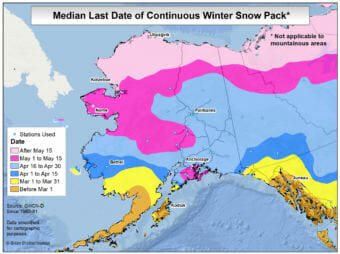
— Melt-out dates around the state include April 12 for Anchorage, April 22 for Fairbanks and May 18 for Kotzebue. In Southeast Alaska, snow is accumulating and melting out all winter long.
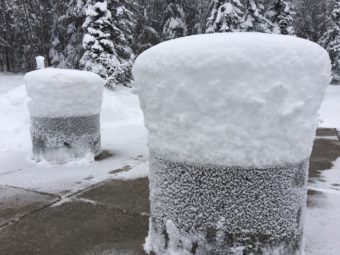
— For any one community, the snow melt-out date can vary quite a bit from year to year. The most important factor is how much snow falls at the end of the winter and during melt season. Once the sun angle is pretty high snow melt happens really fast, even if temperatures are below freezing. The sun can melt 2 to 3 inches a day.
— With a warming climate, the melt-out date is moving a bit earlier in the season. That’s important because this is the driest time of year and if the snow melts-out earlier, it’s going to really increase the wildfire risk.
Brian Brettschneider is a climatologist based in Anchorage, with the University of Alaska Fairbanks.
Lasse Holmes, of Homer, stands in front of his Rocket Mass Heater. Photo by Aaron Bolton/KBBI
Many Alaskans heat their homes by burning wood, and a relatively new take on wood and masonry stoves aims to make wood heat more efficient. Lasse Holmes, who lives in Homer, builds what are known as Rocket Mass Heaters.
He says they’re basically a masonry stove, do-it-yourself style.
“In simple terms, it’s like a wood stove connected to a masonry bench,” Holmes said. “It has the pipes going through this bench, you have a wood fire and you just extract the heat into this dense mass and it slowly releases the heat.”
Lasse says it heats your space and you can cook on it. As part of the Cost of Cold series from Alaska’s Energy Desk, Holmes explains why he likes Rocket Mass Heaters.
The Cost of Cold is a series from Alaska’s Energy Desk about how Alaskans around the state heat their homes. Reporter Aaron Bolton produced this story in Homer.
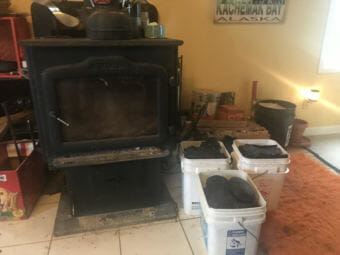
Homer resident Laura Upp keeps buckets of coal next to her stove. Photo by Aaron Bolton/KBBI
Karen Hamm is walking along the tide line at a popular beach on the Homer Spit, five gallon bucket in hand. She reaches down to collect chunks of coal. Some are pebble sized. Others are a large as a loaf of bread.
Hamm says it’s not an ideal day to scavenge.
“It’s always better after a storm, first of all,” she said. “Secondly, the wind has to be coming from the west because if it’s coming from the east, it’s going to blow it out instead of in.”
Hamm would know. She’s been scavenging for coal with her husband for seven years. The coal that washes up on Homer beaches comes from veins in the bluffs that line Cook Inlet and overlook town. Boulder-size sections of coal break off the cliffs, are churned up in the ocean and wash onto area beaches in smaller pieces.
And Hamm needs about 9,000 pounds of coal to heat her home every winter. She and her husband typically drive onto the beach and fill the bed of their truck about nine times every year.
“You go to the beach, you get cold and you go home and stand next to the coal fire,” she said.
Back at her home, Hamm pulls brick size pieces of coal from a trailer and brings them inside.
But before she burns anything, she needs to empty out the ash box. She says it’s not exactly a clean fuel.
“There’s a lot more ash with coal than there is with wood,” she said. “Not only that, but it gets in the air. It’s messy.. but it’s cheap. You can afford to hire a maid.”
Those savings drove Karen Hamm and her husband George to ditch their wood stove and install a coal stove instead.
George Hamm, who is 80 years old, used to gather wood and says it would take about five cords to heat his 2,500 square foot home each year. He also supplements with heating oil when they’re not home.
“You can just figure if you burn 100 gallons of oil, you’re going to burn a cord of wood or you’re going to burn a ton of coal,” he said. “Those are not accurate figures, but it gives you a round figure to work with.”
Coal is scattered across beaches in Homer, especially after a storm. Photo by Aaron Bolton/KBBI
No one knows exactly how many people burn coal in Homer, but it seems to be getting more popular, likely because it’s free. After a big winter storm, you can see a number of people on the beach collecting coal.
Hamm says there’s been more competition on the beach recently.
“I think it has a lot to do with our economy right now,” said Laura upp, who says the economy was certainly a factor.
She switched to a coal and wood burning stove about five years ago after wood became too expensive.
“Cords of wood, cut and split, for you are almost near $200 delivered anymore,” Upp said. “So, that’s a lot of money… if I was only burning wood, I would go through a cord of wood in a month.”
Upp still uses some wood and supplements with oil.
Both Hamm and Upp acknowledge that burning coal isn’t ideal. They worry about the air quality. But they say the savings and convenience drives them and others to the beaches.
“I think people are just trying to find cheaper alternatives,” Upp said. “I know it’s not the best thing for the environment, but right now, it’s just what I have to do.”
Upp says she would consider other options such as natural gas if it was available, but for the foreseeable future, she will continue beach combing for coal.
The spring equinox occurred at 8:15 this morning in Alaska. And no, that doesn’t mean you can balance a raw egg on end.
It does mean that the sun is directly over the equator, giving equal amounts of daylight and darkness around the world.
Brian Brettschneider is a climatologist based in Anchorage with the University of Alaska Fairbanks. He says the March equinox is often confused with the first day of spring.
Interview Highlights:
It’s not the first day of spring, in terms of climate. It’s the 20th day of spring. In climate terms, spring is March, April and May in the northern hemisphere.
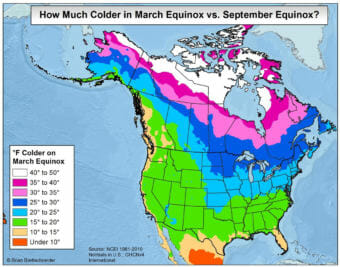
It’s a lot colder on the spring equinox than the fall equinox, even though there’s the same amount of daylight. That’s because of something called thermal lag. The earth is about two-thirds ocean water and that water takes a long time to heat up in the summer. So the warmest temps occur after the summer solstice. It also takes a long time to cool down after the fall equinox.
We move slower around the sun during the time from the spring equinox over to the fall equinox. The warm half of the year is 186 days, while the cold half of the year is about 178 days.
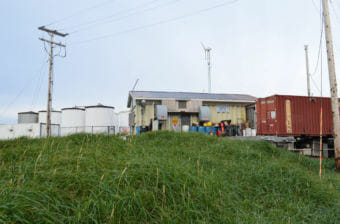
Fuel tank farm in Wales, Alaska. (Photo by Jenn Ruckel/KNOM)
How much do you pay to heat your home in the winter?
This week, Alaska’s Energy Desk is kicking off a new series called The Cost of Cold, looking at how Alaskans across the state keep warm at home.
There are a lot of options. Electricity, natural gas, wood, coal… even french fry oil.
But in much of rural Alaska, and even some cities, the primary heating source is diesel, also called heating fuel.
Many families in some of Alaska’s largest cities, like Juneau and Fairbanks, rely primarily on heating fuel. In rural parts of the state, even more people do. Take the Nome area, for example where, 90 percent of households use heating fuel according to U.S. Census data.
And it is not cheap. Cady Lister is chief economist with Alaska Energy Authority, a state corporation that works to reduce the cost of energy.
“If you are in a small isolated village that has to have fuel flow in, or even just barged in, but just at a high cost, you still are paying amongst the highest cost for heating fuel and for electricity in the country,” she said.
Just how high is the cost of heating fuel? It varies wildly across the state Lister says.
The state surveys communities on the cost of heating fuel twice a year. In the most recent survey, the lowest price was $1.40 in Atqasuk, on the North Slope, where the borough subsidizes the price.
“And the highest was Shishmaref at a little over $15 per gallon, which is pretty astronomical,” she said.
Even heating fuel at about $4.50 a gallon, which is close to the state average right now, can put a significant economic strain on families. For example, in the lower Yukon Kuskokwim region, families spend an average of 26 percent of their income on heat and electricity. Compare that to the railbelt, where that figure is a little less than seven percent.
Lister says given that economic burden, residents are pretty resourceful — they find other ways to heat their homes, like wood.
“If you’re in a place where there’s a lot of forest and a lot of wood and biomass around, you’re obviously going to have households that are taking advantage of that resource,” she said. “There are large parts of the state where there are not a lot of trees and there’s not a lot of option in terms of what you use to heat your home.”
Even in treeless communities though, residents often find ways to scavenge for wood. In places where cord wood is for sale, Lister says one of the things people like about that option is that the cost is relatively stable.
“Over the last ten years, we see it’s 200 – 300 dollars a cord and there’s not a whole lot of change to that. It doesn’t really follow the price of heating fuel like it could. And that is a benefit to people,” she said.
But Lister says no matter where you are or how you heat your home, the single most effective way to mitigate the high cost of fuel is energy efficiency.
Snow piles up at Alaska Public Media in Anchorage, Jan. 23rd, 2017 (File photo by Annie Feidt/Alaska Public Media)
It may not feel like winter is over, but “climatological winter” wrapped up at the end of February. That’s the three month season — December, January and February — that climatologists call winter in the northern hemisphere.
Brian Brettschneider with our Ask a Climatologist segment says defining a standard winter season is important for tracking big picture climate trends.
He says in Alaska, temperatures were significantly above normal for most of the state.
Interview Highlights:
Winter has been extremely warm in northern Alaska
If you look at the northern half of the mainland, many stations were 8, 10, even up to 14 degrees above normal up on the North Slope. Toward Anchorage, it was 3 to 4 degrees above normal, so notably above normal but not as extreme as the rest of the state.
Then down in Southeast, there were some places that were a little bit below normal. But on bulk the state was on average about 7 degrees above normal for the period.
Most areas around the state have plenty of snow
We’ve had a pretty good winter. On average, stations are running a bit above normal. In Anchorage, our snow depth is outperforming our snowfall, which is an interesting side note.
February was a really snowy month in Anchorage; we had about 25 inches. Fairbanks also had about 24 inches, and Juneau had a fair amount, so a lot of snow fell in February.
Close
Update notification options
Subscribe to notifications
Subscribe
Get notifications about news related to the topics you care about. You can unsubscribe anytime.