Annie Feidt, Alaska’s Energy Desk

Ask a Climatologist: The connection between sea ice and global weather

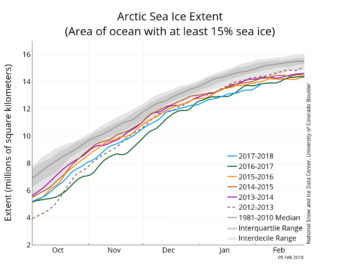
Sea ice extent is near record low levels in the Arctic ocean and that has implications for weather patterns around the globe.

Brian Brettschneider says that in the past climate models have struggled to connect ocean conditions with what happens in the atmosphere. But he says two new studies (you can find here and here) do a much better job describing that link.

He says what happens in one, really drives the other.

Interview Highlights:

What we’re learning is that the reduction of sea ice is affecting the flow of the atmosphere. And we see the response is a deepening of low pressure in some areas and an increase of high pressure in other areas. That affects which direction the wind comes from and where the storm tracks are located, so lots of impacts that are more fine scale than the fact that it’s warming here, or cooling off there.

What are those specific impacts?

What we’ve come to understand is the response to this new state of the climate system is a deepening of the Aleutian low pressure system, a weakening of the Icelandic low pressure system and an increase in the Siberian high pressure system. These are semi-permanent features, they’re typically there for months at a time in the cold season and they drive the weather across the entire globe.

Why does this matter?

When we have this idea that we’re in a warming world, when we just paint that one broad brush, that’s very important over longer time scales. But understanding how these finer scale patterns are going to set up, matters more on more human time scales. We’re talking interactions that are much more complicated. And as we do more of these models and studies, we get a better idea of how things are going to change at the regional scale.

Ask a Climatologist: Winter weather makes a comeback at the winter Olympics

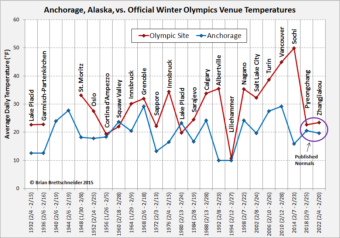
The winter Olympics in PyeongChang, South Korea feature a key ingredient: winter weather. That’s a departure from the last Olympic games in Sochi, Russia, where high temperatures strayed into the upper 50’s.

Brian Brettschneider, with our Ask a Climatologist segment, says PyoengChang is at about the same latitude as Washington, D.C. But he says the climate there this time of year is very similar to Anchorage.

Interview Highlights:

Why is it so cold in PyeongChang?

They’re on the eastern part of the Asian continent and in the winter months they’re subject to the dominant Siberian high pressure system. That’s an area that gets very cold in the winter and they normally have winds that come out of the north. So they’re going to get a cold, dry flow coming in from Siberia and it’s going to functionally make them feel like they’re much farther north than they are.

Is it true that for its latitude, it’s the coldest spot in the world?

It basically is true. There are a couple of spots, like in Colorado that are at the same latitude or even farther south, at something like 11 thousand feet, that are going to be colder. But it really is, for its latitude, about as cold as you can get anywhere on earth.

How does the cold at this Olympics in PyeongChang stack up to previous Olympics?

It’s looking like it will be an average temperature of about 30. That’s going to put it as the coldest winter Olympics since Lillehammer, in 1994. The Sochi Olympics were famously warm, with highs near 60 and lows near 40. Before that, Vancouver was quite warm and even Salt Lake City was fairly warm. So you have to go back over twenty years to find a colder Olympics.

Magnitude 7.9 earthquake was an intriguing one for seismologists

A magnitude 7.9 earthquake struck early Tuesday morning, 180 miles off the Kodiak coast. It was widely felt across Alaska, even in the Interior.

But the Alaska Earthquake Center has received no reports of damage.

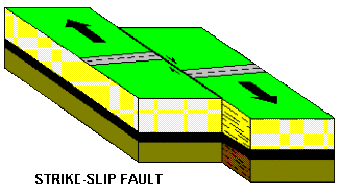
Graphic of a strike slip fault courtesy of the California Department of Conservation.

State seismologist Michael West said that’s likely because the earthquake was far from shore, in the middle of the Gulf of Alaska.

“From the perspective of earthquake shaking, we were helped greatly by the fact that this earthquake was considerably offshore,” he said. “Everybody was at least a couple of hundred miles away from this earthquake.”

The earthquake was an interesting one, West said.

It happened slightly farther out to sea than a massive earthquake in 1964, but it wasn’t triggered by the same mechanism.

Instead of moving up and down, like the ’64 quake, the earth moved from side to side.

It’s called a strike-slip earthquake.

West said that could explain why the tsunami waves were pretty small.

“It is fair to say that historically there tends to be less tsunami activity with earthquakes of that style,” he said.

West said it’s relatively unusual for this type of earthquake to be so large.

“This is certainly on the larger end of what we see for those types of earthquakes,” he said. “It’s by no means unprecedented or anything, but it certainly is one that will garner a lot of attention scientifically.”

Earthquake aftershocks likely will continue for years, West said. He said the vast majority of the early aftershocks will be in the 4- or 5-magnitude range, but some could be larger.

Ask a Climatologist: “Astounding” new state temperature record for January

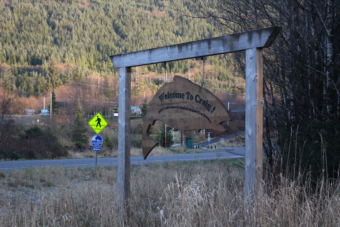
POW Craig sign (Photo by Elizabeth Jenkins/Alaska's Energy Desk)
Craig, Alaska hit a record high of 65 degrees on Sunday, Jan. 14. (Photo by Elizabeth Jenkins/Alaska’s Energy Desk)

A funnel of warm air blasted Southeast Alaska Sunday, producing temperatures that made it feel more like June than January.

Temperatures in several communities climbed into the mid-60’s, shattering records. It was the warmest day ever recorded in January in Alaska.

Brian Brettschneider with our Ask a Climatologist segment says Sunday was remarkably warm across the state but exceptionally warm in Southeast.

Interview Transcript:

Brian: We saw a record high of 66 degrees at the Annette Island Airport and at the climate reference station six miles south of Metlakatla, 66 degrees was the high temperature there. And that was not only a record for the day, it was a record for the month, but not only a record for the month, a record for any station, anywhere in Alaska in the month of January. If you look at all the stations together, we’ve got almost 400,000 January high temperature data points and these two were the absolute highest.
Annie: So really incredible.

Brian: It really is incredible. And those are the two highest, at 66 degrees. But I think four other stations had a temperature that would have also set a record high for the month of January. The old record for the state was 62 degrees and Sitka was 63, Klawock was 64, Craig was 65, and those in and of themselves would have been state records for the month. So to actually break the record by four degrees is almost unheard of. It’s just astounding.

Annie: And it wasn’t just Southeast, right?

Brian: Everywhere was above normal, and some of them were a little bit above normal but many were way above normal. Eagle on the Canadian border- their high temperature was 45 degrees above normal. Fairbanks was almost 30 degrees above normal. Deadhorse, 35 degrees above normal. And those places in the Interior, they can have wider swings, but down at Annette Island, they were 25 degrees above normal, that’s where the record of 66 degrees was. They’ve been keeping records for 70 years and they’ve never had any day that’s more than 20 degrees above normal. So to be 25 degrees above normal, it’s just off the charts.

Annie: And Annette Island- those weather stations aren’t just regular weather stations, right?

Brian: Right, it’s a really important note that the two stations that broke the record, one of them is a climate reference network station. There’s about 110 around the country and this is a station that has the absolute best equipment, they’re sighted in fairly remote areas and they’re meant to collect long-term baseline climate data for monitoring and for projections and future considerations, so it has the absolute best equipment and then the Annette Island Airport, they’ve been keeping records there for 70 years and that’s a weather balloon launching station, so they’ve been launching balloons twice a day, everyday, since 1948. When they launch the balloon they take a temperature at the launch and up through the atmosphere and it shattered the record by five degrees at the launch location for the month. And then at about 1,500 or 2,000 feet it also shattered the record for the warmest temperature. It was warm above that but not record warm. It really shows there’s this core of amazing warmth in the lowest thousand feet that was funneled right along the coastal ranges from the Lower 48.

Ask a Climatologist: What is polar amplification?

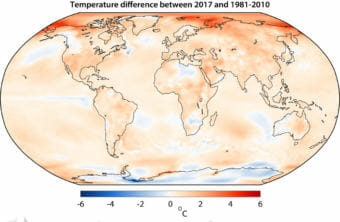
This graphic from NASA shows the temperature difference between 2017 and the years 1981 to 2010

The Arctic is warming twice as fast as the rest of the planet.

Listener Drew Grant, from Juneau, sent an email recently to our Ask a Climatologist segment wondering why the Arctic is warming so much faster.

Brettschneider says it’s a phenomenon called polar amplification.

Interview Transcript:

Brian: We get a limited amount of solar energy. But normally when we’re snow covered, that snow and ice acts as a mirror, so when the sun’s rays come in, if there’s snow on the ground, most of it is reflected back into space, so it’s like it never occurred. However, if you melt that snow, if you warm the globe, say one degree, you’re going to melt that snow a little bit sooner, and turn some of those snow events into rain events. So when you have solar energy in November, February, March, April and there’s no snow on the ground now, that ground can now absorb the solar energy. You create a feedback where you’re absorbing more energy, you’re warming up the air around it which melts more snow, which warms up the air even more. So areas that experience this snow cover variability, they’re going to warm up faster than areas in southerly latitudes that don’t get snow.

Annie: Sea ice plays a big role here as well.

Brian: Sea ice is actually the major input in this equation. So normally in the middle of the summer, when you have 24 hours of daylight, the Arctic ocean has been covered in ice, so 24 hours a day, most of the Arctic ocean was acting like a big mirror, reflecting solar energy back into space, like it never occurred. Now in the summer about half the Arctic ocean is open water and open water is very efficient at storing solar energy. So now for 24 hours a day, six months out of the year, you have half the Arctic ocean absorbing warmth from the sun. And it releases that very slowly, but very consistently. And it warms up the entire area surrounding the Arctic.

Annie: And then we have a scenario like this year where even off the coast of Utqiagvik and Kaktovik, not much sea ice, right?

Brian: Exactly. It’s another feedback cycle. So you warm up the Arctic ocean you make it harder for new sea ice to form, which then makes it more open water that can absorb more heat which can warm the water even more which can make it even harder to form more sea ice and so on. So it’s a vicious cycle. Communities right next to the open water feel this direct effect, because they’re right next to this tremendous heat source, but it’s more than just those direct effects, it’s a global effect because this warmth from the air gets released and fills up the entirety of the air surrounding the ocean. So there are direct effects, which we feel here in Alaska, but then there’s this Arctic wide effect as well.

Site notifications
Update notification options
Subscribe to notifications