For years, fishermen in Alaska have worried that climate change would threaten their livelihoods. Now, it has. In late 2013, a strikingly warm mass of water arrived in the Gulf of Alaska and stayed for three years. Scientists called it “the blob.” Fishermen started to notice a drastic drop in the population of cod- an unassuming fish that’s been an economic powerhouse for the community of Kodiak. As fishermen struggle to adjust to the lowest cod numbers on record, scientists are asking if it’s a preview of what’s to come as the ocean warms.
To hear this and other episodes of the Big Thaw, subscribe to Midnight Oil on iTunes, NPR One or wherever you get your podcasts.
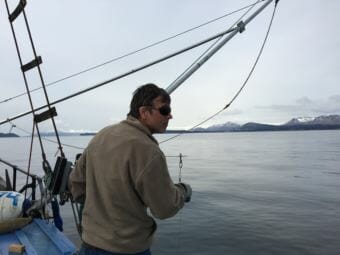
Darius Kasprzak fishes for cod in the Gulf of Alaska. (Photo by Annie Feidt/Alaska’s Energy Desk)
A hint of optimism creeps into Darius Kasprzak’s voice as he pilots his boat, the Marona, out of the harbor in Kodiak on a calm day in early May.
“We’re in the morning, we’re at the start of the flood tide,” he says. “This is where you want to be.”
On the screen of his echo sounder he sees a dense cluster of dots on the ocean bottom.
“Let’s drop on it,” he says. “That looks pretty darn good.”
He kills the engine, leaps onto the deck and lowers one of his fishing lines into the water.
And then…nothing.
For years, Alaska fishermen like Kasprzak have worried that climate change would threaten their livelihoods. Now, it has. The cod population in the Gulf of Alaska is at its lowest level on record. The culprit is a warm water mass called “the blob“ that churned in the Pacific Ocean between 2013 and 2017.
This map shows the blob, (in green and yellow) in Aug. 2015. (Image courtesy of Rick Thoman/NWS Alaska)
At its peak, it stretched from Alaska to South America. In the Gulf of Alaska, the cod population declined by more than 80 percent.
Climate change didn’t cause the blob all on its own. But scientists say global warming made it worse, pushing warm ocean temperatures to the extreme.
Kasprzak says he used to think the rich ocean ecosystem he fishes was unshakable. But he’s mostly given up on finding more cod here.
“We’ve just seen now that even the mighty Gulf of Alaska, how fragile it actually is, when all you’ve got to do is warm it up,” he says. “You don’t even have to warm it up that much, a couple of degrees. It doesn’t take that much.”
Since early 2017, the temperature of the Gulf of Alaska has been close to normal. Now everyone in Kodiak is asking: Will the cod come back?
Fisheries biologist Mike Litzow tosses kelp out of the net he uses to catch young cod. (Photo by Mitch Borden/KMXT)
Mike Litzow is trying to answer that question. He’s a fisheries biologist who works for the University of Alaska, based in Kodiak. With his wiry frame and thick beard, he looks more like a fisherman than a scientist.
Litzow does go fishing every few weeks in the spring and summer — for science, in search of young cod. He stands in shallow water on Long Island, near Kodiak, and uses a net called a beach seine to sweep up fish hiding in the eelgrass and kelp beds.
“There’s all kinds of information you can get over time, once you catch the fish,” Litzow says.
He doesn’t find any cod in this net. But by the end of the summer, Litzow hopes to catch enough tiny cod to provide clues on whether the population will recover.
Litzow doubts it will. He thinks the cod decline may have been so steep that other fish might fill its place in the ecosystem.
“When you push a population down really hard, the resources that population used to rely on can be exploited by other populations,” he says.
Other scientists are more optimistic. But everyone seems to agree on one point — that the blob is a dress rehearsal for a future with climate change. Marine heat waves are expected to happen more often and, overall, ocean temperatures will warm.
Litzow says it’s hard to predict what kind of ripple effects that will have. If you had asked a bunch of scientists to predict how fish would do during the blob years in the Gulf of Alaska, “it would just be like drawing names out of a hat,” he says. “It’s not like all of the scientists would say cod are going to be the ones that collapse.”
Litzow says fishing communities have to get used to the prospect of more frequent shocks to the ocean ecosystem. And Kodiak certainly isn’t the only place that’s seen them. Those changes aren’t all bad, he says. When one species declines, others do well. Right now, sablefish are booming in the Gulf of Alaska.
But the cod decline could be a disaster for fishermen, and for Kodiak. Already, cod boats are traveling more than a thousand miles away to find fish. That means crews aren’t stocking up at stores in town and boats aren’t paying the local fish tax.
Out in the Gulf, Darius Kasprzak has been on his boat for more than four hours. He sees some puffins, even a whale, but no cod.
Darius Kasprzak fills a tote with dusky rockfish. (Photo by Annie Feidt/Alaska’s Energy Desk)
Eventually, he gives up and decides to try to catch some dusky rockfish. He lowers his line over a promising spot and quickly reels one in.
“It’s a nice one, too,” he says as he takes the fish off the hook and puts it on ice.
It’s not nearly enough to bring to a processor, but it will make several meals. Rockfish used to help Kasprzak supplement his cod earnings. Now it’s his main fishery. It doesn’t come close to making up for the cod income he’s lost, but he’s working with a local nonprofit to market rockfish directly to customers to get a better price for the fish.
He’s also considered trolling for salmon instead, but that would require an expensive new permit and gear, and many salmon runs have been weak, too. The blob could be a factor.
Kasprzak says he can’t believe how fast climate change has altered his life. He says he didn’t even know it was an issue until he watched Al Gore’s An Inconvenient Truth in 2006.
“A dozen years later, not only is it real but the climate has warmed so much and the oceans have absorbed so much heat, my industry is gone because of it,” he says.
Kasprzak is looking at other career options. But he says he wants to stay in Kodiak as long as he can. That way if the cod do come back he’ll be one of the first ones out on the water.
This story is part of a new season of the podcast Midnight Oil from Alaska’s Energy Desk. Season two is called The Big Thaw and looks at climate change in Alaska. New episodes begin August 9.
Jeff Welbourn, Senior Director of the China Business Office for the Trident Seafoods Corporation checks out the fresh seafood at a grocery store on Thursday, May 24, 2018, in Beijing, China. (Photo by Rashah McChesney/Alaska’s Energy Desk)
There’s a lot of Alaska-born seafood in China. Walk into any McDonald’s and pick up a fish sandwich and it’s all wild Alaska pollock.
Trident Seafoods has been selling fish in China for 20 years.
Still, the average Chinese consumer probably doesn’t recognize Trident’s three-pronged logo. That’s because they’ve been selling seafood primarily as a commodity in China, not in stores and markets.
But that might change soon. The company sent a team with Alaska Gov. Bill Walker’s trade mission to China and that team is working on a new strategy.
Jeff Welbourn is Senior Director of the Chinese Business Office for Trident Seafoods. He checks out a display of snowcrab legs, sea scallops and baby octopus at a seafood market in Beijing.
Trident isn’t new to China. They’ve got operations in the port cities of Dalian, Quingdao and Weihei.
What is new is the way they want to promote and sell their fish here.
A seafood market in Beijing, China. (Photo by Rashah McChesney/Alaska’s Energy Desk)
On a bus trip across Beijing, Welbourn talks strategy for getting their products into some new markets.
“Per capita consumption of seafood in China is mind-boggling. I mean you’re talking, by some estimates, 40 kilograms [88 lbs.] per person, per year,” Welbourn said.
Trident wants to reach those people directly to let them know that they’re eating wild seafood from Alaska and to tell themwhere they can go to buy it again.
But it’s not easy — there is a huge demand for fish in China. But, a lot of it is farmed.
“Creating comfort and demand for a species that doesn’t currently resonate with consumers is a huge challenge,” Welbourn said. “So wild Alaska pollock is something that we have worked really hard to make sure is differentiated as a very transparent, sustainable and, you know, prestige fishery.”
Welbourn says a lot of Alaska pollock is already being consumed in China. But, Chinese citizens likely don’t realize it’s wild and from Alaska.
“It is kind of a lot of beating your head at the wall until it breaks,” he said.
So Welbourn and his team are exploring ways to bring their fish to a new market. A digital one.
We end up at the Beijing headquarters of JD.com, Incorporated.
It’s an e-commerce company with an enormous platform of about 300 million active users — think Amazon or Alibaba. Trident already has some of its seafood listed on this site. Customers can go online and one-click order something wild from an Alaska seafood company and get it shipped right to them. Grocery stores can order the seafood, too, and Trident wants to expand that reach.
After a tour, the group heads up to a boardroom to talk business.
And, it’s not just seafood here, although that is the bulk of the trade delegates in the room. It’s also people from the Mat-Su borough and Bambino’s baby food. The group talks for a few hours about everything from what the e-commerce giant buys and sells to when and how they should market it and who should pay for that marketing.
And, while they don’t come to any firm deal, it’s clear by the end of the meeting that they’ve made progress and Welbourn’s China-based team can follow up with the company.
Clouds hang over Hope, Alaska on May 19, 2018. (Photo by Annie Feidt/Alaska’s Energy Desk)
In Anchorage, complaining about the gloomy weather this spring has become something of a new pastime.
But is the weather really worse than normal?
According to Brian Brettschneider with our Ask a Climatologist segment, the answer is no.
Brettschneider says since April, the weather in Anchorage has been a few degrees warmer than normal and also drier than normal.
How is that possible?
Brettschneider says there haven’t been any really warm days. Typically Anchorage hits 60 degrees at least once by May 14, but the warmest temperature so far has been 59 degrees.
“So there can be this disconnect where there can be no really warm days, but we can still be above normal,” Brettschneider says.
Brettschneider says it’s also been a bit cloudier and significantly windier than normal.
“But for the most part, the story of this spring has been warmth.”
Brian Brettschneider is a climatologist based in Anchorage, with the University of Alaska Fairbanks.
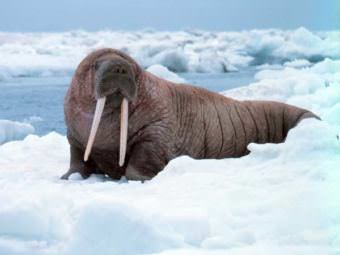
Pacific walrus resting on sea ice. Traditional knowledge and community observations are used to inform the Sea Ice for Walrus Outlook. (Photo courtesy National Oceanic and Atmospheric Association)
Scientists use lots of expensive sensors and satellites for studying climate change in Alaska. But more and more, they’re also relying on something that’s a lot more low tech — traditional ecological knowledge.
Brian Brettschneider, with our Ask a Climatologist segment, says traditional knowledge involves getting out into communities to ask residents for their climate observations and experiences.
He says in Alaska it’s considered best practice to use traditional knowledge in climate research.
Interview highlights:
I like to think of the climate system as a puzzle and we have lots of pieces to the puzzle. Some of those pieces are thermometers, satellite images and river gauges. When we put those pieces together in the puzzle and we can start to get an idea of what the system looks like. But there are more pieces. So if we go to the communities and ask where do ice jams form? And when did the brush start to move in? And when did the permafrost thaw out? Those are more pieces of the puzzle.
A really good example is up on the North Slope, there was a time they thought bowhead whales were critically endangered. But the local Inupiat hunters really had a better feel for what those whale populations were like and they worked with, say, US Fish and Wildlife Service to come up with a new way to track populations. And it turns out they were correct.
It’s really transitioned over the last 20 years or so where it was viewed at one time as an afterthought or an add on. But it really has become an integral part to studying remote areas in Alaska and all of the Arctic North. There’s a lot of benefit to using this data to better understand the world we live in.
Brian Brettschneider is a climatologist based in Anchorage, with the University of Alaska Fairbanks.
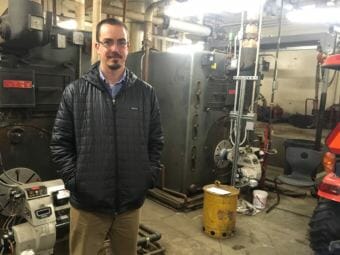
Kodiak Island Borough projects manager Matt Gandel stands in front of two fuel oil boilers at the Kodiak middle school. (Photo by Kayla Desroches/KMXT)
Kodiak is powered by almost 100 percent renewable energy through wind and hydro power. Most homes and businesses heat with fuel oil, but the local utility sees a shift to electric. To meet the growing demand, the Kodiak Electric Association (KEA) is planning a new project to boost the energy potential of Kodiak’s hydroelectric reservoir.
Kodiak Island Borough projects manager Matt Gandel stands in front of two fuel oil boilers at the Kodiak middle school that are taller than he is.
“We replaced the boilers at Peterson [Elementary School] a few years ago. They’re probably half of this size, and you get the same kind of efficiency,” he said.
Gandel says the typical life of a boiler is between 20 and 30 years, and these ones are pushing 35 years old.
He says they’ll switch out one of the boilers with an electric boiler in May.
“The electric boiler that will be here is more sophisticated than these fuel boilers,” he said.
The Kodiak Electric Association is paying to install electric boilers in the middle school, high school and the Kodiak Fisheries Research Center as part of the expansion of its Terror Lake hydroelectric project.
The expansion will catch snow melt and rain and transport it to the Terror Lake reservoir to increase its energy potential.
When it’s complete in 2020, the diversion will produce excess power and KEA will direct the energy to public buildings.
The utility struck a deal with the borough for a 10 percent discount on the excess hydropower for at least the first few years of the hydroelectric project expansion.
KEA president and CEO Darron Scott says the agreement benefits the borough, the school district, and the utility.
“We get to utilize our surplus power, the community gets to benefit from a lower cost of heating source, and we get to have cleaner air to boot,” he said.
Scott sees electric heating as the future in Kodiak.
He says a lot of new construction uses technology like electric boilers or heat pumps, which are now capable of functioning at even lower temperatures.
“You don’t have the potential of an oil leak at your house, you don’t have as significant a maintenance on the electric systems as you do on the fuel oil systems, and you’re hopefully gonna be saving money and more consistent costs over time,” he said.
Fuel prices rise and fall and Chris Rose, the executive director of the Renewable Energy Alaska Project in Anchorage, says the market is unpredictable.
“We have no control over the price of oil. Some kind of geopolitical event could occur and, all of a sudden, oil prices shoot over to $100 a barrel again.”
Rose says cities with lower electricity costs like Kodiak are good candidates for the transition to electric heat if the utility can handle the increased demand.
KEA’s expansion of the hydroelectric facility will help Kodiak do just that in the long run.
The diversion should boost the annual hydropower production by about 33 million kilowatt-hours, which is roughly 25 percent more energy.
KEA plans to start construction in June.
Close
Update notification options
Subscribe to notifications
Subscribe
Get notifications about news related to the topics you care about. You can unsubscribe anytime.