Annie Feidt, Alaska’s Energy Desk

Pebble Mine proposal details released

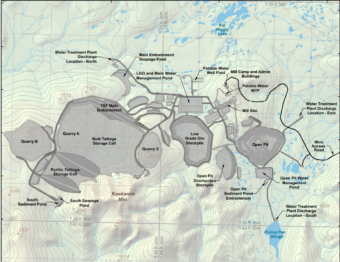
A map of the mine plan Pebble Limited Partnership is proposing. (Image courtesy U.S. Army Corps of Engineers)

Now that the Trump administration removed a key roadblock, the Pebble Limited Partnership is chugging through the bureaucratic process needed to get approval to build its mine.

A federal agency today said a permit application Pebble filed in late December is complete. The agency released the application publicly on its website.

It’s a highly technical document with details on what the controversial mine in Southwest Alaska could look like. But so far, nothing in the application is changing opponents’ minds.

In October, Pebble Limited Partnership released some details on how it plans to build a copper and gold mine near Iliamna. Then, the company claimed it was making a series of adjustments to make the mine safer — it promised a smaller mine than the company originally set out to build, for example.

The application the U.S. Army Corps of Engineers released gives a fuller picture of Pebble’s plans. It’s also a pivotal step. Now, the federal environmental review process can begin, which will help agencies decide whether they should approve the mine.

“This is the first big bite of the apple, if you will. And it’s pretty exciting just to at least have some details out there that people can now start to take a look at and say ‘this is how the Pebble team proposes to design and operate a responsible plan for developing the mineral resources at Pebble,” said Mike Heatwole, a spokesman for Pebble Limited Partnership.

The application includes maps of the open pit mine and the 1.1 billion-ton-capacity tailings storage facility. It shows roads the company wants to build to access the mine. The plan calls for a port on the west shore of Cook Inlet, an ice breaking ferry across Lake Iliamna and a natural gas pipeline from the Kenai Peninsula to help power the whole operation. Many details could be adjusted as Pebble continues its work with the government agencies making the decision whether to approve the project.

According to Pebble, the mine itself will have a footprint of nearly 11 square miles. The application states that over a period of two decades, the company aims to mine 1.2 billion tons of material.

None of the fine print is placating groups against the mine in Bristol Bay and beyond.

“The short time we’ve had to review kind of the highlights of this permit application, it confirms every concern we have had for over the last decade,” said Alannah Hurley with the United Tribes of Bristol Bay, one of the mine’s most outspoken opponents.

Hurley pushed back at Pebble’s message that they’re building a smaller mine than originally planned. She pointed out the application shows over 3,000 acres of wetlands and waters must be filled in to build the mine site.

But opponents main response is that they’re worried this plan is just a beginning.

“I think this is a classic bait and switch,” said Tim Bristol, executive director for SalmonState, another group against the project.

Although Bristol said he’s against the mine as it’s laid out in the permit application, he added there’s nothing stopping anyone from pursuing a bigger mine at a later date. But Bristol’s worried this plan could get a green light from government agencies — especially under the Trump administration.

“They’re trying as hard as they can to get this thing into permitting now and I don’t think anyone can doubt the fact that it’s going to be a much more permissive permitting process during this administration than during the last one,” Bristol said.

Under the Obama administration, the Environmental Protection Agency proposed putting restrictions on the mine. But after President Donald Trump took office, EPA reached a settlement with Pebble and the company began moving forward again.

Pebble says if the company wanted to expand the mine in the future, it would have to roll out a new proposal and get new approvals. Heatwole called the immediate negative response to the permit application “unfortunate.”

“To say unequivocally that the mine presents risks that can’t be managed is, I think, premature and prejudicial,” Heatwole said. “It does not allow this objective, third-party, rigorous review process to take a look at all the issues that development presents.”

Pebble also announced it secured a new partner recently, the Canadian company First Quantum Minerals. That partnership will help fund the permitting process, although the companies haven’t yet reached a final deal on funding the actual project.

As the environmental review process moves forward, the Army Corps said it will hold a series of public meetings. The agency said final approval could take several years.

Ask a Climatologist: 2017 was hot around the globe, warm in Alaska

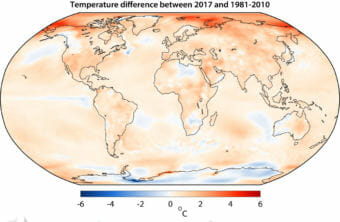
Graphic courtesy of Copernicus Climate Change Service, ECMWF

Across the globe, 2017 was the second hottest year on record, just behind 2016, according to a European Union monitoring center.

Temperatures in Alaska last year were a bit more moderate. 2017 was the 13th warmest year on record.

Brian Brettschneider, with our Ask a Climatologist segment, says the state was still significantly above normal for the year, despite a cold winter.

Interview Transcript:

Brian: We had a pretty chilly winter last winter – December, January and February. And we had a really cold March, about the 12th coldest March on record, so that sent us into a temperature deficit the first three months of the year. Then the switch flipped for the rest of the year and we had a top ten warmest three-quarters of the year. When you add all that together, it ends up being the 13th warmest on record.

Annie: Some people might say 13th warmest, that doesn’t sound very dramatic, we’re used to hearing record warm temperatures, especially in the winter in Alaska. What do you say to that?

Brian: The previous two years were the warmest two on record. And they were also the warmest two on record globally, so Alaska was fitting with that global pattern. 2017 looks to be the second warmest year on record globally, but there’s going to be variations among locations around the earth. It just so happens that for 2017 we were in one of those pockets where it wasn’t quite as warm as most people experienced. But the earth was almost as warm this year, Alaska  just got the lucky roll of the dice where we weren’t embedded in the core above normal temperature pattern.

Annie: There were places in Alaska where the story was more dramatic, right?

Brian: As is usually the case, Alaska’s a big place. There’s a lot of variability from one part of state to the other. So in some places, say Southeast Alaska, they were kind of at or slightly below normal for temperatures. But as you head north and west, the departures got much more dramatic. So as you head up the west coast, say to Kotzebue and the Utqiagvik (Barrow) you ended up with a top five warmest year on record. In those places, it’s highly correlated with the lack of sea ice. The Chukchi Sea, for example this fall, took the longest to freeze over from any year in the satellite record. And that open water provides excess warmth so that really sent the temperature departure for the end of the year to near record levels.

Annie: And what about precipitation?

Brian: For precipitation, 2017 was a fairly unremarkable year. Most places from Anchorage northward were above normal precipitation. But if you go to Bethel and up to the North Slope, they ended up with a top three wettest year on record. South of Anchorage, from Bristol Bay, to Kodiak, and all of Southeast it was at or slightly below normal. So overall unremarkable precipitation story for 2017, but on balance the state was a little bit wetter than normal.

Trump administration proposes vast increase to offshore oil leasing in Alaska

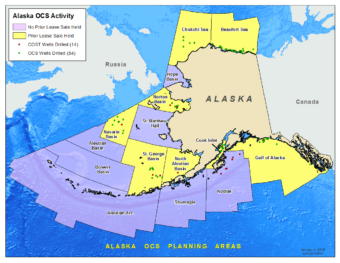
Map showing previous offshore wells drilled in Alaska. (Courtesy of the Bureau of Ocean Energy Management.)

The controversy over offshore oil drilling in Alaska just got bigger.

Today, the Trump administration rolled out a proposal to hold the largest number of offshore oil and gas lease sales nationwide in U.S. history. It could mean more waters off Alaska’s shores are available for oil development than ever before.

As expected, the Interior Department is moving to allow oil drilling in federal Arctic waters that former President Barack Obama mostly took off the table. But there’s a lot more to this announcement — the draft plan includes waters where Alaskans haven’t contemplated oil development for decades, if ever.

Interior Secretary Ryan Zinke rolled out the proposal using one of the administration’s favorite catchphrases — “energy dominance.” That was even the code reporters had to use to get on the press call.

“Today we’re embarking on a new path for energy dominance in America — particularly on offshore,” Zinke said.

When finalized, it will replace the five-year offshore leasing plan the Obama administration put out in 2016. That was controversial in Alaska because it didn’t include any lease sales in Arctic federal waters through 2022.

Zinke’s proposal flips the script — not only could the Beaufort and Chukchi Seas be opened to drilling again, but so could waters that have never before been available for oil development, including areas near the Aleutian Islands. The only federal areas off Alaska’s shores not under consideration for oil leasing is the North Aleutian Basin, which encompasses Bristol Bay.

The Interior Secretary stressed the plan is not final.

“This is a draft program. The President clearly has outlined that states, local communities and congressional delegations all will have a say,” Zinke said.

Between the years 2019 and 2024, the administration is considering 19 offshore oil and gas lease sales in the Alaska region. That’s a huge increase — there have been only two such sales in Alaska in the past decade, one for the Chukchi sea in 2008 and another last year in Cook Inlet.

Zinke said he made the decision because offshore oil development is economically important, and can be done safely.

But the negative reaction from environmental groups was fast — and fierce.

“It was reckless and irresponsible on the part of the agency and the administration to propose this amount of real estate,” said Susan Murray, Oceana’s deputy vice president for the Pacific.

Murray acknowledged that the plan isn’t final; Interior could ultimately decide not to hold oil lease sales in many areas. But she’s alarmed the Trump administration is even considering drilling in the Arctic — and further south.

“The Bering Sea is the fish basket of the United States; the production there is amazing, as well as Gulf of Alaska, the Aleutian Islands. And to put that resource at risk for reckless offshore oil exploration is ridiculous,” Murray said.

Environmental opposition isn’t all that could tarnish the new, expansive vision for offshore oil development in Alaska. It’s an open question how much oil companies want to drill in all the offshore acreage that could be opened up. Over the last decade, several oil and gas lease sales in Cook Inlet were canceled due to lack of industry interest, and Shell famously ended its Arctic drilling program in 2015.

Alaska Oil and Gas Association President Kara Moriarty said while her group pushed for a “much broader” offshore leasing plan than what the Obama administration allowed, she’s not aware of any companies that specifically asked for all the areas proposed by the Trump administration. Still, she said, it’s good to have options.

“There’s nothing wrong in making areas available for evaluation and let the free market determine whether it’s a good business decision or not,” Moriarty said.

“This administration said during the campaign that they believed in true energy development, and they’re true to their word,” Moriarty added. “I don’t think it should be a big surprise that they’re being consistent with what they campaigned on.”

Reaction from Alaska’s political leaders was also positive — but measured. Senator Lisa Murkowski called the announcement “good news” in a statement. But she also emphasized that “nothing in this proposal is final.”

“Secretary Zinke’s ‘blank slate’ approach launches a new discussion with local stakeholders to determine where responsible energy development should take place,” Murkowski said.

Andy Mack, who heads Alaska’s Department of Natural Resources, is happy the Trump administration is proposing lease sales in the Beaufort and Chukchi seas again — that is something the state requested. But Mack said the state wasn’t pushing for access to all the other offshore areas the Trump administration is now proposing. Mack thinks the final plan won’t be as wide-ranging.

“We expect that the ultimate plan and the focus of this will be smaller than what we see today, but we’re happy that we’re having the conversation,” Mack said.

Mack said Walker’s team will be listening to communities across Alaska before they discuss the proposal with the Trump administration. But, he said, when it comes to offshore drilling, their focus remains on the Arctic.


Ask a Climatologist: A remarkably warm December

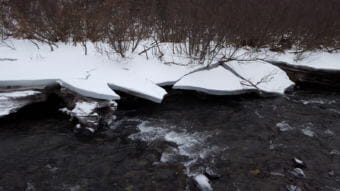
A creek in Anchorage started break-up in December. (Photo by Brian Brettschneider)

December has been remarkably warm across the state. Temperatures in Fairbanks have felt more like Anchorage, Anchorage more like Juneau, Juneau more like Ketchikan. You get the idea.

Brian Brettschneider, with our Ask a Climatologist segment, says the state as a whole is likely to have the warmest December on record.

Interview Transcript:

Brian: From south to north, east to west, everyone has been much above normal. And we’re talking now: the numbers are in through the first 18, 19 days of the month. So we’re talking from Utqiagvik, Barrow, down to Ketchikan and then from Nome all the way to Fairbanks and Eagle. Again, way above normal for everybody.

Annie: Have we set any records?

Brian: Many, many stations, perhaps even most stations in Alaska, are on track to have, or at least through the 19th, have had the warmest first 19 days of December. Many of those places are solidly on track to have their warmest December on record. And as a state we’re looking really good for having perhaps our warmest December on record as a statewide value.

Annie: It’s not unusual to have warm ups in Alaska. What makes this one exceptional?

Brian: It’s really the persistence. A few places that have had their warmest single day, like Juneau had their warmest high temperature, Bettles did, a couple other places did as well, like Kotzebue. Anchorage had their warmest single day if you average the high and the low and we had a run of four days in a row of 45 degrees which had never happened in any winter month. But it’s the persistence. From December 2nd onward it’s been much, much above normal across basically the entire state. And then if you look at the extended forecast, out 8, 10 or 14 days, which takes us through the end of the year, it’s really looking quite warm, way above normal.

Annie: And what’s causing this?

Brian: We talked a few weeks ago about this upper level pattern, these Rossby waves. We’ve had this wave, this upper level area of high pressure that’s been anchored along the western part of North America and we’re on the western side of that and the flow has been from the south. So it’s been this unrelenting transport of air from lower latitudes. The flip side of that has been in the central part of North America, Canada’s been below normal, the lower 48 is about to go into an extended period of below normal. But here in Alaska we just have been stuck in that sweet spot for southerly flow and warm temperatures.

Annie: And you said we’re on track for this to continue for at least another two weeks?

Brian: Yes, so specific forecasts out more than four or five days, we really start to get into broad brush strokes. But the brush strokes are for extremely warm temperatures, much above normal. What the values are is too hard to tell. But there’s really no end in sight, until you get to January, for these remarkable conditions.

Ask a Climatologist: Jet stream pattern keeps Alaska warm, Lower 48 cold

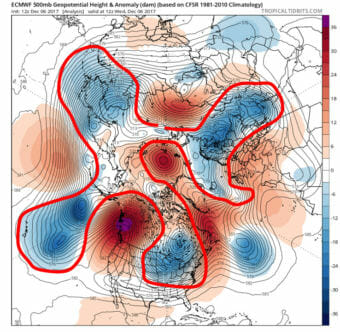
(Graphic by tropicaltidbits.com)

Alaska is likely to stay warm this month, while much of the Lower 48 experiences a cold snap. It’s a flip-flop of the expected weather pattern that’s not uncommon, especially in winter.

Brian Brettschneider, with our Ask a Climatologist segment, says the culprit is a feature of the jet stream called a Rossby wave.
He says the jet stream moves around the planet from west to east, but it doesn’t necessarily take the direct route.

Interview Transcript:

Brian: It waves up and it waves down, kind of like a river meandering. We call these waves Rossby waves and there are generally about five of these waves traveling around the globe. But where ever it goes up in one place, it has to come back down somewhere else. It’s kind of like squeezing a balloon. When you squeeze a balloon in the middle, there’s a reaction, it bulges out on other sides of the balloon. So where these waves move northward, like what’s happening now near Alaska, it’s dragging lots warm air from the subtropics. So we feel that as warm. But if you do the math, the average distance between these peaks and troughs is about two to four thousand miles. If you move east two to four thousand miles, you’re talking about the central part of North America. So the jet stream is now racing south over there and it’s pulling in cold air from the north.

Annie: Is this more likely to happen in the winter?

Brian: We definitely see this in much larger magnitude in the winter. In winter, we have much bigger temperature gradients between lower and higher latitudes and that creates a stronger jet stream and it’s able to move north and south a much greater area and then either draw in warm air from much farther south or cold air from much farther north.

Annie: And what about climate change? Is climate change making this phenomenon more noticeable or worse?

Brian: We need to be careful. Whenever we have a warm spell, it can be convenient to say, oh this is global warming. Or when we have a cold spell, we can say what global warming? So you have to remember that global warming, climate change, is like this background noise, so our warm spells are a little bit warmer and our cold spells are also a little bit warmer. As the earth warms, the temperature gradient decreases a little bit, so it gets warmer at higher latitudes, much warmer, and it gets somewhat warmer at lower latitudes. So the temperature gradient is a little bit less, the jet stream is a little bit weaker, and is susceptible, perhaps, to greater waviness. It can be a little bit paradoxical, that in the lower 48 they can have more frequent cold outbreaks, but perhaps not as intense as before or not as long lived as before. We do still get warm and cold, it’s just a little bit less intense than it would be in a pre-warming environment.

Ask a Climatologist: Chukchi Sea ice at record low


The Chukchi Sea should be almost fully covered in sea ice by now. Instead, it’s mostly open water.

Brian Brettschneider, with our Ask a Climatologist segment, says the ice coverage right now in the Chukchi is typical for mid-October, not late-November.

Interview Transcript:

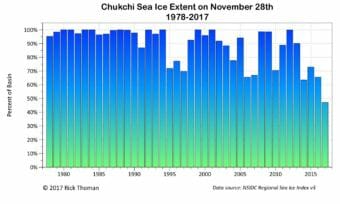
Brian: Normally by this date, it’s 88 percent covered in ice. This year, it’s only 46 percent covered in ice. And that’s dramatically lower than even the second lowest year, which would be 2014, so very, very low ice coverage for this region…unprecedented.

Annie: And a record low by a wide margin…

Brian: By a very wide margin. I should say we’re talking the satellite era, which would be 1979 through present. But it’s fair to assume, and we have historical data that goes out to the late 1800s. It’s not as complete as the satellite era, but there’s really nothing even in that data set that comes close to where the sea ice is for 2017 through the end of November.

Annie: What does that mean for weather in Alaska?

Brian:  Of course all the Arctic is very important, but because this area is adjacent to Alaska and because of the direction of the prevailing flow through much of the winter, it’s really important. Because that area, when it’s open water and it’s about 30 degrees it’s providing a lot of warmth to the atmosphere. When it’s covered in ice, that warmth is locked in underneath it. So if you have a flow of air that’s moving from say the Northwest, as it’s crossing over that water it’s going to be a lot warmer, if it’s locked in ice, it’s going to be a lot colder. It’s also going to be picking up a lot more moisture as it’s moving over the open water. So there’s a lot of local, near term weather impacts from having that open water.

Annie: Is there any ice near Utqiagvik?

Brian: Looking at the Geophysical Institute sea ice web cam, at least this morning there was no ice. There’s been a little bit of ice here and there, at the very nearshore. But basically there’s no ice up there at Utqiagvik. And talking to Rick Thoman, from the National Weather Service office, he’s indicated that in the last number of decades, the latest that it’s taken for the ice to fill in there is mid-November. So at least for the past 30, 40 and probably more years than that, this is the latest it’s ever taken to fill in the ice there in the nearshore areas.

Site notifications
Update notification options
Subscribe to notifications