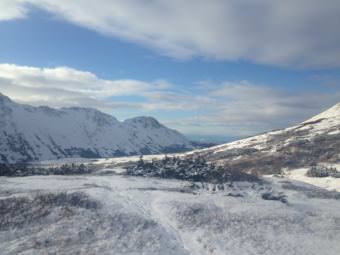
Snow blankets the hidden lake trail above Anchorage, Oct. 22, 2017. (Photo by Elizabeth Harball/Alaska’s Energy Desk)
The first measurable snow of the season fell in Anchorage Saturday. The city got three-tenths of an inch.
The snow came six days later than normal, according to Brian Brettschneider, with our Ask a Climatologist segment.
Brettschneider says the first measurable snow is different than the first trace of snow.
Interview Transcript:
Brian: A trace means less than one-tenth of an inch. That could be a snow flurry or it could be a dusting that’s less than one-tenth of an inch. Normally, the first trace of snow would be observed on Oct. 5, but we didn’t even get a flurry until our measurable snow on Oct. 21, so our trace amount was actually 16 days late versus six days late for measurable snow.
Annie: What about the rest of the state?
(Graphic courtesy of Brian Brettschneider)
Brian: This season, the rest of the state is pretty much on track. Some places were a little early. Some places are a little late. The only place that’s pretty late right now is Bethel. They should have had their first measurable snow on Oct. 11. So they’re pushing two weeks late on their measurable snow.
Annie: Has climate change impacted when the first snow occurs in Alaska?
Brian: The first snow is this great marker for the season: it’s winter. Because we are warming, that’s incontrovertible, we are warming, Alaska’s warming faster than the rest of the world, that means we’re having shorter winters. That being said, the date of the first snow fall is really a very poor marker for climate change because you can have a small confluence of local events dump a quick tenth or two-tenths of snow and then you’ve marked it in the books as your first snow date. So generally around the state we haven’t shifted that date very much over time. For example Fairbanks, their first measurable snow date is about three days earlier now than it used to be. Other places like Bethel, it’s about three days later. So most places are within about a week or so of the date now versus when the date was say, more than 40 years ago.
Annie: Does the first snow of the season mean anything for how much snow we’re going to get during the winter?
Brian: Everyone likes to say, ‘oh we had an early snow, that means it’s going to be a good snow winter,’ or ‘man the first snow was really late. We haven’t had much snow in October, that means it’s going to be a really low snow winter.’ The thing is, in Alaska, it makes no difference at all. If you plot out all the dots of when snow fell versus the seasonal total, you get just complete random patterns. It means absolutely nothing.
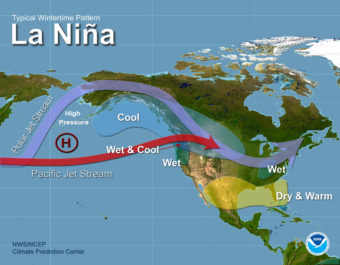
The potential for a La Nina weather pattern this winter is looking more and more likely. The latest forecast says there’s a 66 percent chance for La Nina, a figure that’s been steadily rising for the last few months.
That’s according to Brian Brettschneider, with our Ask a Climatologist segment.
He says La Nina typically brings cooler and drier conditions to Alaska. And because of global warming, that may mean a more typical winter.
Interview Transcript:
Brian: Since we’re comparing against the 1981 to 2010 climate normal period, we’re already a couple of degrees warmer than that. So we’re starting off, all things being equal, as being pretty far above normal. La Nina, and it’s not a done deal, generally it’s going to tilt us toward cooler temperatures. So more than likely it’s going to send us back a couple of degrees, which would put us close to the normal range.
Annie: We had a La Nina last winter. How unusual is it to have back-to-back La Nina’s?
Brian: It is unusual, but it’s not unprecedented. It’s not one La Nina- we had a La Nina last winter and it faded away, but now we’re transitioning back into a new La Nina, so they are separate events. Again, it’s not unprecedented, but it is pretty uncommon. Normally, they’re going to be spaced a couple years apart.
Annie: Do we know why we would have two in a row?
Brian: Actually, we don’t. With El Nino’s and La Nina’s, we kind of understand how they work, but we don’t have a good understanding of what initiates them or why they occur. So that’s an area of intense research. But for now, we watch the progression of it and don’t understand why they occur.
Annie: How does the La Nina work and why does it bring drier, cooler weather to Alaska?
Brian: El Ninos and La Nina’s- they’re a measure of what the ocean temperatures are in an area of the central tropical Pacific Ocean within five degrees of the equator. And it’s curious as to how that affects things in Alaska. The reason it does is because it’s where these warm pools of water set up. In El Nino, they set up more towards South America. In La Nina years, they set up much more towards the west, say towards Indonesia. So you have these tropical thunderstorms sending heat, air movement, masses of air, and that affects large scale atmospheric patterns, called Walker Cells. And it also influences which direction the wind is coming from at upper levels. So in that La Nina year where the warm pool is set up to the west, and that’s where the tropical storms are, we end up with a kind of northerly flow across Alaska which drags in colder air from farther to the north and limits the amount of moisture that comes in.
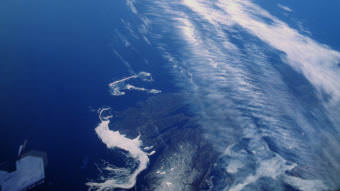
Banded cirrus clouds run perpendicular to the jet stream—a telltale feature photographed by an astronaut aboard Space Shuttle Discovery. (Photo courtesy of NASA’s Goddard Space Flight Center)
The jet stream circles the globe from west to east affecting weather, climate and even the length of many airplane flights.
This week on Ask a Climatologist we’re answering a question from a listener who asked how the jet stream affects weather in Alaska.
Climatologist Brian Brettschneider says the jet stream is basically a ribbon of air circling the globe at high speed.
Interview Transcript:
Brian: It’s generally the boundary between cold, polar air and much warmer mid-latitude or subtropical air. It’s always present, all year round, but it varies in intensity quite a bit and when it’s not quite as cold, in the summer months and fall months it’s in the vicinity of Alaska. In the heart of the winter, usually it’s farther south so it doesn’t really affect us that much. But it’s always there, so it’s something that’s of great interest to the weather and the climate community, to the aviation community. So a lot of people are focused on where the jet stream is, how it’s moving and what it’s going to do over the next number of days.
Annie: But in Alaska, it doesn’t affect us too much?
Brian: The jet stream does affect us here in Alaska. Particularly in the fall and the spring months, we are right at the boundary of where the cold polar air is and the much warmer air farther to the south. The jet stream moves like a ribbon, so at times it goes up and other times it goes down and it has to stay in equilibrium. Where it comes down, you actually spin up low pressure areas and those then form precipitation and have wind. We do have these large fall storms and sometimes in spring as well, those are very frequently associated with these dips in the polar jet stream as they’re situated near Alaska.
Annie: And how is climate change affecting the jet stream?
Brian: In the last few years, there’s been a fair bit of research that’s looked into this issue of what does a warming world do, what will it do to the jet stream. The strength of the jet stream is the temperature difference between the high latitude, arctic polar latitudes, and the equatorial or tropical latitudes.
In a warming world, high latitudes warm faster and that difference in temperatures is reduced which then reduces the strength of the jet stream. The jet stream in a weaker state is more susceptible to these wild gyrations. When you have this jet stream that’s more susceptible to moving around, in the Lower 48 you can get paradoxically more arctic outbreaks. But then you can also get more dramatic warm ups in the winter. So, more variability and more storms are possible.
It’s something that’s an emerging area. It makes sense from a physics point of view and now researchers are trying to put that puzzle together and confirm what they think the theory indicates.
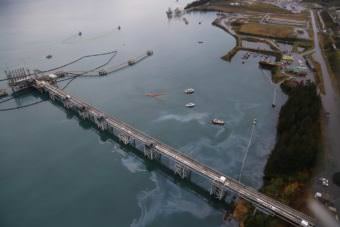
Responders use boom to collect oil near the Valdez Marine Terminal on September 23, 2017. (Photo provided by Alyeska Pipeline Service Company)
Cleanup efforts indicate that a crude spill at the Valdez Marine Terminal was bigger than first reported.
According to Alyeska Pipeline Service Company, approximately 400 gallons of an oily water mix had been recovered from the Port of Valdez as of Saturday night.
When the spill was first reported Thursday, Alyeska estimated the volume of crude spilled to be less than 100 gallons.
“The cause of the spill, piping that released an oily water mix, makes it very difficult to give a precise estimate of the amount spilled,” Scott Hicks, who is leading the response for Alyeska, said in a statement. “But any crude oil in the water is too much, and we will bring all necessary resources and expertise to the response.”
The spill happened during testing of the Marine Terminal’s loading arms — the pipes that deliver oil to tankers. During an unplanned pause in testing, water that was sent through the loading arms flowed out of the water intake piping and into Port Valdez.
Response to the spill is ongoing. According to Alyeska, more than 23,000 feet of boom and more than 25 vessels have been deployed during the cleanup efforts. Overflights conducted over the weekend indicate the sheens have been contained.
Responders have placed booms at the Valdez Duck Flats and the Salmon Gulch Hatchery.
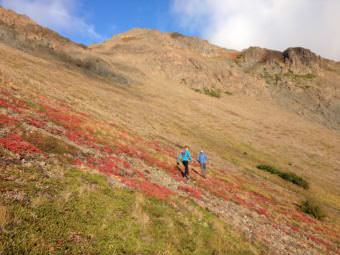
Hikers near McHugh Peak near Anchorage, Sept. 19, 2017. (Photo by Dave Bass)
Fall colors are just past their peak in Southcentral Alaska. And the formula for producing those deep reds and bright yellows is pretty simple: it’s all about the sun angle.
Brian Brettschneider, with our Ask a Climatologist segment, says that’s because the green leaves get their color from chlorophyll, a molecule used in photosynthesis.
Interview transcript:
Brian: When the chlorophyll production shuts down in the fall, those other colors which are kind of always there, but overwhelmed by the green, then they stand out with the green no longer in effect.
Annie: And how does weather and climate play into when the leaves change?
Brian: Interestingly, I get asked this all the time. (People) say, ‘Oh, it’s been a warm summer, it’s been a cool fall, it’s been wet, it’s been dry, that’s really going to effect the colors of the leaves.’ Really, it makes very little difference. When the leaves change colors in the fall is primarily related to the sun angle.
So the leaves, they track the sun over the summer and the fall and they know when that solar energy is getting less and less. It’s that solar energy that drives photosynthesis and when it becomes too hard for the plant to do that it shuts down, the chlorophyll production drops off and you end up with these other colors.
There’s a little bit on the margins that the weather affects when it’s going to happen, but more importantly, the weather affects what the intensity and the duration of color is going to be. So if you have a few hard freezes in September, it’s going to shorten the length you’re going to have those colors, they’ll turn brown and fall off. If it’s sunny and cool but not freezing cold fall, those colors will be a little more intense, and they’ll last a little longer. So it’s not a driver of when it occurs, but it’s a driver of the extent and the duration and the intensity is going to be.
Annie: When the colors do change, does that alter the climate at all?
Brian: It does. In April and May, once green-up occurs, there’s a noticeable increase in atmospheric moisture, because as part of the process of photosynthesis, the leaves are transpiring moisture to the atmosphere. So you end up with a more humid, more moist atmosphere, which in the summer allows for thunderstorm production in the Interior. Once the chlorophyll production shuts down in the fall, that transpiration of moisture goes way down, so you end up with less moisture in the atmosphere that was contributed from the leaf production.
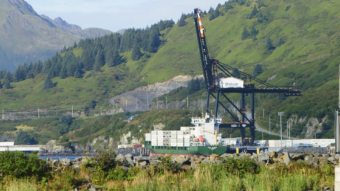
One of the largest shipping cranes in Alaska, operated by Matson, is electric and runs on renewable energy. It prepares to offload a vessel in the Kodiak harbor in Aug., 2017. (Photo by Eric Keto/Alaska’s Energy Desk)
Since 2014, Kodiak has gotten more than 99 percent of its electricity from renewable energy, using a combination of wind and hydro.
It’s part of a growing trend, as cities around the nation aim for a hundred percent clean energy.
But most of those communities are connected to the country’s major power grids – grids that depend on fossil fuel plants to keep them reliable.
Kodiak doesn’t have that option.
To understand Kodiak’s grid, it helps to check out the town’s shipping crane. It’s a black and orange beast on the Kodiak waterfront. At more than 340 feet tall, it is way bigger than anything else around.
This crane serves the nation’s second largest fishing port, loading freezer containers full of salmon and halibut and cod onto ships. Plus it handles just about anything else that needs to come in and out of Kodiak.
“If you’re buying it at Safeway, chances are we brought it in the night before,” said Rick Kniaziowski, who runs the Kodiak terminal for the shipping company Matson.
And, like everything else that runs off electricity here, the crane is entirely powered by renewable energy.
So when Kniaziowski approached the head of the local utility to propose replacing Matson’s old, diesel-powered crane with a giant electric one, the answer at first was: no.
“His eyes got really big, and he’s like, I just don’t see it, Rick,” he said. “Everyone’s TVs are going to brown out and they’re going to hate you or they’re going to hate us.”
Jennifer Richcreek works for Kodiak Electric Association, or KEA, the local co-op. She said an electric crane was a big ask.
Regulatory Specialist Jennifer Richcreek discusses the island’s power grid at the Kodiak Electric Association office. (Photo by Eric Keto/Alaska’s Energy Desk)
“The idea of having an electric crane – great! This is our vision, we’re electrifying the town with renewable energy,” Richcreek said. “But, that load draw on a massive crane was huge! And so looking at it, it was a pretty daunting engineering task.”
Spoiler alert: they did figure it out – with some seriously sci-fi stuff. We’ll get to that later.
Kodiak Electric first set a goal of 95 percent renewable power back in 2007.
It was pretty ambitious. The Kodiak waterfront is lined with fish processors. Down the road is the nation’s largest Coast Guard base. To the south is Kodiak’s rocket launch facility. Those are a lot of big energy users who need rock-solid, reliable, affordable electricity.
Which is not exactly what renewables were known for.
But the co-op also had a major motivation: the cost of diesel. Ten years ago, Kodiak got about 20 percent of its power from diesel generators. The rest was hydro – so in a dry year, diesel use could spike. And the cost of diesel was very high and totally unpredictable. Businesses had trouble forecasting their electricity bill.
Richcreek said it was like being held hostage to diesel.
“When you have that threat of a diesel bill hanging over your head every month, that is very motivating to find solutions,” she said.
So the co-op decided to try something Kodiak has a lot of: wind.
In 2009, they installed the first three wind turbines on Pillar Mountain, above town.
But wind isn’t easy to work with.
“Wind is a wild child,” Richcreek said. “Wind does as it pleases. You don’t know when the wind is going to blow. You don’t know how long it’s going to blow. It’s unpredictable, it’s variable, it’s all over the place.”
That’s the opposite of how a traditional power plant works. With coal or natural gas, it’s there when you need it.
So KEA had to figure out how to make its wild child play nice. Specifically, they had to figure out how to manage the hand-off from wind to hydro power. Wind might change intensity second to second. Meanwhile, the town’s hydro power takes minutes to ramp up.
The solution? A bank of batteries. Those can supply energy quickly while the hydro ramps up behind them. That system worked pretty well.
Then came the crane.
Every time the crane lifts a shipping container, it’s a massive, immediate pull on the grid. And when it drops that container, all that power comes rushing back.
So here’s where it gets a little sci-fi. Kodiak looked around and decided to try a flywheel – a six and a half ton spinning mass.
“It’s in a frictionless vacuum chamber hovered by magnets… which is so cool,” Richcreek said.
Kodiak’s two flywheels sit behind a chainlink fence beside the harbor. One of the wind turbines on Pillar Mountain can be seen in the background. (Photo by Eric Keto/Alaska’s Energy Desk)
The flywheel stores energy as motion. When there’s a surge of energy onto the grid, it spins the flywheel…and it keeps spinning, until that energy is needed again.
Altogether, it’s like a dance, or an orchestra: each piece is watching the rest, and responding second by second, millisecond by millisecond.
The wind drops suddenly and the flywheels kick in. As the flywheels fade, the batteries step in, and behind it all, the hydro ramps up.
All of this is really unusual. KEA’s head, Darron Scott, said as far as he knows, Kodiak is the first to combine batteries and flywheels in this kind of cascading energy storage system. To integrate lots of variable energy like wind or solar onto a grid, especially a small grid like Kodiak, you need that storage and moment-by-moment communication. Not many places have mastered it.
But Richcreek said this is the future.
“The solutions are out there,” she said. “They’re outside the box. They may be different. But the industry is changing.”
Close
Update notification options
Subscribe to notifications
Subscribe
Get notifications about news related to the topics you care about. You can unsubscribe anytime.