Annie Feidt, Alaska’s Energy Desk

When the lights went out – Alaska’s great recession | MIDNIGHT OIL: Episode 06


Less than ten years after oil started flowing, Alaska’s economy cratered. The recession was quick and deep. Ten banks failed, real estate values plummeted and tens of thousands of people fled the state. It was Alaska’s great recession, 20 years before the rest of the country went through almost the same thing.

Eating out wasn’t just a quick bite for Pete Zamarello. It was a sacred time when dreams were sketched in notebooks. He amassed an empire over plates of Italian or Mexican — Pete’s favorite foods.

He liked to arrive at a restaurant with an entourage. And patrons would look up to catch a glimpse. This guy was an Anchorage celebrity. At least, that’s how Paul Gardner remembers it.

“When Pete walked into a restaurant, he didn’t wait for anybody to set him,” said Gardner. “He’d say, I don’t need your help, I can set myself!’ So he’d pick any table and they’d just have to deal with him.”

Paul dealt with Pete for decades. First as an employee and later, a friend.

Zamarello died about three years ago and Paul is now the trustee of his estate.

When Pete was alive, he owned this place. And back when oil was booming, Pete shaped the landscape of Alaska’s largest city, Anchorage. But he grew up on the island of Cephalonia, which is a part of Greece.

When Pete first arrived in Alaska in the 1960’s, he made money buying and selling oil leases. Then he sold a few houses. And by the 1970s, he turned his sights to strip malls. People called him ‘The Stripmall King. And Pete? He wasn’t offended

Pete Zamarello wore thousand dollars suits paired with cheap shoes. All bushy sideburns and big sunglasses. You could catch him driving around town in a blue Lincoln Continental.

But Pete built an extravagant lifestyle on top of a shaky foundation — the conviction that Alaska’s oil boom would never end.

“He was the first time I ever heard someone say I was too big to fail,” said state economist Neal Fried. “That term wasn’t invented just recently in that last Great Recession. He was saying, ‘I owe the banks so much there’s no way they’re going to close on me’.”

Alaska Mutual was just one of the financial institutions that loaned Pete Zamarello money. Kevin Tune worked there. He was in his late-twenties at the time — with a mustache and a rattail haircut. He tucked his eight inch tail of hair into the collar of his suits.

Tune wasn’t a lending guy. He was a bank auditor. But he saw some of the loans that went out the door. And he remembers by the late 70s, it was kind of bonkers.

“I actually saw loan documentation on bar napkins in files,” said Tune. “And I thought this is unbelievable. You’re lending on a financial statement created on a bar napkin from Chilkoot Charlies.”

Tune says more than a dozen banks in Anchorage were competing for customers. They cut deals, like allowing them to have no down payment.

In the heyday, Pete Zamarello was borrowing from at least 15 different banks.

Then in the first half of 1986, the price of oil crashed- it fell nearly 70 percent. That combined with the overbuilt real estate market in Anchorage, caused the state’s economy to suddenly fall off a cliff.

Newspaper articles from the time describe the housing market in freefall and condominium complexes as ghost towns, as owners abandoned their properties.

Paul Gardner says Zamarello’s strip mall empire was also emptying out.

“During that time it looked really, really bleak,” said Gardner. “Pete was telling me that he had tenants coming in and just dropping the keys on his desk and leaving because they couldn’t make it anymore.”

In 1986, Pete Zamarello filed for Chapter 11 bankruptcy. He was about $150 million dollars in debt — owing hundreds of creditors.

Kevin Tune says Alaska Mutual was also struggling. The bank relied heavily on real estate lending — loaning to commercial developers like Pete Zamarello and also regular homeowners. It was a great business to be in during the boom years. But as business owners defaulted on their loans and homeowners started handing in their keys.

It was a busy time for the Federal Deposit Insurance Corporation (FDIC). The agency helped work out a deal for Alaska Mutual to merge with another bank in an effort to keep the bank’s doors open. But it was still at risk of being shut down by the FDIC. So at the end of each week, Kevin Tune sat back and waited.

“Every Friday everybody is going is this going to be the day? Is this going to be the day? Is this going to be day?” said Tune. “And I still remember sitting in the office of our vice president going OK, there’s the rental cars we’re expecting. And they came in. And you’re first kind of shocked even though you knew it was coming. But the fact of the matter is probably 300 people just lost their job effectively at 6 o’clock that night. Nobody knew what was going to happen.”

Tune and his colleagues were asked to return to the bank on a Saturday, while the FDIC went through the bank’s numbers. It was much worse than they thought.

“And they were absolutely shocked,” said Tune. “The first thing out of the one individual’s mouth was… ‘We’re going to have to go back. We’re going to have to get additional people’.”

The FDIC had a small office in town already. But this bank failure called for a much bigger presence in Anchorage. So the FDIC moved into a large glass office building in midtown. And there was a bright side.

“They hired virtually everybody back,” said Tune.

He and his colleagues had new jobs with the FDIC. Because who better to try to get rid of bad loans than the very people who helped create them?

“I don’t think that ended up being any sort of problem but its an interesting dynamic when you have people collecting on a loan that they did,” said Tune.

When it was all over, the FDIC ended up closing ten failed banks in Alaska.

The state economy started growing again in late 1988. But the real estate market took much longer to recover. Since those days, the economy chugged along, growing modestly for nearly 30 years. But things have changed. We’re now in our first recession since the 1980s.

In some ways it’s the same old story: The price of oil dropped dramatically in 2015, which meant billions of dollars in state revenue vanished. The oil industry has lost thousands of jobs.

But Neal Fried says what’s happening now is not the same.

“I mean there’s just monstrous difference between now and then,” he said.

In the early 80s, there were way too many condos and houses being built. Right now, Anchorage has a tight housing market. And nearly two years into the recession, prices are flat.
The population is also a lot more stable. Back then, the median age in Alaska was 26. When things got bad, people picked up and moved. That’s not as easy for most residents today.

Another key difference? Alaska has a lot more savings in the bank.

But here’s the thing: This time, it’s not a classic oil town bust. Alaska’s recession now is a lot less predictable. Even if the price of oil jumps again, it won’t save the state’s economy because there’s a lot less oil in the pipeline.

“And these are sort of uncharted waters, which does create uncertainty,” said Fried. “I mean if this is just a classic boom bust. I wouldn’t be worried about it at all.”

When he was going through the airport security line in Anchorage recently, a TSA agent pulled Fried aside and asked him if he should buy a house. It’s a question he gets a lot these days.

He told the man the same thing he tells everyone who asks — it depends on your situation.

“I’m generally a pessimist,” he said, “But what I do know, since I’ve been doing this long enough, is that the optimists typically have been right more often than the pessimists, and that gives me some optimism.”

He says it’s impossible to say what the future holds for Alaska’s economy. But the state learned a humbling lesson during the 80s bust. There’s a difference between being an optimist and believing you’re too big to fail.

Listen to the full series at ktoo.org/midnight-oil.

How Alaska decided to give its oil wealth to everyone in the state | MIDNIGHT OIL: Episode 05

In Alaska, we don’t pay income tax. We don’t pay state sales tax. But once a year every man, woman and child gets a cut of the state’s oil wealth. There are plenty of other oil states in the world, but Alaska is the only one that treats residents like shareholders and sends them dividend checks every year.
The idea of saving our oil money did not come naturally at first. After finding the biggest oil field in the United States in the late 1960s, the state auctioned off oil leases all along the North Slope.

They thought they would get a couple million dollars from the auction — maybe 10 — but those lease sales made $900 million — nine times the state’s entire budget for that year. Alaska’s lawmakers had a choice: save it or spend it. What did they do?

“Well, I don’t have anything but a crude way to say…they went and pissed it up against the wall,” said Clem Tillion, who was a state legislator at the time.

He wanted to lock up the 900 million dollars and throw away the key.

But the state was only 10 years old at the time…with an economy based on fish. The legislature wanted to spend the money on infrastructure. And they did. They spent it on all sorts of “fancy projects,” said Tillion.

“…like grain storage and dreams and roads that pushed on into nowhere. We built auditoriums, built schools that were less interested in education and just fancy. In other words, we took the $900 million and blew it.”

Not everyone agrees that we blew that money. That was the cash we used to make Alaska a real state with a real economy and real infrastructure. The bulk of it went to education.

But it makes sense that Tillion thinks the money was wasted.

He’s 92 years old now and lives in Halibut Cove, Alaska — a community he founded — in a house he built himself.

Talking to him, it’s obvious that he feels strongly about preserving things for future generations. He even has a reminder of his own mortality.

“I keep a coffin just outside the door,” he said. “It’s a steel one. Made in China I think. I have a place to put it. The grave is all dug. There’s a hatch. I should stencil on it ‘Reserved: Clem Tillion’.”

This is not just the philosophy of a man staring death in the face. This is more or less the philosophy that drove him to fight for Alaska’s Permanent Fund.

In 1976 the legislature passed a bill that would require the state to save 25% of all its oil money. And that November the people of Alaska voted it into the constitution. Tillion got his Permanent Fund.

The next year, when oil started flowing down the trans Alaska Pipeline, money started flowing into the account.

The fund was earning interest, but lawmakers couldn’t figure out what to do with that interest. Governor Jay Hammond had an idea: take that money, divvy it up and give it to the people of Alaska.

“I want to make sure that everybody at the conclusion of this activity can say ‘hey, I got a piece of the action’,” he said in a 1977 public TV program.

He called his plan Alaska, Inc., a corporation of sorts with every Alaskan as a shareholder.

Hammond wanted the oil money equally distributed across the state — to rural and to urban areas, to rich and to poor. He was worried if the government was responsible for deciding where to spend that money, it would go to pet projects, to well-connected politicians. That it would stay in Juneau and Anchorage.

It took a few years for the PFD to wind its way through the legislature. There was some debate, some political push back, even a lawsuit that went to the Supreme Court. But the story ends like this: in 1982 dividend checks for $1,000 were dropped in the mail to every Alaska resident.

“When you collect that check it is your share as an owner of the resource,” said Tillion. “With the Permanent Fund, we converted a non renewable resource into a renewable. And you get a piece of that every year.”

The account that the PDFs are drawn from is managed by the Alaska Permanent Fund Corporation. The headquarters are in Juneau. In a big blocky tan building.  Angela Rodell is the CEO.

It’s not like there’s a giant vault here with those billions squirreled away.

But there are a ton of computer screens.

Alaska’s billions are in a diverse portfolio: We own whole city block in Manhattan, shopping centers in Spain, industrial parks in Minneapolis. We have stocks in 7-11 stores in Malaysia and Churchill Downs — the home of the Kentucky Derby.

And the fund is doing really well.

“We’re having a very good year so far,” said Rodell. “We are up 7 billion dollars over where we started the fiscal year.”

One thing that’s missing from that successful fund, though: oil money.

Last year the state only put away $300 million of actual oil money. The fund earns twice that in interest…every month.

The Permanent Fund is supposed to be just that: permanent. But, oil prices and production are down. And it’s becoming very clear that we just can’t rely on oil money anymore to fund our government.

Alaska has a $2.5 billion budget deficit, which makes that $60 billion dollar savings account awfully tempting.

Constitutionally, the state can’t touch the principle of the Fund, but the legislature can change what happens to the interest. And they have. For two years in a row now, the dividend has been capped — meaning Alaskans are getting half of their PFD check. The state is taking the rest and saving it…with the hopes of figuring out a way to use it to pay for government eventually.

This is Clem Tillion’s nightmare.

“To take something from the Permanent Fund that belongs to the people,” he said in Juneau this summer. “You’re taking money away from some widow in Emmonak.”

He was in town fighting for the PFD like it’s 1976. He’s currently suing Governor Walker for capping the PFD last year.

If oil money isn’t paying the bills, then we need find another source of income. Like taxes. This is a song Tillion has been singing for a long time. When Alaska got rid of its income tax in 1980, he was the only one who voted to keep it.

But if we don’t figure out how to solve our budget woes any other way, we will have no choice but to start spending our savings. As Angela Rodell at the Permanent Fund Corporation is well aware.

“If you were in a tight spot and there was nothing left, I don’t know how you would not spend that money if that was the only thing you had left to tap,” she said. “So, it absolutely could go away.”

Back when Alaska’s oil was discovered, Clem Tillion knew it wouldn’t last forever. Everyone kind of knew it, but it took a special kind of foresight to start planning for the end of oil during the excitement of the bonanza. How does he feel about his legacy?

“If my children have a decent chance for life due to anything I’ve done then I’m a success,” he said. “To take care of my children, I’m forced to take care of yours. Look what happened to the French aristocracy in the 1700s. No thank you! You always have to take care of the little guy.”

Taking care of the little guy, in Alaska’s case, won’t involve guillotines…but unfortunately might mean finally tapping into the Permanent Fund.

Listen to the full series at ktoo.org/midnight-oil.

Ask a Climatologist: Remembering the record breaking July snow

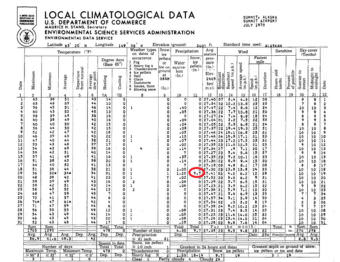
The Climate log from the July 19, 1970 record snow event at the Summit weather station.

When it comes to weather in Alaska, anything is possible — including snow in July.

According to Brian Brettschneider with our Ask a Climatologist segment, Alaska holds the North American record for most snow on a single day in July. Back in 1970 on July 19, it snowed 9.7 inches at the Summit weather station just south of Cantwell on the Parks Highway.
Brettschneider says 16 stations in Alaska have recorded snow in July.

Interview Transcript:

Brian: To get snow in July, a lot of things have to come together, but it’s most likely to occur north of the Brooks Range. So Barrow, Utqiagvik, has recorded snow a number of days. To the west of there, Wainwright, Cape Lisburne, and east toward Kaktovik or Barter Island, also (have recorded) a number of snow days. Once you get south of the Brooks Range, the snow observations are all going to be at higher elevations. So places above 2,000 feet, so still uncommon, but not unheard of.

Annie: And what has to come together for it to snow in July?

Brian: Usually it’s going to be associated with an upper level low pressure system — the big L’s on the map. Not necessarily one of those Gulf of Alaska storms that’s moving in. It’s going to be something that’s packing its own cold air punch at several thousand feet up. And then when you get heavy precipitation, it can actually drag that cold air down, so often you see, it will be maybe 35 or 40 degrees and rain but as the precipitation intensity increases it will drag that cold air down and transition to snow. So it’s an uncommon event, but not unheard of.

Annie: How much snow are we talking?

Brian: Generally July snow events are light snow events. But there are a couple of instances where there have been greater than six inches. So back in 1976, up at Cape Lisburne, they had 7.2 inches of snow on July 4. And then at the Summit weather service office in July 1970, they had 9.7 inches on July 19. That’s not only an Alaska and United States record, that appears to be a North American record. In fact it’s so unusual that it’s been flagged by the National Center for Environmental Information as an outlier — that it’s probably bad data. But there was actually a weather service staffed person there to record it, so it almost certainly did actually occur.

Ask a Climatologist: Utqiagvik ends above normal temperature streak

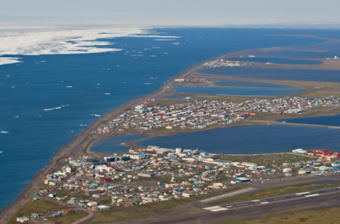
Utqiagvik, Alaska. (File photo by Steven Kazlowsk)

Residents of Utqiagvik have experienced above normal temperatures for the last 17 months. But a cooler-than-normal June will end that streak.

Brian Brettschneider with our Ask a Climatologist segment says the rest of the state has drifted back toward normal temperatures this year, after spending several years in above normal territory.

But he says Utqiagvik stayed warm — until this month.

Interview Transcript:

Brian: They’re going to break their 17 month string of above normal months and end up just probably about one degree below normal. So for them they get to experience what the rest of the state has so far in 2017.

Annie: How significant was that streak?

Brian: Well 17 months, that’s a long streak. I believe that’s the currently longest streak in the United States. There’s a few places in, say, Minnesota and in the southeastern lower 48 that that are running about 12 months in a row above normal. But 17 is a long time. It’s quite the statistical anomaly to be that above normal for that many months in a row. So it’s very noteworthy.

Annie: What about the rest of the state this summer, how are temperatures shaping up?

Brian: We consider June the first traditional month of the summer and we have both extremes in the state. On the North Slope, they’re a little bit below normal. And then down in southeast from Juneau southward, they’ve been a little bit below normal. And then everyone else is at, or slightly above, normal. Anchorage is about half a degree above normal. Fairbanks, Bethel and McGrath are about two degrees above normal. And then over on the west coast in Nome and Kotzebue, it’s about five degrees above normal. So even though in some respects it’s kind of felt like a cool start to the summer, we’re actually running a little bit above normal.

Annie: I think people in Anchorage will say you’re crazy to suggest we’re having even a little bit warmer than normal summer.

Brian: We’ll oftentimes think of how many 70 degree days we’ve had here in Anchorage. We’ve only had two so far. And normally we would have about five in by now and for the whole summer we’d have about 15 or 16. So sometimes people look at those warm events, those outlier events, and that’s their metric on whether it’s been an above-normal-temperature summer or below normal. You can actually run above normal even without having your requisite number of so-called warm days.

Annie: Explain how the average daily temperature is calculated?

Brian: When we talk about how it’s been x degrees above or below normal, we’re not talking just about the high temperature. You add the high and the low together and divide by two. And from a climate point of view, from an ecological point of view, it’s that average daily temperature that really matters. So in Anchorage, our normal high is about 65 degrees this time of year. You can actually have a 65-degree high temperature and that same day be one or two degrees above normal because you haven’t looked at the low temperature yet. And if that’s running one or two or four degrees above normal then the whole day will run above normal.

So over the long term, we’ve actually seen more of an increase in our low temperatures than we have in the high temperatures during the summer months. So don’t just keep an eye on the high temperature. You also have to look at the low temperature to see how we’re doing from a climate perspective.

Ask a Climatologist: Summer solstice

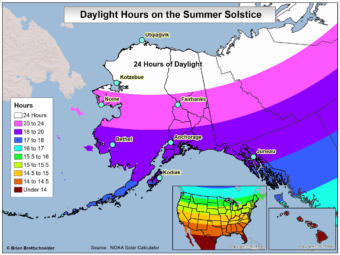
(Graphic courtesy of Brian Brettschneider)

Alaskans will celebrate the summer solstice at 8:24 tonight. The solstice is the point when the sun’s rays reach their highest latitude of the year. And also the moment when the days start getting shorter.

And Brian Brettschneider, with our Ask a Climatologist segment says the solstice is always a popular topic with Alaskans.

Interview Transcript:

Brian: From an astronomical point of view it’s when the sun’s rays reach their farthest, most northerly point. So they’re directly over the Tropic of Cancer, which is at 23.5 degrees latitude at approximately 8:24 pm Alaska Daylight Time.

Annie: And is this typically when our hottest temperatures are too?

Brian: If you look at the peak all time single day temperature records, they actually do occur kind of near the solstice. In Anchorage, the all time record was measured at the end of June and statewide, the all time record was at the end of June. So when everything comes together, that long day can add just a little more solar energy to generate those all time records. But on average, we’re still a couple of weeks away from when we would see our seasonal peak of temperatures.

Annie: How quickly do we start losing daylight?

Brian: As we approach the solstice, say in April and May, you might see we gained six minutes a day, or in Fairbanks, eight minutes a day. As we’ve been approaching the solstice the last few days, you might see we gained only 30 seconds a day. So we’re slowly reaching that peak and then we’ll stop, turn the corner and we’ll only gain a few seconds tomorrow and maybe 15 or 20 seconds after that. It will take a week or ten days before we start losing a minute or two minutes a day. So we have the extended daylight right now and we’ll have it for quite a while.

Annie: Do you celebrate the summer solstice?

Brian: A couple times I’ve done the Flattop hike here in Anchorage. It’s better if the weather is clear. There are 24 hours of twilight, so unless it’s really cloudy and rainy, you can do it without a headlamp. If the weather’s good, I may be on Flattop tonight, so keep an eye out for me.

Ask a Climatologist: Alaska’s hottest temp ever matches Hawaii’s

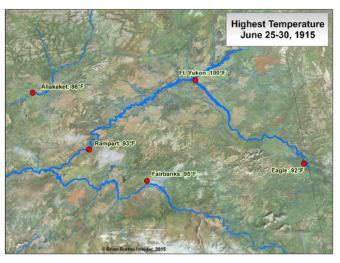
Graphic courtesy of Brian Brettschneider

Fairbanks hit 90 degrees last week for the first time in four years. The heat was very localized to the Tanana and Yukon river valleys.

We asked Brian Brettschneider, with our Ask a Climatologist segment, which areas of Alaska usually see the hottest temperatures in the summer.

He says the warmest temperatures are almost always found in the Interior.

Interview Transcript:

Brian: Somewhere from about Tanana and then eastward to the Canadian border around Eagle. Especially when you get into the Tanana and the Yukon river valleys, those are the places that over the last 100 or so years, they’ve observed the most days in the upper 80’s, the 90’s and even a 100 degree reading occurred at Fort Yukon in 1915.

Annie: And what makes that the warm spot?

Brian: Well, there are a lot of things that go into it. One is, at our high latitude, we get nearly continuous daylight in Interior Alaska. The sun sets for a few hours but it’s basically at solar heating for nearly the entire day. Also, June is a very sunny month, so you don’t have clouds that are blocking that sun’s energy. Then you also have, in say the Tanana and the Yukon river valleys, those are relatively low elevation, so, as most people know, high elevation is cooler, there’s less atmosphere above you.

They’re also far from the coast. Here in Anchorage, along any part of the coastal areas of Alaska, when the sun is out and it starts to heat up the ground, hot air rises and air has to fill in for that air that’s risen and that comes in from all directions. But when you’re in close proximity to the water, the air that’s filling in for the air that’s risen, is relatively cooler. So a lot of things come together to make it warmer in the Interior.

Annie: What else do we know about that 100 degree record in Fort Yukon?

Brian: That happened in 1915. A number of places in the Interior were in the 90’s and Fort Yukon topped out at 100 degrees. Looking at all the data around it, it may have been a little bit too warm, but it’s plausible that it occurred. Interestingly, it’s the only 100 degree reading ever in Alaska, it also ties Hawaii for their warmest temperature on record. So that’s an interesting bit of trivia, that Alaska and Hawaii share a record for the hottest all time temperature. And it’s also worth noting- the 100 degree reading in Hawaii- some people have looked into it, and it’s probably a bad reading, it probably overstates what their hottest temperature is. Their hottest temperature is probably something in the upper 90’s. So it’s very possible it’s gotten warmer in Alaska than it ever has in Hawaii.

Site notifications
Update notification options
Subscribe to notifications