Arctic

Alaska’s congressional leaders renew push to allow ANWR drilling

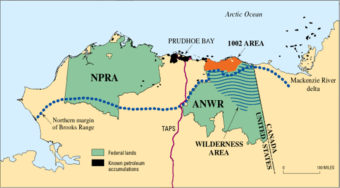
ANWR-USGS
Alaska’s congressional delegation this week renewed their effort to allow development in the Arctic National Wildlife Refuge. (Image courtesy U.S. Geological Survey)

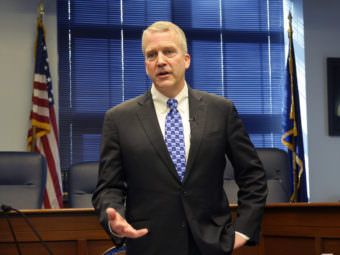
U.S. senators Lisa Murkowski and Dan Sullivan introduced a bill Thursday to open up a portion of the Arctic National Wildlife Refuge for oil and gas drilling.
For decades Alaska politicians have pushed to allow development in the refuge’s coastal plain, but with Donald Trump taking the White House this month and a Republican-led Congress, the latest bill may gain more traction.

In a joint news release, the senators say the Alaska Oil and Gas Production Act would allow development on 2,000 surface acres within the refuge’s coastal plain, also known as the 10-02 Area.

On the House side, Alaska Rep. Don Young introduced a bill to open a portion of the refuge for development on Tuesday.

Environmental groups oppose the efforts, citing potential impacts to wildlife and subsistence hunting.

The feds are finally paying to move a village, but it’s not in Alaska

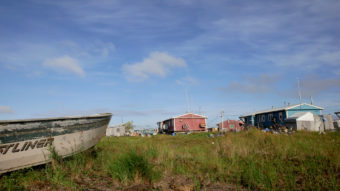
The village of Newtok, August 2016. (Photo by Eric Keto/Alaska's Energy Desk)
The village of Newtok in August 2016. (Photo by Eric Keto/Alaska’s Energy Desk)

Alaska villages facing rapid erosion have been trying to move for decades. But they’ve always run up against one major problem: money.

Then this year, for the first time, the federal government made tens of millions of dollars available to relocate a small Native village threatened by climate change.

The problem? That village is in Louisiana, not Alaska.
One day this past January, Washington D.C. reporter Christopher Flavelle got an email. It announced the results of a federal competition awarding nearly $1 billion to communities from New York to California to improve their “resilience” in the face of disasters and climate change. One project was for the relocation of a small tribe in Louisiana: 60 people for $48 million. Flavelle was intrigued.

“I’ve spent the past year looking at that corner of climate policy,” he said.

That corner is what happens when people have to move because of climate change.

Flavelle writes for Bloomberg View. He wrote about the Louisiana town, Isle de Jean Charles. Then he had a thought. He called up the Department of Housing and Urban Development, the agency that awarded the money.

He said to HUD, “Hey, I don’t think this is the only town in this situation. In fact I’ve heard of coastal towns in Alaska. And I wonder, why is it that this place in Louisiana got money, but these other towns in Alaska did not? How did you decide?”

HUD clammed up.

“They were surprisingly reluctant to talk about it.” Flavelle said. “In fact, entirely reluctant.”

Meanwhile, in Alaska, officials were asking the same questions.

Sally Russell Cox is a planner with the state who helped prepare Alaska’s request asking for more than $280 million for four villages, including Newtok, in western Alaska. Newtok has lost its landfill, sewage lagoon, and barge landing. Erosion threatens the school, airport and drinking water. It’s estimated it will cost $80 million to $130 million to move the whole village of about 350 people to a new site upriver.

Cox says the team was “blown away” when Alaska got nothing. After all, President Barack Obama had just visited the state, and talked about exactly this issue.

She says the state still isn’t sure why it lost out, but apparently one reason is Alaska didn’t put up enough state money to match the federal funds.

“We didn’t have it,” said Cox. “Because, I mean, why are we asking for this money if we already have money committed to it?”

But Christopher Flavelle says that’s not the whole story. For instance, Louisiana didn’t commit any money specifically for the Isle de Jean Charles relocation. In the end, he says, HUD had a check list, and Alaska just didn’t score well.

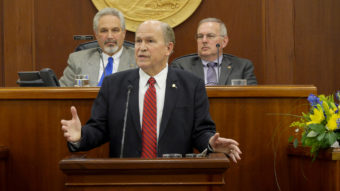
Alaska officials voiced their bafflement. In a letter to HUD officials, Gov. Bill Walker said the decision “simply astonishes me,” while Sen. Lisa Murkowski called it “unacceptable.”

HUD spokesman Lee Jones says the agency always has three, four or five times as many applicants as it can fund.

“Their proposals might be able to demonstrate as much need, as much innovation, as much integrity as the winners,” he said. “It’s just, at some point, the dollars only go so far. And a billion dollars is lot of money, no question about it, but it’s not a lot of money when you’re trying to address issues of infrastructure resiliency, which is a fairly costly exercise in most communities.”

For Cox, the lesson is there needs to be more funding and a better way to decide who gets it.

“You don’t do it in a competition,” she said with a laugh. “I mean, that’s crazy! Because you’re rewarding those that have the best marketing or the best grant writing skills.”

Instead, she says, we need a system to decide which communities are most in need, and make sure they get funding first.

Bloomberg’s Christopher Flavelle agrees. He says it needs to be clear why one community gets money and another doesn’t.

“Just as important as finding the right way to move a town is, I think, finding the right way to decide which towns to move. And there has to be some sort of standard that is transparent and credible and defensible.”

Right now this is a pretty rare issue. There are not a ton of communities talking about relocation due to climate change. But Flavelle says, that’s going to change.

“This isn’t just Alaska. And it’s not going to just be little towns along the coast that you’ve never heard of. This is going to be more and more of the United States,” he said. “And either we figure it out how to deal with it now, when it’s a small problem and the costs aren’t huge, or we wait, and we try to develop some sort of a response, some sort of a policy, when we’re pressed … when something really bad has happened.”

Obama bans future oil leases in much of Arctic, Atlantic

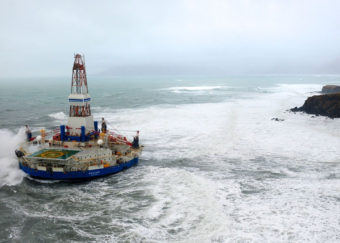
The Kulluk is an Arctic drill rig owned by Royal Dutch Shell. In 2012, the rig ran aground off Sitkalidak Island near Kodiak Island. The highly publicized incident was used by drilling opponents as an example of Shell's lack of qualifications to drill in the Arctic. (Photo by Petty Officer 1st Class Sara Francis/U.S. Coast Guard)
The Kulluk, an Arctic drill rig owned by Royal Dutch Shell. In 2012, the rig ran aground off Sitkalidak Island near Kodiak Island. (Photo by Petty Officer 1st Class Sara Francis/U.S. Coast Guard)

President Obama on Tuesday put nearly all waters in the U.S. Arctic off-limits for future oil and gas drilling. The White House announced the decision in conjunction with a similar statement from the Canadian government covering its Arctic waters.

The president used a rarely deployed power in the Outer Continental Shelf Lands Act to remove areas from leasing consideration for an indefinite period of time. The law includes no way for the next president to reverse his decision.

Since Shell halted its exploratory drilling in the Chukchi Sea last year, no company has seemed close to returning to federal waters in the Arctic. But Alaska officials and industry trade associations have been desperately trying to keep the door open to future activity in the area.

Joshua Kindred of the Alaska Oil and Gas Association looked with dismay at the map of the president’s new withdrawals.

Outgoing President Barack Obama ordered a withdrawal from Arctic offshore oil and gas leasing in the Beaufort and Chukchi seas on Dec. 20, 2016. (Graphic courtesy Bureau of Ocean Energy Management)
Outgoing President Barack Obama ordered offshore oil and gas leasing off-limits in much of the Beaufort and Chukchi seas. (Graphic courtesy Bureau of Ocean Energy Management)

“It looks like it’s virtually the entirety of the Chukchi and Beaufort Sea that would be exempt so, yeah, that’s about as absolute of a withdrawal as can be,” Kindred said.

The White House cited the area’s important ecology, subsistence and the health of marine mammals in explaining the decision. The action drew immediate praise from environmental groups. By acting jointly with Canada, supporters say the U.S. isn’t merely pushing development into Canadian Arctic waters. But Kindred said the announcement does nothing to lessen the risks of Russian drilling.

“And by us not having our own energy companies in the region, we are less prepared if there was an incident in the Russian Chukchi Sea, just miles away from U.S. Arctic waters,” Kindred said. “So it is a very sort of reactionary way to approach this.”

Obama made the withdrawals, just as environmental groups requested, using a provision of the Outer Continental Shelf Lands Act known as 12(a). It does not affect the rights of existing leaseholders.

Obama also left 2.8 million acres of the near-shore Beaufort, close to the existing oilfields and pipelines, outside of his withdrawal.

Though created with the stroke of a presidential pen, the Obama withdrawals could be tough to get rid of.

“12(a) says the president has the power to withdraw these lands. It does not give the president the power to un-withdraw lands previously withdrawn,” University of California-Hastings Law professor John Leshy said. Leshy was the top attorney in the Interior Department under President Bill Clinton.

Leshy said there’s “substantial doubt” President Donald Trump could issue an order undoing the Arctic withdrawal.

“It’s never been done, so we don’t have any judicial test of this,” Leshy said. “But there is related law that basically said when Congress gives the president the authority to do something, and does not give the president authority to undo it, the president doesn’t have the authority to undo it. So it is permanent.”

On the other hand, the law professor said it’s clear Congress can pass a bill to cancel a 12(a) withdrawal.

Alaska Congressman Don Young said he doesn’t buy the argument that the incoming president can’t cancel Obama’s decision.

“If I was the president, I’d just go ahead and tell his secretary of Interior, Mineral Management, to put it up for lease,” Young said. “Let them take it to court.”

Young, in a press release, called Obama’s action a “cowardly move by a lame-duck president.”

“I say he’ll go down as one of the worst presidents we’ve ever had,” Young said.

Young said he thinks the House will move a bill next year to undo this order and lots of other Obama decisions. He says it would easily pass the House but Young declined to speculate on its fate in the Senate.

Editor’s note: This story has been expanded.


Obama brought attention to threatened Alaska villages, but little funding so far

Waving goodbye to Kotzebue from the doorway of Air Force One. (Official White House Photo by Pete Souza) https://medium.com/the-white-house/behind-the-lens-photographing-alaska-for-real-this-time-2f466ddf8f7d#.shdh8q6di
Waving goodbye to Kotzebue from the doorway of Air Force One. (Official White House Photo by Pete Souza)

It’s been more than a year since President Barack Obama visited Alaska, and became the first sitting president to travel above the Arctic Circle.

The trip was designed to draw attention to climate change in the lead up to last year’s international conference in Paris, and the president went out of his way to highlight Alaska villages threatened by rapid erosion.

But as Obama prepares to leave office, most of those villages find themselves no closer to a solution.

On September 2, 2015, Obama stepped up to the microphone in the Kotzebue school gym and greeted the loudly cheering crowd.

Obama said he had come north for one big reason: to raise the alarm about the dangers of climate change in one of the places where it’s most obvious.  Places like the eroding village of Kivalina, which he flew over on his way to Kotzebue.

For many Alaskans, he said, it’s no longer a question of if they will have to relocate, but when.

“Think about it,” Obama said. “If another country threatened to wipe out an American town, we’d do everything in our power to protect it.”

Climate change, he said, should be no different.

“What’s happening here is America’s wake-up call,” he said. “It should be the world’s wake-up call.”

Taking in the sights from Air Force One, Sept. 2, 2015. (Official White House Photo by Pete Souza) https://medium.com/the-white-house/behind-the-lens-photographing-alaska-for-real-this-time-2f466ddf8f7d#.shdh8q6di
Taking in the sights from Air Force One, Sept. 2, 2015. (Official White House Photo by Pete Souza)

Maija Lukin was mayor of Kotzebue during the president’s visit. She also worked on climate change issues for the Maniilaq Association, the regional nonprofit.

Lukin said personally, she was pretty excited about Obama’s visit. And professionally, she hoped it would draw attention to the issues facing rural Alaska. Which it did, she said. And she appreciates that.

But, she said, attention isn’t enough.

“When the president says something like ‘the United States would do anything in its power to make sure that these places aren’t wiped off the face of the Earth,'” she said, “you gotta put your money where your mouth is.”

On that front, the response hasn’t matched the rhetoric.

Five months after the president’s visit, the Obama administration released its major funding proposal, as part of its final budget request to Congress: $400 million over 10 years for issues including village relocation in rural Alaska.

The money would have been part of a proposed $2 billion “Coastal Climate Resilience program” overseen by the Interior Department. But U.S. Sen. Lisa Murkowski, R-Alaska, called that essentially a bait and switch. The program would have been paid for by taking revenue away from other oil-producing states, and had little chance of passing Congress. Murkowski accused the Obama administration of using Alaska as simply a “backdrop” for his climate change agenda.

During his visit to Kotzebue, Obama also announced that the Denali Commission, which has historically built infrastructure in rural Alaska, would be the lead federal agency coordinating relocation efforts.

Joel Neimeyer, co-chair of the Denali Commission, says that’s a pretty big deal.

The view from Air Force One of Kivalina, as President Barack Obama flew to Kotzebue, Sept. 2, 2015. (Official White House Photo by Pete Souza) https://medium.com/the-white-house/behind-the-lens-photographing-alaska-for-real-this-time-2f466ddf8f7d#.shdh8q6di
The view from Air Force One of Kivalina, as President Barack Obama flew to Kotzebue, Sept. 2, 2015. (Official White House Photo by Pete Souza)

“There would be one federal agency that could marshal all the federal agencies together and then be responsive to the state and the individual communities,” he said.

But the new assignment came with no new funding.

The Obama administration requested an additional $4 million a year for the commission. But Congress has yet to appropriate it.

Neimeyer says the Denali Commission is doing what it can within its small existing budget. But it’s frustrating.

“All of Alaska now knows the Commission has this assignment,” he said. “My concern is, if in future appropriations there are no funds for this effort, that’s immaterial to rural Alaska. They’re still going to come to us and say, this is your assignment. See it through.”

For awhile this year, Neimeyer says, he even had trouble getting a call back from the White House to clarify his agency’s new assignment.

Obama, of course, has many fans in rural Alaska. They point out there’s only so much the president can do. It’s Congress that controls the federal purse strings.

And Sally Russell Cox, a planner with the state who’s worked on relocation for about a decade, says the issues are clearly getting more attention.

“The federal agencies are now engaged at a very high level,” she said. “So there’s a lot of high-level attention to how funding and other resources can be pooled to help these communities.”

Agencies including the departments of Agriculture, Energy and Interior have made money available for things like water infrastructure, energy efficiency and planning. But nothing close to the amounts needed to move a whole village.

The Army Corps of Engineers has estimated it will cost $80 million to $130 million just to move the 350 or so people in Newtok, one of the most threatened villages.

Cox says the state will continue to do what it can. But, she says, the federal government has a special responsibility, because in many cases, villages are where they are because the federal government put them there — often by choosing the location for a school.

With Obama on his way out the door, that federal responsibility now falls to Congress and the incoming Trump administration.

Maija Lukin, in Kotzebue, says she hopes the next president will pay attention, because rural Alaska is running out of time.

“We don’t call them climate change adaptation plans, we call them a survival plan,” she said. “So how are we going to survive, how are we going to ensure that our culture stays alive in our changing weather?”

Report: 2016 was Arctic’s warmest year on record, effects are cascading down into ecosystem

Svalbard ice pack
Ice pack near Svalbard (Creative commons photo by Luc Jamet)

2016 was not a good year for the Arctic with the continued warming of the air and sea water, and diminishing sea ice.

The National Oceanic and Atmospheric Administration on Tuesday released its Arctic Report Card for 2016.

It was the warmest year on record for the Arctic where the average air temperature is increasing at twice the rate as the global average.

This year was 6.3 degrees Fahrenheit hotter than 1900. Also, water temperatures in the Arctic were 9 degrees Fahrenheit higher than the recent average.

“The report card this year clearly shows a stronger and more-pronounced signal of persistent warming than any previous year in our observational record,” said Jeremy Mathis, director of NOAA’s Arctic Research Program and an editor of the 106-page report.

“Those warming effects in the Arctic have had a cascading effect through the environment, including down into Arctic ecosystems,” Mathis said.

Listen to the full story about the Arctic Report Card 2016:


Topping the list of the warmth’s cascading effects is this fall’s slow freezeup and continued decline of the Arctic ice pack.

The minimum Arctic sea ice extent in October tied for the second lowest since the beginning of satellite observations in 1979.

Thinner, more-fragile first-year ice now makes up the overwhelming majority of the Arctic ice pack, compared with 30 years ago when it was roughly a half-and-half mix with thicker, stronger, multi-year ice.

Temperature anomaly map
Temperature anomaly map from NOAA Climate.gov)

Dartmouth College’s Donald Perovich, another of the report’s editors, says the Arctic ice pack could recover if temperatures cool.

But he doesn’t think it’s likely.

“What we’re seeing right now is the first act of a three-act play,” Perovich said. “We’re seeing the fall freezeup has been very slow, and we have a record minimum ice extent. Act 2 will come in March when we see what the maximum is. And, Act 3 of course will be in September. I kind of await that with both anticipation and a little bit of concern.”

Download the 106-page Arctic Report Card 2016 (5.9 mb PDF)


It’s hard to predict when the Arctic Ocean will be ice-free in the summer or what the Arctic will look like in 10 years. But Mathis said Arctic communities should be concerned about diminishing access to subsistence resources.

“It’s getting harder and harder for them to harvest resources as the ice pulls back further and further away from the coast,” Mathis said. “That’s a place where we need to be focusing our attention and our efforts to help them either continue to find those food sources and to rely on those food sources. Or, think about ways that we can help them deal with the loss or the decline of the food sources.”

Mathis said one positive aspect of less sea ice and earlier melting is that it stimulates more growth of phytoplankton, the base of the marine food web.

“But, at the same time, that primary productivity is the mechanism in which carbon dioxide is moved from the atmosphere into the ocean, and that’s what ocean acidification is,” Mathis said. “So, we already see a rapid progression of ocean acidification in the Arctic. And, that seems to be accelerating as the ice melts back further and further and productivity increases.”

Watch a short video presentation about the Arctic Report Card 2016:

The Arctic Report Card also notes a shrinking Greenland ice sheet, and spring snow cover dropped to a record low in the American and Canadian Arctic.

Columbia University’s Marco Tedesco said the amount of snow melt affects hydropower production and fresh water reserves.

“But, also, it’s impacting the ecosystems around it. The snow melting sooner and faster is leaving a drier soil exposed to a warmer summer,” Tedesco said. “So, you might have more jobs. You might have more forest fires. So, this might have, of course, ramifications for the economy, for the population.”

Melting permafrost can also affect infrastructure development or construction in the far north.

Watch the news conference on Tuesday about the Arctic Report Card 2016 at the annual meeting of the American Geophysical Union in San Francisco:

The warming, largely greening tundra is now releasing more carbon than it is taking in, and scientists are worried that the immense amounts of carbon stored in the melting permafrost could eventually be released and alter weather and climate around the globe.

“It’s a reminder of what I think many of us in Alaska feel is happening right before our eyes. And, that the Arctic is changing so dramatically,” said Margaret Williams, with the World Wildlife Fund in Anchorage after reviewing the Arctic Report Card.

Williams doesn’t think we’ve passed the window of opportunity to take action on climate change, she said.

“At the state level, every state can make a difference on the policies on energy efficiency and conservation,” Williams said. “Then, as individuals, people can also make a difference in how they manage their own personal carbon footprint.”

This is the 11th year for the Arctic Report Card, a peer-reviewed report sponsored by NOAA that includes the work of more 60 scientists from 11 countries. The findings were presented Tuesday at the annual meeting of the American Geophysical Union in San Francisco.

Enviros ready for ANWR fight, with military vets in their camp

Genevieve Chase
Genevieve Chase, an Army vet from Idaho, in the DC office of Alaska Wilderness League. (Photo by Liz Ruskin/Alaska Public Media)

With Donald Trump about a month away from the White House, Alaska’s congressional delegation sees a chance to finally open the coastal plain of the Arctic National Wildlife Refuge to oil drilling. The environmental lobby is ready for the fight. And they’ve got some new, patriotic allies on their side: military veterans.

Genevieve Chase served in the Army in Afghanistan, where she earned a bronze star and a purple heart. For years the Sierra Club has been taking veterans like her into the wilderness to heal. Chase says a special trip to the Arctic National Wildlife Refuge restored and inspired her.

“I wish I could bottle that up, and I wish I could send as many vets there as possible to experience the incredible vastness and to see the land,” she said, “the country that we defended.”

While she was in the refuge, she says she heard or felt a message: “Don’t play small in the world.”

“It changed my life,” she said. “And that’s why I’m here.”

“Here” at that moment, was a comfy couch in the Washington, D.C. office of the Alaska Wilderness League at the base of Capitol Hill. The League was founded in the 1990s to be a permanent presence in the capital, fighting to keep oil rigs out of ANWR and to preserve other parts of Alaska. They, with the rest of the green lobby, have made the Arctic refuge a potent symbol. They can marshal a torrent of constituent phone calls to wavering lawmakers when they need to. Now, they’re reaching beyond their usual membership to help spread their message.

“If it wasn’t for our public lands I would never have survived the transition home,” says one veteran in a video shot during a trip in the Arctic refuge amid clouds of mosquitoes. The video was made for a coalition that includes the Alaska Wilderness League.

“So let’s get out there as military veterans and protect the lands that are helping save us.”

The Alaska Wilderness League, year in and year out, has a budget of about $3 million. They have a staff of 21.

The League’s counterpart in Washington used to be Arctic Power, a largely state-funded effort to press Congress to open ANWR. Their side used to bring veterans to the hill to make a national security argument for more domestic oil production. Now, Arctic Power has no budget and no office, a victim of state budget cuts, and of the Obama years, when it was obvious no ANWR bill would become law. Arctic Power board member Gail Phillips says they’re beginning to take themselves out of mothball status. They haven’t decided yet whether to seek money to join the fight.

“We’re just getting re-grouped, so we’re just in the beginning of reorganization,” she said.

Even with GOP control of Congress and the White House and even with a cabinet that would be the oil industry’s dream team, it’s not clear ANWR drilling tops anyone’s priority list outside of Alaska and its three members of Congress.

“Compared to the past we haven’t seen as much advocacy promoting ANWR,” said Dan Simmons, a vice president at American Energy Alliance, an industry-supported advocacy group.  “Why that is, I’m not 100 percent sure.”

Simmons’ boss is the head of Trump’s energy transition team. His blueprint for Trump’s energy policy calls for more development in Alaska. It mentions the Chukchi and Beaufort Seas, and the National Petroleum Reserve. It says nothing about the Arctic refuge. Simmons says, after eight years of Obama, trade associations need time to sift through their priorities.

“It’s definitely important, for the state of Alaska,” he said. “But it’s tough to say how the energy industry views ANWR.”

Kyle Parker, an Anchorage attorney who represents companies in the oil sector, says it’s fine with him if there’s no big, noisy ANWR fight next year.

“In Alaska, for years, people talk about ‘ANWR ANWR ANWR,'” Parker said. “I hope that’s not the focus of the new administration.”

Parker says his clients would rather see the Trump administration ease rules and policies elsewhere on the North Slope than see Congress and the administration mired in another tangle over the Arctic National Wildlife Refuge.

Site notifications
Update notification options
Subscribe to notifications